
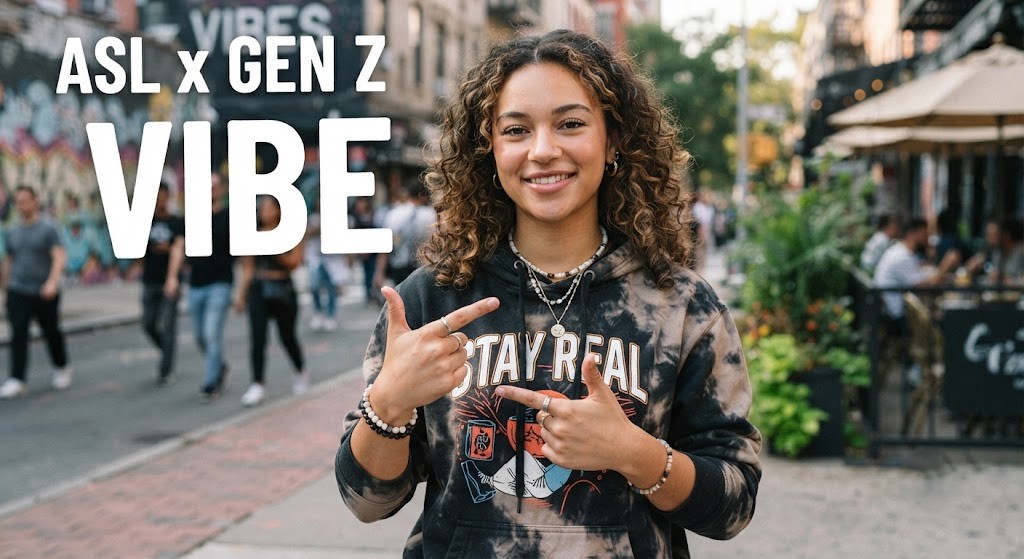
You’ve probably already seen Gen Z hand gestures on TikTok, Instagram, memes, or in everyday conversations—even if you don’t always know what they mean. From finger hearts to viral movements like “6-7” and “clock it,” these gestures can communicate emotions, reactions, humor, and shared cultural references without a single spoken word.
The confusing part is that Gen Z sign language is not a formal language. Its gestures can change rapidly, vary between communities, and sometimes resemble signs used in established sign languages such as American Sign Language (ASL).
In this guide, you’ll learn what Gen Z sign language means, why these gestures are popular, the most common Gen Z hand gestures and their meanings, how TikTok influences gesture trends, and—most importantly—the difference between internet gestures and formal sign languages.
What Is Gen Z Sign Language and What Does It Mean?
Gen Z sign language is an informal term for hand gestures, facial expressions, and visual signals commonly used in Gen Z and online culture. It is not an official language or standardized sign-language system. Instead, it refers to a loose collection of gestures, reactions, memes, and cultural signals that help people communicate without always typing or speaking.
These gestures often function like visual slang. For example, someone might use a finger heart to express affection, point toward something they noticed, or make an exaggerated facial expression to communicate disbelief.
There is also no single dictionary that defines every Gen Z gesture. A gesture can become popular on one platform, take on a different meaning in another community, or disappear as a trend changes.
Is Gen Z Sign Language an Actual Language?
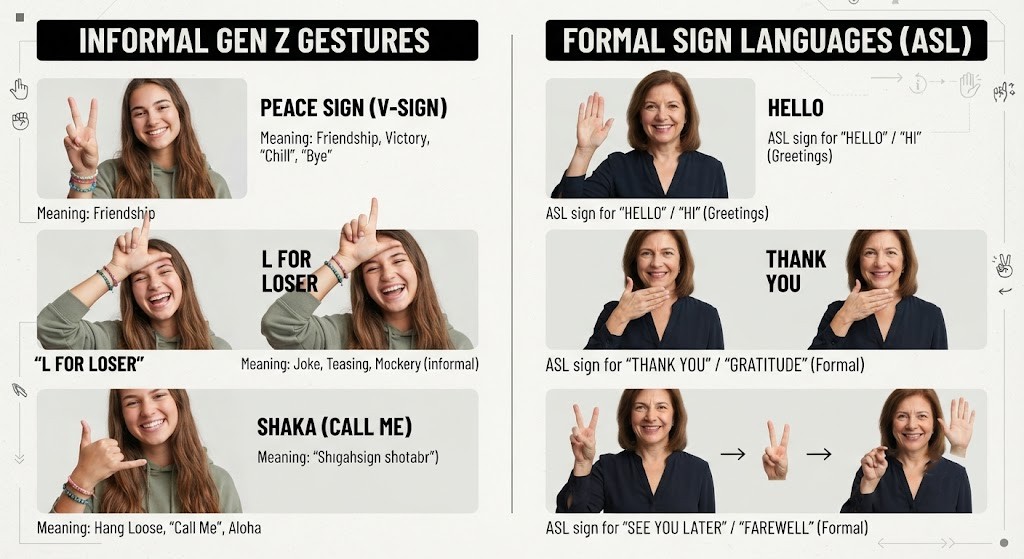
No. Gen Z sign language is not a standardized language like ASL. It is better understood as an informal collection of internet gestures and visual expressions.
A formal sign language has established linguistic rules, vocabulary, grammar, and syntax. Viral Gen Z gestures generally do not have a comparable standardized system.
That distinction is important because calling every viral hand movement “sign language” can unintentionally minimize the linguistic and cultural importance of actual sign languages.
Why Are Gen Z Hand Gestures So Popular?
Gen Z hand gestures are popular because social media makes visual communication fast, memorable, and easy to reproduce. Short-form video platforms allow a gesture to spread from one creator or community to millions of viewers within a short period.
For example, Pew Research Center reported that 37% of U.S. adults said they used TikTok in 2025, compared with 21% in 2021 — Source: Pew Research Center, 2026.
In addition, social platforms increasingly influence how people communicate. A 2025 Sprout Social survey found that 41% of Gen Z respondents planned to use Instagram more in 2026, while 39% planned to use TikTok more — Source: Sprout Social, 2025.
As a result, gestures can become part of a recognizable online vocabulary. A creator may perform a gesture in a reaction video, viewers copy it, and the gesture eventually becomes recognizable within that online community.
Furthermore, gestures complement emoji meanings guide, facial expressions, sounds, captions, and Social media trends guide. Together, these elements create a highly visual and context-driven communication style.
Social Media and Visual Communication
Social media favors communication that can be understood quickly. A simple movement of the hands, a facial expression, or a reaction can communicate an idea without requiring a long explanation.
This makes gestures especially useful in:
- Short-form videos
- Reaction content
- Memes
- Photos and selfies
- Livestreams
- Group conversations
- Comment-section culture
- Viral challenges
Because these formats move quickly, gestures can spread alongside sounds, hashtags, captions, and slang.
What Are the Most Common Gen Z Hand Gestures?
Common Gen Z hand gestures include finger hearts, pointing gestures, expressive hand movements, the “6-7” gesture, “clock it” gestures, and other viral signs whose meanings depend on context. Some are longstanding gestures that have gained new internet meanings, while others are short-lived trends.
Finger Heart
The finger heart is a small heart shape made by crossing the thumb and index finger. It commonly communicates affection, appreciation, support, or a playful expression of love.
For example, someone might make a finger heart toward a friend while taking a photo or use it in a short video to show appreciation.
The gesture is strongly associated with Korean popular culture and has spread internationally through K-pop, Korean dramas, and social media.
“6-7” Gesture
The “6-7” gesture is a recent viral Gen Z trend whose meaning varies across online communities. Some recent coverage describes the gesture as an “average” or “so-so” expression, while other online communities attach different humorous meanings to it.
For example, a person might move their hands while saying “six-seven” as part of a meme rather than using the gesture as a literal numerical statement.
Therefore, it is safer to treat “6-7” as trend-based internet communication, not as a universally defined hand sign.
“Clock It” Gesture
“Clock it” generally communicates noticing, recognizing, or calling attention to something. The expression has roots in ballroom and queer cultural language and has developed new viral forms online.
For example, someone might use a pointing or rhythmic hand movement while saying “clock it” after noticing an obvious detail or inconsistency.
Recent 2026 coverage has highlighted the popularity of “clock it” and related finger-clap gestures across social media.
Pointing and Reaction Gestures
Pointing gestures often direct attention toward a person, object, comment, or moment. Their meaning is usually determined by the surrounding conversation rather than by the hand position alone.
For example, pointing toward a friend after someone makes a funny comment can mean “Exactly—you said it.”
Likewise, thumbs-up, peace signs, finger hearts, open palms, and other familiar gestures can acquire different meanings depending on the community using them.
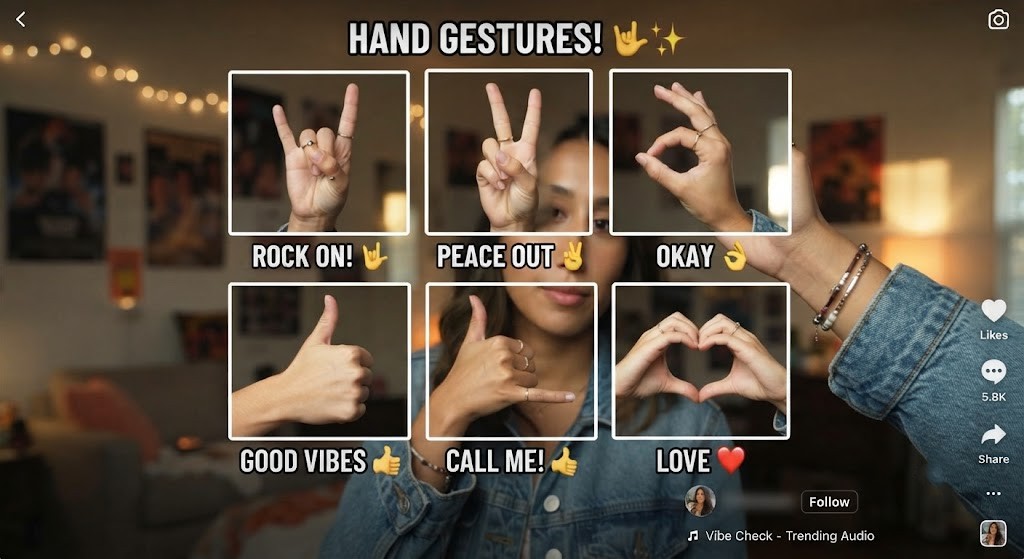
TikTok’s own Effect House documentation demonstrates how numerous recognizable hand shapes, including finger hearts, victory signs, thumbs-up, pointing, “I love you,” and “call me,” can be detected as distinct gestures in effects.
What Do Popular Gen Z Hand Signs Mean?
Popular Gen Z hand signs communicate reactions, emotions, attention, agreement, humor, affection, or shared cultural references rather than forming one standardized language. The following table provides a practical starting point.
| Gesture | Common online meaning | Typical context |
|---|---|---|
| Finger heart | Love, affection, appreciation | Photos, comments, videos |
| “Clock it” | Notice or recognize something | Reactions, commentary |
| “6-7” | Viral meme expression; meaning varies | TikTok and short videos |
| Peace/V sign | Peace, playful pose, victory | Photos, videos |
| Pointing | Drawing attention or agreement | Conversations, reactions |
| Thumbs up | Approval or acknowledgment | Messages, videos, conversations |
| Open palm | Stop, emphasis, greeting, or context-specific meaning | Everyday interaction |
| “I love you” handshape | Can resemble a formal sign | Context matters; do not assume ASL |
First, this table should be treated as a context guide rather than a universal dictionary. Internet gestures can evolve quickly, and the same movement may communicate something different between friends, creators, communities, or cultures.
Moreover, Gen Z slang words guide can provide additional context when a gesture appears alongside a phrase or meme.
How Do You Use Gen Z Gestures in Everyday Conversations?
Gen Z gestures are usually used to add emotion, humor, emphasis, or shared cultural meaning to ordinary conversations. They often supplement spoken language rather than replacing it completely.
For example, friends might use a finger heart when taking a picture, point dramatically at someone after a funny statement, or use a facial expression to communicate disbelief without saying anything.
Consider these everyday examples:
- With friends: A person points at another friend after they make an accurate observation.
- In photos: Someone makes a finger heart to show affection or appreciation.
- In videos: A creator uses exaggerated hand movements to emphasize a punchline.
- In reactions: Someone silently gestures toward a surprising event to communicate “Did you see that?”
- In group conversations: A familiar gesture can act as an inside joke shared by everyone present.
Therefore, Gen Z gestures are best understood as social signals that complement conversation.
Gen Z Gestures in Online Conversations
Online communication removes many traditional forms of body language. Gestures shown through videos and images can help restore some of that emotional context.
A creator may use a hand movement to emphasize sarcasm, signal agreement, react to a comment, or make a joke more visually recognizable.
However, because viewers may come from different backgrounds, the intended meaning is not always obvious. That is why context remains essential.
Why Can the Same Gen Z Gesture Have Different Meanings?
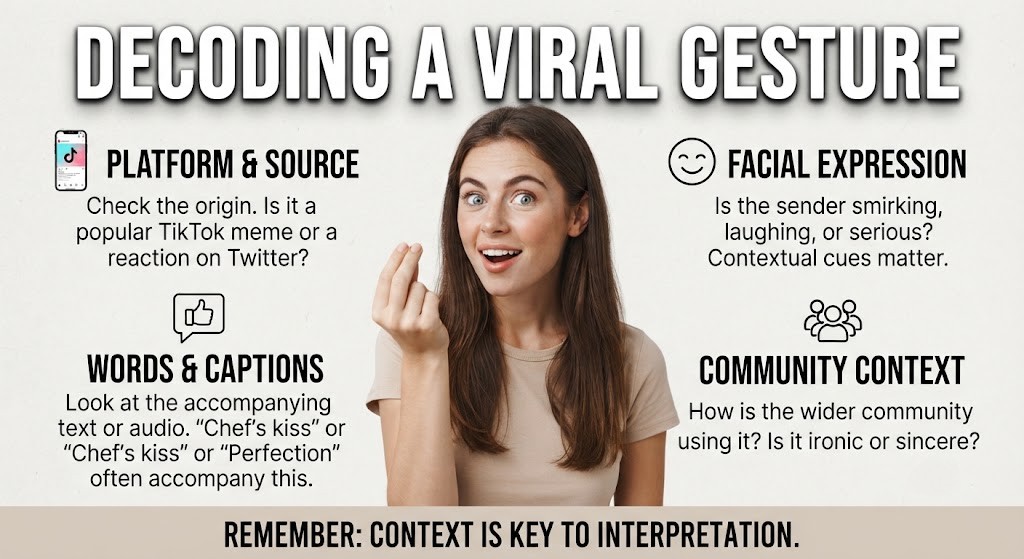
The same Gen Z gesture can have different meanings because interpretation depends on context, facial expression, community, culture, platform, and timing. A hand movement that looks playful in one video could appear sarcastic, serious, or completely different somewhere else.
For example, a thumbs-up may communicate agreement in one conversation but sarcasm in another if it is paired with an exaggerated facial expression.
At the same time, regional and cultural differences matter. A gesture that feels harmless in one culture may carry another meaning elsewhere.
Understanding Gen Z gestures requires looking at how a gesture is used in context rather than assuming that one hand sign always has one universal meaning.
Factors That Can Change a Gesture’s Meaning
When interpreting an unfamiliar Gen Z gesture, consider:
- The platform: TikTok, Instagram, YouTube, and private messaging communities can develop different trends.
- The community: A gesture may have a specific meaning within a particular online group.
- Facial expression: Smiling, laughing, or looking serious can completely change interpretation.
- Words and captions: Spoken language or text can clarify the intended meaning.
- Cultural background: Gestures can carry different meanings across cultures.
- Timing: A gesture may be associated with a temporary meme or trend.
This is why memorizing a single definition is often less reliable than observing several examples.
Is Gen Z Sign Language the Same as American Sign Language?
Gen Z sign language is not the same as American Sign Language because Gen Z gestures are informal cultural signals, while ASL is a complete natural language with its own linguistic structure. The two should not be treated as interchangeable.
The National Association of the Deaf explains that American Sign Language is a visual language with its own grammar and syntax, and that hand shape, placement, movement, facial expressions, and body movements can all contribute to meaning.
For example, seeing a viral handshape that resembles an ASL sign does not automatically mean that the person is communicating in ASL.
In addition, ASL is not simply English translated into hand movements. The NAD describes ASL as having a complex visual-spatial linguistic structure distinct from English.
What Is the Difference Between Gen Z Gestures and ASL?
The biggest difference between Gen Z gestures and ASL is that Gen Z gestures are informal and context-dependent, while ASL is a structured language used for communication within Deaf communities and beyond.
| Gen Z gestures | American Sign Language |
| Informal cultural communication | Established natural language |
| Often trend-driven | Has linguistic rules |
| Meanings can change quickly | Has established vocabulary and grammar |
| Often accompanies speech | Can communicate complete ideas |
| Strongly influenced by social media | Developed within Deaf communities |
| No universal standardized system | Recognized as a distinct language |
First, formal sign languages should be approached with respect because they are not simply collections of trendy hand signs.
The NAD also notes that learning ASL takes time and practice, and that individual signs are only part of learning a language with its own grammar and syntax.
Why You Should Not Assume a Viral Gesture Is ASL
Some internet gestures may look similar to signs used in ASL. However, visual similarity does not necessarily mean linguistic equivalence.
A single handshape is only one component of a formal sign language. Meaning can depend on movement, location, orientation, facial expression, body movement, and the grammatical structure surrounding the sign.
Therefore, someone who wants to learn ASL should study it as a language rather than memorizing lists of viral hand gestures.
What Do TikTok Hand Gestures Mean?
TikTok hand gestures are visual trends whose meanings are often created, popularized, or modified by online communities. Their rapid spread makes TikTok an important environment for modern gesture culture.
For example, “clock it,” “6-7,” reaction movements, finger hearts, and exaggerated facial expressions can become recognizable because users repeatedly reproduce them in short videos.
Furthermore, TikTok’s gesture-detection technology itself recognizes numerous hand forms, showing how central visual hand movements have become within the platform’s creative ecosystem.
As such, TikTok slang meanings and terminology guide and TikTok trends guide can help readers understand the words and trends appearing alongside these gestures.
Social media platforms can rapidly popularize Gen Z gestures, causing new meanings and variations to spread across online communities.
Recent reporting also shows how quickly new gestures can become viral cultural references, with 2026 coverage highlighting trends such as “clock it,” “6-7,” and other expressive movements.
Why TikTok Gestures Change So Quickly
TikTok’s short-form format encourages repetition and remixing. A gesture can appear in one creator’s video, become part of a sound or meme, and then be reproduced by thousands of other users.
As more people participate, the gesture may develop variations. Its meaning can also shift as users adapt it to different jokes, situations, or communities.
That means an explanation of a viral gesture can become outdated surprisingly quickly.
How Can You Learn Gen Z Gestures Without Misunderstanding Their Meaning?
You can learn Gen Z gestures responsibly by checking context, identifying the community using the gesture, and avoiding assumptions about universal meaning. A quick search can explain a trend, but the surrounding video or conversation often provides the most reliable clue.
First, identify where the gesture appeared. A TikTok meme, private group chat, K-pop community, classroom, and Deaf community may use similar-looking hand movements differently.
Second, observe facial expression and accompanying language. A gesture paired with laughter may communicate humor, while the same movement in a serious conversation could have another purpose.
Third, check current sources when a gesture appears to be new. Viral meanings can change quickly, so older explanations may no longer describe how people currently use the gesture.
Finally, do not describe every hand movement as “sign language.” If you are trying to learn an actual sign language, use qualified educational resources and learn its grammar, vocabulary, and cultural context.
A Simple Checklist for Interpreting a New Gesture
When you encounter an unfamiliar gesture, ask:
- Where did I see it?
- What was happening when it was used?
- What words or caption accompanied it?
- What facial expression was being used?
- Who appears to be using the gesture?
- Is it part of a current meme or trend?
- Could the gesture have a cultural or formal sign-language meaning?
These questions can prevent common misunderstandings and make it easier to understand internet communication accurately.
What’s Next: How Should You Use Gen Z Gestures?
The best next step is to treat Gen Z gestures as evolving cultural communication rather than a fixed dictionary of signs. Learning the surrounding slang, platform culture, and social context will usually provide more accurate interpretations than memorizing isolated hand shapes.
For example, when a new gesture appears repeatedly in short-form videos, look at how several creators use it before deciding what it means.
A practical approach is:
- Watch the context before interpreting the gesture.
- Check multiple examples rather than relying on one viral post.
- Consider cultural background and community-specific meanings.
- Look at facial expressions and accompanying words.
- Avoid copying sensitive gestures without understanding their meaning.
- Use formal learning resources when your goal is to learn ASL or another established sign language.
This approach helps you stay current without treating internet culture as a rigid language system.
Conclusion
Gen Z sign language is an informal term for the constantly evolving gestures, expressions, and visual signals used throughout Gen Z and internet culture. These gestures can make conversations more expressive, humorous, and recognizable, but their meanings are rarely universal.
Ultimately, context matters more than the handshape alone. TikTok trends, memes, cultural communities, facial expressions, and changing slang can all influence how a gesture is interpreted.
Most importantly, Gen Z gestures should not be confused with American Sign Language or another formal sign language. ASL is a complete visual language with its own grammar and structure, and learning it properly requires more than memorizing individual hand signs.
So, the next time you see a viral hand gesture, pause before assuming you know exactly what it means. Understand the context, check the culture behind it, and remember that internet communication changes fast.
FAQs
What is Gen Z sign language?
It is an informal collection of gestures and visual signals used in Gen Z and internet culture.
What are common Gen Z hand gestures?
They include finger hearts, “clock it,” “6-7,” pointing, peace signs, and thumbs-up gestures.
What does the finger heart mean?
It usually expresses love, affection, appreciation, or support.
What does “clock it” mean?
It generally means noticing, recognizing, or calling attention to something.
What does the “6-7” gesture mean?
It is a viral gesture whose meaning can vary depending on the context.
Is Gen Z sign language the same as ASL?
No, Gen Z gestures are informal, while ASL is a complete natural sign language.
Why do Gen Z gestures have different meanings?
Their meanings can change based on culture, context, community, and trends.
Are TikTok hand gestures actual sign language?
Not always, as many TikTok gestures are informal internet trends.
How can I understand Gen Z gestures?
Look at the context, facial expressions, words, and how others use the gesture.
Can Gen Z gestures look like ASL signs?
Yes, but a similar-looking gesture does not necessarily have the same ASL meaning.
Why are Gen Z gestures popular?
Social media makes gestures easy to copy, share, and turn into viral trends.
2 thoughts on “Gen Z Sign Language: Popular Gestures, Meanings & Digital Trends”