

You’ve probably experienced it: a conversation that once felt normal suddenly goes completely silent. Messages remain unanswered, plans disappear, and you are left wondering what changed.
But not every delayed reply is ghosting. Someone may be busy, need personal space, experience an emergency, or simply communicate differently. So, what is ghosting, exactly?
Ghosting is generally the sudden withdrawal from communication without an explanation or clear closure. It can happen in dating, friendships, professional relationships, and online interactions.
In this guide, you’ll learn what ghosting means, what ghosting looks like, why people ghost, how ghosting differs from taking space, how long it takes to recognize a pattern, and what to do if you are ghosted or have ghosted someone else.
What Is Ghosting and What Does It Mean?
Ghosting is the sudden end of communication with someone without an explanation or clear indication that the relationship or conversation is over. It usually involves repeatedly ignoring texts, calls, messages, or attempts to reconnect rather than directly saying that contact should end.
The ghosting meaning is therefore based on a pattern of withdrawal rather than a single delayed response. For example, someone who normally replies every evening but takes two days to respond may simply be busy. In contrast, someone who suddenly stops answering messages altogether and provides no explanation may be ghosting.
Ghosting can happen at almost any stage of a relationship. It may occur after a single dating-app conversation, after several dates, during a friendship, or even within a professional relationship.
For example, imagine making weekend plans with a friend and then receiving no response afterward. If the person ignores several reasonable follow-up messages and never explains what happened, that pattern is much closer to ghosting than simply replying late.
Ghosting is different from ordinary communication delays because it involves a sustained withdrawal without meaningful explanation. For more context on communicating expectations.
Research also shows that ghosting is not limited to romantic relationships. A 2024 review describes professional and personal ghosting as an abrupt communication breakdown between two people without explanation. — Source: American Journal of Pharmaceutical Education, 2024
Why Does Ghosting Matter?
Ghosting matters because unexplained silence can create uncertainty, rejection, and difficulty finding emotional closure. When someone disappears without explaining why, the other person may be left trying to interpret what happened.
A clear ending provides information. For example, receiving “I don’t think we should continue talking” communicates a decision, while receiving nothing can leave someone repeatedly checking their phone and wondering whether a response will eventually arrive.
However, ghosting does not affect everyone in exactly the same way. A 2020 study of 626 adults found that people who experienced breadcrumbing, or combined breadcrumbing and ghosting, reported lower life satisfaction and greater loneliness and helplessness, although the researchers did not find the same significant relationship for ghosting alone. — Source: Personality and Individual Differences, 2020
Newer research also suggests that ghosting can involve complicated motives rather than simple cruelty. A 2024 study found that people who ghosted sometimes believed they were avoiding hurting the other person’s feelings, even though the person being ghosted could interpret the silence differently. — Source: Journal of Experimental Social Psychology, 2024
Ghosting can hurt because it removes information that people normally use to understand the end of a relationship. That uncertainty can make it tempting to blame yourself, even when the actual reason for the silence is unknown.
What Are the Signs Someone Is Ghosting You?
The main signs of ghosting include repeated unanswered messages, sudden withdrawal from communication, and a lack of explanation or closure. One sign alone does not prove that someone is ghosting you, but several signs appearing together can indicate a deliberate withdrawal.
Common signs include:
- Repeated unanswered messages: Your messages are consistently ignored.
- Sudden communication change: Someone who previously communicated regularly abruptly stops.
- Avoided plans: They cancel or avoid plans without suggesting another time.
- No explanation: They disappear without saying that they need space or want to end contact.
- Digital withdrawal: They may stop interacting with you online or block communication channels.
- Continued silence: The lack of response continues despite a reasonable opportunity to communicate.
For example, if someone misses one message because they are working, that is not necessarily ghosting. However, if they repeatedly ignore several reasonable attempts to communicate after previously having regular conversations, the pattern becomes more significant.
Context Matters When Identifying Ghosting
Ghosting should always be considered in context. Someone may be dealing with illness, family problems, work pressure, technical problems, or an unsafe situation that prevents communication.
Ghosting is best identified by a persistent pattern of unexplained withdrawal, not by a specific number of hours or days without a reply. Understanding boundaries can also help you distinguish genuine withdrawal from normal communication differences; see healthy relationship boundaries.
Why Do People Ghost Someone?
People ghost for different reasons, including conflict avoidance, loss of interest, emotional discomfort, overwhelm, and concerns about personal safety. The exact reason cannot be known with certainty unless the person explains it.
Understanding possible reasons can provide context, but it is important not to assume that any particular explanation applies to a specific situation.
Conflict Avoidance
Conflict avoidance is one common reason people ghost because disappearing can feel easier than having an uncomfortable conversation. Someone who no longer wants to date, for example, may ignore messages rather than directly communicate that they are no longer interested.
Loss of Interest
Loss of interest can lead someone to stop communicating when they no longer want to continue a relationship. A dating-app match may decide there is no connection after a date but avoid sending a rejection message.
Emotional Overwhelm
Emotional overwhelm can cause some people to withdraw when communication begins to feel demanding or stressful. Research involving 978 young people in Germany found that communication overload predicted ghosting in romantic relationships, although the same relationship was not found for friendships. — Source: Telematics and Informatics, 2023
Fear or Safety Concerns
Personal safety can be a legitimate reason for ending communication without a conventional goodbye. Someone experiencing harassment or threatening behavior may block another person rather than engage in a final conversation.
In these circumstances, conventional closure is not necessarily the priority. Personal safety and control over communication are more important.
Digital Dating Culture
Online communication can make ghosting easier because people can end contact without a face-to-face interaction. Dating apps provide convenient ways to meet people, communicate briefly, and disengage without sharing physical spaces.
Importantly, these reasons explain possible behavior but do not automatically justify it. Healthy communication remains preferable whenever direct communication is safe and practical.
What Are the Different Types of Ghosting?
Types of ghosting include dating ghosting, friendship ghosting, workplace ghosting, social-media ghosting, and gradual soft ghosting. Although the circumstances vary, the common feature is unexplained withdrawal from communication.
| Type of ghosting | What it looks like | Example |
|---|---|---|
| Dating ghosting | A romantic interest suddenly stops communicating | A date stops replying after several conversations |
| Friendship ghosting | A friend abruptly ends regular contact | A close friend stops answering without explanation |
| Workplace ghosting | A professional contact disappears | A recruiter stops responding after an interview |
| Social-media ghosting | Someone withdraws from online interaction | A person stops responding while remaining active online |
| Soft ghosting | Communication becomes extremely minimal or inconsistent | Someone repeatedly reacts to messages but avoids real conversation |
What Is Soft Ghosting?
Soft ghosting is a low-effort form of withdrawal in which someone gives minimal responses without maintaining meaningful communication. For example, someone might repeatedly react to your messages with an emoji but never answer questions or make plans.
Soft ghosting can be more difficult to identify because communication technically continues. However, the key question is whether the person is making a genuine effort to maintain the relationship.
A pattern of minimal reactions without meaningful conversation may communicate disinterest even when the person has not completely disappeared.
What Is Ghosting in Dating?
Ghosting in dating occurs when one person abruptly stops communicating with a romantic interest without clearly explaining that they want to end contact. It can happen after messaging, a first date, several dates, or even within a longer relationship.
For example, someone may have several positive dates with another person and then suddenly stop responding to texts, calls, and invitations. If there is no explanation or indication that they need space, the behavior may qualify as dating ghosting.
Research supports the idea that ghosting is particularly relevant in online dating. One study involving 177 participants found that ghosting was the most frequently experienced rejection type among several forms of online-dating rejection examined by researchers. — Source: Journal of Social and Personal Relationships, 2024
Moreover, older research involving 626 adults examined ghosting and breadcrumbing experiences among dating partners, showing that these behaviors are significant subjects of relationship research. — Source: Personality and Individual Differences, 2020
When dating, it can help to recognize dating red flags without assuming that every communication change represents a serious warning sign.
What Is the Difference Between Ghosting and Taking Space?
Ghosting and taking space are different because taking space generally involves communicating a need for distance, while ghosting typically provides little or no explanation. The distinction becomes clearer when you consider communication, expectations, and whether the person provides context.
For example, “I’m overwhelmed right now and need a few days to myself” communicates a boundary. Suddenly disappearing for several weeks without explanation creates uncertainty.
| Taking space | Ghosting |
| Communicates a need for distance | Provides little or no explanation |
| May establish expectations | Usually leaves expectations unclear |
| Can include a timeframe | Often has no clear timeframe |
| Maintains some communication | Frequently involves complete silence |
| Gives the other person context | Leaves the other person guessing |
Taking space also does not guarantee that a relationship will continue. Someone can respectfully request distance and later decide to end the relationship.
Healthy communication in relationships allows people to express boundaries without forcing the other person to guess what silence means. For more guidance, see healthy communication in relationships.
Why Does Ghosting Hurt So Much?
Ghosting can hurt because it combines social rejection with uncertainty and limited feedback. A clear rejection gives you an answer, while ghosting can leave you repeatedly wondering whether you misunderstood something.
Uncertainty Can Encourage Overthinking
Unanswered questions can encourage overthinking. You may replay your last conversation, examine individual messages, and wonder whether something you said caused the person to disappear.
However, without an explanation, those interpretations remain assumptions. The actual reason for the person’s silence may be completely different from the explanation you create in your mind.
Ghosting Can Affect People Differently
Ghosting can affect people differently depending on the relationship and circumstances. A 2023 report summarized research involving 978 participants ages 16–21, with 415 participants completing a second survey four months later; participants who reported ghosting friends initially showed greater depressive tendencies later. — Source: American Psychological Association, 2023
At the same time, research does not support the idea that every person who experiences ghosting will develop serious psychological problems. A 2026 randomized study with 112 participants found no measurable short-term effect of experimentally induced ghosting on objective or subjective sleep outcomes. — Source: Journal of Social and Personal Relationships, 2026
Ghosting can feel personal even when the reason for the other person’s behavior has nothing to do with your worth. If rejection is especially difficult, how to deal with rejection can provide additional coping strategies.
What Should You Do If Someone Ghosts You?
If someone ghosts you, send one clear follow-up, avoid repeated attempts to contact them, and give yourself permission to move forward. The goal is not to force an explanation but to protect your dignity and emotional well-being.
1. Pause Before Reacting
Give yourself time to consider whether there could be an ordinary explanation. A delayed response does not automatically mean that someone has intentionally ended communication.
2. Send One Respectful Follow-Up
A simple message such as “Hey, I noticed we haven’t connected recently. I hope you’re okay. Let me know if you’d like to talk.” is enough.
The purpose is to leave space for the other person to respond without demanding an immediate answer.
3. Stop Repeated Messaging
Multiple unanswered messages rarely create the closure you want. Repeatedly asking “Why are you ignoring me?” can also increase your own stress and keep your attention focused on the situation.
4. Accept Uncertainty
You may never discover the exact reason for the silence. Accepting that uncertainty can be difficult, but it prevents you from spending excessive time trying to solve a problem for which you do not have enough information.
5. Protect Your Boundaries
Decide what level of communication you consider acceptable in future relationships. Your boundaries can help you recognize when a pattern of inconsistent communication does not work for you.
6. Reconnect With Supportive People
Friends and family can help shift your attention away from constant speculation. Spending time with supportive people can also remind you that one person’s communication behavior does not define your value.
People who experience ghosting can protect their well-being by avoiding repeated attempts to contact the person, accepting the uncertainty, and focusing on supportive relationships and healthy boundaries.
You can also explore how to set personal boundaries when deciding what communication standards you want in future relationships.
How Long Does It Take to Know If Someone Is Ghosting You?
There is no universal number of hours or days that proves someone is ghosting you. The strongest indicator is a sustained pattern of unexplained withdrawal compared with the communication pattern you previously had with that person.
For example, a person who normally replies within hours but takes one day to respond may simply be busy. Someone who regularly communicates with you and then stops answering multiple reasonable messages for an extended period without explanation presents a stronger ghosting pattern.
Context also matters. Work schedules, travel, family emergencies, health problems, time zones, and technical issues can all affect communication.
Ghosting is defined by unexplained withdrawal rather than a strict deadline for replying. If you are uncertain, one respectful follow-up is usually more useful than trying to calculate an exact number of hours.
What Should You Do If You Ghosted Someone?
If you ghosted someone, take responsibility by acknowledging the silence, explaining honestly when appropriate, and apologizing for the lack of communication. You do not need to create an elaborate excuse to make your behavior healthier.
Understand Why You Disappeared
First, consider why you stopped communicating. Maybe you lost interest, felt overwhelmed, feared confrontation, or felt uncomfortable continuing the relationship.
Understanding the reason can help you communicate more honestly if you decide to reconnect.
Communicate Directly When Appropriate
If reconnecting is safe and appropriate, acknowledge what happened. For example, you could say, “I’m sorry I disappeared instead of communicating clearly. I should have told you that I didn’t want to continue the relationship.”
A straightforward apology is generally more constructive than inventing an elaborate explanation.
Respect Their Response
The other person may accept your apology, decline further contact, or need their own space. Respect their response rather than expecting forgiveness or renewed communication.
Taking responsibility for ghosting means recognizing the impact of silence without demanding forgiveness from the person you hurt.
At the same time, safety comes first. If ending contact was necessary because you felt threatened, harassed, or unsafe, you do not owe someone continued access to you simply to provide conventional closure.
How Can You Respond to Ghosting in a Healthy Way?
A healthy response to ghosting focuses on boundaries, self-respect, and emotional recovery rather than repeatedly seeking an explanation. You cannot control whether another person communicates honestly, but you can control how much energy you give the situation.
Practical ways to create emotional distance may include:
- Muting the conversation
- Archiving messages
- Stopping repeated checks of someone’s online status
- Spending time with supportive friends or family
- Exercising or returning to hobbies
- Journaling about your feelings
- Establishing clearer communication boundaries for future relationships
Avoid automatically turning silence into a statement about your value. Someone else’s communication habits may reflect their emotional skills, circumstances, preferences, or fears rather than your attractiveness, intelligence, or worth.
Being ghosted does not establish that you were unworthy of communication or respect. For practical confidence-building strategies, consider how to build self-confidence.
What Can You Do Next After Being Ghosted?
What’s next after being ghosted is usually creating your own closure, strengthening your boundaries, and continuing with relationships that offer mutual effort. Closure does not always require receiving an explanation from the person who disappeared.
Create Your Own Closure
Self-created closure means accepting what you know without inventing an explanation for what you do not know. You can acknowledge that the person stopped communicating without deciding that you must have done something wrong.
This approach separates facts from assumptions. The fact may be that communication stopped; the reason may remain unknown.
Strengthen Future Boundaries
Healthy boundaries help you recognize what communication patterns you will and will not accept in future relationships. For example, you might decide that consistent communication and direct conversations are important qualities in people you date.
Clear personal standards can help you identify relationships that provide mutual effort rather than leaving you constantly guessing.
Focus on Mutual Relationships
Mutual relationships involve effort from both people rather than one person constantly chasing communication. Look for people who communicate clearly, respect boundaries, and show consistent interest.
You can also explore signs of a healthy relationship when evaluating future dating or friendship experiences.
What Is a Practical Way to Handle Ghosting?
A practical ghosting response is a simple decision process that helps you distinguish uncertainty from a repeated pattern of unexplained withdrawal. Instead of repeatedly checking your phone, use a short sequence to decide what action makes sense.
- Check the context: Was the person communicating normally before the silence?
- Consider alternatives: Could work, travel, family circumstances, or another reasonable issue explain the delay?
- Send one message: Ask whether everything is okay without demanding an immediate answer.
- Give space: Avoid sending repeated messages.
- Set your boundary: Decide when you will stop waiting for a response.
- Move forward: Put your attention back into your own relationships and routines.
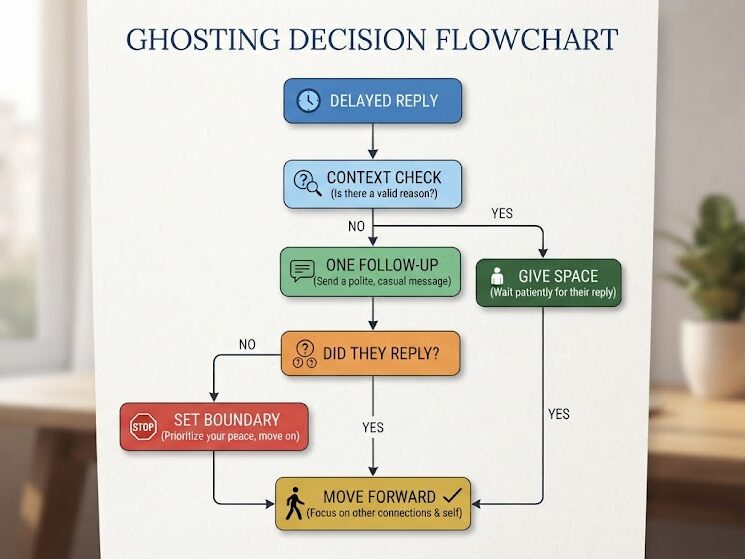
A simple decision process can prevent an uncertain communication problem from becoming a cycle of repeated checking and messaging.
Free tools such as your phone’s mute, archive, block, and notification controls can also help you create distance from a conversation without repeatedly opening it.

What’s Next After Being Ghosted?
What’s next after being ghosted is to accept the communication pattern, protect your boundaries, and invest your energy in people who communicate consistently. Moving forward does not require pretending that the experience did not hurt.
First, allow yourself to acknowledge the disappointment. You can feel confused or rejected while still recognizing that you cannot force another person to communicate.
Second, avoid turning unanswered questions into permanent self-criticism. The reason someone ghosts may remain unknown, and guessing can create a story that has no factual basis.
Third, use the experience to clarify what you want from future relationships. You may value direct conversations, reliability, emotional maturity, and mutual effort more strongly after experiencing unexplained silence.
Conclusion
Ghosting is a communication behavior in which someone abruptly stops communicating without providing a clear explanation or closure. It can happen in dating, friendships, workplaces, and online relationships, and its causes can range from conflict avoidance and loss of interest to emotional overwhelm or legitimate safety concerns.
Importantly, what is ghosting is not simply a question of how long someone takes to reply. A delayed response, busy period, or request for personal space is not automatically ghosting. Taking space usually communicates a need for distance, while ghosting generally leaves the other person without meaningful context.
If someone ghosts you, one respectful follow-up is usually enough. After that, protect your boundaries, avoid repeated attempts to force an answer, and focus your energy on supportive people and relationships built on mutual effort.
FAQs
What is ghosting?
Ghosting is suddenly ending communication without explanation or closure.
What does ghosting mean in a relationship?
Ghosting means abruptly stopping communication with someone without explaining why.
What are the signs of ghosting?
Common signs include ignored messages, canceled plans, sudden silence, and no explanation.
How long before it is considered ghosting?
There is no fixed timeframe; it depends on a pattern of unexplained silence.
Why do people ghost?
People may ghost because of lost interest, conflict avoidance, overwhelm, or safety concerns.
Is ghosting the same as taking space?
No, taking space usually involves communicating the need for distance.
What is soft ghosting?
Soft ghosting means giving minimal responses without meaningful communication.
What should I do if someone ghosts me?
Send one respectful follow-up, then give them space and focus on yourself.
Should I text someone who ghosted me?
One calm follow-up is okay, but avoid repeatedly messaging them.
Does ghosting mean I did something wrong?
Not necessarily; you may not know why the person stopped communicating.
Can ghosting happen in friendships?
Yes, a friend can suddenly stop communicating without explanation.
Can ghosting happen at work?
Yes, professional contacts can also stop responding without explanation.
What should I do if I ghosted someone?
Apologize, communicate honestly, and respect the other person’s response.
Is ghosting ever acceptable?
Ghosting may be appropriate when ending contact is necessary for personal safety.
You can also read this:
Gen Z Sign Language: Popular Gestures, Meanings & Digital Trends
Bed Rotting Benefits: Can This Viral Rest Trend Reduce Stress?
1 thought on “What Is Ghosting? Meaning, Signs, Reasons & How to Respond”