

You’ve probably seen bed rotting described online as the ultimate way to relax, recharge, and escape a busy schedule. But is spending extra time in bed actually good for you, or can too much of it become counterproductive?
The answer depends on why you are doing it, how often you do it, and what effect it has on your daily life. Intentional downtime can be relaxing and enjoyable, but excessive time in bed may interfere with sleep, movement, responsibilities, and social connection.
In this guide, we’ll explore the potential bed rotting benefits, what bed rotting actually means, how it differs from sleep and rest days, possible risks of excessive bed time, and practical ways to make this popular wellness trend healthier and more intentional.
What Is Bed Rotting?
Bed rotting is a social-media wellness term for intentionally spending an extended period in bed while resting or doing low-effort activities. The phrase became popular online as people began describing days spent watching shows, scrolling, reading, napping, listening to music, or simply doing very little as a form of self-care. Cleveland Clinic describes the trend as intentionally exchanging normal activities for relaxation in bed.
However, bed rotting is not a formal medical treatment or established therapeutic practice. Instead, it is a casual term for intentional downtime that may overlap with relaxation, recovery, rest, or sleep.
For example, spending a quiet Saturday morning reading in bed after a demanding week may simply be intentional rest. On the other hand, remaining in bed for most of the day because you feel unable to handle normal activities represents a different pattern.
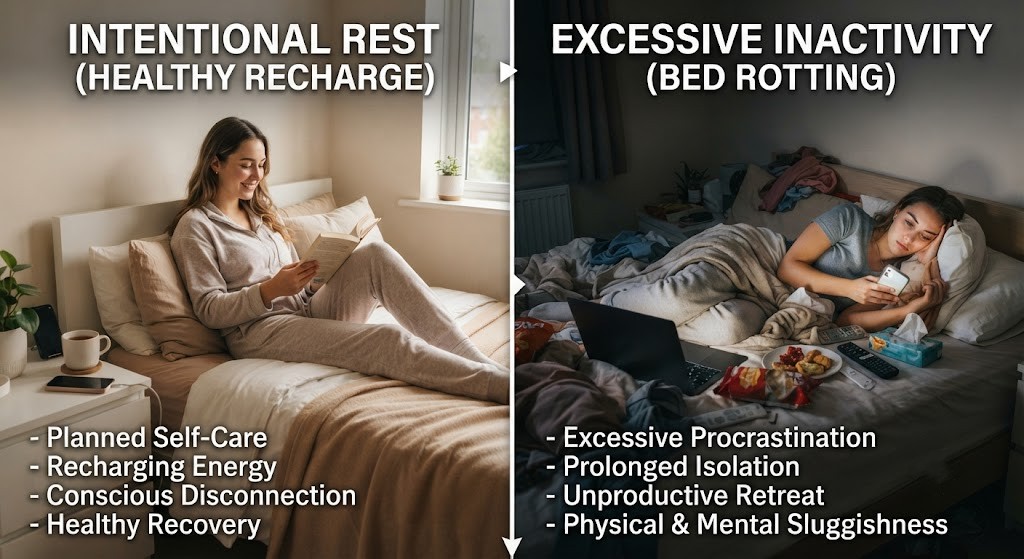
Bed rotting may involve activities such as:
- Watching a favorite movie or television series
- Reading a book or magazine
- Listening to music or podcasts
- Journaling
- Meditating
- Taking a short nap
- Relaxing without a demanding task
- Using your phone or social media
The important distinction is that resting in bed is not automatically unhealthy or healthy. Its value depends on whether it supports your overall routine or gradually replaces important aspects of daily life.
Why Has Bed Rotting Become a Popular Wellness Trend?
Bed rotting became popular because it reflects a growing desire for low-pressure downtime in an always-connected lifestyle. Social media helped turn deliberately doing very little into a recognizable wellness trend, particularly among younger people.
Modern routines can make it feel as though every free moment needs to be productive. Work, school, exercise, household responsibilities, notifications, and social commitments can leave little room for simply stopping.
Bed rotting challenges that mindset by giving people permission to pause without turning relaxation into another achievement.
For example, a student might spend an hour reading in bed after completing assignments rather than immediately moving on to another task. Similarly, someone who has had a particularly demanding week may choose a quiet morning in bed before returning to their normal routine.
At the same time, popularity does not automatically make every form of bed rotting beneficial. The purpose, frequency, duration, and effect on your daily life matter more than the label itself.
What Are the Potential Bed Rotting Benefits?
The potential bed rotting benefits mainly come from intentional rest, relaxation, and temporary relief from demanding activities rather than from staying in bed itself. Cleveland Clinic notes that mindful, moderate periods of bed-based relaxation may provide an opportunity for physical and mental recovery.
Here are some of the potential benefits when bed rotting is practiced intentionally and in moderation.
1. It Can Create Mental Downtime
Mental downtime gives your attention a temporary break from demanding tasks and constant stimulation. A quiet period may make it easier to step away from work, school, notifications, and other daily pressures.
For example, reading a few pages without checking work messages can create a calmer transition between a stressful day and your evening.
This type of break can also provide a psychological boundary between periods of productivity and personal time. Instead of immediately moving from one demanding task to another, you give yourself permission to pause.
2. It Can Feel Physically Comfortable
Comfortable rest can give tired muscles and joints a temporary break from daily demands. Sitting or lying comfortably can be especially appealing after a long day of commuting, studying, working, or exercising.
For example, lying down for 20–30 minutes after a demanding day may feel more restorative than immediately moving into another demanding task.
However, comfort should not be confused with complete physical recovery. Resting briefly can be useful, while prolonged inactivity can reduce the amount of movement you get throughout the day.
3. It Can Support Intentional Relaxation
Intentional relaxation means deliberately choosing a low-demand activity instead of remaining busy by default. Reading, listening to calming music, journaling, meditation, or watching a favorite show can turn downtime into a conscious choice.
For example, you could spend 30 minutes journaling in bed instead of automatically scrolling through short-form videos.
The difference is intentionality. When you know why you are resting and what you want to get from the break, it can be easier to stop when the break has served its purpose.
Holistic Spa relaxation techniques
4. It Can Provide Space for Reflection
Quiet downtime can create an opportunity to notice how you feel physically and emotionally. That reflective space may help you recognize that you need sleep, a meal, movement, social connection, or a genuine break.
For example, realizing that you are exhausted rather than simply unmotivated may help you choose an appropriate recovery strategy.
This can make rest more purposeful because you are responding to what your body and mind need rather than simply staying in bed out of habit.
That being said, intentional rest can provide mental downtime and relaxation, but bed rotting is not a medically established treatment for mental or physical health conditions.
Is Bed Rotting Actually Healthy?
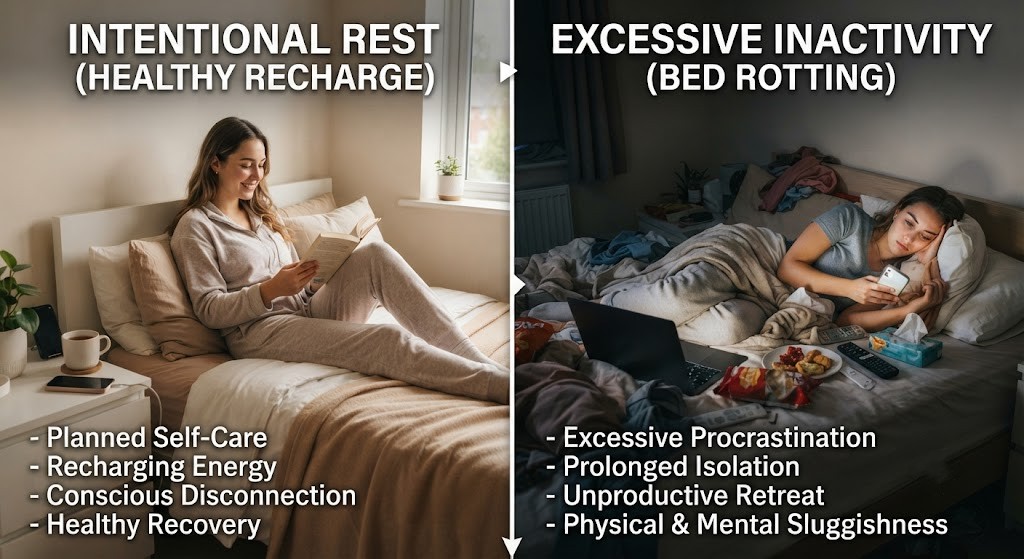
Bed rotting can be healthy as occasional intentional rest when it does not interfere with sleep, movement, responsibilities, or relationships. The behavior becomes less helpful when it turns into a frequent pattern of inactivity or avoidance.
There is also no universal number of minutes that officially defines healthy bed rotting. Instead, consider what happens before, during, and after your rest period.
For example, staying in bed for an hour after a stressful week and feeling refreshed afterward is very different from spending an entire weekend in bed and feeling more isolated and unmotivated.
A useful rule is simple:
Healthy rest should generally help you return to life, not make returning to life harder.
| Type of bed time | Main purpose | Generally healthier approach |
|---|---|---|
| Intentional rest | Relaxation | Set a rough time boundary |
| Nighttime sleep | Physical and mental recovery | Maintain a consistent sleep routine |
| Rest day | Recovery from training | Include gentle movement |
| Short nap | Temporary sleep recovery | Avoid disrupting nighttime sleep |
| Excessive bed time | Avoidance or persistent inactivity | Identify the underlying reason |
How Can You Practice Bed Rotting in a Healthy Way?
Healthy bed rotting means setting boundaries around rest while maintaining normal sleep, nutrition, movement, and responsibilities. The goal is to make downtime restorative instead of allowing it to become indefinite inactivity.
Set a Clear Time Boundary
A time boundary can prevent intentional rest from accidentally becoming an entire day of inactivity. You might decide to relax in bed for 30 minutes, an hour, or a specific part of an afternoon.
For example, setting a timer for 60 minutes can make it easier to enjoy your break without losing track of time.
The exact duration does not need to be rigid. What matters is having enough awareness to recognize when your intended break has ended.
Choose Restorative Activities
Rest becomes more intentional when you choose activities that genuinely help you unwind. Reading, music, journaling, meditation, and calm entertainment can be more deliberate than endless scrolling.
For example, choosing one favorite episode instead of automatically watching videos for four hours gives your downtime a clearer endpoint.
Consider choosing activities that leave you feeling relaxed rather than mentally overstimulated.
Keep Food and Hydration Normal
Rest should not mean regularly skipping meals or ignoring hydration. Continue eating balanced meals and drinking fluids according to your normal routine.
For example, get out of bed for lunch rather than eating every meal under the covers simply because you are resting.
Maintaining normal meals also creates useful structure during an otherwise low-demand day.
Add Small Movement Breaks
Short movement breaks can reduce the physical effects of prolonged inactivity. Cleveland Clinic recommends getting out of bed periodically, even for simple movement such as stretching or walking to another room.
You do not necessarily need an intense workout. Small actions can help break up long periods of lying down.
Try:
- Standing up and walking around your room
- Refilling your water bottle
- Walking to another room
- Performing gentle stretches
- Taking a short walk outside
How Is Bed Rotting Different From Getting Enough Sleep?
Bed rotting and sleep are different because sleep is a biological recovery process, while bed rotting usually describes waking relaxation in bed. Spending time in bed does not automatically provide the same benefits as getting adequate, high-quality sleep.
Adults generally need at least 7 hours of sleep per night, while teenagers aged 13–17 generally need 8–10 hours. — Source: Centers for Disease Control and Prevention, 2024
For additional context, 30.5% of U.S. adults reported getting less than seven hours of sleep on average in 2024. — Source: Centers for Disease Control and Prevention, 2026
For example, spending three extra hours in bed watching videos after sleeping only five hours does not necessarily compensate for inadequate nighttime sleep.
This distinction is particularly important because spending more time in bed is not always the same as sleeping more.
Bed Rotting vs. Sleep vs. a Rest Day
Sleep, rest, and recovery are related but serve different purposes.
- Sleep: Provides essential biological recovery.
- Bed-based relaxation: Provides waking downtime and comfort.
- Rest day: Reduces structured training demands while still allowing normal daily movement.
- Active recovery: Uses low-intensity movement to support recovery without demanding a hard workout.
For example, an athlete can take a rest day while still walking, stretching, eating properly, and maintaining a normal bedtime.
Understanding these differences can help you avoid using bed rotting as a substitute for either sleep or healthy physical activity.
What Are the Risks of Spending Too Much Time in Bed?
Excessive time in bed can become problematic when it reduces physical activity, disrupts sleep routines, increases isolation, or interferes with everyday responsibilities. Prolonged sedentary behavior is associated with poorer health outcomes, while replacing sedentary time with physical activity can provide health benefits.
Reduced Physical Activity
Long periods of inactivity can reduce the amount of movement you get throughout the day. The World Health Organization recommends that adults aged 18–64 get at least 150 minutes of moderate-intensity physical activity each week, or 75 minutes of vigorous activity. — Source: World Health Organization, 2026
For example, spending an entire weekend in bed could make it much harder to reach your normal weekly movement goals.
Disrupted Sleep Habits
Excessive daytime bed time can blur the distinction between waking relaxation and nighttime sleep. Cleveland Clinic notes that bed-based habits can contribute to poor sleep hygiene, particularly for people already experiencing sleep problems.
For example, a long afternoon nap may make it harder to fall asleep at your normal bedtime.
Creating a clear distinction between daytime relaxation and nighttime sleep can therefore help protect a consistent sleep routine.
Social Withdrawal and Avoidance
Bed time becomes concerning when it consistently replaces social connection, work, school, or basic responsibilities. Regularly using bed rotting to avoid stressful situations may reinforce avoidance rather than provide genuine recovery.
For example, repeatedly canceling plans because you cannot motivate yourself to leave bed deserves more attention than an occasional lazy afternoon.
If the pattern keeps growing, it may be useful to look at the reason behind it rather than focusing only on the behavior.
Can Bed Rotting Help With Stress and Mental Fatigue?
Bed rotting may temporarily support relaxation when stress and mental fatigue come from an unusually demanding period. However, it should not be treated as a cure for anxiety, depression, burnout, or another mental-health condition.
The key question is often whether the rest period leaves you feeling refreshed or more depleted.
Cleveland Clinic recommends paying attention to that response and looking for other symptoms when the behavior becomes difficult to control.
For example, taking an afternoon to decompress after exams may feel restorative, while repeatedly staying in bed because you feel unable to face normal life may signal a deeper issue.
Additionally, depression can affect daily activities such as sleeping, eating, and working, according to the National Institute of Mental Health. — Source: National Institute of Mental Health, 2026
Bed rotting vs. depression is therefore not a simple either-or comparison. The behavior itself does not diagnose depression, but persistent difficulty functioning should not be dismissed as a wellness trend.
If you are struggling to perform normal daily activities or the pattern is persistent, consider speaking with an appropriately qualified healthcare professional.
When Does Bed Rotting Become Excessive?
Bed rotting becomes excessive when it repeatedly interferes with sleep, movement, responsibilities, relationships, or your ability to function normally. Frequency alone is less important than the pattern and its consequences.
Ask yourself these questions:
- Do I feel refreshed after resting?
- Can I get out of bed when I need to?
- Am I maintaining normal meals and hydration?
- Am I sleeping adequately at night?
- Am I still moving regularly?
- Am I avoiding people or responsibilities?
- Do I feel like I need to stay in bed to cope?
These questions can help you distinguish occasional relaxation from a pattern that may be affecting your well-being.
For example, if your occasional rest day has gradually become several days of avoiding normal activities, it may be time to reconsider the pattern.
Persistent difficulty getting out of bed is a reason to look beyond the bed-rotting trend and consider professional support. Mental-health or physical-health symptoms that interfere with everyday functioning deserve proper assessment rather than being explained away as self-care.
What Are Healthier Alternatives to Spending All Day in Bed?
Healthier alternatives combine relaxation with light movement, social connection, outdoor time, and enjoyable low-pressure activities. These options can provide recovery without requiring you to remain inactive for most of the day.
Try these alternatives:
- Take a short walk. A gentle walk can provide movement and a change of environment.
- Read somewhere outside your bedroom. This preserves the relaxing activity while creating separation from your sleep space.
- Practice gentle stretching. A few minutes of mobility can break up long periods of inactivity.
- Listen to music. Music can provide downtime without requiring you to stay in bed.
- Spend time with friends. Social connection can provide a different form of recovery.
- Try mindfulness. Meditation or breathing exercises can create intentional mental downtime.
- Take an active recovery session. Light movement can be restorative after demanding workouts.
These alternatives do not mean that you have to eliminate bed-based relaxation. Instead, they provide more variety so that rest does not become synonymous with staying in bed all day.
What Are Practical Bed-Rotting Ideas for a Healthier Rest Day?
Healthy bed-rotting ideas focus on intentional, enjoyable activities that have a clear beginning and end. The objective is not to maximize the number of hours spent in bed but to make your downtime genuinely restorative.
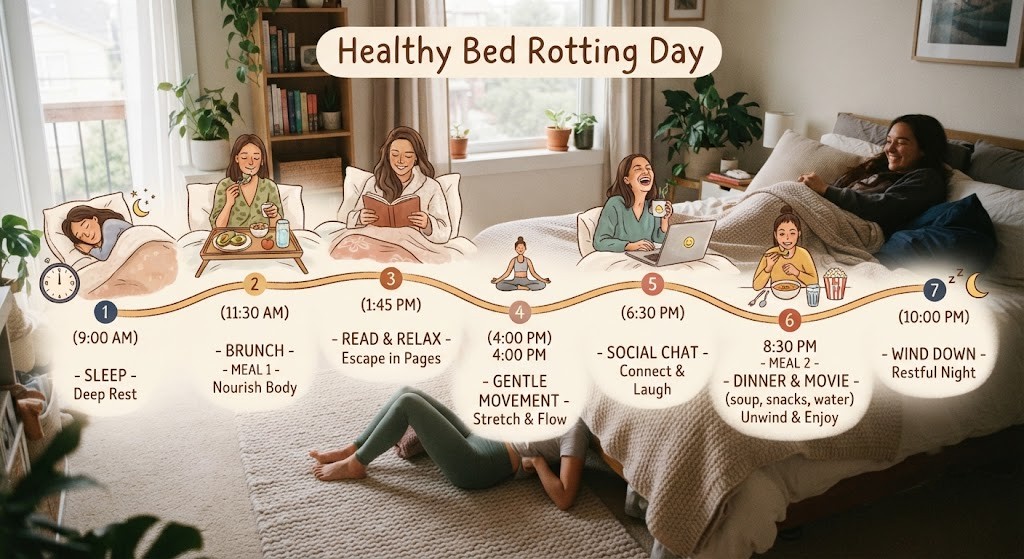
A simple weekend routine could look like this:
- Morning: Get up, hydrate, eat breakfast, and get some natural light.
- Late morning: Spend 30–60 minutes reading or relaxing in bed.
- Afternoon: Take a walk, stretch, or meet a friend.
- Evening: Watch a favorite show without turning it into an all-night session.
- Night: Return to your normal sleep routine.
This approach keeps the enjoyable part of bed rotting while protecting the habits that support overall well-being.
The goal is not to make every rest period productive. Instead, it is to make relaxation intentional without allowing it to take over the rest of your routine.
How Can You Balance Rest With Daily Activity?
Balanced rest means combining intentional downtime with adequate sleep, regular movement, nutritious meals, social connection, and everyday responsibilities. This approach recognizes that recovery does not always require complete inactivity.
Moreover, the WHO recommends at least 150 minutes of moderate physical activity or 75 minutes of vigorous activity per week for adults aged 18–64, along with muscle-strengthening activities on at least two days. — Source: World Health Organization, 2026
For example, someone can enjoy a relaxed Saturday morning in bed while still walking during the afternoon and maintaining a normal bedtime.
A balanced routine can include:
- Sleep: Protect your regular nighttime sleep schedule.
- Movement: Break up long periods of sitting or lying down.
- Nutrition: Keep regular meals and hydration.
- Connection: Maintain relationships and social activities.
- Downtime: Schedule guilt-free periods of relaxation.
- Responsibilities: Return to essential work, school, and household tasks.
This balance allows you to enjoy periods of doing less without allowing rest to become a substitute for the habits that support your overall well-being.
How Should You Use Bed Rotting as Self-Care?
The best way to use bed rotting as self-care is to treat it as occasional intentional downtime rather than an all-day lifestyle. Start with a defined rest period and choose activities that leave you feeling calmer, refreshed, or ready to continue your day.
1. Decide Why You Want to Rest
First, identify what you need.
If you are simply tired after a demanding week, intentional downtime may be exactly what you need. If you are staying in bed because you feel unable to deal with normal activities, the situation deserves more attention.
2. Set a Reasonable Boundary
Second, establish a time window for your break.
A specific period can help you enjoy the rest without allowing it to replace movement, meals, sleep, or responsibilities.
3. Choose How You Want to Relax
Third, choose an activity that actually feels restorative.
Reading, listening to music, journaling, meditating, or watching a favorite show can all make downtime feel more intentional.
4. Check How You Feel Afterwards
Finally, pay attention to the result.
If your rest consistently leaves you more isolated, exhausted, guilty, or unable to function, the strategy may not be helping you.
Active recovery can also be rest. A walk, gentle stretching session, relaxing hobby, or time with friends may provide the reset you are looking for without requiring prolonged inactivity.
Conclusion
Bed rotting can be a useful form of intentional rest when it is occasional, mindful, and balanced with normal daily activity. The potential bed rotting benefits come primarily from creating space for relaxation and mental downtime rather than from prolonged inactivity itself.
Healthy bed rotting should complement adequate sleep and regular daily activity rather than replace them. Spending excessive amounts of time in bed can contribute to inactivity and disrupted routines when it interferes with normal sleep, movement, responsibilities, or social activities.
Ultimately, a balanced approach to rest combines intentional downtime, adequate sleep, regular movement, nutritious meals, social connection, and everyday activities.
So, enjoy your lazy day when you need one—but make sure your rest helps you return to life rather than withdraw from it.
FAQs
What is bed rotting?
Bed rotting means intentionally staying in bed to relax or do low-effort activities.
What are the benefits of bed rotting?
Bed rotting may provide relaxation, mental downtime, and temporary stress relief.
Is bed rotting healthy?
It can be healthy when practiced occasionally and balanced with sleep, movement, and daily activities.
How long should you bed rot?
There is no fixed time, but it should not interfere with your normal routine.
Is bed rotting the same as sleeping?
No, bed rotting is usually waking relaxation, while sleep provides essential recovery.
Can bed rotting help with stress?
Yes, it may provide temporary relaxation and mental downtime.
Is bed rotting bad for you?
Excessive bed time may contribute to inactivity, isolation, and disrupted routines.
What are healthier alternatives to bed rotting?
Walking, stretching, mindfulness, reading, and social activities are good alternatives.
Can bed rotting be a form of self-care?
Yes, occasional bed rotting can be a form of intentional relaxation and self-care.
When does bed rotting become unhealthy?
It becomes concerning when it interferes with sleep, movement, responsibilities, or relationships.