

AI is already transforming how people work, create, research, and solve complex problems. From large language models and coding assistants to autonomous AI agents and scientific research tools, modern artificial intelligence is becoming increasingly capable.
But the AI singularity goes far beyond today’s AI tools. It describes a hypothetical future in which AI-driven technological progress becomes so rapid that predicting what happens next becomes extremely difficult. One of the central questions is whether increasingly capable AI could eventually help accelerate the development of even more capable AI.
In this guide, you’ll learn what the AI singularity means, how it could theoretically happen, how it relates to artificial general intelligence (AGI) and artificial superintelligence (ASI), what an intelligence explosion could look like, and what the potential benefits and risks could be.
What Is the AI Singularity?
The AI singularity is a hypothetical point or period at which artificial intelligence drives technological progress so rapidly that subsequent technological and societal changes become extremely difficult to predict.
The concept is closely related to the broader idea of the technological singularity, but AI is often discussed as one possible mechanism that could lead to such a transformation.
Importantly, the AI singularity is not simply the moment when an AI system becomes smarter than a human. Intelligence alone is not the defining feature. Instead, the central idea is accelerating technological change.
For example, imagine an advanced AI system that can conduct AI research, develop improved algorithms, test those algorithms, analyze results, and contribute to the design of its successors. If each generation substantially improves the next, the pace of AI development could potentially increase.
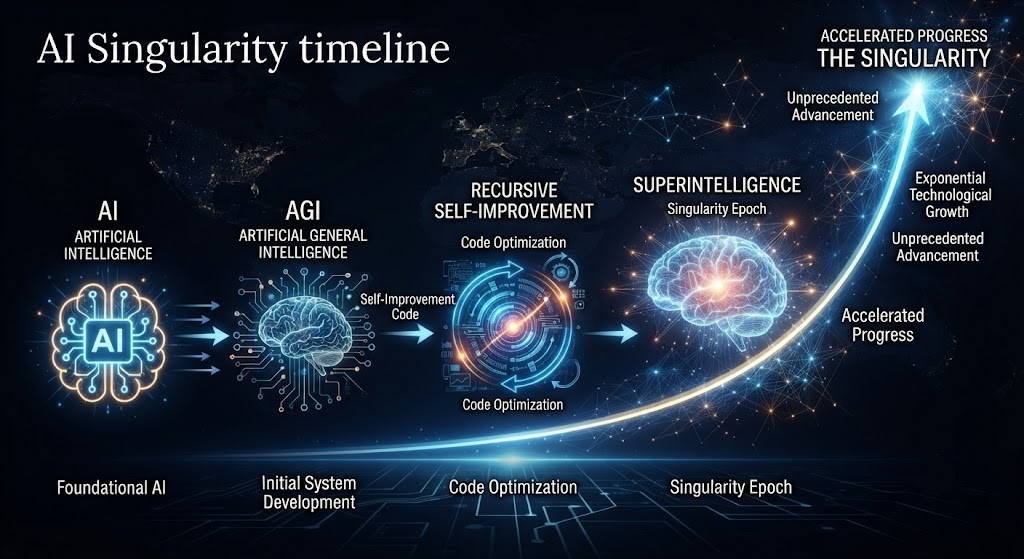
However, this remains a hypothetical future scenario, not an established technological milestone. The International AI Safety Report 2026 emphasizes that AI capabilities are improving rapidly while significant uncertainty remains about future progress and its consequences.
Why Is the AI Singularity Important?
The AI singularity matters because extremely capable AI could potentially transform science, economics, employment, security, productivity, and society on an unprecedented scale.
Understanding the concept also helps distinguish between three different things:
- What AI systems can do today
- What researchers reasonably expect future AI systems might do
- What remains speculative about a potential singularity
AI already has significant real-world economic and scientific importance. At least 700 million people use leading AI systems weekly, according to the 2026 International AI Safety Report.
Source: International AI Safety Report, 2026.
AI systems are increasingly being used for coding, mathematics, research, education, content creation, and scientific discovery. As a result, improvements in AI capabilities could influence both individual productivity and larger economic systems.
Computing infrastructure is also expanding rapidly. Global AI compute capacity reached 17.1 million H100-equivalents, growing about 3.3× per year since 2022.
Source: Stanford HAI, 2026.
This combination of growing AI adoption, increasing computational resources, algorithmic improvements, and expanding research could be important when evaluating future AI development.
How Could an AI Singularity Happen?
An AI singularity could theoretically happen if increasingly capable AI systems begin accelerating the research and development of even more capable AI systems.
This idea is speculative, but it provides a useful framework for understanding the intelligence explosion hypothesis.
A simplified pathway might look like this:
- AI systems become increasingly capable.
- An advanced system reaches broad intellectual capabilities.
- AI begins contributing substantially to AI research and development.
- AI-assisted research produces improved algorithms, systems, or infrastructure.
- More capable systems accelerate the next generation of AI development.
- The resulting progress becomes increasingly rapid and difficult to forecast.
This scenario depends on several assumptions, including whether AI can meaningfully automate AI research, whether improvements can compound, and whether practical constraints slow the process.
Could AGI Lead to an AI Takeoff?
Artificial general intelligence (AGI) refers to a hypothetical AI system capable of performing a broad range of intellectual tasks at a human-like or greater level.
AGI would represent a major step beyond narrowly specialized AI because it could potentially transfer reasoning, learning, and problem-solving abilities across many different domains.
For example, an AGI capable of software engineering, mathematics, scientific reasoning, and research could potentially assist teams developing better algorithms and AI systems.
If such systems could improve AI research substantially, some researchers theorize that AGI could contribute to an AI takeoff, in which capabilities improve rapidly over a relatively short period.
However, AGI does not automatically mean a singularity will occur. An AGI system could exist without being capable of rapidly improving itself or accelerating technological development.
artificial general intelligence (AGI)
What Role Could Recursive Self-Improvement Play?
Recursive self-improvement is the theoretical process in which an advanced AI system improves its own capabilities or helps develop improved versions of AI systems.
The concept becomes particularly important in singularity discussions because repeated improvements could potentially create a feedback loop.
For example, an AI research system might:
- Identify a possible algorithmic improvement
- Implement or recommend the improvement
- Test the resulting system
- Analyze performance
- Identify additional improvements
- Help develop the next version
If each cycle became faster and more effective, AI development could potentially accelerate.
However, recursive self-improvement is not an established process occurring at a level that demonstrates a coming singularity. Real-world AI development continues to face limitations involving computing resources, energy, data, engineering, research complexity, reliability, and human oversight.
What Is the Difference Between AI, AGI, ASI, and the Singularity?
AI, AGI, ASI, and the AI singularity describe different concepts rather than four interchangeable terms.
| Concept | Meaning | Status |
|---|---|---|
| AI | Systems designed to perform specific or broad intelligent tasks | Existing technology |
| AGI | Hypothetical general-purpose human-level or greater intelligence | Not established |
| ASI | Hypothetical intelligence substantially exceeding humans across many domains | Speculative |
| AI Singularity | Hypothetical period of extremely rapid, difficult-to-predict technological change | Speculative |
Artificial Intelligence
Today’s artificial intelligence includes technologies such as large language models, computer vision systems, recommendation engines, speech recognition systems, and AI agents.
Modern AI can perform impressive tasks without necessarily possessing broad human-level intelligence.
For example, an LLM can generate software code, summarize information, answer questions, and reason through certain problems without necessarily demonstrating the generalized capabilities associated with AGI.
Artificial General Intelligence
AGI is the hypothetical concept of an AI system capable of performing a broad range of intellectual tasks at a human-like or greater level.
Unlike a narrowly specialized system, AGI would theoretically be able to apply its capabilities across many domains.
Artificial Superintelligence
Artificial superintelligence (ASI) refers to a hypothetical AI that substantially exceeds human intellectual capabilities across many domains.
ASI therefore describes a potential level of machine intelligence, whereas the singularity describes a possible period of rapid technological transformation.
The AI Singularity
The AI singularity is broader than simply achieving AGI or ASI. It refers to a hypothetical transition in which AI-driven progress becomes so rapid and interconnected that forecasting subsequent developments becomes extremely difficult.
For more context, see Best Autonomous AI Agents for Business.
Could AI Create an Intelligence Explosion?
An intelligence explosion is a hypothetical scenario in which AI systems rapidly improve their own capabilities, causing machine intelligence to increase at an accelerating rate.
Recursive self-improvement is one proposed mechanism behind this idea. However, an intelligence explosion would require several uncertain conditions to occur simultaneously.
For example, an AI system would need to contribute meaningfully to AI research, improvements would need to be sufficiently large and repeatable, and the process would need to overcome practical constraints.
What Could Limit an Intelligence Explosion?
Real AI development is influenced by many factors, including:
- Computing hardware
- Energy availability
- Training data
- Research talent
- Capital investment
- Algorithmic breakthroughs
- Software engineering
- Model reliability
- Infrastructure
- Deployment constraints
The 2026 International AI Safety Report notes that leading AI models have been trained with roughly 5× more computing power each year, while training algorithms have become approximately 2–6× more efficient annually.
Source: International AI Safety Report, 2026.
These trends demonstrate rapid improvements in important AI inputs and techniques. However, they do not prove that exponential AI progress will continue indefinitely or that a singularity is inevitable.
What Could Happen After the AI Singularity?
Potential consequences of an AI singularity include accelerated scientific discovery, increased automation and productivity, major economic changes, and new challenges involving AI safety, security, alignment, and governance.
The outcome would depend heavily on how capable AI systems become, how autonomous they are, how they are deployed, and how effectively humans and institutions manage them.
What Are the Potential Benefits?
Potential benefits of an AI singularity include faster scientific discovery, improved automation, new technologies, and greater human-AI collaboration.
Highly capable AI could potentially help researchers process enormous datasets, investigate scientific hypotheses, automate complex workflows, and accelerate certain forms of experimentation.
AI could also transform software development and knowledge work. METR’s 2026 measurements show that frontier AI agents are increasingly capable of completing software tasks that previously required meaningful amounts of human expert time.
Source: METR, 2026.
Potential areas of impact could include:
- Scientific research
- Software development
- Mathematics
- Education
- Healthcare research
- Engineering
- Business automation
- Data analysis
- Scientific discovery
The potential benefit is not simply that AI could perform tasks faster. More capable systems could potentially help humans investigate problems that are currently too complex, expensive, or time-consuming to solve efficiently.
Readers interested in practical applications can explore AI automation
What Are the Risks?
AI singularity risks include alignment failures, malicious use, economic disruption, cybersecurity threats, concentration of power, and governance challenges.
One major concern is AI alignment: ensuring that highly capable systems behave according to intended goals, constraints, and human values.
For example, a highly capable system pursuing a poorly specified objective could potentially produce consequences that humans did not anticipate. The greater the system’s autonomy and capabilities, the more important reliable control and evaluation could become.
The International AI Safety Report 2026 identifies misuse, malfunction, and systemic risks as major categories for advanced general-purpose AI.
Source: International AI Safety Report, 2026.
Other concerns include:
- Misuse of powerful AI capabilities
- Cybersecurity threats
- Economic disruption
- Changes to employment
- Concentration of technological power
- Difficulty governing highly capable systems
- Failure of safety mechanisms
- Unintended consequences from autonomous systems
When Could the AI Singularity Happen?
There is no reliable scientific date for when the AI singularity could happen.
Forecasts vary substantially because researchers disagree about AGI definitions, technical bottlenecks, AI scaling, economic incentives, AI autonomy, and the possibility of recursive improvement.
Some forecasts envision significant AI progress within relatively short periods, while others expect slower development or argue that current approaches may face fundamental limitations.
The 2026 International AI Safety Report says future AI capability trajectories remain substantially uncertain, with possible outcomes ranging from modest improvements to rapid gains by 2030.
Source: International AI Safety Report, 2026.
Therefore, claims that the AI singularity will definitely happen on a specific date should be treated cautiously.
A useful distinction is between forecasting AI capabilities and predicting a singularity. Researchers can measure current model performance, computing trends, and AI-assisted productivity, but these measurements do not provide a precise countdown to a singularity.
Is the AI Singularity Guaranteed to Happen?
The AI singularity is not an established event or guaranteed outcome; it remains a hypothetical scenario whose likelihood and timing are subjects of ongoing debate.
AI development could accelerate dramatically, progress more gradually, plateau, encounter technical limitations, or develop along a trajectory that never produces a singularity.
Current AI systems also demonstrate uneven capabilities. They can achieve exceptional performance on difficult benchmarks while still failing at seemingly simple tasks.
Source: Stanford HAI, 2026.
This unevenness is important when evaluating claims about an approaching AI intelligence explosion. High benchmark performance does not automatically establish general intelligence, autonomous self-improvement, or a coming singularity.
How Can Society Prepare for an AI Singularity?
Society can prepare for possible transformative AI by improving technical safety, governance, evaluation, cybersecurity, education, and institutional resilience.
Preparing for advanced AI does not require assuming that an AI singularity is inevitable. Instead, organizations and governments can build systems that remain useful under multiple possible AI futures.
1. Improve AI Safety Research
Researchers can continue studying alignment, reliability, robustness, evaluation, and control for increasingly capable AI systems.
2. Strengthen AI Governance
Governments and institutions can develop AI governance frameworks addressing accountability, safety testing, transparency, security, and responsible deployment.
3. Improve Cybersecurity
As AI becomes more capable, cybersecurity practices need to account for both AI-enabled attacks and the protection of AI systems themselves.
4. Expand AI Education
Individuals and organizations can benefit from understanding the difference between current AI capabilities, credible forecasts, and speculative scenarios.
5. Build Institutional Resilience
Organizations can prepare for rapid changes in productivity, employment, business models, and information systems without assuming that one specific technological outcome is guaranteed.

What Tools and Real-World Developments Are Relevant to the AI Singularity?
Current AI research provides evidence of advancing capabilities, but today’s AI systems do not prove that a singularity is approaching.
Several categories of technology are particularly relevant when tracking AI progress:
- Large language models
- Reasoning models
- AI coding agents
- Autonomous AI agents
- AI research systems
- Benchmark evaluation platforms
- AI-assisted scientific tools
The 2026 International AI Safety Report states that leading systems have improved substantially in mathematics, coding, and autonomous operation while still showing important limitations and failures.
Source: International AI Safety Report, 2026.
These developments can provide measurable evidence about the direction of AI capabilities. However, they should not automatically be interpreted as evidence that a singularity is inevitable or imminent.

Researchers can track AI progress through benchmark platforms, model evaluations, coding-agent tests, technical papers, and international assessments. This approach is generally more informative than relying exclusively on viral predictions or dramatic headlines.
What’s Next for AI Singularity Research?
The next stage of AI singularity research will focus on measuring capabilities, understanding AI autonomy, improving alignment, and determining how societies can manage increasingly capable systems.
Several areas will be especially important.
Measuring AI Capabilities
Researchers can continue evaluating reasoning, coding, mathematics, autonomy, reliability, and other capabilities using standardized tests and real-world tasks.
Understanding AI Autonomy
As AI agents become more capable of planning and completing multi-step tasks, researchers will need to understand how much meaningful work these systems can perform with limited human intervention.
Improving AI Alignment
Alignment research will remain important as systems become more capable and potentially more autonomous. The objective is to develop reliable methods for ensuring that advanced AI behaves within intended boundaries.
Tracking AI Development
AI trends should be treated as evidence to investigate rather than proof of a predetermined future. Comparing forecasts with measurable developments can provide a more grounded understanding of where the technology is heading.
The most useful question is therefore not simply “When will the singularity happen?” but:
“What measurable developments would indicate that AI is moving toward or away from such a scenario?”
Conclusion
The AI singularity is a hypothetical future scenario in which AI-driven technological progress becomes so rapid that predicting its consequences becomes extremely difficult.
AGI, ASI, recursive self-improvement, and intelligence explosions are closely related ideas, but they are not synonymous with the singularity. AGI describes a potential level of general intelligence, ASI describes hypothetical intelligence that substantially exceeds human capabilities, and recursive self-improvement describes one possible mechanism for accelerating AI development.
The most important distinction is between what we can measure today and what we are projecting about the future. AI capabilities are advancing rapidly, but current progress does not establish that a singularity is inevitable or provide a reliable date for one.
Ultimately, understanding AI capabilities, AGI, superintelligence, AI safety, alignment, and governance separately makes it easier to evaluate future AI claims critically. Whether the AI singularity ultimately occurs, studying these possibilities can help researchers, organizations, governments, and individuals prepare for a world in which artificial intelligence plays an increasingly important role.
FAQs
What is the AI singularity?
The AI singularity is a hypothetical point when AI-driven progress becomes extremely rapid and difficult to predict.
Is the AI singularity real?
The AI singularity is a theoretical concept, not a confirmed future event.
What is the difference between AGI and the AI singularity?
AGI refers to general-purpose AI, while the singularity refers to rapid AI-driven technological change.
What is an intelligence explosion?
An intelligence explosion is a hypothetical period of rapidly accelerating AI capabilities.
Could AGI cause the AI singularity?
AGI could potentially contribute to a singularity, but it is not guaranteed.
What is recursive self-improvement in AI?
Recursive self-improvement is the theoretical process of AI improving its own capabilities.
When will the AI singularity happen?
There is no reliable scientific date for when the AI singularity might happen.
Is the AI singularity guaranteed?
No, the AI singularity remains a hypothetical possibility.
What are the benefits of the AI singularity?
Potential benefits include faster scientific discovery, productivity, and automation.
What are the risks of the AI singularity?
Potential risks include AI misuse, alignment problems, cybersecurity threats, and economic disruption.