
Walk into any modern gym, wellness clinic, or biohacking studio in 2026 and you’ll likely see it: glowing red panels, handheld light devices, or full-body booths promising faster recovery, less soreness, and better performance.
Red light therapy has exploded in popularity, especially among athletes, fitness enthusiasts, and people chasing optimal recovery. But with every trend comes a question worth asking:
Is Red Light Therapy for Muscle Recovery backed by real science — or is it mostly hype?
This article breaks down what red light therapy actually does, what the research says, where claims go too far, and whether it deserves a place in your recovery routine.
1. What Is Red Light Therapy?
Red light therapy (also known as photobiomodulation) involves exposing the body to specific wavelengths of red and near-infrared light.
These wavelengths typically range between:
- Red light: ~630–660 nm
- Near-infrared light: ~810–880 nm
Unlike UV light, red light does not damage the skin. Instead, it penetrates tissue and interacts with cells in a very specific way.
That interaction is the foundation of Red Light Therapy for Muscle Recovery.
2. Why Red Light Therapy Became Popular for Recovery
The fitness and wellness world is obsessed with recovery — and for good reason.
Better recovery means:
- Less muscle soreness
- Faster return to training
- Reduced injury risk
- Improved long-term performance
Red light therapy gained traction because it promised all of this without:
- Drugs
- Supplements
- Intense interventions
Just light.
3. How Red Light Therapy Is Supposed to Work
The science behind red light therapy centers on mitochondria — the energy producers inside your cells.
Proposed mechanisms include:
- Increased mitochondrial efficiency
- Enhanced ATP (energy) production
- Reduced oxidative stress
- Improved blood flow
- Modulation of inflammation
In theory, this cellular boost supports muscle repair and recovery.
4. What the Science Actually Says in 2026
Research on Red Light Therapy for Muscle Recovery has grown significantly over the past decade.
What studies consistently suggest:
- Reduced delayed-onset muscle soreness (DOMS)
- Improved short-term recovery markers
- Potential improvements in muscle endurance
- Reduced inflammation in some contexts
However, results depend heavily on:
- Wavelength accuracy
- Dosage and exposure time
- Distance from the light source
- Consistency of use
Red light therapy is not magic — it’s highly conditional.
5. Where the Hype Starts to Outpace the Evidence
Not all claims are created equal.
Common exaggerated promises include:
- “Instant recovery”
- “Muscle growth without training”
- “Complete inflammation elimination”
- “Replacement for sleep or nutrition”
No credible research supports these extremes.
Red Light Therapy for Muscle Recovery appears to be a supportive tool, not a standalone solution.
6. Who May Actually Benefit From Red Light Therapy
Based on current evidence, red light therapy may be most useful for:
- Strength and endurance athletes
- People training frequently with limited recovery time
- Individuals experiencing chronic muscle soreness
- Older adults with slower recovery
- People managing inflammation from intense training
For casual exercisers, benefits may be subtle.
7. Timing and Consistency Matter More Than Intensity
One mistake many people make is overusing red light therapy.
Research suggests:
- Moderate, consistent exposure works better than aggressive sessions
- Pre- or post-workout timing may influence results
- Overexposure does not equal faster recovery
When it comes to Red Light Therapy for Muscle Recovery, more is not always better.
8. At-Home Devices vs Clinical Setups
In 2026, red light therapy devices range from affordable home panels to high-end clinical systems.
Key differences include:
- Power output
- Coverage area
- Wavelength precision
- Treatment consistency
At-home devices can be effective, but expectations should match their capabilities.
9. Red Light Therapy vs Traditional Recovery Methods
Red light therapy doesn’t replace fundamentals.
It works best when combined with:
- Quality sleep
- Proper nutrition
- Hydration
- Active recovery
- Strength programming
Think of Red Light Therapy for Muscle Recovery as a multiplier — not the foundation.
10. Safety and Side Effects
One reason red light therapy gained popularity is its safety profile.
Generally observed:
- Low risk when used properly
- No ionizing radiation
- Minimal reported side effects
Potential issues arise mostly from:
- Overuse
- Poor-quality devices
- Eye exposure without protection
Used responsibly, it’s considered low-risk.
11. Cost vs Benefit: Is It Worth It?
This is where personal context matters.
Red light therapy may be worth it if:
- You train frequently
- Recovery limits your progress
- You value marginal gains
- You already optimize basics
It may not be worth it if:
- Training volume is low
- Sleep and nutrition are inconsistent
- Expectations are unrealistic
The biggest mistake is expecting transformation instead of support.
12. The Future of Red Light Therapy in Recovery
Looking ahead, trends include:
- More precise wavelength targeting
- Personalized recovery protocols
- Integration with wearables
- Clinical-grade tech becoming more affordable
As research improves, Red Light Therapy for Muscle Recovery may become more standardized — and less hype-driven.
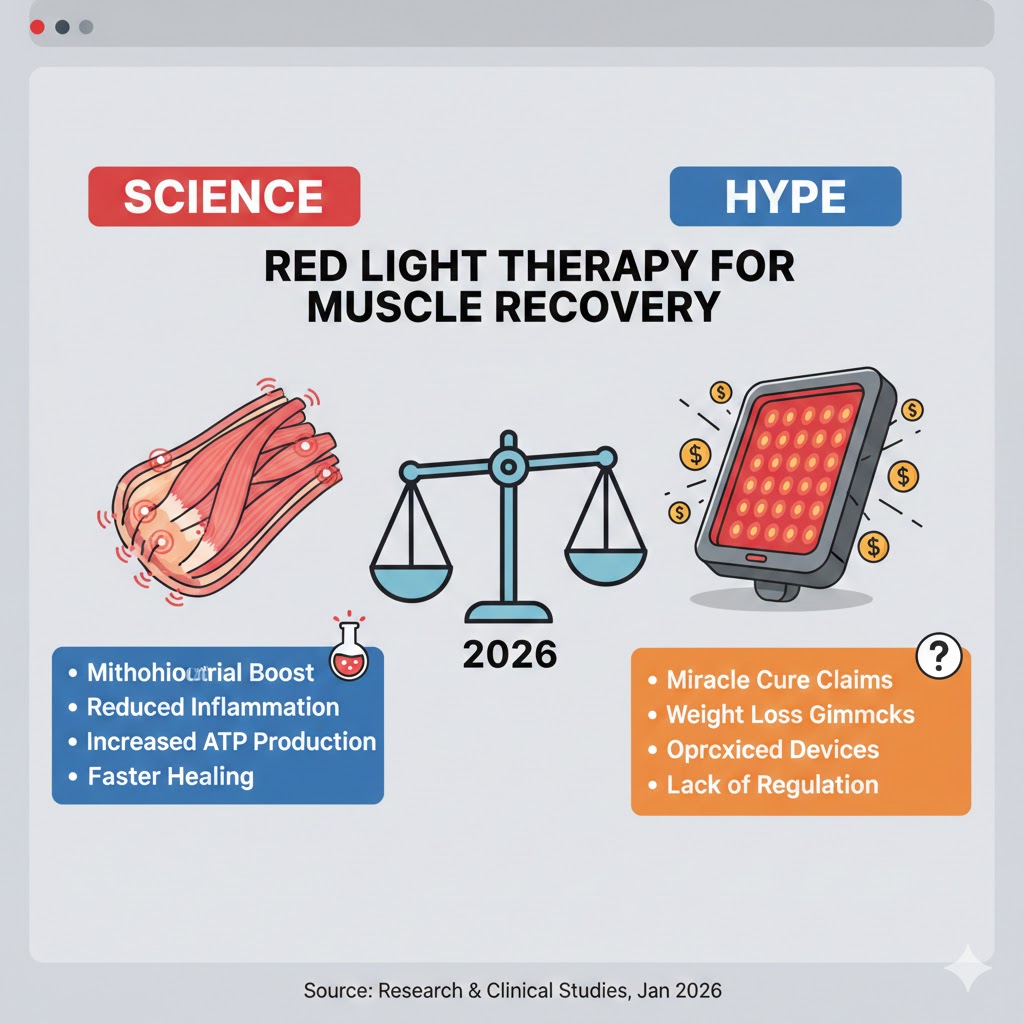
13. Final Verdict: Science vs Hype in 2026
So where does red light therapy land?
The science says:
- It can support muscle recovery
- It may reduce soreness and inflammation
- It works best with proper dosage and consistency
The hype says:
- It replaces recovery fundamentals
- It works instantly
- It guarantees performance gains
The truth sits in the middle.
Red Light Therapy for Muscle Recovery is neither a scam nor a miracle. It’s a legitimate tool — valuable when used correctly, disappointing when misunderstood.
FAQ: Red Light Therapy for Muscle Recovery
What is red light therapy used for in muscle recovery?
It’s used to support muscle repair, reduce soreness, and improve recovery through cellular energy enhancement.
Does red light therapy really reduce muscle soreness?
Some studies show reduced DOMS, but results vary based on usage and individual response.
How often should red light therapy be used for recovery?
Most protocols suggest several sessions per week rather than daily overuse.
Is red light therapy better before or after workouts?
Both timing strategies exist, but post-workout use is more common for recovery.
Can red light therapy replace rest days?
No. It supports recovery but does not replace rest, sleep, or proper training structure.
Are at-home red light devices effective?
They can be, but results depend on device quality and correct usage.
Is red light therapy safe long-term?
When used properly, it’s considered low-risk, though long-term data is still evolving.
More Related Topics:
I Lost 40 Pounds on Semaglutide—The Good, Bad, and Ugly Truth (No Hype, Just Reality)
I Tracked My Biological Age for 6 Months—Here’s What Actually Moved the Needle (Real Data, No Hype)