
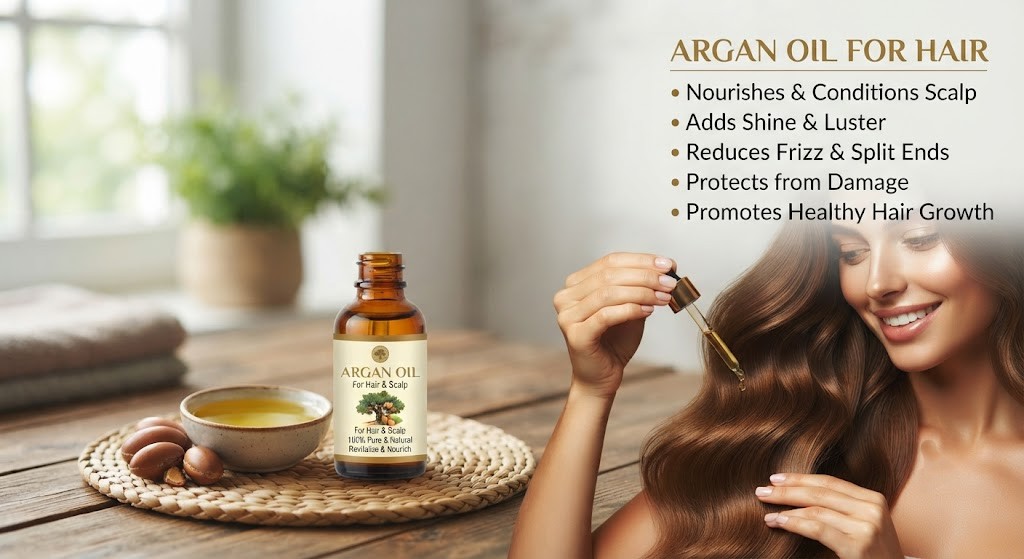
You’ve probably seen argan oil promoted as a simple way to make hair softer, shinier, and less frizzy. But while this lightweight plant oil can be a useful addition to a hair-care routine, using too much—or expecting it to solve every hair problem—can leave strands greasy and create unrealistic expectations.
So, what are the real Argan Oil for Hair Benefits? In this guide, you’ll learn how argan oil works as a hair-conditioning ingredient, which hair types may benefit most, how to use it without weighing your hair down, and what the research actually says about claims involving damage, split ends, and hair growth.
What Is Argan Oil and Why Is It Used for Hair?
Argan oil is a plant-derived oil pressed from the kernels of the argan tree, Argania spinosa, traditionally associated with Morocco. Argan oil is commonly used in hair care as a conditioning ingredient that can improve the softness, shine, and manageability of hair.
Cosmetic argan oil contains a mixture of fatty acids and other naturally occurring compounds, with oleic and linoleic acids among its major fatty acids. Researchers have also identified tocopherols and other antioxidant-related compounds in argan oil.
Source: PubMed, 2019.
Argan oil primarily works as a cosmetic conditioning ingredient rather than a medication. For example, a few drops worked through the mid-lengths and ends can make rough-feeling strands feel smoother without requiring a complicated routine.
What Makes Argan Oil Popular in Hair Care?
Argan oil is popular because its lipid-rich composition can help provide a smooth, conditioned feel to the hair fiber. A small amount can coat the hair surface and improve how strands look and feel.
For example, applying one or two drops to dry ends may make them appear more polished after styling. However, the effect is mainly cosmetic, so argan oil should not be presented as permanently repairing damaged hair.
A 2022 systematic review examined 22 studies involving coconut, castor, and argan oils and found that clinical evidence supporting argan oil for hair growth or hair-quality improvement remained limited.
Source: Journal of Drugs in Dermatology, 2022.
Why Does Argan Oil Matter for Hair Care?
Argan oil matters for hair care because it can provide conditioning, lubrication, softness, shine, and improved manageability when used appropriately. These cosmetic effects can be particularly useful when hair feels dry, rough, tangled, or difficult to style.
Conditioned hair generally feels easier to comb and manipulate because the strands have less surface friction. For example, a small amount of oil applied to the ends after washing can help make detangling and styling feel easier.
Argan oil can also complement a broader routine that includes shampoo, conditioner, gentle detangling, and heat protection. The American Academy of Dermatology recommends conditioner and leave-in products to help reduce breakage, split ends, and frizz, while also recommending limits on excessive heat.
Source: American Academy of Dermatology, 2024.
What Hair Concerns Can Argan Oil Address?
Argan oil can help with several appearance- and feel-related hair concerns, although it does not correct every underlying cause.
People commonly use argan oil for:
- Dry-feeling hair
- Frizz and flyaways
- Dull-looking strands
- Rough texture
- Difficult detangling
- Dry or brittle-looking ends
- Styling and finishing
- Curly and wavy hair definition
That said, persistent hair loss, scalp inflammation, severe dandruff, or sudden changes in hair density require a different approach. An oil can improve the feel and appearance of hair without treating an underlying medical condition.
What Are the Benefits of Argan Oil for Hair?
The main Argan Oil for Hair Benefits are related to conditioning and appearance. When used correctly, argan oil may help improve softness, shine, smoother-feeling strands, manageability, and the appearance of frizz.
However, the amount you use matters. A small quantity can provide a conditioning effect, while too much can leave hair flat, oily, or weighed down.
Can Argan Oil Make Hair Shinier and Softer?
Argan oil can make hair appear shinier and feel softer by leaving a thin conditioning layer over the strands. Argan oil can improve the appearance and feel of dry or damaged hair, but it should not be described as a permanent repair treatment.
For example, rubbing one drop between your palms and lightly smoothing it over the ends can create a more polished finish. Using more oil does not necessarily create more shine because excess product can make hair look flat or greasy.
Does Argan Oil Help With Dry and Frizzy Hair?
Argan oil may help dry and frizzy hair by coating and smoothing the hair surface, making strands feel softer and easier to manage. Argan oil may help reduce the appearance of frizz by coating and smoothing the hair surface, making strands feel softer and easier to manage.
For example, someone with dry, wavy hair may apply a few drops to damp mid-lengths and ends after conditioning. This can help reduce the rough appearance of individual strands while preserving some natural texture.
Is Argan Oil Good for Damaged Hair?
Argan oil can support the cosmetic care of damaged-looking hair, but it does not reverse structural damage that has already occurred.
A laboratory study published in 2022 found that argan-oil pretreatment reduced protein loss in excised human hair exposed to oxidative damage.
Source: Journal of Cosmetic Dermatology, 2022.
For example, chemically treated hair may feel rougher and more fragile, so a conditioning oil can improve its surface feel. However, reducing bleaching, excessive heat, and harsh handling remains more important for preventing additional damage.
Can Argan Oil Help Reduce the Appearance of Split Ends?
Argan oil can temporarily improve the appearance and feel of split ends, but it cannot permanently fuse a split hair shaft back together. Split ends are structural damage, so trimming damaged ends remains the definitive way to remove them.
For example, applying a tiny amount of oil to the last few centimeters of hair can make frayed ends look smoother between trims.
Dermatologists also recommend conditioning and reducing damaging practices because breakage and split ends can worsen when hair is repeatedly exposed to friction or excessive heat.
Source: American Academy of Dermatology, 2024.
How Does Argan Oil Help Different Hair Types?
Argan oil can work differently across hair types because fine, thick, straight, wavy, curly, dry, and chemically treated hair have different conditioning needs.
The following starting amounts can help you determine how much to use:
| Hair type | Starting amount | Best application |
|---|---|---|
| Fine | 1 drop | Ends only |
| Straight | 1–2 drops | Mid-lengths and ends |
| Wavy | 1–3 drops | Damp lengths and ends |
| Curly | 2–4 drops | Ends and curl sections |
| Thick/coarse | 3–5 drops | Mid-lengths and ends |
| Very dry | 3–5 drops | Pre-wash or leave-in |
| Chemically treated | 2–5 drops | Ends and damaged areas |
These are starting amounts rather than universal rules. Hair density, length, porosity, styling habits, and individual response can all affect how much product feels appropriate.
Is Argan Oil Good for Curly or Wavy Hair?
Argan oil can be useful for curly or wavy hair because it can provide slip, softness, and a smoother-looking finish without necessarily eliminating natural texture.
After washing and conditioning, you can distribute a small amount through damp curls before air-drying. Curly hair often benefits from careful detangling and conditioning, while excessive manipulation can contribute to breakage.
Can Argan Oil Make Fine Hair Greasy?
Argan oil can make fine hair look greasy when too much product is applied or when it is placed close to the roots. Fine hair generally requires less argan oil than thick or coarse hair because excessive application can leave lightweight strands looking greasy or weighed down.
Start with one drop, spread it between your palms, and apply it only to the last third of your hair. You can always add another drop later, but removing excess oil usually requires washing.
How Should You Use Argan Oil on Your Hair?
Using argan oil on hair involves applying a small amount to the mid-lengths and ends and adjusting the quantity according to hair thickness, dryness, and texture.
Choose an application method based on your goal:
- Leave-in: Apply one to several drops to damp or dry lengths after washing.
- Finishing oil: Smooth a tiny amount over dry ends to reduce flyaways.
- Pre-wash treatment: Apply a modest amount before shampooing, particularly to dry lengths.
- Deep-conditioning addition: Combine a small amount with your usual conditioner if the product instructions allow it.
For example, someone with fine straight hair might use one drop after washing, while someone with thick curly hair may need several drops distributed across multiple sections.
Should You Apply Argan Oil Before or After Shampooing?
Argan oil can be applied either before or after shampooing depending on the desired effect and hair type. After-wash application is generally more convenient for lightweight conditioning and finishing, while pre-wash application can provide a richer treatment for very dry hair.
For example, apply a small amount to the lengths before shampooing and wash normally afterward if your hair feels extremely dry. If your main goal is shine and frizz control, apply a tiny amount after conditioning instead.
How Often Should You Use Argan Oil on Your Hair?
Argan oil can be used from a few times per week to occasionally, depending on how your hair responds. The ideal frequency is the lowest amount that produces the desired conditioning effect without buildup or greasiness.
Fine hair may need oil only once or twice weekly, while very dry or coarse hair may tolerate more frequent use. Start conservatively and increase the frequency only when your hair still feels dry or rough.
Can You Use Argan Oil on Your Scalp?
Argan oil can be applied to the scalp by some people, but scalp application is not necessary for most hair-care routines. Argan oil should not be considered a proven treatment for dandruff, scalp disease, or hair loss.
Scalp products can behave differently from hair-length products because they remain in contact with the skin. The American Academy of Dermatology notes that oils in hair products can sometimes contribute to clogged pores and breakouts around the hairline.
Source: American Academy of Dermatology, 2024.
If your scalp becomes oily or irritated after applying oil, stop scalp application and keep the product focused on the lengths and ends.
Is Argan Oil Good for Hair Growth?
Argan oil is not a proven treatment for hair growth or hair loss. A systematic review found no significant clinical evidence supporting argan oil for hair growth.
Source: Journal of Drugs in Dermatology, 2022.
Argan oil may make existing hair look smoother and healthier while having no effect on the biological rate of follicle growth. If you are experiencing persistent shedding or noticeable thinning, evidence-based evaluation is more appropriate than relying on an oil alone.
What Should You Look for When Choosing Argan Oil for Hair?
A quality argan oil for hair should have a simple ingredient list, clear labeling, and packaging that helps protect the oil from unnecessary light and heat exposure.
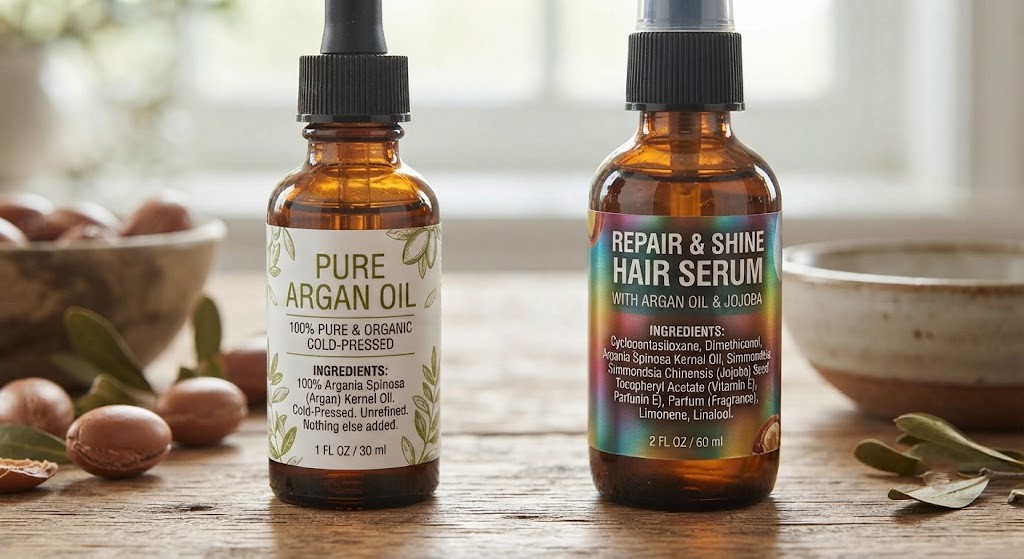
Look for products that clearly identify argan oil and avoid confusing a pure oil with a silicone-based serum or heavily fragranced styling blend. Cosmetic argan oil has a characteristic fatty-acid profile dominated by oleic and linoleic acids.
Source: PubMed, 2020.
When choosing an argan oil product, consider these practical checks:
- Look for Argania spinosa kernel oil when choosing pure argan oil.
- Check whether fragrance or additional oils are included.
- Prefer reputable manufacturers with transparent ingredient labeling.
- Avoid assuming that a higher price automatically means higher quality.
- Store the product according to the manufacturer’s instructions.
How Can You Build a Simple Argan Oil Hair Routine?
A simple argan oil hair routine starts with a small amount, targeted application, and gradual adjustment based on your hair’s response.
Follow this basic routine:
- Wash: Clean your scalp according to your normal hair-washing schedule.
- Condition: Apply conditioner primarily to the lengths and ends.
- Dry gently: Avoid aggressive towel rubbing and excessive heat.
- Apply: Rub one or two drops between your palms.
- Distribute: Smooth the oil through the mid-lengths and ends.
- Assess: Check whether your hair feels softer without becoming heavy.
- Adjust: Increase or decrease the amount or frequency as needed.
For example, fine straight hair might need only one drop after washing, while thick curly hair may need several drops distributed section by section.

What Are Common Argan Oil Hair Mistakes?
Common argan oil mistakes include using too much product, applying it directly to oily roots, expecting damaged hair to become permanently repaired, and using oil instead of heat protection.
For example, coating freshly styled hair with a large amount of oil can make it appear greasy rather than glossy. Similarly, applying oil does not remove the need for a dedicated heat-protective product when using hot styling tools.
The American Academy of Dermatology recommends limiting excessive heat and using low or medium settings because repeated heat exposure can damage hair.
Source: American Academy of Dermatology, 2024.

Conclusion
The Argan Oil for Hair Benefits are primarily cosmetic, but they can still make a noticeable difference in a well-designed hair-care routine. Argan oil can help improve softness, shine, smoother-feeling strands, manageability, and the appearance of frizz when used in appropriate amounts.
The key is to match the application to your hair type. Fine hair generally needs very little, while thick, coarse, curly, or very dry hair may tolerate more.
Most importantly, argan oil is a conditioning and styling ingredient rather than a cure for hair loss, split ends, or scalp disease. Start with a small amount, focus on the lengths and ends, and combine it with gentle washing, conditioning, careful detangling, and sensible heat protection for a more complete hair-care routine.
yes give it like this make question bold and give title
FAQs
What are the main benefits of argan oil for hair?
It can improve softness, shine, smoothness, manageability, and frizz.
Is argan oil good for dry hair?
Yes, it can soften and condition dry-feeling hair.
Does argan oil reduce frizz?
Yes, it can smooth the hair surface and reduce visible frizz.
Can argan oil repair damaged hair?
It can improve the feel of damaged hair but cannot permanently repair it.
Is argan oil good for split ends?
It can temporarily smooth their appearance but cannot repair split ends.
Does argan oil promote hair growth?
No, there is not enough clinical evidence that it promotes hair growth.
Can I use argan oil on my scalp?
Yes, but it is generally better suited to the hair lengths and ends.
How many drops of argan oil should I use?
Start with 1–2 drops and increase only if needed.
Should I apply argan oil to wet or dry hair?
It can be applied to either damp or dry hair.
How often should I use argan oil?
Use it a few times a week or as needed for your hair type.
Can argan oil make fine hair greasy?
Yes, using too much can make fine hair greasy or weighed down.
Is argan oil good for curly hair?
Yes, it can add softness, shine, and smoother-looking curls.