

Planning a trip often means opening multiple tabs for destinations, maps, hotels, restaurants, transportation, activities, packing lists, and travel requirements. Even after hours of research, travelers still have to connect all those pieces into one realistic itinerary.
An AI travel companion can bring much of that process together. Instead of switching between different tools and manually organizing information, you can use conversational AI to research destinations, build itineraries, personalize recommendations, adjust plans, and get assistance while traveling.
In this guide, you’ll learn what an AI travel companion is, how it works, what it can do, how to create better personalized itineraries, how different AI travel tools compare, and why important travel information should still be verified with trusted official sources.
What Is an AI Travel Companion and How Does It Work?
An AI travel companion is an AI-powered digital assistant that helps travelers research destinations, create personalized itineraries, organize trip details, and solve travel-related problems through conversational assistance.
Instead of requiring travelers to navigate a series of separate menus, an AI travel companion can understand natural-language instructions. For example, you could ask for a three-day Paris itinerary for a couple with a moderate budget, an interest in food and museums, and a preference for walking.
The AI can then use those preferences to structure recommendations around the type of trip you want. Modern AI travel planning can combine qualitative preferences, such as travel style and interests, with quantitative constraints, such as budget, timing, and transportation requirements.
Google Research describes travel planning as a problem involving both personal preferences and measurable constraints.
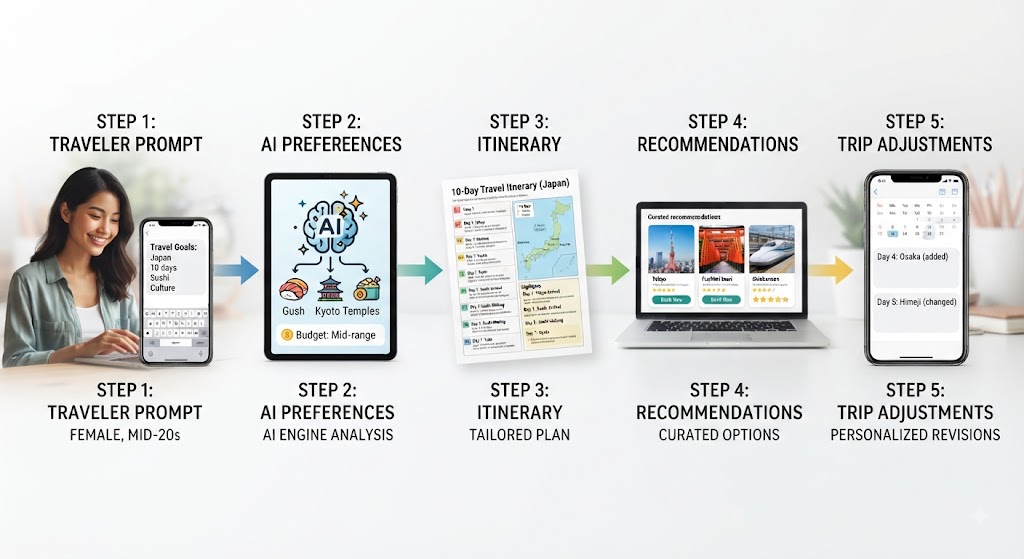
One of the biggest advantages is that the conversation can continue after the initial itinerary is generated. Instead of starting from scratch, you can say, “Make day two less crowded and replace the expensive restaurant with a local option.”
The AI can then revise the plan according to the new instruction. This makes an AI travel companion particularly useful for iterative trip planning.
Why Should Travelers Use an AI Travel Companion?
An AI travel companion matters because it can combine research, personalization, organization, and trip assistance into a single conversational workflow.
Traditional travel planning often requires travelers to gather information from search engines, maps, booking websites, review platforms, tourism pages, and individual business websites. AI can help connect those planning tasks into a more streamlined workflow.
Booking.com’s 2025 Global AI Sentiment Report found that 67% of consumers had already used AI in some aspect of travel, while 89% wanted to use AI in future travel planning. — Source: Booking.com, 2025.
These figures indicate that travelers are increasingly comfortable using AI as part of the travel-planning process.
Moreover, travelers are using AI for practical decisions rather than simple inspiration. Booking.com reported destination research, local experiences, and restaurant recommendations among the leading planning use cases. — Source: Booking.com, 2025.
Personalization Makes AI Travel Planning More Useful
A generic travel recommendation may not work equally well for every traveler. A solo backpacker, a family with children, a couple looking for romantic experiences, and a business traveler can have completely different priorities in the same destination.
An AI travel companion can make recommendations more relevant when you provide specific constraints.
For example:
- A solo traveler can prioritize inexpensive activities near public transportation.
- A family can prioritize shorter walking distances and child-friendly attractions.
- A food-focused traveler can prioritize restaurants and local culinary experiences.
- A museum enthusiast can build a schedule around cultural attractions.
- A budget traveler can request free or lower-cost alternatives.
The more clearly you describe your preferences, the easier it is for the AI to tailor its suggestions.
What Can an AI Travel Companion Do for a Trip?
An AI travel companion can help with itinerary planning, destination research, activity recommendations, restaurant discovery, transportation planning, translation, packing lists, and travel organization.
Rather than treating AI as a tool for only one travel task, think of it as a conversational layer that can support different stages of a trip.
Destination Research
An AI travel companion can help you explore destinations, compare neighborhoods, identify potential attractions, and understand what types of experiences may fit your interests.
For example, instead of searching separately for museums, restaurants, parks, and neighborhoods, you can ask for recommendations based on a specific travel style.
Daily Itinerary Creation
AI can organize activities into a day-by-day schedule based on your available time and preferences.
For example, an AI trip planner can reorganize a sightseeing day around attractions that are geographically close, reducing unnecessary travel between locations.
Restaurant and Activity Recommendations
Travelers can provide dietary preferences, budget limits, cuisine preferences, or activity interests and ask for recommendations that match those requirements.
This can make a long list of possibilities easier to narrow down.
Transportation Planning
AI can help organize transportation preferences into an itinerary. For example, you can ask it to prioritize walking and public transit rather than taxis or private transportation.
However, transportation schedules and service disruptions should always be checked against current official sources.
Packing and Travel Organization
AI can also create packing suggestions based on the destination, trip duration, activities, and expected circumstances.
Translation and Language Assistance
An AI travel companion can also support basic language and translation needs during a trip.
Booking.com’s 2025 research found that travelers commonly use AI during trips for translation, activities, restaurants, and navigation. — Source: Booking.com, 2025.
Backup Plans
Travel rarely goes exactly according to schedule. Weather, closures, delays, or changes in personal preferences can force travelers to adjust their plans.
An AI travel companion can help rebuild an itinerary around those changes instead of requiring you to manually reorganize the entire trip.
How Can AI Create a Personalized Travel Itinerary?
AI travel planning involves providing an AI assistant with travel preferences such as destination, dates, budget, interests, and pace so it can generate and refine a personalized trip plan.
The quality of the itinerary depends heavily on the information you provide. A short prompt such as “Plan a trip to Rome” gives the AI very little context, while a detailed prompt gives it meaningful constraints to work with.
Step 1: Provide Your Core Trip Details
Start with the basics:
- Destination
- Travel dates
- Number of travelers
- Budget
- Accommodation area
- Interests
- Preferred transportation
- Desired travel pace
- Food or dietary preferences
For example, you could use this prompt:
“Create a four-day Rome itinerary for two people with a $150 daily activity and food budget, prioritizing history, local food, and moderate walking.”
This gives the AI enough context to create a more focused starting point.
Step 2: Refine the First Itinerary
Do not assume the first itinerary is the final version.
Instead, ask the AI to modify it based on practical concerns. You could request:
- Less travel between attractions
- Fewer activities per day
- More free attractions
- Cheaper restaurants
- More local experiences
- More indoor activities
- More time for rest
- Alternative activities
AI Travel Companion Prompt Examples
| Travel preference | Example AI instruction |
|---|---|
| Budget | Keep daily activities under $100 |
| Pace | Limit the day to four major activities |
| Interests | Prioritize food, museums, and architecture |
| Transportation | Prefer walking and public transit |
| Dietary needs | Recommend vegetarian restaurants |
| Weather | Add indoor alternatives for rain |
These instructions help turn a broad travel request into a more structured planning problem.
What Are the Different Types of AI Travel Companions?
AI travel companions generally include general-purpose AI assistants, dedicated travel planners, itinerary-management platforms, booking-focused tools, and destination-specific assistants.
Although these tools may all be described as AI travel companions, they can serve different purposes.
General-Purpose AI Assistants
General-purpose AI assistants are useful for flexible research, brainstorming, comparisons, and conversational itinerary planning.
They can be particularly useful when you want to ask follow-up questions and gradually develop a trip rather than use a fixed planning workflow.
Dedicated AI Travel Planners
Dedicated travel-planning tools focus more specifically on destinations, itineraries, travel preferences, and trip workflows.
These tools may be designed around building and organizing complete travel plans.
Itinerary-Management Platforms
Itinerary-management tools focus on organizing reservations, schedules, and trip information in one place.
This can be useful when a trip contains multiple bookings and activities that need to remain organized.
Booking-Focused AI Tools
Booking platforms are increasingly integrating AI into search, recommendations, and travel assistance.
For example, Google’s AI-powered Maps experience is expanding conversational travel assistance, including personalized recommendations and itinerary-related capabilities.
The right option depends on whether your priority is research, itinerary generation, navigation, reservations, or organization.
How Do You Use an AI Travel Companion to Plan a Trip?
The best way to use an AI travel companion is to build a trip in stages rather than asking for one generic itinerary.
A staged workflow gives you more opportunities to identify unrealistic assumptions and improve the itinerary.
A Practical AI Travel Planning Workflow
- Define the trip: Enter destination, dates, group size, and travel purpose.
- Add preferences: Include interests, budget, pace, food preferences, and transportation choices.
- Generate a draft: Ask for a realistic day-by-day itinerary.
- Refine the plan: Request shorter routes, alternative activities, or budget adjustments.
- Verify details: Check official websites for flights, visas, opening hours, prices, and reservations.
- Prepare alternatives: Create backup plans for weather, delays, closures, or schedule changes.
Use Follow-Up Prompts Instead of Starting Over
One of the most useful features of conversational AI is the ability to refine an existing plan.
For example, if rain is forecast, you could ask:
“Replace outdoor activities on Saturday with indoor attractions within 30 minutes of my hotel.”
You can then continue refining the result by asking for cheaper options, fewer activities, shorter transportation times, or more local experiences.
This approach makes the AI travel companion function more like an interactive planning assistant than a one-time itinerary generator.
What Are the Best AI Travel Companion Tools to Try?
The best AI travel companion depends on whether you need conversational research, itinerary creation, navigation, booking assistance, or trip organization.
General AI assistants such as ChatGPT, Claude, and Perplexity can help with destination research, brainstorming, comparisons, and itinerary refinement.
Dedicated travel platforms can provide more specialized booking, mapping, reservation, or itinerary-management features.
The choice therefore depends on what you expect the tool to do. A traveler researching a destination may prioritize conversational research, while someone managing a complex multi-stop trip may value itinerary organization and booking integration.
Expedia Group’s 2026 research found that 40% of surveyed travelers use or would use AI to help build itineraries, while 48% said AI saves time and helps them discover places they otherwise might not find. — Source: Expedia Group, 2026.

Can an AI Travel Companion Help During a Trip?
An AI travel companion can provide useful in-trip assistance when travelers need quick recommendations, translations, route ideas, or alternative activities.
AI travel planning does not have to stop once you leave home. The same conversational workflow can be useful when plans change or you need help making a quick decision.
In-Trip Recommendations
Travelers can ask for nearby restaurants, attractions, transportation options, or activities based on their current plans.
Booking.com’s research found translation was the most common in-trip AI use case at 45%, followed by activity suggestions at 44%. — Source: Booking.com, 2025.
Handling Unexpected Changes
Imagine arriving at a museum only to discover that it is unexpectedly closed. Instead of manually rebuilding your afternoon, you can ask an AI travel companion to suggest alternative activities and reorganize the rest of your schedule.
You could also ask it to prioritize attractions near your current location or create an alternative route based on your remaining time.
How Accurate Are AI Travel Recommendations?
AI-generated travel information should be verified against official sources because AI systems can produce outdated, incomplete, or inaccurate information about schedules, prices, reservations, entry requirements, and local conditions.
This is one of the most important principles when using an AI travel companion.
AI can be excellent at organizing information and generating options, but that does not mean every recommendation is guaranteed to reflect current real-world conditions.
Always Verify Important Travel Details
Before making an important decision, check information directly with relevant official sources.
Pay particular attention to:
- Flight schedules
- Visa requirements
- Border and entry rules
- Hotel reservations
- Transportation schedules
- Attraction opening hours
- Ticket availability
- Prices
- Cancellation policies
- Local travel requirements
Booking.com’s 2025 research found that only 6% of respondents fully trusted AI, while 42% said they always fact-check AI outputs. — Source: Booking.com, 2025.
Expedia Group reported that 68% of surveyed travelers preferred booking with a trusted travel brand rather than an AI chatbot or agent, showing that AI assistance and trusted transaction sources still play different roles. — Source: Expedia Group, 2026.
AI can therefore be most effective as a planning and decision-support layer, while official sources remain important for confirming critical information.
What Are the Risks and Limitations of AI Travel Companions?
The main limitations of AI travel companions include inaccurate information, outdated data, privacy concerns, incomplete context, and excessive reliance on automated recommendations.
Understanding these limitations helps travelers use AI more effectively.
Outdated or Inaccurate Information
Travel information can change quickly. A restaurant may close, a museum may change its hours, a transportation route may be disrupted, or an entry requirement may change.
For this reason, AI-generated information should be treated as a starting point that requires verification when accuracy matters.
Privacy Considerations
Travel planning can involve personal information, but you should avoid providing unnecessary sensitive data to AI systems.
For example, an itinerary may require your travel dates and preferences, but it generally does not require passwords, payment credentials, or confidential identification numbers.
Incomplete Context
An AI system may not automatically know every detail that affects your trip.
A recommendation that looks reasonable in isolation may not work because of your exact hotel location, mobility requirements, transportation limitations, budget, or schedule.
Providing more relevant context can help produce a more useful result.
Overreliance on AI
AI should support human judgment rather than replace it.
Booking.com’s research found only 12% of consumers were comfortable allowing AI to make decisions independently. — Source: Booking.com, 2025.
That distinction is important. The strongest approach is to use AI to generate possibilities, compare options, organize information, and adapt plans while retaining personal control over important decisions.
What’s Next: How Can You Get More Value From an AI Travel Companion?
You get better results from an AI travel companion when you provide specific constraints, preferences, priorities, and real-world limitations.
A detailed prompt gives the AI a clearer understanding of what a successful trip looks like.
Tell the AI What Matters to You
Include relevant details such as:
- Budget: How much you want to spend
- Interests: Food, museums, photography, nature, nightlife, history, or other experiences
- Travel pace: Relaxed, moderate, or packed
- Mobility needs: Walking preferences or limitations
- Dietary requirements: Foods or cuisines you prefer or need to avoid
- Transportation: Walking, public transit, rental car, or other preferences
- Experience priorities: Popular attractions, local experiences, quiet areas, or specific activities
Specific instructions usually produce more useful recommendations than simply asking, “Plan my vacation.”
For example, instead of asking for “things to do in Tokyo,” ask:
“Give me five affordable Tokyo experiences near Shinjuku for a solo traveler who enjoys food, photography, and quiet neighborhoods.”
This prompt gives the AI several useful constraints and makes it easier to produce focused suggestions.
Ask for Multiple Versions
Another effective strategy is to ask the AI to challenge or modify its own itinerary.
Request:
- A cheaper version
- A slower version
- A rainy-day version
- A version with less walking
- A version that minimizes transportation
- A version with more free attractions
Comparing these alternatives can help you identify which itinerary best matches your actual priorities.
Conclusion
An AI travel companion can reduce the friction of travel planning by bringing destination research, itinerary creation, personalization, organization, and in-trip assistance into a single conversational workflow.
Instead of manually connecting information from dozens of sources, travelers can use AI to create a starting itinerary, adjust it around their preferences, explore alternatives, and respond to unexpected changes.
However, AI should not be treated as an unquestionable source of truth. The most effective approach is to provide detailed preferences, refine recommendations through follow-up prompts, and independently verify critical information such as flights, visas, reservations, opening hours, prices, and transportation schedules.
Ultimately, an AI travel companion works best as a smart travel-planning assistant. With thoughtful prompts and careful verification, it can help you spend less time organizing your trip and more time actually experiencing it.
FAQs
What is an AI travel companion?
An AI travel companion is a digital assistant that helps plan, organize, and personalize trips.
How does an AI travel companion work?
An AI travel companion uses your travel preferences to provide personalized recommendations and itineraries.
What can an AI travel companion do?
An AI travel companion can help with itineraries, destinations, restaurants, activities, transportation, and translation.
Can an AI travel companion create itineraries?
Yes, an AI travel companion can create personalized itineraries based on your budget, interests, and schedule.
Can an AI travel companion help during a trip?
Yes, it can provide recommendations, translation, navigation ideas, and alternative activities.
Are AI travel recommendations reliable?
AI travel recommendations can be useful, but important information should be verified with official sources.
What are the benefits of an AI travel companion?
An AI travel companion can save planning time and provide personalized travel recommendations.
Can an AI travel companion replace a travel agent?
An AI travel companion can assist with many planning tasks but does not completely replace human judgment.
How can I get better AI travel recommendations?
Provide details about your budget, interests, travel dates, pace, and transportation preferences.
What are the limitations of an AI travel companion?
AI may provide outdated or inaccurate information, so important travel details should always be checked.