
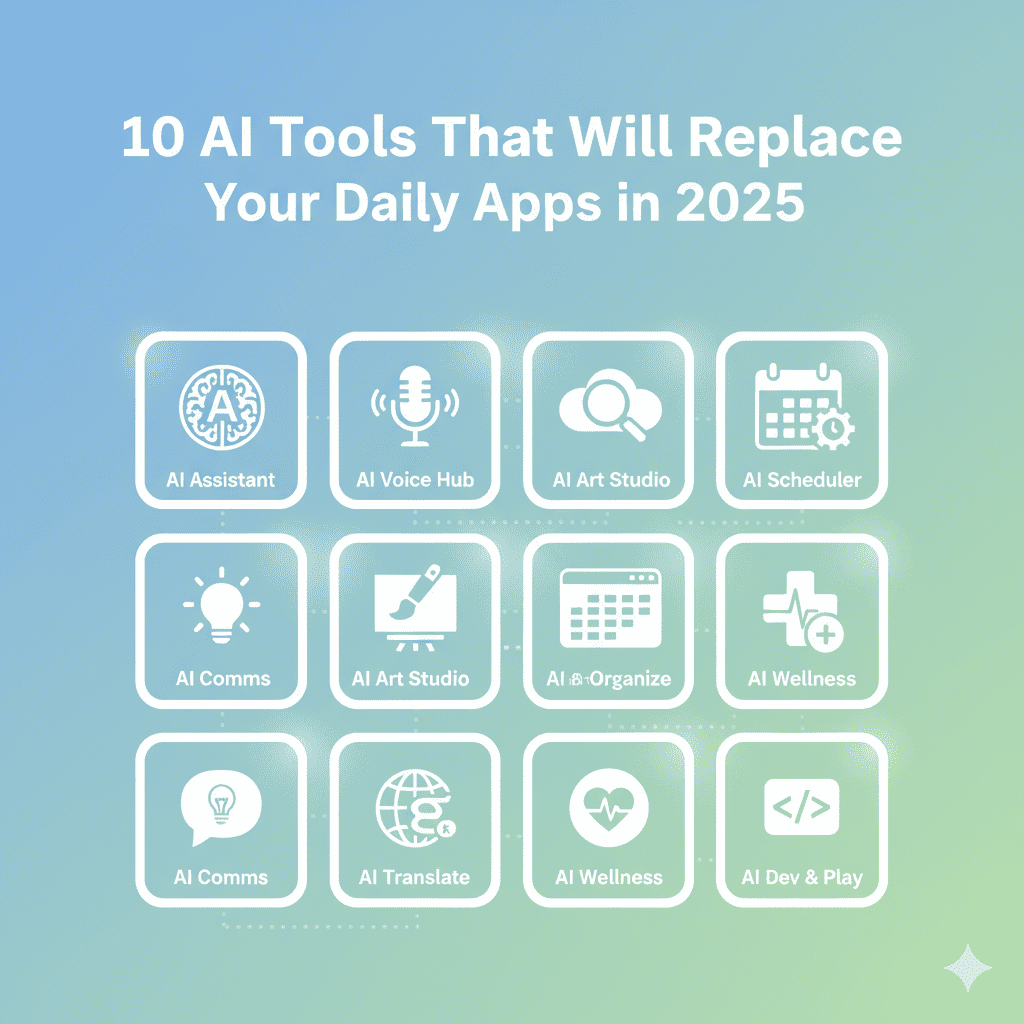
The digital landscape is undergoing a seismic shift. The apps you’ve relied on for years—your productivity suite, communication platforms, design tools, and organizational systems—are facing competition from a new generation of artificial intelligence-powered alternatives that promise to do more with less.
AI tools that will replace your daily apps aren’t just theoretical concepts anymore. They’re here, they’re sophisticated, and they’re fundamentally changing how we work, create, communicate, and manage our digital lives. These tools don’t just match the functionality of traditional applications—they exceed them by learning from your behavior, anticipating your needs, and automating tasks that once required your constant attention.
In this comprehensive guide, we’ll explore the 10 AI tools that will replace your daily apps in 2025. These aren’t minor improvements or incremental updates—these are revolutionary platforms that consolidate multiple applications into single, intelligent solutions. Whether you’re a professional looking to streamline your workflow, a creative seeking more powerful tools, or someone who simply wants technology to work smarter, understanding these AI-powered alternatives is essential for staying competitive and productive in today’s fast-paced digital environment.
The shift toward AI tools that will replace your daily apps represents more than technological advancement—it’s a fundamental reimagining of how software should serve users. Rather than forcing you to adapt to rigid application structures, these AI tools adapt to you, learning your preferences, understanding your context, and delivering exactly what you need, when you needIt.
1. AI-Powered Unified Workspace Replacing Project Management Apps
Traditional project management requires juggling multiple applications—Asana for task tracking, Slack for communication, Google Drive for documents, Zoom for meetings, and countless others. AI tools that will replace your daily apps are consolidating these fractured workflows into unified intelligent workspaces.
These AI-powered platforms offer:
Intelligent Task Management that goes beyond simple to-do lists:
- Automatic task creation from meeting transcripts and emails
- Priority ranking based on deadlines, dependencies, and importance
- Smart scheduling that considers your energy levels and calendar
- Predictive timelines estimating project completion dates
- Automatic workload balancing across team members
- Context-aware task suggestions based on project goals
Integrated Communication eliminating app-switching:
- AI-moderated discussions highlighting key decisions
- Automatic meeting summaries and action item extraction
- Smart notifications filtering noise and prioritizing urgency
- Real-time translation for global teams
- Sentiment analysis identifying team morale issues
- Threaded conversations that self-organize by topic
Document Intelligence transforming static files:
- Automatic document generation from meeting notes
- Version control with AI-explained changes
- Smart search finding information across all documents
- Content suggestions based on project context
- Collaborative editing with AI-assisted writing
- Template creation from existing successful projects
Predictive Analytics providing insights traditional tools miss:
- Project risk identification before problems emerge
- Resource allocation optimization
- Budget forecasting with accuracy improvements
- Timeline prediction based on historical data
- Bottleneck detection and resolution suggestions
- Team performance trends and coaching opportunities
Companies implementing these unified AI workspaces report dramatic efficiency gains—reducing time spent on administrative tasks by up to 60% while improving project visibility and team alignment. The consolidation of multiple tools into one intelligent platform eliminates context switching, reduces subscription costs, and creates a single source of truth for all project information.
The most sophisticated platforms learn organizational patterns, adapting workflows to match how your team actually works rather than forcing compliance with rigid methodologies. This flexibility combined with powerful automation makes these platforms clear examples of how AI tools that will replace your daily apps deliver transformative value.
2. AI Writing Assistants Replacing Word Processors and Content Tools
Microsoft Word, Google Docs, Grammarly, Hemingway Editor—most content creators use multiple writing tools for drafting, editing, and publishing. Advanced AI writing assistants are collapsing these separate functions into single, intelligent platforms.
Modern AI writing tools provide:
Intelligent Drafting that accelerates content creation:
- Context-aware suggestions completing thoughts naturally
- Structural recommendations organizing ideas logically
- Research integration citing relevant sources automatically
- Tone adjustment matching target audience and purpose
- Multiple variation generation for A/B testing
- Writer’s block breakthrough with relevant prompts
Advanced Editing beyond grammar checking:
- Clarity improvements simplifying complex sentences
- Consistency enforcement across long documents
- Voice and style analysis maintaining authentic tone
- Fact-checking with source verification
- Plagiarism detection protecting originality
- Accessibility improvements for diverse audiences
Format Intelligence adapting content for different purposes:
- Automatic transformation between formats (blog to social posts)
- Platform-specific optimization (LinkedIn vs Twitter)
- SEO enhancement with keyword integration
- Readability scoring for target demographics
- Visual element suggestions for better engagement
- Multi-language translation maintaining tone and meaning
Collaborative Features improving team writing:
- Real-time co-editing with conflict resolution
- Feedback integration from multiple reviewers
- Version comparison with explained changes
- Comment management with AI-synthesized feedback
- Style guide enforcement ensuring brand consistency
- Writing quality benchmarking across team members
The productivity gains are substantial. Writers report completing first drafts 3-5 times faster while maintaining or improving quality. The AI handles mechanical aspects of writing—grammar, structure, optimization—allowing creators to focus on ideas, insights, and storytelling that require human creativity and expertise.
These platforms demonstrate how AI tools that will replace your daily apps enhance rather than eliminate human capability. They’re not replacing writers; they’re amplifying what skilled writers can accomplish, making professional-quality content creation accessible to broader audiences while enabling experts to achieve unprecedented productivity levels.
3. AI Design Suites Replacing Photoshop, Illustrator, and Canva
Graphic design traditionally required expensive software and significant training. Adobe Creative Suite dominated professional design, while Canva democratized basic design for non-professionals. AI tools that will replace your daily apps are now bridging and surpassing both categories.
Comprehensive AI design platforms offer:
Text-to-Image Generation creating custom visuals:
- Original images from text descriptions
- Brand-consistent illustration generation
- Photo-realistic rendering for product mockups
- Style-specific artwork matching design directions
- Infinite variations exploring creative options
- Commercial licensing without stock photo limitations
Intelligent Photo Editing requiring minimal expertise:
- One-click background removal and replacement
- Object addition and removal maintaining realism
- Color grading and correction with mood presets
- Resolution upscaling improving low-quality images
- Lighting adjustment and shadow correction
- Facial retouching and portrait enhancement
Vector Graphics and Logo Creation for brand identity:
- Logo generation from brand descriptions
- Icon set creation maintaining consistent style
- Vector illustration from sketches or descriptions
- Brand guideline development with color palettes
- Typography pairing recommendations
- Scalable graphics for all applications
Layout and Composition Intelligence for marketing materials:
- Automatic layout generation optimized for engagement
- Template creation from reference designs
- Multi-format adaptation (Instagram, Facebook, print)
- Accessibility compliance checking
- Visual hierarchy optimization
- White space and balance recommendations
Motion Graphics and Animation bringing designs to life:
- Animated social media content from static designs
- Video editing with AI-assisted cutting and transitions
- Text animation and kinetic typography
- Logo animation for brand presentations
- Explainer video creation from scripts
- Social media story templates with effects
Professional designers initially skeptical of AI tools are discovering they accelerate mundane tasks—background removal, resizing, color matching—freeing time for creative strategy and conceptual work where human judgment remains irreplaceable.
For non-designers, these tools democratize professional-quality design previously requiring years of training or expensive freelancers. Small businesses can create sophisticated marketing materials, individuals can develop personal brands with polished visuals, and content creators can produce eye-catching graphics without design backgrounds.
The consolidation of multiple expensive applications into affordable AI platforms represents significant cost savings while delivering superior capabilities. This exemplifies how AI tools that will replace your daily apps provide better results at lower costs with reduced complexity.
4. AI Personal Assistants Replacing Calendar, Email, and Task Apps
Managing email, calendars, tasks, and communications typically requires multiple applications and significant mental overhead. Intelligent AI personal assistants are consolidating these functions into single, proactive platforms that anticipate needs rather than simply responding to commands.
Next-generation AI assistants provide:
Intelligent Email Management reducing inbox overwhelm:
- Priority sorting separating important from noise
- Automatic categorization by topic and urgency
- Draft response generation in your communication style
- Follow-up reminders for unanswered messages
- Email summarization extracting key information
- Unsubscribe recommendations for unwanted senders
- Meeting scheduling without back-and-forth exchanges
Proactive Calendar Intelligence optimizing time usage:
- Automatic scheduling based on priorities and preferences
- Meeting preparation with briefing documents
- Optimal timing recommendations for different task types
- Buffer time insertion preventing back-to-back overload
- Travel time calculation and route optimization
- Conflict resolution with rescheduling suggestions
- Focus time protection blocking deep work periods
Task and Project Orchestration eliminating manual tracking:
- Automatic task creation from emails and messages
- Deadline prediction based on task complexity
- Workload balancing preventing overwhelm
- Context switching minimization grouping similar tasks
- Progress tracking with completion probability estimates
- Dependency management ensuring proper sequencing
- Delegation suggestions for overcommitted schedules
Communication Synthesis connecting fragmented channels:
- Unified inbox aggregating email, messages, and notifications
- Cross-platform search finding information anywhere
- Contact intelligence providing context before conversations
- Communication style adaptation for different recipients
- Meeting transcript analysis extracting commitments
- Action item tracking across all communication channels
Lifestyle Integration managing personal and professional life:
- Appointment booking with service providers
- Reservation management for restaurants and travel
- Bill payment reminders and financial tracking
- Health appointment scheduling and medication reminders
- Family calendar coordination
- Smart home integration for seamless transitions
Users report reclaiming 5-10 hours weekly previously spent on administrative tasks. The AI handles scheduling coordination, email triage, task organization, and routine communications, allowing focus on high-value activities requiring human judgment and creativity.
These comprehensive platforms demonstrate how AI tools that will replace your daily apps eliminate the complexity of managing multiple specialized applications while providing superior functionality through intelligent integration and automation.
5. AI Code Assistants Replacing IDEs and Development Tools
Software development has traditionally required multiple tools—code editors, debuggers, version control interfaces, documentation platforms, and testing frameworks. AI tools that will replace your daily apps are transforming development through intelligent coding environments that understand context, anticipate needs, and automate routine programming tasks.
Advanced AI coding platforms deliver:
Intelligent Code Completion beyond simple autocomplete:
- Function generation from natural language descriptions
- Context-aware suggestions understanding project architecture
- Bug prediction identifying potential issues during writing
- Best practice enforcement following coding standards
- Library and API recommendations for specific tasks
- Code pattern recognition suggesting optimized approaches
Automated Testing and Debugging improving code quality:
- Test generation covering edge cases automatically
- Bug identification with root cause analysis
- Performance optimization recommendations
- Security vulnerability detection and remediation
- Code smell identification suggesting refactoring
- Regression testing automation across codebases
Documentation Intelligence keeping information current:
- Automatic documentation generation from code
- Comment suggestions explaining complex logic
- API documentation creation and updates
- README file generation for repositories
- Technical specification drafting from requirements
- Code example creation for documentation
Collaboration Enhancement for development teams:
- Code review automation highlighting issues
- Merge conflict resolution with intelligent suggestions
- Pair programming assistance with real-time collaboration
- Knowledge sharing extracting patterns from codebases
- Onboarding acceleration for new team members
- Technical debt tracking and prioritization
Multi-Language Support for polyglot developers:
- Cross-language code translation
- Framework migration assistance
- Legacy code modernization
- Syntax conversion between languages
- Library equivalent identification across ecosystems
- Language learning with contextual explanations
Professional developers report productivity increases of 30-50% using AI coding assistants. Junior developers accelerate learning curves by receiving expert-level guidance in real-time. Companies reduce code review cycles, minimize bugs reaching production, and maintain better documentation without additional overhead.
The transformation extends beyond efficiency to accessibility. People with limited programming experience can now build functional applications by describing desired functionality in natural language, with AI generating properly structured, optimized code.
This democratization while simultaneously empowering experts exemplifies how AI tools that will replace your daily apps serve users across skill levels more effectively than traditional tools designed for single expertise categories.
6. AI Finance Tools Replacing Banking and Budgeting Apps
Personal finance management typically involves multiple applications—banking apps, budgeting tools, investment platforms, expense trackers, and bill payment systems. Intelligent AI finance platforms are unifying these functions while providing insights and automation traditional tools cannot match.
Comprehensive AI finance tools offer:
Automated Budget Management adapting to your life:
- Spending pattern analysis with category classification
- Dynamic budget creation based on income and goals
- Anomaly detection identifying unusual transactions
- Subscription tracking with cancellation recommendations
- Savings goal automation transferring money intelligently
- Bill negotiation identifying overpayment opportunities
Intelligent Investment Guidance democratizing wealth management:
- Portfolio optimization based on risk tolerance and goals
- Market analysis with personalized investment opportunities
- Tax-loss harvesting automation maximizing returns
- Rebalancing recommendations maintaining target allocations
- Dividend reinvestment optimization
- Retirement planning with scenario modeling
Predictive Cash Flow Management preventing financial stress:
- Income and expense forecasting based on patterns
- Upcoming bill reminders with balance warnings
- Overdraft prevention with proactive alerts
- Irregular expense anticipation (annual subscriptions, etc.)
- Emergency fund recommendations sized appropriately
- Seasonal spending pattern adaptation
Credit Optimization improving financial health:
- Credit score monitoring with improvement recommendations
- Debt payoff strategy optimization
- Credit utilization tracking and alerts
- Refinancing opportunity identification
- Credit card reward maximization
- Interest rate negotiation suggestions
Financial Education personalized to your situation:
- Spending insights explaining financial patterns
- Goal progress tracking with milestone celebrations
- Peer comparison (anonymized) showing relative performance
- Financial literacy content matching knowledge level
- Decision support for major purchases
- Long-term financial planning assistance
Users report saving significant amounts monthly through subscription optimization, better spending awareness, and automated savings transfers they’d never implemented manually. Investment returns improve through consistent rebalancing and tax optimization previously requiring expensive financial advisors.
The consolidation of multiple financial apps into single intelligent platforms simplifies financial life while providing superior insights and automation. Security concerns, initially significant barriers, are addressed through bank-level encryption, biometric authentication, and read-only account access options.
Financial institutions themselves are integrating AI capabilities, making these features increasingly standard rather than requiring separate applications. This evolution shows how AI tools that will replace your daily apps become embedded in primary services, eliminating the need for numerous specialized tools.
7. AI Learning Platforms Replacing Educational Apps and Courses
Education and skill development traditionally involve multiple resources—online courses, flashcard apps, note-taking tools, video platforms, and learning management systems. AI tools that will replace your daily apps are creating personalized learning environments that adapt to individual needs, learning styles, and goals.
Intelligent learning platforms provide:
Adaptive Learning Paths customized for each student:
- Skill assessment identifying knowledge gaps
- Personalized curriculum generation targeting specific goals
- Difficulty adjustment maintaining optimal challenge levels
- Learning style adaptation (visual, auditory, kinesthetic)
- Pace customization accommodating different speeds
- Prerequisite identification ensuring proper foundations
Interactive Content Generation engaging learners actively:
- Custom practice problems at appropriate difficulty
- Real-world application examples relevant to learner interests
- Interactive simulations for hands-on learning
- Gamification elements maintaining motivation
- Quizzes and assessments testing understanding
- Project suggestions applying learned concepts
Intelligent Tutoring providing personalized support:
- Question answering with detailed explanations
- Concept clarification using multiple approaches
- Mistake analysis identifying misunderstandings
- Learning strategy recommendations improving retention
- Study schedule optimization based on retention patterns
- Peer learning facilitation connecting similar learners
Progress Intelligence tracking and optimizing learning:
- Mastery assessment of individual concepts
- Retention prediction identifying review needs
- Learning velocity tracking showing improvement rates
- Strength and weakness analysis guiding focus
- Goal progress monitoring with milestone tracking
- Career pathway alignment showing relevant skills
Multi-Modal Learning accommodating preferences:
- Video content generation from text materials
- Audio lessons for learning during commutes
- Visual infographics simplifying complex concepts
- Text transcripts of video content
- Interactive coding environments for technical skills
- Virtual reality experiences for immersive learning
Students using AI learning platforms show improved retention rates, faster skill acquisition, and higher completion rates compared to traditional online courses. The personalization ensures learners aren’t bored by content they’ve mastered or overwhelmed by concepts requiring more foundation.
Professional development benefits significantly from AI learning tools. Career changers acquire new skills efficiently, existing professionals stay current with evolving technologies, and lifelong learners explore interests without committing to rigid course structures.
This transformation shows how AI tools that will replace your daily apps deliver personalized experiences impossible with one-size-fits-all traditional applications, fundamentally improving outcomes while simplifying the learning experience.
8. AI Health and Fitness Coaches Replacing Wellness Apps
Health and fitness management typically requires multiple apps—workout trackers, nutrition logging, meditation guides, sleep monitors, and health dashboards. Comprehensive AI health coaches are integrating these functions while providing personalized guidance rivaling human trainers and nutritionists.
Integrated AI health platforms offer:
Personalized Fitness Programming adapting to you:
- Custom workout generation based on goals and equipment
- Exercise form analysis preventing injuries
- Progressive overload optimization for consistent gains
- Recovery tracking preventing overtraining
- Workout variety maintaining engagement
- Modification suggestions for limitations or injuries
- Performance prediction showing expected progress
Intelligent Nutrition Guidance simplifying healthy eating:
- Meal planning matching dietary preferences and restrictions
- Recipe generation using available ingredients
- Nutrition tracking from food photos
- Macro and calorie optimization for goals
- Restaurant recommendation with healthy options
- Shopping list creation from meal plans
- Nutritional education personalized to needs
Holistic Wellness Monitoring connecting health factors:
- Sleep quality analysis with improvement recommendations
- Stress level tracking with management techniques
- Energy pattern identification optimizing activity timing
- Hydration reminders based on activity and conditions
- Supplement recommendations addressing deficiencies
- Mental health tracking with early intervention suggestions
- Lifestyle factor correlation revealing impacts
Preventive Health Intelligence identifying issues early:
- Vital sign monitoring detecting concerning trends
- Symptom tracking with medical consultation prompts
- Medication reminders with interaction warnings
- Health screening schedule management
- Risk factor assessment with mitigation strategies
- Genetic data integration for personalized recommendations
- Healthcare provider communication facilitation
Motivation and Accountability maintaining consistency:
- Goal setting with achievable milestone creation
- Progress visualization celebrating achievements
- Social features connecting similar health journeys
- Habit formation assistance building sustainable routines
- Setback recovery strategies maintaining momentum
- Personalized motivation matching individual drivers
- Reward systems reinforcing positive behaviors
Users report achieving fitness goals faster with better sustainability compared to generic programs. The AI adapts to life circumstances—busy weeks, illnesses, injuries—maintaining progress without rigid adherence to predetermined plans.
Cost comparisons favor AI health coaches significantly. Personal trainer and nutritionist fees can reach hundreds monthly, while comprehensive AI platforms cost a fraction while providing 24/7 availability and consistent monitoring impossible with human coaches.
The integration of multiple health apps into unified platforms eliminates data fragmentation, providing holistic views connecting sleep, nutrition, exercise, and wellness factors. This demonstrates how AI tools that will replace your daily apps deliver superior outcomes through intelligent integration rather than specialized isolation.
9. AI Creative Studios Replacing Music and Video Editing Software
Creative content production traditionally requires expensive, complex software with steep learning curves—Adobe Premiere, Final Cut Pro, Logic Pro, Pro Tools. AI tools that will replace your daily apps are democratizing professional-quality creative production while accelerating workflows for experienced creators.
Comprehensive AI creative platforms provide:
Intelligent Video Editing simplifying production:
- Automatic scene detection and cutting
- Smart transitions matching content mood
- Color grading with style presets
- Audio synchronization and enhancement
- Text and graphic overlay generation
- Multi-camera angle switching optimization
- Subtitle generation with translation
- Aspect ratio adaptation for different platforms
Music Composition and Production for any project:
- Original music generation matching mood specifications
- Beat creation in various genres
- Melody and harmony composition
- Instrument arrangement and orchestration
- Audio mixing and mastering
- Vocal synthesis for demos and projects
- Copyright-free music eliminating licensing issues
- Style matching to reference tracks
Voice and Audio Processing enhancing sound quality:
- Podcast editing with filler word removal
- Noise reduction and audio cleanup
- Voice cloning for consistent narration
- Multi-language dubbing maintaining speaker voice
- Audio enhancement improving clarity
- Sound effect generation and library
- Spatial audio creation for immersive experiences
- Transcription with speaker identification
Visual Effects and Animation adding professional polish:
- Motion graphics creation from templates
- 3D animation generation from descriptions
- Special effects application without complex software
- Character animation from reference performances
- Product visualization and rendering
- Animated logo and intro creation
- Visual storytelling enhancement
Content Optimization for maximum impact:
- Thumbnail generation optimized for clicks
- Video length optimization for platform algorithms
- Engagement prediction with improvement suggestions
- A/B testing for different versions
- SEO optimization with title and description suggestions
- Publishing automation across platforms
- Analytics integration with performance insights
Professional creators report workflow acceleration of 50-70%, with post-production time dramatically reduced. Solo creators produce content quality previously requiring teams, while established production companies scale output without proportional cost increases.
Accessibility extends creative opportunities to people without technical training or expensive equipment. Musicians compose quality soundtracks without instrument proficiency, filmmakers edit professional videos without years of software mastery, and podcasters produce polished shows without audio engineering expertise.
This creative democratization while simultaneously empowering professionals exemplifies how AI tools that will replace your daily apps serve diverse user needs more effectively than traditional tools requiring significant expertise and investment.
10. AI Research and Knowledge Management Replacing Note-Taking and Reference Apps
Research, note-taking, and knowledge management typically require multiple tools—Evernote, Notion, reference managers, read-it-later apps, and document libraries. AI tools that will replace your daily apps are creating intelligent knowledge systems that don’t just store information but understand, connect, and surface insights from your accumulated knowledge.
Advanced AI knowledge platforms offer:
Intelligent Information Capture streamlining research:
- Web clipping with automatic formatting and cleanup
- PDF annotation with text extraction
- Audio and video transcription with key point extraction
- Email integration capturing important correspondence
- Meeting notes with automatic structuring
- Cross-platform sync maintaining accessibility
- Mobile capture through voice, photo, or text
Semantic Understanding connecting ideas meaningfully:
- Automatic tagging based on content analysis
- Relationship mapping between related notes
- Concept extraction identifying key themes
- Duplicate detection consolidating information
- Citation management with bibliography generation
- Source verification checking information validity
- Knowledge gap identification suggesting research areas
Intelligent Retrieval finding information effortlessly:
- Natural language search understanding questions
- Context-aware suggestions based on current work
- Related content surfacing connections you missed
- Time-based filtering showing recent or archived information
- Source filtering by type, author, or reliability
- Semantic search finding conceptually similar content
- Visual knowledge graphs showing relationship networks
Synthesis and Analysis generating insights from information:
- Summary generation of long documents and note collections
- Comparative analysis highlighting similarities and differences
- Timeline creation ordering events chronologically
- Argument extraction identifying key claims and evidence
- Question answering from your knowledge base
- Research report generation from collected notes
- Presentation creation from research materials
Collaborative Intelligence for team knowledge:
- Shared knowledge bases with access controls
- Contribution tracking showing who added what
- Collaboration features for joint research
- Expertise identification showing topic experts
- Knowledge distribution ensuring team awareness
- Onboarding acceleration with curated knowledge paths
- Collective intelligence preserving organizational knowledge
Researchers report finding information 3-5 times faster with AI knowledge management versus traditional note-taking apps. The AI surfaces forgotten notes relevant to current projects, preventing duplication and building on previous work rather than starting from scratch.
Students benefit enormously from intelligent study systems that identify gaps in understanding, suggest review schedules optimizing retention, and generate practice questions from course materials. Professionals managing large information volumes finally have systems matching how human memory actually works—through association and context rather than rigid folder structures.
This transformation from passive storage to active intelligence demonstrates how AI tools that will replace your daily apps provide qualitatively different capabilities rather than merely improved versions of traditional functions.
Navigating the AI Tool Transition
The AI tools that will replace your daily apps represent unprecedented opportunities for productivity, creativity, and capability enhancement. However, successful adoption requires thoughtful strategy rather than impulsive replacement of familiar systems.
Evaluation criteria for considering AI alternatives:
- Functionality completeness: Does the AI tool genuinely replace your current app or just supplement it?
- Data migration: Can you transfer existing information smoothly?
- Learning curve: Is the productivity gain worth the transition time?
- Cost comparison: Do subscription savings or productivity gains justify switching?
- Privacy and security: Does the platform meet your data protection requirements?
- Integration compatibility: Does it work with your remaining tools and workflows?
- Platform stability: Is the company established enough to trust long-term?
Adoption strategies minimizing disruption:
- Start with parallel usage maintaining your current tools as backup
- Choose AI tools with data export preventing lock-in
- Begin with single-use cases proving value before complete migration
- Invest time in initial setup and customization maximizing benefits
- Join communities sharing best practices and troubleshooting
- Stay informed about updates and new capabilities
- Maintain flexibility adjusting as better alternatives emerge
Balancing AI adoption with human capability preservation:
- Use AI for amplification not replacement of critical skills
- Maintain core competencies even when AI assistance is available
- Develop judgment distinguishing when AI suggestions need human override
- Understand AI limitations preventing over-reliance
- Preserve creative thinking and strategic planning skills
- Build AI literacy understanding capabilities and constraints
- Cultivate uniquely human skills AI cannot replicate
The shift toward AI tools that will replace your daily apps isn’t about abandoning technology you know for unknown alternatives—it’s about evolving your digital toolkit to match modern capabilities. The apps serving you well may eventually integrate AI features eliminating the need to switch, while others will become obsolete as AI-native alternatives prove superior.
Staying informed, experimenting thoughtfully, and adapting strategically positions you to capture productivity gains while minimizing transition risks. The future belongs to those who leverage AI intelligently while maintaining the judgment, creativity, and critical thinking that technology amplifies rather than replaces.
Embracing the AI-Powered Application Future
The 10 AI tools that will replace your daily apps in 2025 outlined in this guide represent more than convenience improvements—they signal a fundamental shift in how software serves human needs. Rather than forcing users to adapt to application limitations, these AI-powered tools adapt to users, learning preferences, anticipating needs, and automating routine tasks.
The consolidation of multiple specialized apps into unified intelligent platforms simplifies digital life while paradoxically expanding capabilities. You gain more functionality with fewer tools, reduce subscription costs while accessing premium features, and accomplish more with less effort through intelligent automation.
Resistance to change is natural, particularly when familiar tools have served you well. However, the trajectory is clear: AI tools that will replace your daily apps deliver superior results more efficiently at lower costs with better user experiences. Early adoption provides competitive advantages as these tools continue improving through usage and feedback.
The transformation isn’t instantaneous—legacy applications will coexist with AI alternatives for years. However, the direction is unmistakable. Just as smartphones replaced dedicated cameras, GPS devices, music players, and numerous other specialized tools, AI-powered platforms are consolidating functionality while transcending what specialized apps could individually accomplish.
Your success in this evolving landscape depends on embracing change thoughtfully, maintaining focus on outcomes rather than tools, and leveraging AI to amplify your uniquely human capabilities. The AI tools that will replace your daily apps exist to serve you better—understanding and adopting them strategically ensures you remain productive, competitive, and capable in an increasingly AI-augmented world.
Also read this:
How Generative AI Is Changing Blogging Forever