
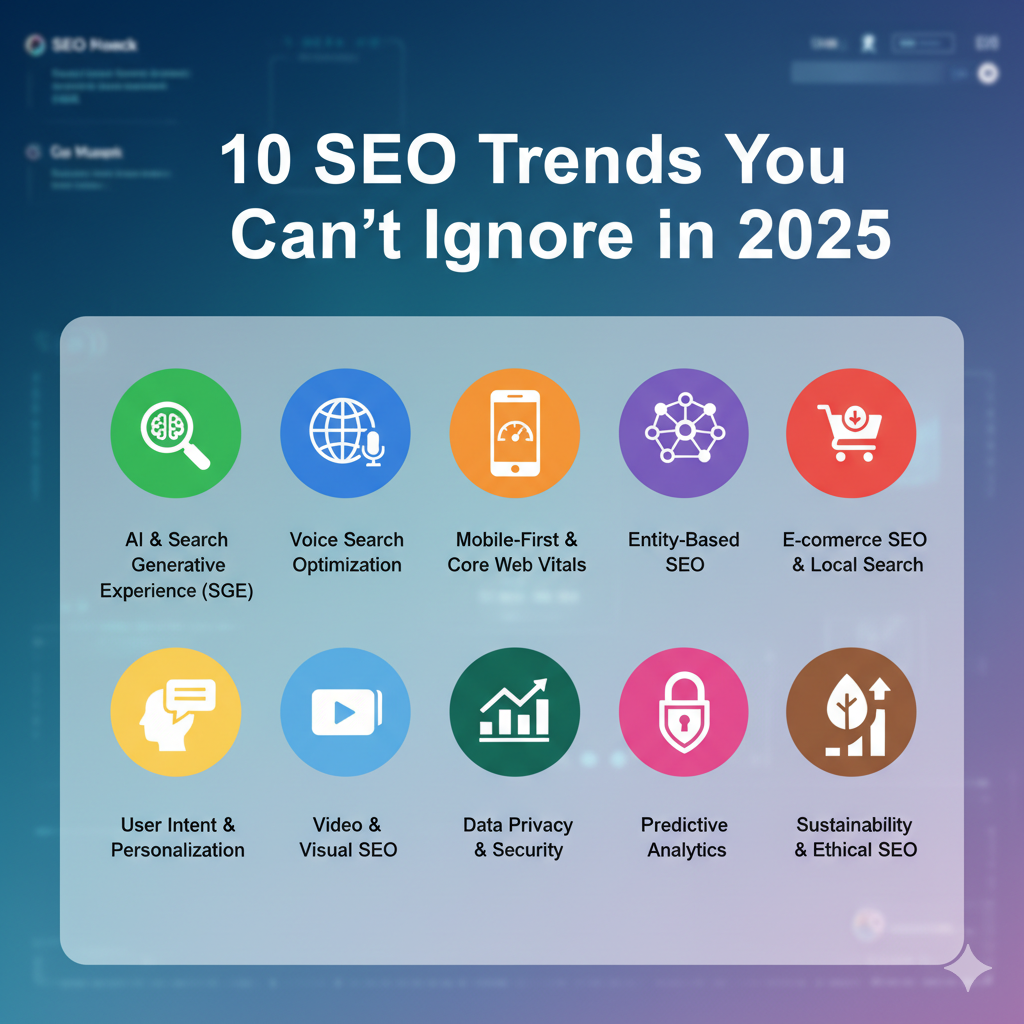
The digital landscape is evolving at breakneck speed, and search engine optimization continues to be the cornerstone of online visibility. As we navigate through 2025, understanding and implementing the latest SEO trends has become more critical than ever for businesses looking to maintain their competitive edge. The rules of the game are changing, and those who adapt will thrive while others struggle to keep pace.
In this comprehensive guide, we’ll explore the 10 SEO trends you can’t ignore in 2025 that are reshaping how websites rank, how users search, and how businesses connect with their target audiences. Whether you’re a seasoned digital marketer or a business owner looking to improve your online presence, these insights will help you stay ahead of the curve.
1. AI-Powered Search and Generative Engine Optimization (GEO)
The integration of artificial intelligence into search engines has fundamentally transformed how people find information online. Google’s Search Generative Experience (SGE) and similar AI-powered features from other search engines are creating a new paradigm in search behavior.
AI-Powered Search is no longer a futuristic concept—it’s today’s reality. Search engines now use advanced language models to understand context, intent, and nuance in ways that were impossible just a few years ago. This means that traditional keyword stuffing and outdated SEO tactics are not only ineffective but potentially harmful to your rankings.
Generative Engine Optimization (GEO) represents the next frontier in SEO trends. Unlike traditional SEO that focuses on ranking in a list of blue links, GEO aims to position your content so that AI-powered search summaries cite and feature your brand. This requires creating comprehensive, authoritative content that AI models can confidently reference.
To succeed with AI-powered search in 2025, focus on:
- Creating content that directly answers questions with clear, concise information
- Building topical authority through comprehensive coverage of subject areas
- Ensuring your content is structured with proper schema markup
- Developing E-E-A-T (Experience, Expertise, Authoritativeness, Trustworthiness) signals
- Optimizing for featured snippets and AI-generated summaries
The businesses that understand how to optimize for these AI-generated responses will capture significant market share in 2025 and beyond. This is arguably the most transformative of all 10 SEO trends you can’t ignore in 2025.
2. Voice and Visual Search Optimization
Voice search continues its upward trajectory, with smart speakers, virtual assistants, and voice-enabled devices becoming ubiquitous in homes and workplaces. Simultaneously, visual search technology has matured, allowing users to search using images rather than text.
Voice search queries tend to be longer, more conversational, and question-based compared to traditional text searches. When someone types a query, they might search for “best Italian restaurant Chicago,” but when using voice search, they’re more likely to ask, “What’s the best Italian restaurant near me that’s open now?”
Visual search, powered by Google Lens and similar technologies, enables users to snap a photo of a product, landmark, or object and instantly receive relevant search results. This technology is particularly impactful for e-commerce, fashion, home décor, and travel industries.
To optimize for voice and visual search:
- Target long-tail, conversational keywords and question-based queries
- Optimize for local SEO with complete Google Business Profile information
- Implement structured data markup for rich results
- Create FAQ sections that address natural language questions
- Ensure images are high-quality with descriptive alt text and file names
- Use image sitemaps to help search engines discover and index your visual content
- Optimize page speed for faster voice search responses
As voice and visual search continue growing, businesses that prioritize these optimization strategies will capture audiences using these increasingly popular search methods.
3. Core Web Vitals and Page Experience Signals
User experience has always mattered for SEO, but Google’s emphasis on Core Web Vitals and page experience signals has made it a formal ranking factor that can’t be ignored.
Core Web Vitals measure three critical aspects of user experience:
- Largest Contentful Paint (LCP): Measures loading performance (should occur within 2.5 seconds)
- First Input Delay (FID) / Interaction to Next Paint (INP): Measures interactivity and responsiveness
- Cumulative Layout Shift (CLS): Measures visual stability
Beyond Core Web Vitals, Google considers additional page experience signals including mobile-friendliness, HTTPS security, absence of intrusive interstitials, and safe browsing.
In 2025, websites with poor Core Web Vitals scores face significant ranking disadvantages. Users have become less tolerant of slow, unresponsive websites, and search engines reward sites that prioritize user experience.
Improving your Core Web Vitals requires:
- Compressing and optimizing images
- Minimizing JavaScript and CSS
- Implementing lazy loading for images and videos
- Using content delivery networks (CDNs)
- Eliminating render-blocking resources
- Optimizing server response times
- Ensuring proper sizing for images and embedded content
Regular monitoring through Google Search Console and PageSpeed Insights is essential. Remember that Core Web Vitals performance is measured based on real user data, so continuous optimization is crucial for maintaining strong SEO trends performance.
4. E-E-A-T and Content Quality
Google’s emphasis on E-E-A-T—Experience, Expertise, Authoritativeness, and Trustworthiness—has intensified in 2025, particularly for YMYL (Your Money or Your Life) topics that impact health, financial stability, safety, or well-being.
The addition of “Experience” to the traditional E-A-T framework reflects Google’s recognition that first-hand experience adds value that pure expertise alone cannot provide. For example, a product review from someone who actually used the product carries more weight than one written solely from specifications.
Demonstrating E-E-A-T requires:
- Showcasing author credentials and expertise prominently
- Including author bios with relevant qualifications
- Earning backlinks from authoritative sources in your industry
- Encouraging and displaying customer reviews and testimonials
- Maintaining accurate, up-to-date information
- Citing credible sources and research
- Demonstrating first-hand experience with topics covered
- Building a strong brand reputation across the web
Content quality goes beyond just E-E-A-T. In 2025, search engines can identify thin, derivative content that offers little unique value. The winning strategy involves creating comprehensive, original content that provides genuine utility to readers.
Avoid content that simply rehashes what’s already ranking. Instead, add unique insights, original research, expert opinions, case studies, and actionable advice that readers can’t find elsewhere. This approach aligns with the most important 10 SEO trends you can’t ignore in 2025.
5. Video Content and YouTube SEO
Video content has exploded in popularity, and search engines increasingly feature video results in traditional search results pages. YouTube, as the world’s second-largest search engine, represents a massive opportunity for visibility.
Video content benefits from several advantages:
- Higher engagement rates compared to text
- Increased time on site when embedded
- Multiple opportunities for featured snippets and rich results
- Growing preference among younger audiences
- Better storytelling and demonstration capabilities
YouTube SEO requires specific optimization strategies:
- Conducting keyword research specific to YouTube
- Creating compelling thumbnails with high click-through rates
- Writing keyword-optimized titles and descriptions
- Using tags strategically
- Adding timestamps for longer videos
- Encouraging engagement through likes, comments, and subscriptions
- Creating playlists to increase watch time
- Including transcripts and closed captions
- Embedding videos on your website with relevant surrounding content
The integration between YouTube and Google Search means that optimizing video content can help you appear in both traditional search results and video carousels, effectively doubling your visibility opportunities.
Short-form video content on platforms like TikTok and Instagram Reels is also becoming searchable, creating additional opportunities for businesses to reach audiences through video-first SEO trends.
6. Local SEO and Hyperlocal Targeting
Local SEO has evolved beyond simple Google My Business optimization to encompass sophisticated hyperlocal targeting strategies. With “near me” searches continuing to surge and mobile devices dominating search traffic, local visibility has never been more valuable.
Successful local SEO in 2025 requires:
- A fully optimized Google Business Profile with complete information
- Consistent NAP (Name, Address, Phone) citations across the web
- Local link building from community organizations and businesses
- Location-specific content and landing pages
- Positive review management across multiple platforms
- Local schema markup implementation
- Engagement with local online communities and directories
- Optimization for voice search queries with local intent
- Hyperlocal content targeting specific neighborhoods or districts
Hyperlocal targeting takes local SEO further by creating content and optimization strategies for very specific geographic areas. This is particularly effective for businesses with multiple locations or those serving distinct neighborhoods within a larger city.
User-generated content, particularly customer reviews, plays an enormous role in local SEO. Businesses that actively encourage reviews, respond to feedback, and maintain high ratings enjoy significant advantages in local search results.
The integration of map results into search pages means that local businesses can achieve prominent visibility even when competing against larger national brands, making local SEO one of the most valuable 10 SEO trends you can’t ignore in 2025 for small and medium businesses.
7. Zero-Click Searches and Featured Snippets
Zero-click searches—where users get their answers directly on the search results page without clicking through to a website—have become increasingly common. Featured snippets, knowledge panels, and AI-generated summaries contribute to this trend.
While zero-click searches might seem problematic for website traffic, they present unique opportunities:
- Massive brand visibility and recognition
- Establishment as an authoritative source
- Potential for click-through when users want deeper information
- Voice search results often pull from featured snippets
Optimizing for featured snippets requires:
- Identifying questions your target audience asks
- Providing clear, concise answers in your content
- Using proper heading structures (H2, H3, etc.)
- Creating lists, tables, and step-by-step instructions
- Implementing FAQ schema markup
- Answering questions at the top of relevant pages
- Providing more comprehensive information below the snippet-optimized answer
Different types of featured snippets require different optimization approaches. Paragraph snippets benefit from concise 40-60 word answers, list snippets from bulleted or numbered formats, table snippets from structured data, and video snippets from YouTube content with timestamps.
Even if users don’t click through, appearing in featured snippets builds brand awareness and positions you as the go-to authority in your field. This visibility compounds over time, leading to increased branded searches and direct traffic.
8. Mobile-First Indexing and Mobile Experience
Google completed its shift to mobile-first indexing, meaning the mobile version of your website is now the primary version Google uses for indexing and ranking. With mobile devices accounting for the majority of searches, mobile optimization is no longer optional.
Mobile-first doesn’t simply mean responsive design—it encompasses the entire mobile user experience:
- Fast loading times on mobile networks
- Touch-friendly navigation and buttons
- Readable text without zooming
- Appropriate image sizes for mobile screens
- Simplified forms and checkout processes
- Accessible menus and site navigation
- No intrusive interstitials or pop-ups
- Mobile-optimized content layouts
The mobile experience extends beyond your website to include:
- App optimization for app-based businesses
- Progressive Web Apps (PWAs) for enhanced mobile experiences
- AMP (Accelerated Mobile Pages) for ultra-fast loading news and content sites
- Mobile-specific features like click-to-call buttons and map integration
Testing your mobile experience regularly through tools like Google’s Mobile-Friendly Test and Mobile Usability reports in Search Console is essential. Real device testing across different screen sizes and operating systems ensures you’re delivering optimal experiences.
Consider that mobile users often have different intent than desktop users—they may be searching on-the-go, looking for quick answers, or ready to take immediate action. Your mobile optimization strategy should account for these behavioral differences, making mobile excellence one of the critical SEO trends for success.
9. Semantic Search and Topic Clusters
Search engines have become remarkably sophisticated at understanding semantic relationships between words, concepts, and topics. Rather than focusing solely on individual keywords, modern SEO requires a topic-based approach centered on comprehensive coverage of subject areas.
Semantic search means search engines understand:
- Synonyms and related terms
- Context and user intent
- Relationships between entities
- Natural language patterns
- Topic relevance beyond keyword matching
The topic cluster model organizes content around pillar pages and cluster content:
- Pillar pages provide comprehensive overviews of broad topics
- Cluster content dives deep into specific subtopics
- Internal linking connects clusters to pillars, signaling relationships
- This structure demonstrates topical authority to search engines
Implementing a topic cluster strategy involves:
- Identifying core topics relevant to your business
- Creating comprehensive pillar content for each topic
- Developing supporting cluster content covering subtopics
- Strategically linking cluster content to pillar pages
- Using consistent terminology and semantic variations
- Updating and expanding content regularly
- Avoiding keyword cannibalization through clear content differentiation
This approach moves beyond individual keyword rankings to establish your site as a comprehensive resource on specific topics. Search engines reward this topical authority with improved visibility across numerous related queries.
Co-occurrence and entity-based SEO complement the topic cluster approach by ensuring you’re including related entities, concepts, and terms that search engines expect to see when covering specific topics thoroughly.
10. Sustainability and Ethical SEO Practices
An emerging trend gaining momentum in 2025 is the emphasis on sustainability and ethical SEO practices. This encompasses both environmental considerations and ethical standards in digital marketing.
Sustainable SEO considers:
- Website carbon footprint and energy efficiency
- Green hosting solutions
- Optimized code and compressed files reducing data transfer
- Sustainable business practices featured in content
- Brand values aligned with environmental responsibility
Users increasingly prefer brands that demonstrate environmental and social responsibility. Search engines are beginning to factor sustainability signals into their algorithms, particularly for brand-related queries where user preferences matter.
Ethical SEO practices include:
- Transparency in sponsored content and affiliate relationships
- Honest product descriptions and reviews
- Privacy protection and data security
- Accessibility for users with disabilities
- Avoiding manipulative tactics and dark patterns
- Building genuine authority rather than gaming algorithms
- Creating value-driven content rather than pure SEO bait
White-hat SEO techniques remain the only sustainable long-term strategy. Manipulative tactics may provide short-term gains but inevitably result in penalties, loss of trust, and damaged brand reputation.
Accessibility overlaps with ethical SEO and provides SEO benefits:
- Proper heading structures help both screen readers and search engines
- Alt text serves both visually impaired users and image SEO
- Clear navigation benefits all users and improves crawlability
- Readable content serves broader audiences and improves engagement
Building a sustainable, ethical SEO strategy aligns with the long-term evolution of search engines toward rewarding genuine value creation. This final entry in our 10 SEO trends you can’t ignore in 2025 represents the future direction of the industry.
Bringing It All Together
The SEO trends shaping 2025 represent both challenges and opportunities for businesses willing to adapt. Success requires moving beyond outdated tactics and embracing a holistic approach that prioritizes user experience, content quality, technical excellence, and ethical practices.
These 10 SEO trends you can’t ignore in 2025 are interconnected. AI-powered search depends on quality content and E-E-A-T. Mobile optimization supports better Core Web Vitals. Topic clusters enhance semantic search understanding. Voice search connects with local SEO and featured snippets.
Rather than implementing these trends in isolation, develop an integrated strategy that addresses multiple trends simultaneously. Start by auditing your current SEO performance against each trend, identifying gaps, and prioritizing improvements based on your business goals and resources.
The businesses that will thrive in 2025 and beyond are those that view SEO not as a set of tactics to manipulate rankings, but as a discipline focused on creating genuinely valuable experiences for users. Search engines continue evolving toward rewarding sites that deserve to rank—those providing the best answers, the best experiences, and the most trustworthy information.
As you implement these SEO trends, remember that SEO is not a one-time project but an ongoing process of optimization, testing, and refinement. Stay informed about algorithm updates, monitor your performance metrics, and remain flexible enough to adapt as the landscape continues evolving.
The 10 SEO trends you can’t ignore in 2025 outlined in this guide provide your roadmap for success. By understanding and implementing these strategies, you’ll position your website for improved visibility, increased traffic, and better business outcomes in an increasingly competitive digital landscape.
Start today, prioritize consistently, and commit to excellence in every aspect of your SEO strategy. The results will speak for themselves as you climb rankings, capture more qualified traffic, and convert visitors into loyal customers. The future of SEO is here—are you ready to embrace it?
Also read this:
Why Your Blog Isn’t Getting Traffic (And How to Fix It)