
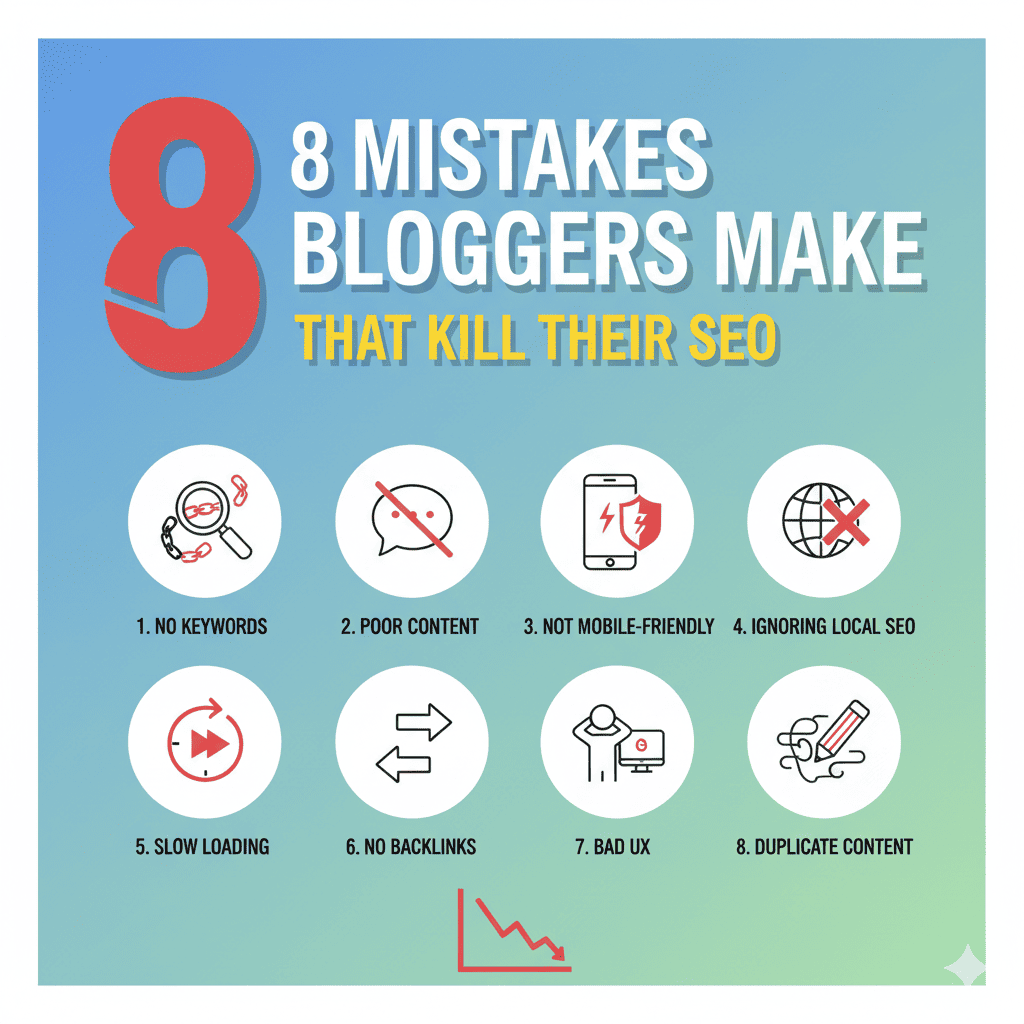
You’ve poured your heart into creating content. You’ve spent hours researching, writing, editing, and publishing blog posts that you believe offer genuine value. Yet, your traffic remains stagnant. Your posts languish on page three of Google search results—the digital equivalent of invisibility. Your competitors with seemingly inferior content outrank you consistently.
The frustration is real, and you’re not alone. Thousands of talented bloggers struggle with SEO not because they lack writing skills or subject matter expertise, but because they unknowingly commit critical errors that sabotage their search visibility. These mistakes bloggers make often stem from outdated advice, misunderstanding of how modern search algorithms work, or simply not knowing what matters most in today’s SEO landscape.
The good news? Most of these mistakes are entirely fixable. Once you identify what’s holding your blog back, you can implement strategic corrections that dramatically improve your rankings, traffic, and overall online visibility. This comprehensive guide examines the eight most damaging mistakes bloggers make that kill their SEO—and more importantly, how to fix them.
1. Ignoring Search Intent and Creating Content Nobody Searches For
Perhaps the most fundamental of all mistakes bloggers make is creating content based on what they want to write about rather than what their audience actually searches for. This writer-centric approach might satisfy creative impulses, but it guarantees SEO failure.
Search intent refers to the underlying goal behind a user’s query. When someone types “best running shoes,” they’re not looking for a philosophical essay on footwear design—they want product recommendations, comparisons, and buying advice. When search intent misaligns with your content, even perfectly optimized posts will fail to rank because search engines recognize that users quickly bounce back to results seeking what they actually need.
The mistake manifests in several ways. Some bloggers write content that’s interesting but addresses questions nobody asks. Others target keywords with decent search volume but fail to understand the intent behind those searches. For instance, targeting “coffee beans” might seem logical for a coffee blog, but this broad keyword encompasses vastly different intents—some users want to buy beans, others want growing information, and still others seek roasting techniques.
How to fix this mistake: Start every piece of content with intent research. Use tools like Ahrefs, SEMrush, or free alternatives like AnswerThePublic and Google’s “People Also Ask” feature to understand actual user queries. Analyze the top-ranking pages for your target keywords—what type of content dominates? Are they how-to guides, product reviews, listicles, or in-depth tutorials? This reveals what search engines have determined best satisfies user intent.
Create content that directly addresses the predominant intent. If your keyword research shows people searching “how to start a blog” want step-by-step tutorials with screenshots, don’t write a philosophical piece about blogging’s importance. Match content format, depth, and angle to what currently ranks. This doesn’t mean copying competitors—it means understanding the baseline expectations you must meet before differentiation matters.
Validate intent before writing. Search your target keyword and examine the top ten results. Note the common elements, questions addressed, and content structure. If your planned content significantly diverges from what’s ranking, you’re either targeting the wrong keyword or misunderstanding user intent. Alignment with intent is non-negotiable for SEO success.
2. Terrible On-Page SEO and Optimization Basics
Among the most common mistakes bloggers make is neglecting fundamental on-page optimization. They create quality content but fail to structure it in ways search engines can understand and rank. On-page SEO encompasses everything from title tags and meta descriptions to header hierarchy and internal linking.
The title tag represents your primary opportunity to tell both users and search engines what your page is about. Yet bloggers frequently waste this opportunity with vague titles, missing keywords, or titles optimized for creativity rather than clarity. A title like “Thoughts on Digital Marketing” tells search engines nothing useful. “7 Digital Marketing Strategies for Small Businesses in 2025” provides clear, keyword-rich information that improves rankings.
Meta descriptions, while not direct ranking factors, dramatically influence click-through rates. Compelling meta descriptions that promise clear value and include target keywords convince users to choose your result over competitors. Bloggers who ignore meta descriptions or let search engines auto-generate them from random page content miss opportunities to control their search appearance.
Header tags (H1, H2, H3) create content hierarchy that helps search engines understand structure and relationships between ideas. The single H1 should contain your primary keyword and clearly state the page topic. H2s break content into major sections, while H3s create subsections. Mistakes bloggers make include using multiple H1 tags, skipping header levels (H1 to H3 without H2), or creating headers that don’t describe the content beneath them.
URL structure matters more than many realize. Clean, descriptive URLs that include target keywords perform better than random strings of numbers and characters. “yourblog.com/best-running-shoes-2025” beats “yourblog.com/p=12345?category=shoes&id=running” in both SEO value and user clarity.
How to fix this mistake: Implement a comprehensive on-page SEO checklist for every post. Ensure title tags are 50-60 characters, include primary keywords near the beginning, and accurately describe content. Write meta descriptions of 150-160 characters that promise value and incorporate target keywords naturally.
Structure content with proper header hierarchy. Use one H1 that includes your primary keyword. Create H2 sections for major topics, H3s for subtopics within those sections, and so on. Headers should be descriptive—readers should understand what each section covers by reading headers alone.
Optimize URLs before publishing. Most content management systems default to the post title for URLs, which often requires editing. Remove stop words (a, an, the, of), keep URLs concise (3-5 words ideal), and include your primary keyword. Never change URLs after publication without proper redirects, as this breaks existing links and loses accumulated SEO value.
Include primary keywords in the first 100 words of content, naturally incorporate variations and related terms throughout, and use keywords in image alt text where relevant. Avoid keyword stuffing—write naturally while being intentional about terminology. Modern algorithms recognize semantic relationships, so exact-match repetition is unnecessary and potentially harmful.
3. Creating Thin Content Without Depth or Value
One of the most damaging mistakes bloggers make is publishing thin content—posts that superficially address topics without providing sufficient depth, insight, or value. In SEO terms, thin content fails to comprehensively satisfy search intent, resulting in poor user engagement signals that tank rankings.
Thin content takes various forms. Some bloggers publish extremely short posts (300-500 words) on complex topics that require detailed explanation. Others create longer posts that lack substance—they hit target word counts through fluff, repetition, and tangential rambling rather than genuine insight. Still others produce content that merely summarizes information readily available elsewhere without adding original perspective, analysis, or value.
Search engines have become sophisticated at identifying thin content through multiple signals. Low dwell time (users quickly leave), high bounce rates, and poor engagement metrics all indicate that content fails to satisfy users. Additionally, algorithms analyze content comprehensiveness by comparing your coverage of a topic to competing pages. If top-ranking articles address fifteen aspects of a topic while you cover only five, your post appears less comprehensive.
The proliferation of AI-generated content has raised the bar significantly. When anyone can generate basic content instantly, merely adequate posts no longer compete. Bloggers must provide depth, expertise, original thinking, or unique perspectives that AI cannot easily replicate. Generic, surface-level content—whether human or AI-generated—struggles to rank in competitive niches.
How to fix this mistake: Prioritize content quality over publishing frequency. It’s better to publish one comprehensive, valuable post monthly than four thin posts weekly. Each piece should aim to be the definitive resource on its specific topic—the result users bookmark and reference repeatedly.
Research comprehensively before writing. Analyze top-ranking content to understand the depth competitors provide. Use tools like Clearscope, Surfer SEO, or Frase to identify concepts, questions, and terms that comprehensive content on your topic should address. Don’t just copy competitors, but ensure you cover essential aspects they’ve identified through their research.
Add unique value that differentiates your content. Include original research, personal case studies, expert interviews, proprietary data, or perspectives based on genuine experience. Share specific examples, actionable steps, and practical applications rather than abstract advice. Answer questions your research shows users have but competitors haven’t adequately addressed.
Structure content for comprehensive coverage. Create detailed outlines before writing, ensuring each section provides genuine value rather than filler. Use the inverted pyramid approach—start with the most important information, then layer in additional depth for readers wanting more detail. Include examples, data, quotes, and multimedia that enrich understanding.
Update existing thin content rather than leaving it to perform poorly. Identify underperforming posts through Google Analytics, expand them with additional depth and current information, then republish with updated dates. This approach improves existing posts while signaling fresh content to search engines.
4. Neglecting Technical SEO and Site Performance
While content quality dominates SEO discussions, technical foundations determine whether search engines can effectively crawl, index, and rank your content. Mistakes bloggers make in technical SEO often stem from viewing it as intimidating or assuming their platform handles everything automatically.
Site speed represents one of the most critical technical factors. Slow-loading pages frustrate users and directly impact rankings through Google’s Core Web Vitals. Yet bloggers frequently use cheap hosting, fail to optimize images, implement inefficient themes, and load unnecessary scripts that devastate performance. A page taking five seconds to load might seem acceptable, but it’s losing visitors and rankings to competitors loading in two seconds.
Mobile optimization is non-negotiable with Google’s mobile-first indexing. Search engines primarily use mobile versions of pages for indexing and ranking. Yet bloggers still use non-responsive themes, create images too large for mobile screens, implement navigation that works poorly on touchscreens, or use pop-ups that frustrate mobile users.
Crawlability issues prevent search engines from accessing and indexing content properly. Bloggers accidentally block important pages in robots.txt, use noindex tags incorrectly, create orphan pages (content with no internal links pointing to it), or generate excessive duplicate content that confuses search engines about which version to rank.
SSL certificates (HTTPS) are table stakes for modern websites. Yet some bloggers still operate on unsecured HTTP, triggering browser warnings that devastate trust and rankings. Similarly, broken links throughout a site signal poor maintenance and negatively impact user experience and SEO.
How to fix this mistake: Start with a comprehensive technical SEO audit. Use free tools like Google Search Console, PageSpeed Insights, and Screaming Frog (free for up to 500 URLs) to identify technical issues. Pay particular attention to Core Web Vitals metrics: Largest Contentful Paint (loading), First Input Delay (interactivity), and Cumulative Layout Shift (visual stability).
Optimize images aggressively. Compress all images before uploading using tools like TinyPNG or ShortPixel. Implement lazy loading so images load only as users scroll to them. Use next-gen formats like WebP when possible. Properly size images—don’t upload 3000px-wide images for 600px display spaces.
Upgrade hosting if necessary. Cheap shared hosting might save money but costs traffic through poor performance. Consider managed WordPress hosting from providers like Kinsta, WP Engine, or SiteGround for dramatically better speed. Enable caching plugins and content delivery networks (CDNs) like Cloudflare to serve content faster globally.
Ensure mobile responsiveness. Test your site thoroughly on various devices and screen sizes. Use Google’s Mobile-Friendly Test tool to identify issues. Implement responsive design that adapts seamlessly to different screens. Avoid fixed-width elements, ensure text is readable without zooming, and space interactive elements appropriately for touchscreens.
Fix crawlability issues systematically. Submit an XML sitemap through Google Search Console to help search engines discover content. Review robots.txt to ensure you’re not blocking important pages. Find and fix broken links using tools like Broken Link Checker. Create internal linking structures that ensure every important page is accessible within a few clicks from your homepage.
Implement HTTPS across your entire site. Most hosting providers now offer free SSL certificates through Let’s Encrypt. After installation, ensure all internal links use HTTPS, set up proper redirects from HTTP to HTTPS, and update your Search Console property to the HTTPS version.
5. Building No Backlinks or Building Terrible Ones
Link building remains one of the most powerful SEO factors, yet many mistakes bloggers make involve either completely ignoring backlinks or pursuing them in ways that harm rather than help rankings. Links from other websites signal trust, authority, and relevance—but quality matters exponentially more than quantity.
Some bloggers operate under the “build it and they will come” fallacy. They believe that creating quality content automatically generates backlinks. While exceptional content is necessary, it’s rarely sufficient. Most quality content receives few natural links without promotion. Passive approaches leave enormous SEO potential unrealized.
Conversely, other bloggers pursue backlinks aggressively but without discrimination. They engage in link schemes—reciprocal linking arrangements, buying links, participating in link farms, or using automated tools to generate spammy backlinks. These tactics might work temporarily but inevitably trigger penalties that devastate rankings. Recovering from manual penalties can take months or years.
Low-quality backlinks from irrelevant sites, spam directories, article farms, or obviously manipulative sources provide minimal benefit and potential risk. A link from a random directory listing hundreds of unrelated businesses carries far less value than a relevant editorial link from an authoritative site in your niche.
Anchor text over-optimization represents another common mistake. When all backlinks use exact-match anchor text (the clickable text in a link) containing your target keywords, it signals manipulation. Natural link profiles include varied anchor text—brand names, generic phrases (“click here”), URLs, and varied keyword combinations.
How to fix this mistake: Develop a white-hat link building strategy focused on earning quality links naturally. Start by creating genuinely link-worthy content—comprehensive guides, original research, data-driven studies, interactive tools, or content that takes unique angles on important topics. Link-worthy content provides more value than competitors offer, making it reference-worthy.
Promote content strategically. Share new posts with your email list, social media followers, and relevant online communities (without spamming). Identify influencers, bloggers, and journalists in your niche who might find your content valuable. Send personalized outreach emails (not mass spam) explaining why your content would benefit their audience.
Guest posting on reputable sites in your niche builds relationships and authoritative backlinks. Focus on providing genuine value to the host blog’s audience rather than just link building. Write quality guest posts that showcase expertise, include natural links to relevant content on your blog, and establish you as an authority.
Reclaim lost or broken links through link reclamation. Use tools like Ahrefs or SEMrush to find mentions of your brand or content without links, then reach out requesting they link to your site. Similarly, identify broken links on other sites that pointed to resources similar to yours, then suggest your content as a replacement.
Build relationships rather than just links. Engage genuinely with other bloggers in your niche through comments, social media, and collaboration. Strong relationships lead to natural link opportunities—references in roundup posts, citations in comprehensive guides, or collaborations that generate mutual links.
Monitor your backlink profile regularly through Google Search Console and specialized tools. Disavow spammy or manipulative links you didn’t create to prevent negative SEO attacks from harming your site. Focus on steady acquisition of quality links rather than rapid accumulation of questionable ones.
6. Publishing Inconsistently Without Content Strategy
Among the most frustrating mistakes bloggers make is treating content creation as sporadic rather than strategic. They publish enthusiastically for a few weeks, then disappear for months before returning with occasional posts. This inconsistency confuses audiences, disappoints search engines, and prevents blogs from building momentum.
Search engines favor sites that regularly publish fresh, relevant content. Consistent publishing signals active maintenance, current information, and commitment to serving user needs. Sites that rarely update struggle to establish topical authority because they lack the content depth and frequency that demonstrates expertise.
Publishing inconsistency often stems from lack of planning. Bloggers write when inspiration strikes or time allows, rather than following strategic content calendars. This reactive approach leads to content gaps, missed opportunities around trending topics, and stress when trying to maintain visibility without preparation.
Some bloggers confuse activity with strategy. They publish frequently but without coherent themes, target audience focus, or consideration of how posts interconnect. Random content on loosely related topics prevents blogs from establishing strong authority in specific areas. Search engines struggle to categorize such sites, and audiences find them unfocused.
Content strategy extends beyond publishing frequency to include topical planning, keyword targeting, internal linking architecture, and consideration of user journeys. Mistakes bloggers make include creating individual posts in isolation rather than planning how content pieces support each other, guide users through topics, and comprehensively cover subject areas.
How to fix this mistake: Develop a realistic content calendar you can maintain consistently. Whether that’s weekly, bi-weekly, or monthly, consistency matters more than frequency. It’s better to publish one quality post monthly without fail than to publish daily for two weeks then go silent for months.
Plan content strategically around topic clusters. Identify 5-10 core topics relevant to your niche and audience. Create comprehensive pillar content for each core topic—your definitive guide that covers the subject broadly. Then develop cluster content that dives deep into specific aspects, all linking back to the pillar page and to each other.
Use keyword research to inform content planning. Identify keywords with decent search volume, manageable competition, and clear intent that aligns with your expertise. Build your content calendar around these strategic keywords, ensuring you systematically address topics your audience actually searches for.
Batch content creation during productive periods to maintain consistency. Many successful bloggers write multiple posts during focused writing sessions, then schedule them for future publication. This approach smooths out periods when life gets busy, maintaining consistency even during challenging times.
Balance evergreen content with timely pieces. Evergreen content remains relevant indefinitely, driving consistent traffic long-term. Timely content capitalizes on trends, seasonal interest, or current events for short-term traffic spikes. A healthy mix provides both immediate visibility and long-term value.
Repurpose and update existing content rather than always creating new posts. Update popular posts with current information, expand successful content with additional depth, combine related posts into comprehensive guides, or adapt written content into different formats (videos, infographics, podcasts). This strategy maintains freshness while maximizing existing assets.
Track content performance to inform strategy. Use Google Analytics and Search Console to identify which topics, formats, and angles resonate most with your audience. Double down on what works, experiment with variations, and discontinue approaches that consistently underperform.
7. Completely Ignoring User Experience and Engagement
Many mistakes bloggers make stem from focusing exclusively on search engines while forgetting that humans actually use their sites. User experience (UX) encompasses everything affecting how visitors interact with your blog—design, navigation, readability, functionality, and overall ease of use.
Poor readability kills engagement. Bloggers sometimes write in academic jargon, use unnecessarily complex language, create wall-of-text paragraphs, or choose fonts and color schemes that strain eyes. If visitors struggle to read content, they leave—generating bounce rate signals that harm rankings.
Intrusive elements devastate user experience. Aggressive pop-ups that immediately cover content, auto-playing videos with sound, excessive ads that push content down the page, or interstitials that block mobile users all frustrate visitors. While some monetization is necessary, it must balance with usability.
Navigation confusion prevents users from discovering valuable content. Blogs with unclear menus, missing search functionality, no related post suggestions, or poor internal linking structures trap visitors on single pages. When users can’t easily find more relevant content, they leave rather than exploring your site.
Mobile experience often receives insufficient attention. Bloggers design for desktop then assume mobile responsiveness handles everything. In reality, mobile users need specific considerations—larger tap targets, simplified navigation, faster loading, readable text without zooming, and layouts optimized for vertical scrolling.
Engagement opportunities go unutilized. Blogs that disable comments, provide no social sharing buttons, ignore building email lists, or fail to include clear calls-to-action miss opportunities to build community and relationships that extend beyond individual page visits.
How to fix this mistake: Prioritize readability in every post. Write conversationally using short sentences and paragraphs. Aim for eighth-grade reading level for broad accessibility. Use bullet points, numbered lists, bold text, and headers to break up content and make it scannable. Choose readable fonts (16px minimum for body text) with sufficient line spacing.
Implement user-friendly design. Use clean, uncluttered layouts that highlight content. Ensure adequate white space so pages don’t feel crowded. Choose color schemes with sufficient contrast for readability. Test your site with multiple browsers and devices to identify experience issues.
Limit intrusive elements. If using pop-ups, delay them until users show engagement (scrolling 50% or spending significant time on page). Comply with Google’s intrusive interstitial guidelines. Keep ads reasonable—excessive ads that push content below the fold or dominate the screen harm both experience and SEO.
Optimize mobile experience specifically. Test your blog thoroughly on various mobile devices. Ensure buttons and links are easily tappable (minimum 44×44 pixels). Implement hamburger menus or simplified navigation for mobile. Prioritize content over sidebars on small screens. Compress images aggressively for faster mobile loading.
Create strong internal linking structures. Include related post suggestions at the end of articles. Use contextual internal links within content to guide readers to relevant resources. Create a logical site structure where users can easily navigate between topics. Implement breadcrumb navigation for complex sites.
Enable engagement opportunities. Allow comments (moderate them to maintain quality), include prominent social sharing buttons, build an email list with valuable lead magnets, and include clear calls-to-action guiding next steps. Consider adding features like comment highlighting, discussion threads, or community forums for highly engaged audiences.
Monitor user behavior through analytics. Track metrics like bounce rate, average time on page, pages per session, and conversion rates. High bounce rates and low time on page often indicate UX problems. Use tools like Hotjar or Microsoft Clarity to watch actual user sessions and identify friction points.
8. Failing to Track, Analyze, and Adapt Performance
Perhaps the most strategic of all mistakes bloggers make is operating blindly without tracking performance, analyzing results, or adapting strategies based on data. SEO is not “set it and forget it”—it requires continuous monitoring, testing, and refinement based on actual outcomes.
Many bloggers never install analytics or only superficially check visitor numbers. They don’t know which posts drive traffic, what keywords they rank for, how users find their content, or what actions visitors take. This blind approach makes improvement impossible because you can’t optimize what you don’t measure.
Others install tracking tools but never analyze the data meaningfully. They glance at vanity metrics like total visitors without understanding traffic sources, user behavior, or conversion patterns. Surface-level analysis misses crucial insights about what’s working and what’s not.
Failing to use Google Search Console represents a massive missed opportunity. This free tool reveals which keywords drive impressions and clicks, which pages rank where, what technical issues exist, and how Google’s algorithms perceive your site. Bloggers ignoring Search Console operate without access to direct insights from the search engine they’re trying to please.
Some bloggers track data but never act on insights. They notice certain content types perform better, specific keywords drive quality traffic, or particular promotion channels generate results—yet continue publishing the same random content without strategic adjustment. Data without action represents wasted potential.
Mistakes bloggers make include chasing rankings for their own sake rather than business goals. A post ranking #1 for a keyword that generates zero conversions or engagement represents SEO success but business failure. Smart bloggers align SEO efforts with actual business objectives—email subscribers, product sales, affiliate revenue, or whatever metrics matter for their goals.
How to fix this mistake: Implement comprehensive tracking immediately. Install Google Analytics 4 (GA4) to monitor traffic sources, user behavior, and conversions. Set up Google Search Console to track search performance, impressions, rankings, and technical issues. Consider additional tools like Ahrefs, SEMrush, or Ubersuggest for competitive intelligence and keyword tracking.
Define meaningful metrics tied to actual goals. Beyond vanity metrics, track goal completions—email signups, product purchases, affiliate clicks, contact form submissions, or whatever outcomes matter for your blog. Monitor engagement metrics like average time on page, pages per session, and scroll depth to understand content quality.
Analyze data regularly and systematically. Schedule weekly or monthly analytics reviews. Identify top-performing content and understand why it succeeds—topic selection, keyword targeting, content depth, promotion strategy? Conversely, examine underperforming content to identify patterns and improvement opportunities.
Use Search Console strategically. Identify high-impression, low-click-through keywords—these represent opportunities where you rank but your title/meta aren’t compelling enough to earn clicks. Find pages with declining performance that might benefit from updates. Monitor for technical issues like crawl errors, mobile usability problems, or security issues.
A/B test key elements. Experiment with different headline formats, content structures, call-to-action placements, or internal linking strategies. Make one change at a time, measure impact, and systematically optimize based on results. Testing transforms guesswork into data-driven refinement.
Track competitor performance. Use tools to monitor what keywords competitors rank for, what content they publish, and what backlinks they earn. Identify gaps in their coverage you can fill, successful strategies you can adapt, and weaknesses you can exploit.
Adapt strategies based on insights. When data shows certain content types perform better, create more of them. When specific keywords drive quality traffic, develop more content targeting related terms. When particular promotion channels generate results, invest more effort there. Let data guide strategy evolution.
Create performance dashboards. Use tools like Google Data Studio (free) to build custom dashboards showing your most important metrics at a glance. Regular visibility into performance keeps strategy data-informed rather than assumption-based.
Document changes and results. Keep records of major SEO changes—algorithm updates, site redesigns, strategy pivots—alongside performance data. This historical context helps you understand what drives results over time and makes it easier to replicate successes or avoid repeating failures.
Moving Forward: From Mistakes to SEO Success
Understanding these eight mistakes bloggers make represents your first step toward dramatically improved search visibility. Each mistake, once identified, becomes an opportunity for strategic improvement that compounds over time. SEO success rarely happens overnight—it results from consistently avoiding common pitfalls while implementing best practices that search engines reward.
The most encouraging reality is that your competitors likely commit several of these same mistakes. By systematically addressing each area—search intent alignment, on-page optimization, content depth, technical excellence, link building, strategic consistency, user experience, and performance tracking—you create compounding advantages that translate into higher rankings, more traffic, and greater success.
Start by auditing your blog against these eight mistakes. Identify which issues most significantly impact your performance, then prioritize fixes based on potential impact and implementation difficulty. Quick wins build momentum, while systematic addressing of major issues creates sustainable improvement.
Remember that SEO exists to serve humans, not algorithms. Search engines continuously evolve toward better understanding and serving user needs. By focusing your efforts on creating genuinely valuable content, delivering excellent user experiences, and strategically optimizing for discovery, you align with both search engine objectives and audience needs—the ultimate formula for long-term SEO success.
Also read this:
The Next Wave of Online Jobs: What You’ll Be Doing (and How to Start)
The Subscription Business Model for Creators: Earn Forever From One Skill