
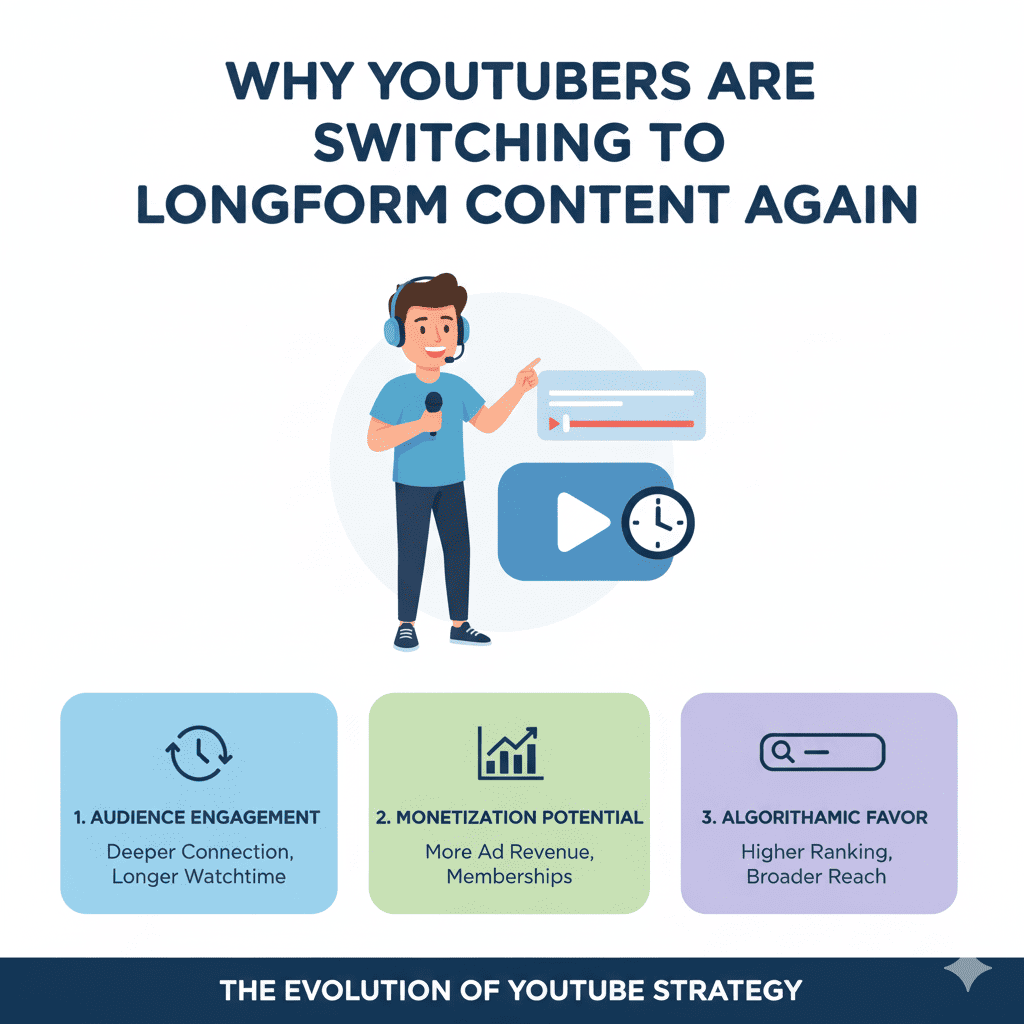
Something unexpected is happening on YouTube. After years of watching creators chase the short-form video trend, frantically pumping out Shorts to compete with TikTok and Instagram Reels, we’re witnessing a dramatic shift. The same creators who abandoned their 20-minute videos are now returning to longform content—and they’re doing it with a vengeance.
If you’ve noticed your favorite creators suddenly releasing 30, 40, or even 60-minute videos, you’re not imagining things. YouTubers are switching to longform content at an unprecedented rate, and the reasons behind this shift reveal everything about where digital content is headed.
This isn’t nostalgia or stubbornness. It’s a calculated response to changing algorithms, audience behavior, and the harsh realities of building a sustainable creator business. Let’s dive into why this seismic shift is happening and what it means for the future of online video.
The Short-Form Experiment: What Went Wrong?
To understand why YouTubers are switching to longform content, we need to talk about what happened during the short-form boom.
The promise of short-form video:
- Explosive growth potential with millions of views
- Lower production barriers and faster turnaround
- Perfect for mobile-first audiences with short attention spans
- The “future” of content consumption
The reality creators discovered:
- Views don’t equal revenue with minimal watch time
- Audience retention and loyalty remained shallow
- Constant content treadmill with no breathing room
- Inability to build deep connections with viewers
- Algorithm dependency with no control
The math simply didn’t work. A creator could get 5 million views on a Short and earn $200, while a 20-minute longform video with 100,000 views could generate $2,000-3,000. The economics forced a reckoning.
But it’s not just about money. Creators began realizing that short-form success was hollow—millions of views from people who couldn’t remember their channel name five minutes later.
The Algorithm Changed Everything
YouTube’s algorithm updates in late 2024 and early 2025 fundamentally altered the platform’s priorities, and that’s a major reason YouTubers are switching to longform content so rapidly.
What YouTube now prioritizes:
- Total watch time over view count
- Session time (keeping viewers on the platform longer)
- Engagement depth (comments, likes, shares on substantial content)
- Subscriber conversion rates from views
- Content that keeps viewers watching multiple videos
Longform content dominates every single one of these metrics. A 30-minute video that retains 60% of viewers delivers 18 minutes of watch time per view. To match that with Shorts, you’d need a viewer to watch 18 different 60-second videos—which almost never happens.
The algorithmic advantages of longform:
- Higher suggested video placement due to watch time contribution
- Better homepage recommendations for loyal audiences
- Increased likelihood of binge-watching behavior
- More mid-roll ad opportunities driving creator revenue
- Stronger signals for building subscriber relationships
YouTube didn’t explicitly say “abandon Shorts,” but their algorithm spoke volumes. Creators who doubled down on longform saw their channels explode while those chasing Shorts struggled to monetize their massive view counts.
The Audience Maturation Factor
Perhaps the most fascinating reason YouTubers are switching to longform content is what’s happening with audiences themselves.
Viewer behavior shifts observed:
- Growing fatigue with mindless scrolling and superficial content
- Desire for substance, education, and genuine entertainment
- Willingness to invest time in content they care about
- Preference for creators who feel like friends, not strangers
- Active seeking of deep dives, tutorials, and comprehensive coverage
The same generation that supposedly had 8-second attention spans is now binge-watching 4-hour video essays about niche topics. Viewers aren’t unable to focus—they’re unwilling to focus on content that doesn’t respect their intelligence.
What audiences value in longform content:
- Depth and comprehensiveness that actually teaches something
- Personality and authentic connection with creators
- Entertainment value that justifies the time investment
- Community feeling through longer engagement
- Content worth remembering and sharing
This audience evolution caught many creators off guard. They assumed shorter meant better, but viewers were hungry for the opposite.
The Economics of Sustainable Creation
Let’s talk money, because the financial realities are driving why YouTubers are switching to longform content at an accelerating pace.
Revenue comparison breakdown:
Short-form video (60 seconds):
- Average views: 500,000
- RPM (revenue per thousand): $0.03-0.05
- Total earnings: $15-25
- Production time: 2-3 hours
- Hourly rate: $5-12
Longform video (20 minutes):
- Average views: 50,000
- RPM (revenue per thousand): $4-8
- Total earnings: $200-400
- Production time: 6-8 hours
- Hourly rate: $25-67
The numbers don’t lie. Even with 10x fewer views, longform content generates 10-15x more revenue per video. For creators trying to build full-time careers, this isn’t even a choice—it’s survival.
Additional revenue streams longform enables:
- Sponsorship integration (brands pay 5-10x more for longform)
- Affiliate marketing opportunities within content
- Course and product promotion that actually converts
- Membership and Patreon support from engaged audiences
- Multiple ad breaks without ruining viewer experience
Creators who master longform aren’t just making more per video—they’re building diversified income streams that short-form could never support.
The Community Building Advantage
One of the most powerful reasons YouTubers are switching to longform content involves something that can’t be captured in analytics: genuine community.
How longform builds stronger communities:
- Viewers invest enough time to feel connected to the creator
- Complex ideas and personalities can fully develop
- Inside jokes and recurring elements create familiarity
- Comment sections become actual discussions, not just reactions
- Subscribers remember and actively seek out new uploads
Think about your favorite YouTube channels. Chances are, they’re producing longform content that makes you feel like you know the creator personally. That’s not an accident—it’s a direct result of the time investment required.
The loyalty differential:
- Short-form viewers: Casual, scroll past, rarely subscribe
- Longform viewers: Engaged, anticipating next upload, active community members
This community strength translates into business resilience. When algorithm changes hit (and they always do), creators with loyal communities weather the storm. Those dependent on viral Shorts get devastated overnight.
Creative Freedom and Artistic Expression
Here’s something creators don’t always talk about publicly but admit privately: making Shorts was creatively suffocating. This frustration is why many YouTubers are switching to longform content even when the data isn’t overwhelmingly clear yet.
Creative limitations of short-form:
- No room for nuance, complexity, or depth
- Forced to grab attention in 1-2 seconds (exhausting hooks)
- Constant pressure to follow trending formats
- Inability to tell actual stories or develop ideas
- Reduction of creativity to gimmicks and tricks
Creative possibilities in longform:
- Space to explore topics comprehensively
- Room for storytelling, pacing, and narrative structure
- Ability to showcase personality and unique perspectives
- Freedom to experiment with format and style
- Satisfaction of creating something substantial
Creators entered YouTube to make content they cared about. Short-form turned them into content factories. Longform lets them be artists again—and that intrinsic motivation produces better work, which creates better results.
Platform Sustainability and Control
Smart creators are playing the long game, and that’s another critical reason YouTubers are switching to longform content strategically.
Platform risk assessment:
Short-form dependencies:
- TikTok could be banned or restricted (ongoing concern)
- Instagram constantly changes Reels algorithm
- YouTube Shorts could be deprioritized anytime
- Trends change weekly, requiring constant adaptation
- No loyalty means starting over with each video
Longform advantages:
- YouTube has 15+ year track record of supporting longform
- Search traffic provides evergreen discovery
- Library of content continues generating views years later
- Platform financially invested in longform success
- Less vulnerable to trend-based algorithm chaos
Creators who went all-in on Shorts are now scrambling because they built businesses on quicksand. Those who maintained or returned to longform have stable, growing channels even as the broader creator economy faces turbulence.
The Quality Over Quantity Revolution
Perhaps the most profound shift is philosophical. YouTubers are switching to longform content because they’re rejecting the quantity-obsessed creator culture that dominated 2020-2023.
The old model that burned everyone out:
- Post daily or die
- More content equals more success
- Quality doesn’t matter if volume is high
- Trending topics trump personal interest
- Algorithm demands supersede creative vision
The new model that’s sustainable:
- One exceptional video weekly beats seven mediocre ones
- Depth creates more value than breadth
- Quality content has exponential reach over time
- Authentic passion attracts the right audience
- Building a body of work matters more than viral moments
This isn’t just feel-good philosophy—the data supports it. Channels posting one outstanding longform video weekly are growing faster than those posting daily Shorts. The algorithm rewards quality signals, and audiences reward creators who respect their time.
Case Studies: Creators Who Made the Switch
Looking at specific examples clarifies why YouTubers are switching to longform content and what results they’re seeing.
Education and Commentary Creators: Multiple creators in the education space abandoned 5-minute explainers for 30-40 minute deep dives. Results: 3-5x subscriber growth, 10x revenue increase, dramatically higher viewer loyalty and community engagement.
Gaming Content Creators: Gamers who shifted from highlight clips to full playthroughs, analysis videos, and longform reviews report similar patterns: fewer views per video but massively higher earnings, sponsorship opportunities, and audience retention.
Lifestyle and Vlog Creators: Even lifestyle creators, the original champions of short, snappy content, are extending video length. Twenty-minute “day in the life” content performs better than 5-minute versions, with viewers commenting they want to “spend more time” with their favorite creators.
The pattern across niches:
- Initial view count drops (expected and temporary)
- Massive increases in watch time and session duration
- 5-10x revenue growth per video
- Stronger community bonds and engagement
- More sustainable content production schedules
These success stories are spreading, creating a bandwagon effect as more creators realize the benefits of making the switch.
How to Transition Successfully
For creators wondering how to join this trend, understanding the strategy behind why YouTubers are switching to longform content helps inform the transition.
Successful transition strategies:
Don’t abandon short-form entirely:
- Use Shorts as trailers for longform content
- Create Shorts from longform highlights
- Maintain Shorts for discoverability while building longform library
Extend gradually:
- If making 10-minute videos, move to 15-20 minutes
- Test audience response and adjust
- Don’t jump from 5 minutes to 60 minutes overnight
Focus on value density:
- Longer isn’t better if it’s fluff
- Every minute must serve the viewer
- Edit ruthlessly, but don’t cut valuable content just to be brief
Set audience expectations:
- Communicate why you’re making the change
- Explain the benefits for viewers (more depth, better content)
- Give your audience time to adjust their consumption habits
Invest in production quality:
- Longform needs better pacing and editing
- Audio quality becomes more critical
- Structure and narrative flow matter significantly
The creators succeeding with this transition aren’t just making longer videos—they’re making better videos that happen to be longer.
The Technical Advantages
There are practical, technical reasons YouTubers are switching to longform content that often get overlooked.
SEO and discoverability benefits:
- Longer videos allow for more keyword inclusion naturally
- Better opportunity for comprehensive topic coverage
- Higher ranking in YouTube search results
- Increased likelihood of appearing in suggested videos
- More timestamps for specific section discoverability
Retention and recommendation algorithms:
- Longer watch time signals content quality to YouTube
- Better session time contribution improves channel authority
- Higher probability of appearing in “Up Next” sidebar
- Increased weight in homepage recommendations
- Better performance in notification delivery
Monetization mechanics:
- Multiple mid-roll ad opportunities (significant revenue boost)
- Higher overall ad revenue per view
- Better sponsorship integration possibilities
- Premium positioning for YouTube Premium revenue share
- Longer videos qualify for more ad formats
These technical advantages compound over time, meaning channels that switch to longform see benefits that accelerate rather than plateau.
Audience Psychology and Commitment
Understanding viewer psychology reveals deeper reasons YouTubers are switching to longform content beyond simple metrics.
The commitment-consistency principle: When viewers invest 20-30 minutes in your content, they’ve made a significant commitment. Psychology shows people justify their investments—if they watched your whole video, they’re more likely to:
- Subscribe because they’ve already “invested” in you
- Watch future videos to validate their initial time investment
- Engage with comments to maximize value from time spent
- Share content because they want others to experience what they did
- Support through memberships, feeling more connected
The perceived value equation: A 30-minute video is perceived as having 6x the value of a 5-minute video, even if the actual information density is similar. Viewers equate length with effort, research, and value—making them more grateful and loyal.
The parasocial relationship factor: Spending extended time with a creator builds familiarity and trust that short-form simply cannot achieve. This is why podcast audiences are so loyal—longform video creates the same effect.
The Creator Wellbeing Factor
Here’s something rarely discussed but absolutely crucial for why YouTubers are switching to longform content: mental health and sustainability.
Burnout from short-form creation:
- Posting 3-7 Shorts daily leads to creative exhaustion
- Constant trend-chasing creates anxiety and stress
- No time for strategic thinking or growth
- Feeling like a content machine rather than a creator
- Diminishing joy in the creative process
Wellbeing benefits of longform:
- Manageable production schedule (1-2 videos weekly)
- Time for research, planning, and quality work
- Satisfaction from creating substantive content
- Sustainable pace that prevents burnout
- Rediscovering why they started creating
Creators are human beings, and the industry’s shift toward longform recognizes that sustainability matters. A creator who enjoys their work produces better content and maintains consistency over years, not months.
The Future Landscape
As more YouTubers are switching to longform content, we can predict how the platform will evolve.
Anticipated developments:
- Continued algorithm prioritization of watch time over views
- More sophisticated monetization tools for longform creators
- Enhanced editing and production tools within YouTube
- Greater revenue share for longform content
- Potential deprioritization of Shorts as differentiation from competitors diminishes
What this means for new creators:
- Entering YouTube with longform is now viable again
- Building an audience may take longer but results in stronger foundation
- Production quality standards are rising
- Niche content can thrive without going viral
- Patience and consistency matter more than ever
The hybrid model emergence: Many successful creators will use both formats strategically—Shorts for discovery and audience building, longform for monetization and community development. This balanced approach leverages the strengths of each format.
Making the Decision: Is Longform Right for You?
Not every creator should immediately jump on the longform bandwagon just because YouTubers are switching to longform content en masse. Consider these factors:
Longform makes sense if:
- You have expertise or perspectives that require time to convey
- You want to build a sustainable, full-time creator business
- You enjoy deep research, storytelling, or comprehensive coverage
- You’re willing to invest in production quality and editing
- You want to create content with lasting value
Stick with shorter content if:
- Your niche genuinely works better in bite-sized format
- You’re using YouTube primarily for brand awareness elsewhere
- Your audience explicitly prefers quick content
- You lack resources for longform production quality
- Your content style thrives on quick hits and variety
The hybrid approach if:
- You want maximum reach and monetization
- You have time and resources for multiple content types
- Your content naturally breaks into both formats
- You’re testing what resonates with your audience
- You want to hedge against algorithm changes
The key is strategic thinking, not trend-following. Understanding why YouTubers are switching to longform content helps you make the right decision for your specific situation.
Taking Action: Your Longform Content Strategy
If you’re convinced that joining the trend of YouTubers switching to longform content makes sense for your channel, here’s your implementation roadmap:
Phase 1: Research and Planning (Week 1-2)
- Analyze top-performing longform content in your niche
- Identify topics that deserve comprehensive coverage
- Assess your production capabilities and gaps
- Study successful transitions other creators have made
Phase 2: Pilot Production (Week 3-4)
- Create your first longform video (20-30 minutes)
- Focus on one topic you’re passionate and knowledgeable about
- Invest extra time in scripting, pacing, and editing
- Include chapters/timestamps for viewer navigation
Phase 3: Launch and Learn (Week 5-8)
- Publish and promote your longform content
- Monitor retention graphs and audience feedback closely
- Compare performance metrics to your shorter content
- Adjust length, pacing, and structure based on data
Phase 4: Optimization and Scale (Week 9-12)
- Refine your production workflow for efficiency
- Develop templates and systems for consistent quality
- Build your longform content library strategically
- Balance longform with Shorts for maximum impact
Ongoing Evolution (Month 4+)
- Continuously test and optimize video length
- Pay attention to audience preferences and feedback
- Stay flexible as algorithms and trends evolve
- Build your unique approach to longform content
Success with longform isn’t about following a formula—it’s about understanding why the format works and adapting it to your strengths, audience, and goals.
Final Thoughts: The Renaissance of Meaningful Content
The trend of YouTubers switching to longform content represents something bigger than algorithm changes or monetization strategies. It’s a referendum on what we want the internet to be.
For years, we’ve been told that attention spans are shrinking, that people want everything fast and superficial, that depth doesn’t matter in the digital age. Creators reluctantly accepted this narrative, even as it made them miserable and their content forgettable.
Now we’re discovering something powerful: the narrative was wrong. People absolutely will invest time in content that respects their intelligence and provides genuine value. They’ll watch 60-minute videos if those 60 minutes are worth watching. They’ll form deep connections with creators who give them space to do so.
The deeper meaning of this shift:
- Quality and substance still matter in the digital age
- Audiences are hungry for meaning, not just distraction
- Sustainable creator businesses require sustainable content models
- The race to the bottom in attention spans is reversing
- Human connection requires time and space to develop
As YouTubers continue switching to longform content, they’re not just changing video lengths—they’re participating in a broader cultural shift toward valuing depth, quality, and authentic human connection in digital spaces.
The opportunity ahead:
For creators willing to embrace this shift, the opportunity is enormous. While others are still chasing viral Shorts with diminishing returns, you can build a loyal, engaged community around substantive content. While competitors burn out from posting multiple times daily, you can create sustainably and joyfully. While algorithm changes wreak havoc on trend-dependent channels, yours remains stable and growing.
The creators who understand why YouTubers are switching to longform content—not just that they are—will position themselves for long-term success in an evolving platform landscape.
Your move:
The question isn’t whether longform content will continue dominating YouTube—the evidence is clear that it will. The question is whether you’ll be early to this renaissance or late. Will you be among the creators building substantial, valuable channels now, or will you wait until everyone else has already captured the opportunity?
The trend is undeniable. YouTubers are switching to longform content because it works—for the algorithm, for audiences, for revenue, and for creative fulfillment. The only question remaining is: will you join them?
Also read this:
The Ultimate Social Media Growth Cheat Sheet: Reels, Shorts & TikTok
How to Start a Membership Site as a Creator (And Make Recurring Income in 2025)
Why Your Blog Isn’t Getting Traffic (Simple Fixes That Work in 2025)