
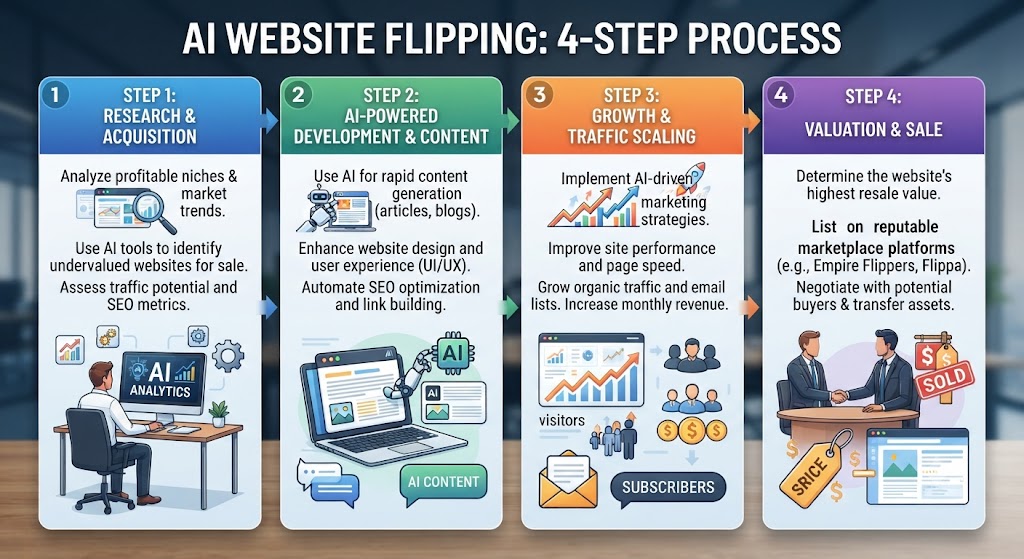
The digital asset market has grown rapidly over the past few years, creating exciting opportunities for entrepreneurs looking to build wealth online. One of the fastest-growing business models is AI Website Flipping—the process of buying undervalued websites, improving them with artificial intelligence, and selling them for significantly higher prices.
In the past, website flipping required countless hours of writing content, researching keywords, auditing SEO, designing pages, and analyzing performance. Today, AI has transformed that process. Modern AI tools can automate many repetitive tasks, helping beginners and experienced investors improve websites faster while reducing costs.
Whether you’re looking to create a side income or build a portfolio of profitable digital assets, understanding AI Website Flipping can give you a significant competitive advantage.
In this guide, you’ll learn how AI Website Flipping works, why it’s becoming increasingly popular, how to evaluate websites before purchasing them, and how AI can accelerate content creation, SEO, and website optimization while still requiring smart human decision-making.
What Is AI Website Flipping?
AI Website Flipping is the process of buying existing websites, improving them using artificial intelligence, and selling them later at a higher valuation.
Instead of building a website from scratch, investors purchase websites with untapped potential. They then use AI-powered tools to improve content, search engine optimization (SEO), design, user experience, and monetization before selling the website for profit.
Traditional website flipping often requires weeks or even months of manual work. AI dramatically speeds up tasks such as:
- Keyword research
- Content creation
- Content updates
- Technical SEO audits
- Competitor analysis
- Internal linking
- Website optimization
- Performance monitoring
Rather than replacing human expertise, AI acts as a productivity tool that allows website owners to accomplish more work in less time.
How AI Website Flipping Works
A typical AI website flipping project follows a simple cycle:
- Buy an undervalued website.
- Analyze strengths and weaknesses.
- Improve content using AI.
- Optimize SEO and user experience.
- Increase traffic and revenue.
- Sell the website at a higher valuation.
The more valuable the website becomes, the greater the potential return on investment.
Example of AI Website Flipping
Imagine purchasing an affiliate website earning $150 per month. Although the site already has some traffic, it suffers from outdated content, poor SEO, and weak monetization.
Using AI, you can:
- Update old articles.
- Publish new SEO-focused content.
- Improve page structure.
- Fix technical SEO issues.
- Add better affiliate opportunities.
- Increase internal linking.
- Improve user engagement.
After several months, the website could generate $600 per month, dramatically increasing its market value and making it attractive to buyers.
According to Grand View Research (2025), the global AI market continues to grow rapidly, encouraging businesses to automate repetitive digital tasks. — Source: Grand View Research, 2025
Why Is AI Website Flipping Important?
AI Website Flipping has become increasingly important because it helps entrepreneurs build valuable online businesses more efficiently than ever before.
Websites are no longer just blogs—they are digital assets capable of producing recurring monthly income through advertising, affiliate marketing, digital products, memberships, and online services.
Artificial intelligence allows website owners to focus more on strategy while automating repetitive tasks that previously consumed most of their time.
Benefits of AI Website Flipping
Some of the biggest advantages include:
- Faster content production
- Automated keyword research
- Better SEO optimization
- Improved user experience
- Lower outsourcing costs
- Higher scalability
- Faster website analysis
- Easier workflow management
- Consistent content planning
- Better data-driven decisions
These benefits allow investors to improve multiple websites simultaneously instead of managing every task manually.
Why Investors Prefer Digital Assets
Unlike many traditional businesses, websites often have:
- Low operating costs
- Global audiences
- Passive income potential
- Flexible monetization
- High scalability
- Strong resale value
Because of these characteristics, website investing has become increasingly attractive for entrepreneurs seeking long-term online income.
According to Statista (2025), global digital advertising spending continues growing, creating larger monetization opportunities for website owners. — Source: Statista, 2025
However, automation alone doesn’t guarantee success. The most profitable AI Website Flipping strategies combine AI-powered efficiency with careful planning, quality content, ethical SEO practices, and a deep understanding of audience needs.
How Does AI Website Flipping Work?
AI Website Flipping works by purchasing undervalued websites, improving them with AI-assisted workflows, increasing traffic and revenue, and selling them at a higher valuation.
Let’s explore each step in detail.
Step 1: Find Undervalued Websites
Finding the right website is arguably the most important part of AI Website Flipping. Buying the wrong website can result in months of wasted effort, while buying the right one can produce exceptional returns.
Look for websites that already receive consistent traffic but have obvious opportunities for improvement.
Ideal characteristics include:
- Low content quality
- Poor SEO optimization
- Weak monetization
- Slow website speed
- Outdated website design
- Inconsistent publishing
- Untapped keyword opportunities
- Stable organic traffic
Avoid websites that have experienced sudden traffic crashes unless you fully understand the cause.
Popular Website Marketplaces
Many successful investors purchase websites from trusted marketplaces such as:
- Flippa
- Motion Invest
- Empire Flippers
- Acquire.com
Each marketplace offers websites across different industries, price ranges, and monetization models.
What to Look for Before Buying
Before making an offer, ask questions like:
- Does the website solve a real problem?
- Is the niche evergreen?
- Can AI improve the content efficiently?
- Is there room for additional monetization?
- Are competitors outperforming the website?
Buying a website with growth potential is far more important than buying one that already appears perfect.
Step 2: Value the Website
Before investing your money, you need to determine whether the asking price accurately reflects the website’s true value.
Website valuation depends on multiple factors—not just revenue.
Factors That Affect Website Value
Evaluate the following carefully:
- Monthly earnings
- Organic visitors
- Domain authority
- Backlink profile
- Content quality
- Brand potential
- Email subscribers
- Revenue consistency
- Traffic diversity
- Growth opportunities
A website generating stable income with diversified traffic sources is generally more valuable than one relying on a single traffic channel.
Typical Website Multiples
Most content websites sell for approximately 30–45× monthly profit, although actual valuation varies depending on:
| Factor | Impact on Valuation |
|---|---|
| Stable Revenue | High |
| Organic Traffic | High |
| Strong Backlinks | High |
| Brand Recognition | Medium |
| Evergreen Niche | High |
| Email Subscribers | Medium |
| Multiple Income Sources | Very High |
Buyers often pay higher multiples for websites that demonstrate consistent performance over several months.
Step 3: Purchase the Website
Once you’ve identified a promising opportunity, it’s time to perform due diligence.
Never rely solely on screenshots or seller claims.
Instead, verify every important metric before completing the purchase.
Essential Due Diligence Checklist
Before purchasing:
- Verify Google Analytics
- Check Search Console
- Review backlink history
- Audit content quality
- Inspect technical SEO
- Confirm revenue proof
- Review historical traffic trends
- Check domain ownership history
- Analyze competitor performance
- Identify potential SEO penalties
A thorough review helps reduce the risk of purchasing a low-quality or penalized website.
Successful investors spend considerable time validating websites before making offers because avoiding a poor investment is just as important as finding a profitable one.
Step 4: Improve Content with AI
Content is often the fastest way to increase a website’s traffic and value.
AI dramatically accelerates the content improvement process while allowing creators to publish more consistently.
Instead of writing every article from scratch, AI can assist with planning, drafting, optimization, and updates.
Use AI to:
- Update outdated articles
- Generate new outlines
- Write first drafts
- Create FAQs
- Improve readability
- Optimize internal linking
- Suggest additional headings
- Expand topical coverage
- Improve content organization
Best Practices for AI-Assisted Content
Although AI saves significant time, every article should still undergo human review.
Make sure to:
- Verify facts and statistics.
- Add personal insights or expert opinions.
- Improve readability.
- Remove repetitive wording.
- Ensure content satisfies search intent.
- Maintain a consistent brand voice.
The best-performing websites use AI as an assistant—not a replacement—for high-quality content creation.
Step 5: Optimize SEO
Search engine optimization is one of the biggest factors affecting website value.
Higher rankings often lead to more visitors, greater revenue, and higher resale prices.
AI-powered SEO helps automate many optimization tasks while identifying opportunities that might otherwise be overlooked.
Areas to Improve
Focus on improving:
- Meta titles
- Meta descriptions
- Internal links
- Heading structure
- Page speed
- Schema markup
- Image optimization
- Content freshness
- Keyword targeting
- Mobile usability
According to BrightEdge (2025), organic search continues driving the majority of trackable website traffic. — Source: BrightEdge, 2025
Modern AI SEO platforms can also help identify keyword gaps, optimize semantic relevance, improve topical authority, and recommend internal linking opportunities that strengthen your site’s overall search performance.
With strong SEO foundations and consistently valuable content, your website becomes more attractive to both search engines and potential buyers.
Step 6: Increase Revenue
Once your website begins attracting consistent traffic, the next goal is to increase its monthly earnings. Since website valuations are typically based on monthly profit, even small revenue improvements can significantly increase the final selling price.
Rather than relying on a single income source, build multiple revenue streams to create a more stable and valuable business.
Popular Website Monetization Methods
Some of the most effective monetization strategies include:
- Affiliate marketing
- Display ads
- Sponsored content
- Digital products
- Memberships
- Online courses
- Email marketing
Diversifying income reduces business risk while making your website more appealing to buyers looking for predictable, recurring revenue.
affiliate marketing for beginners
Tips for Increasing Revenue
Before selling your website, consider these improvements:
- Promote higher-converting affiliate products.
- Create downloadable guides or templates.
- Grow an email list for repeat visitors.
- Add premium resources or memberships.
- Improve call-to-action placement.
- Optimize landing pages for conversions.
A website with several reliable income streams often commands a higher valuation than one dependent on a single monetization method.
Step 7: Grow Traffic
Traffic is one of the strongest indicators of a website’s long-term value. Buyers are willing to pay more for websites that show consistent growth and diversified traffic sources.
While AI can accelerate content production, long-term traffic growth still depends on a well-planned content strategy.
Proven Traffic Growth Strategies
Focus on:
- Content clusters
- Topical authority
- Link building
- Updating old content
- Social media promotion
- Email newsletters
Publishing helpful, in-depth content consistently signals expertise to both users and search engines.
Why Topical Authority Matters
Instead of publishing random articles, create groups of related content around one niche.
For example, a fitness website might cover:
- Workout routines
- Nutrition guides
- Supplement reviews
- Recovery techniques
- Weight-loss strategies
This structured approach improves internal linking, user experience, and search visibility while making your website more valuable.
Step 8: Sell the Website
After improving traffic, revenue, and overall site quality, it’s time to prepare your website for sale.
Buyers want transparency. Well-organized documentation builds trust and often leads to faster sales at better prices.
What Buyers Want to See
Include:
- Profit reports
- Google Analytics
- Search Console
- SOPs
- Growth opportunities
- Traffic sources
Providing complete documentation demonstrates professionalism and reduces uncertainty for potential buyers.
Preparing for a Successful Exit
Before listing your website:
- Organize financial records.
- Update outdated content.
- Fix technical SEO issues.
- Improve page speed.
- Document operating procedures.
- Highlight future growth opportunities.
A well-prepared website typically receives stronger offers than one with incomplete information.
What Types of Websites Are Best for AI Website Flipping?
The best websites for AI Website Flipping have stable traffic, scalable content opportunities, and multiple monetization options.
| Website Type | Difficulty | Profit Potential |
|---|---|---|
| Affiliate Blog | Medium | High |
| SaaS Website | High | Very High |
| Local Business Site | Easy | Medium |
| Display Ad Blog | Easy | High |
| Digital Product Website | Medium | High |
| Niche Authority Site | Medium | Very High |
Evergreen Niches
Some niches consistently perform well because they solve ongoing consumer needs.
Popular evergreen niches include:
- Health
- Fitness
- Finance
- Technology
- Education
- Home Improvement
- Pets
- Travel
These industries typically offer long-term content opportunities and multiple monetization methods.
Which AI Tools Are Best for Website Flipping?
The right AI tools can dramatically reduce manual work while improving productivity and consistency.
AI Writing Tools
- ChatGPT
- Claude
- Jasper
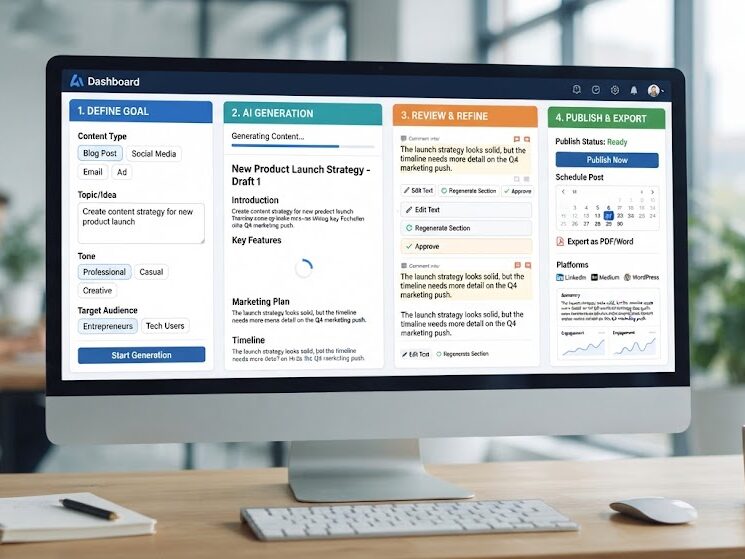
These platforms help generate outlines, first drafts, FAQs, content updates, and article ideas.
SEO Tools
- Surfer SEO
- Ahrefs
- Semrush
- SE Ranking
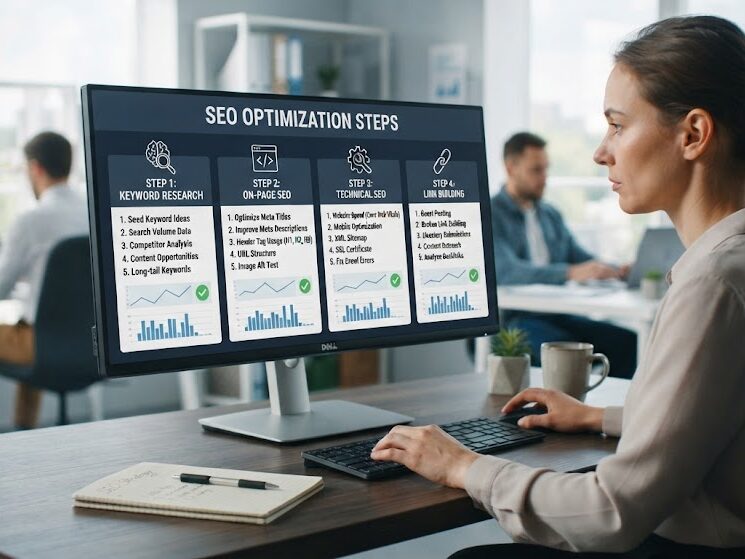
These tools assist with:
- Keyword research
- Competitor analysis
- Content optimization
- Backlink monitoring
- Technical SEO audits
Website Builders
- WordPress
- Elementor AI
- Framer AI
These platforms simplify website customization while supporting scalable content management.
Design AI Tools
- Canva AI
- Adobe Firefly
- Midjourney
Use these tools to create graphics, featured images, social media visuals, and branding assets.
Analytics Tools
Measure performance using:
- Google Analytics 4
- Google Search Console
- Microsoft Clarity
Analytics help identify user behavior, traffic trends, and optimization opportunities.
Automation Platforms
Reduce repetitive work with:
- Zapier
- Make
- n8n
Automation tools connect your favorite applications, saving hours every week while improving workflow efficiency.
How Can AI Improve SEO Before Selling a Website?
AI improves SEO by identifying keyword opportunities, optimizing content, fixing technical issues, and strengthening topical authority.
Modern AI platforms can analyze competing pages, recommend missing headings, improve internal linking, and generate optimized FAQ sections designed to increase visibility in Featured Snippets and AI-powered search experiences.
Other ways AI enhances SEO include:
- Finding low-competition keywords
- Updating outdated articles
- Optimizing metadata
- Detecting content gaps
- Improving readability
- Suggesting schema markup
- Monitoring ranking changes
According to HubSpot (2025), marketers increasingly use AI for content optimization and productivity improvements. — Source: HubSpot State of Marketing, 2025
Despite these advantages, AI-generated content should always be reviewed by a human editor. Accurate information, original insights, and helpful content remain essential for sustainable search performance.
How Much Money Can You Make with AI Website Flipping?
The income potential of AI Website Flipping depends on several factors, including:
- Purchase price
- Website niche
- Existing traffic
- Monetization strategy
- Quality of improvements
- Final exit valuation
Example
| Metric | Value |
|---|---|
| Purchase Price | $2,500 |
| Monthly Revenue | $120 |
| Revenue After Improvements | $650 |
| Estimated Exit Multiple | 38× |
| Selling Price | $24,700 |
| Approximate Profit | $22,200 |
This example demonstrates how increasing monthly earnings can dramatically raise a website’s resale value.
Results vary depending on execution, market conditions, and buyer demand, but strategic improvements often generate substantial returns over time.
What Are the Biggest Risks of AI Website Flipping?
Like any investment, AI Website Flipping involves risks.
Understanding these challenges helps reduce costly mistakes.
Common Mistakes
- Buying penalized domains
- Ignoring backlink quality
- Publishing AI spam
- Weak monetization
- Poor UX
- No email list
- Overpricing listings
Other risks include:
- Search engine algorithm updates
- Declining niche demand
- Seasonal traffic fluctuations
- Poor due diligence
- Overreliance on automation
Diversifying traffic sources and maintaining high-quality content can significantly reduce long-term risk.
Is AI Website Flipping Worth It for Beginners?
Yes—AI Website Flipping can be an excellent business model for beginners willing to learn the fundamentals of SEO, content marketing, analytics, and website valuation.
AI reduces repetitive work, making it easier to manage websites without hiring large teams.
However, success still depends on thoughtful decision-making and consistent execution.
Skills Every Beginner Should Learn
Focus on mastering:
- SEO
- Analytics
- Monetization
- Content optimization
- Website valuation
Start with a small, affordable website rather than making a large investment.
The lessons learned from your first successful flip are often worth more than months of reading tutorials.
What’s Next?
The next step is creating a repeatable AI Website Flipping workflow that you can refine with every project.
Follow this roadmap:
- Choose a profitable niche.
- Learn website valuation.
- Buy one small website.
- Improve SEO using AI.
- Increase revenue.
- Document every process.
- Sell for profit.
- Repeat with larger websites.
Over time, you’ll develop systems that allow you to scale efficiently and build a portfolio of valuable digital assets generating recurring income.
Conclusion
AI Website Flipping combines artificial intelligence with strategic website investing to create valuable digital assets that generate recurring income and profitable exits. By automating tasks such as content creation, SEO analysis, keyword research, and workflow management, AI allows entrepreneurs to improve websites faster than traditional methods while reducing manual effort.
However, successful website flipping is about much more than automation. Careful website selection, thorough due diligence, high-quality content, effective monetization, and a long-term growth strategy remain the foundation of profitable investments. AI should enhance your decision-making—not replace it.
Start with one manageable project, focus on delivering genuine value to users, and continuously refine your systems with each flip. As your skills grow, you’ll be able to scale from a single profitable website to an entire portfolio of digital assets that generate consistent income and attractive resale opportunities.
FAQs
What is AI Website Flipping?
AI Website Flipping is buying, improving, and selling websites with AI to increase their value and profit.
Is AI Website Flipping profitable?
Yes. Improving traffic and revenue can significantly increase a website’s resale value.
Do I need coding skills?
No. Most AI tools and website builders require little or no coding knowledge.
How much money do I need to start?
You can start with a few hundred dollars, depending on the website you buy.
Which AI tools are best?
ChatGPT, Claude, Jasper, Surfer SEO, Ahrefs, Semrush, and Canva AI are among the best options.
How long does a website flip take?
Most website flips take between 3 and 12 months, depending on growth and improvements.
Can AI replace human work?
No. AI automates repetitive tasks, but human strategy and editing remain essential.
Which websites are best to flip?
Affiliate blogs, niche websites, SaaS sites, and digital product websites usually offer the best returns.
How are websites valued?
Websites are valued based on monthly profit, traffic, backlinks, niche demand, and growth potential.
Is AI Website Flipping good for beginners?
Yes. Starting with one small website is the best way to learn and build experience.