
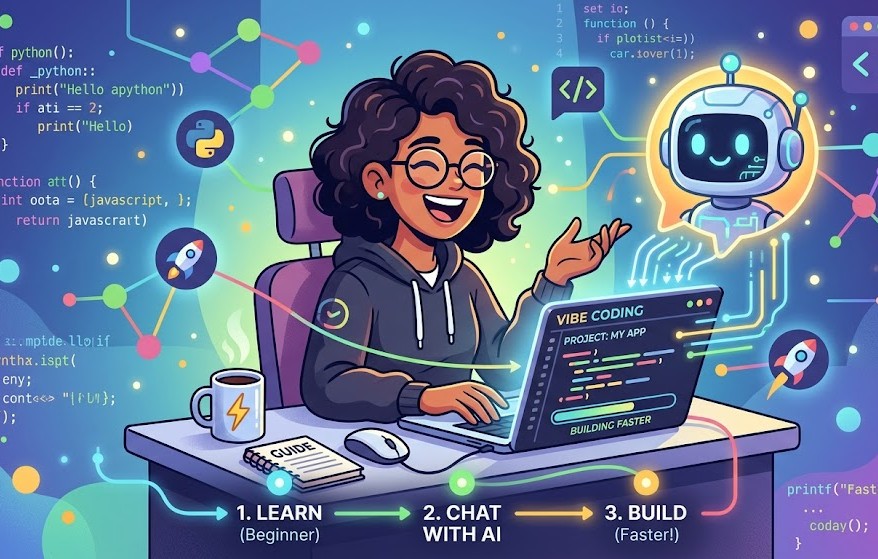
You’ve probably seen developers, entrepreneurs, and creators talking about building apps simply by describing what they want in plain English. Instead of manually writing every line of code, they use AI tools to generate software through natural-language prompts.
This approach is known as vibe coding, and it’s changing how software is built.
Whether you’re a developer looking to boost productivity or a beginner with no coding experience, vibe coding can help you create websites, applications, automations, and MVPs faster than ever before.
In this guide, you’ll learn what vibe coding is, how it works, its benefits and limitations, the best AI coding tools, and how to get started successfully.
What Is Vibe Coding?
Vibe coding is an AI-assisted software development approach where users describe desired functionality in natural language and AI generates much of the code required to build it.
Instead of focusing heavily on programming syntax, users focus on explaining outcomes and refining results.
For example, you might type:
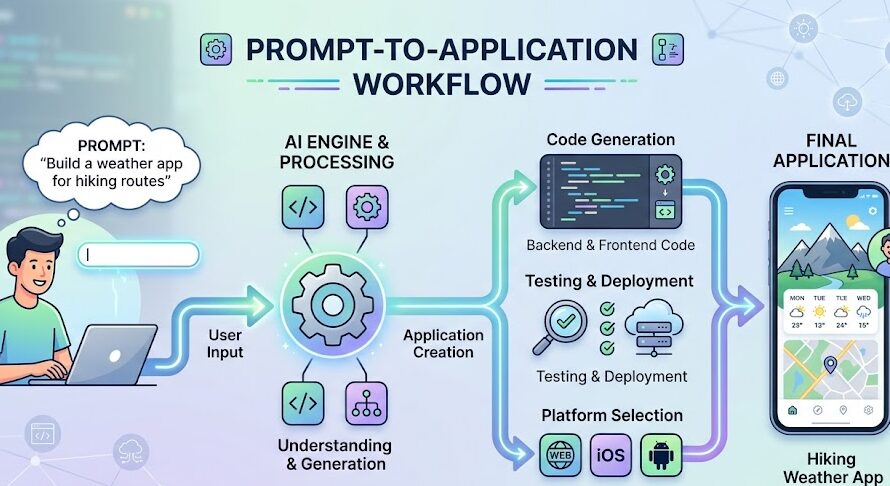
“Build a customer feedback dashboard with user authentication, analytics, and sentiment analysis.”
An AI coding assistant can generate much of the frontend, backend, and database structure within minutes.
The developer’s role shifts from manually writing code to guiding, reviewing, testing, and improving AI-generated outputs.
Key Takeaways
- Vibe coding uses AI to generate software from natural-language instructions.
- Developers focus more on outcomes and less on manual coding.
- AI coding tools accelerate prototyping and MVP development.
- Human review remains essential for quality and security.
- Clear prompts significantly improve software quality.
- Modern AI tools can build websites, apps, automations, and full-stack software.
Why Is Vibe Coding Becoming So Popular?
Vibe coding has gained massive popularity because it dramatically reduces the time required to create software.
Traditionally, building applications required significant programming knowledge and weeks or months of development work. AI-assisted development makes software creation faster and more accessible.
Major Benefits Driving Adoption
Faster Development
AI can generate large amounts of code within seconds, reducing development timelines significantly.
Lower Costs
Businesses can reduce manual development hours and build prototypes more efficiently.
Better Productivity
Developers spend less time on repetitive tasks and more time solving important problems.
Greater Accessibility
Non-developers can participate in software creation without mastering multiple programming languages.
According to GitHub’s Developer Survey, over 90% of developers have used AI coding tools in some part of their workflow.
Source: GitHub Developer Survey, 2024
How Does Vibe Coding Work?
Vibe coding combines natural-language instructions, AI-generated code, human review, and iterative improvement.
The process is simple but highly effective.
The Core Workflow
- Define the desired outcome.
- Write a detailed prompt.
- Generate code using AI.
- Review the output.
- Refine through follow-up prompts.
- Test functionality and performance.
- Deploy the application.
For example, a user could request:
“Create a SaaS landing page with pricing tables, testimonials, contact forms, and Stripe payment integration.”
The AI may generate the layout, components, backend logic, and deployment instructions.
Human Oversight Remains Essential
AI can generate code quickly, but it is not perfect.
Developers should always review code for:
- Security vulnerabilities
- Performance issues
- Maintainability
- Scalability concerns
- Logic errors
Successful vibe coding combines AI speed with human judgment.
Different Types of Vibe Coding
Vibe coding can be used in several ways depending on the user’s goals and technical experience.
Prompt-Based Vibe Coding
Users describe requirements directly to an AI assistant and receive generated code.
Example:
“Create a personal portfolio website with dark mode and contact forms.”
AI Pair Programming
Developers work alongside AI tools that suggest improvements, bug fixes, and code optimizations.
Agentic Development
Advanced AI agents can perform multi-step development tasks such as generating code, testing functionality, fixing bugs, and preparing deployments.
No-Code + AI Development
AI combines with visual builders, allowing users to create applications without traditional programming knowledge.
How to Start Vibe Coding as a Beginner
Getting started is easier than many people think.
Step 1: Choose an AI Coding Tool
Select a beginner-friendly platform that supports natural-language instructions.
Step 2: Learn Basic Prompt Engineering
The quality of your prompts directly affects the quality of generated software.
Step 3: Build Small Projects First
Start with simple projects such as:
- Personal websites
- To-do apps
- Budget trackers
- Portfolio pages
- Content automation tools
Step 4: Test Everything
Never assume AI-generated code is production-ready.
Always validate:
- Functionality
- Security
- Performance
- User experience
Who Benefits Most From Vibe Coding?
Vibe coding helps both technical and non-technical users.
Developers
Developers use AI to generate boilerplate code, documentation, and test cases faster.
Startup Founders
Founders can validate ideas and create MVPs before investing heavily in development.
Freelancers and Agencies
AI allows service providers to complete projects more efficiently.
Students and Beginners
Beginners can gain practical software-building experience without mastering every programming language first.
Main Benefits of Vibe Coding
Faster Software Creation
Projects that once took days can often be built in hours.
Reduced Development Costs
Automation lowers the amount of manual coding required.
Rapid Experimentation
Teams can test multiple ideas quickly without significant investment.
Increased Accessibility
More people can participate in software development regardless of technical background.
According to Stack Overflow’s Developer Survey, AI-assisted coding adoption continues to grow among developers worldwide.
Source: Stack Overflow, 2024
Risks and Limitations of Vibe Coding
While powerful, vibe coding is not without risks.
Security Issues
AI-generated code may contain vulnerabilities that require expert review.
Technical Debt
Poorly structured AI-generated code can become difficult to maintain over time.
Hallucinations
AI sometimes generates incorrect or non-functional code while appearing confident.
Architectural Challenges
Complex enterprise systems often require human planning and oversight.
According to Stanford University research, AI-generated code can introduce security weaknesses if not reviewed carefully.
Source: Stanford University, 2024
How to Write Better AI Coding Prompts
Prompt quality often determines project success.
Poor Prompt
Build a website.
Better Prompt
Build a responsive SaaS landing page using React and Tailwind CSS with pricing tables, testimonials, dark mode support, and email signup forms.
Best Practices
- Be specific.
- Include technical requirements.
- Define desired outcomes.
- Specify frameworks and integrations.
- Refine outputs through multiple prompt rounds.
Clear prompts consistently produce better software.
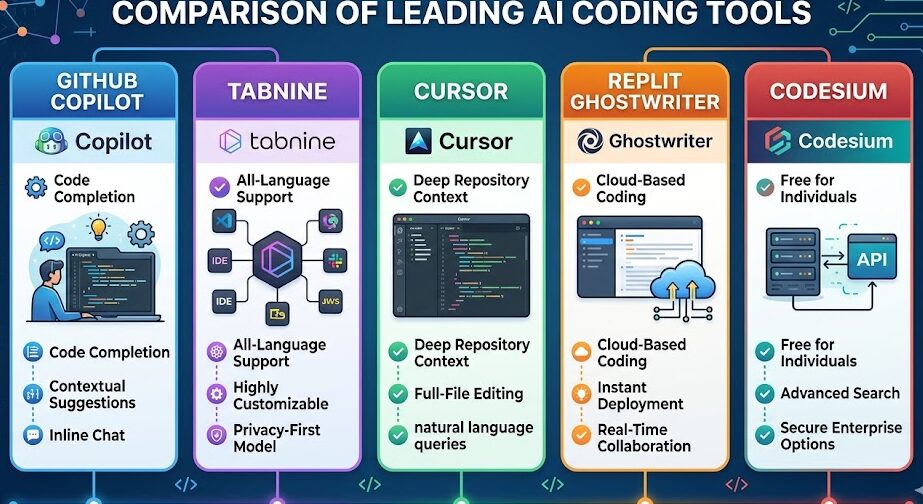
Best AI Tools for Vibe Coding
Several AI platforms have become popular among developers and creators.
| Tool | Best For |
|---|---|
| ChatGPT | General coding assistance |
| GitHub Copilot | AI pair programming |
| Cursor | AI-powered development workflows |
| Replit AI | Rapid prototyping |
| Claude | Long-context planning |
| Bolt.new | Full-stack app generation |
| Lovable | Startup MVP creation |
Choosing the Right Tool
- Beginners should prioritize ease of use.
- Developers should evaluate integrations.
- Businesses should assess collaboration and scalability.
Best Projects for Vibe Coding
Vibe coding works particularly well for:
- SaaS MVPs
- Landing pages
- Internal dashboards
- Customer portals
- Marketing automation systems
- Content management tools
- Productivity applications
Many startups now use AI-assisted development to validate ideas before seeking investment.
The Future of Vibe Coding
The future of software development will likely involve even greater AI assistance.
Emerging AI systems are becoming capable of:
- Planning projects
- Writing code
- Running tests
- Fixing bugs
- Deploying applications
Future tools may allow users to build software using:
- Voice commands
- Screenshots
- Sketches
- Diagrams
- Natural conversations
According to Gartner, AI-enhanced development tools are expected to become standard across many software teams in the coming years.
Source: Gartner, 2025
What Should Beginners Do Next?
If you’re interested in vibe coding, start small.
- Choose one AI coding platform.
- Build a simple project.
- Learn prompt-writing fundamentals.
- Test everything thoroughly.
- Document lessons learned from each project.
Consistent experimentation is the fastest path to improvement.
Conclusion
Vibe coding is transforming software development by allowing users to create applications through natural-language instructions and AI assistance. By reducing technical barriers and accelerating development, AI coding tools are making software creation more accessible than ever before.
However, successful vibe coding requires more than simply chatting with AI. Clear prompts, testing, iterative refinement, and human oversight remain essential for building reliable software.
Whether you’re a developer, founder, freelancer, or beginner, learning how to build apps with AI is becoming an increasingly valuable skill. Start with small projects, improve your prompting abilities, and gradually develop a workflow that combines human creativity with AI-powered execution.
FAQs
What is vibe coding?
Vibe coding is an AI-assisted software development approach where users describe desired functionality in natural language and AI generates much of the code.
Can beginners use vibe coding?
Yes. Many AI coding platforms are designed for beginners and allow users to build applications through simple prompts.
Does vibe coding replace developers?
No. AI can accelerate development, but human oversight remains necessary for security, testing, architecture, and maintenance.
What are the best tools for vibe coding?
Popular tools include ChatGPT, GitHub Copilot, Cursor, Claude, Replit AI, Bolt.new, and Lovable.
Can vibe coding build full applications?
Yes. Modern AI platforms can generate websites, mobile apps, dashboards, automation workflows, and full-stack applications.
What are the risks of vibe coding?
Potential risks include security vulnerabilities, incorrect code generation, technical debt, and overreliance on AI outputs.
How do I improve my AI coding prompts?
Use clear requirements, specify technologies, define goals, and refine outputs through multiple prompt iterations.
Is vibe coding the future of software development?
Many experts believe AI-assisted development will become a standard part of software engineering workflows, making vibe coding increasingly important.