
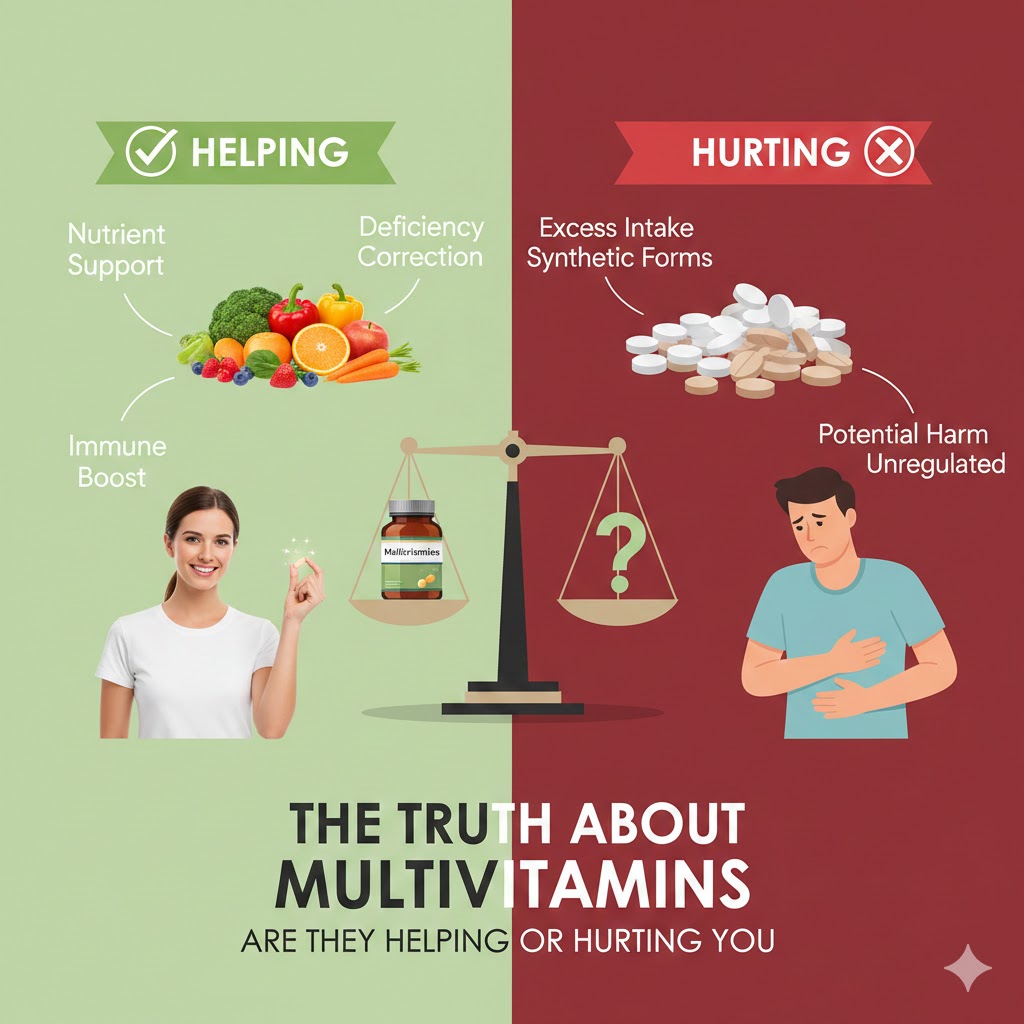
Walk down any pharmacy aisle and you’ll see hundreds of multivitamins promising better energy, stronger immunity, sharper focus, and longer life. For decades, they’ve been marketed as nutritional insurance — a simple way to “cover your bases.”
But recent research and clinical observations have raised a harder question:
Are multivitamins actually helping, or could they be doing more harm than good?
This article explores The Truth About Multivitamins — what science really says, who benefits, who doesn’t, and how to decide whether they belong in your routine.
This is educational content, not medical advice.
1. Why Multivitamins Became So Popular
Multivitamins didn’t rise by accident. They filled a real concern.
Key reasons for their popularity:
- Modern diets became more processed
- People worried about nutrient gaps
- Busy lifestyles reduced meal quality
- Marketing positioned vitamins as “easy health”
Multivitamins promised convenience in a complicated world.
2. What Multivitamins Are Actually Designed to Do
At their core, multivitamins aim to:
- Prevent nutrient deficiencies
- Provide baseline vitamin and mineral coverage
- Support general health when diet falls short
They were never designed to:
- Replace whole foods
- Treat disease
- Boost performance beyond normal function
Understanding this gap is central to The Truth About Multivitamins.
3. What Science Says About Multivitamins and Overall Health
Large population studies show mixed results.
What research generally finds:
- Multivitamins reduce certain deficiencies
- Little evidence of reduced mortality in healthy adults
- Minimal impact on heart disease or cancer risk
- Benefits vary based on age, diet, and health status
For many healthy people with adequate diets, the effect is neutral — not harmful, but not transformative.
4. When Multivitamins Can Actually Help
Multivitamins may be beneficial in specific situations.
Groups that may benefit include:
- Older adults with reduced nutrient absorption
- People with restricted diets
- Individuals with diagnosed deficiencies
- Certain stages of pregnancy (with targeted formulas)
- People with malabsorption conditions
In these cases, multivitamins act as support, not enhancement.
5. The Hidden Problem: Too Much of a Good Thing
More isn’t always better.
Potential issues with multivitamins include:
- Excess fat-soluble vitamins (A, D, E, K)
- Mineral overload (iron, zinc, selenium)
- Nutrient interactions that reduce absorption
- Masking underlying health problems
This is an often-ignored part of The Truth About Multivitamins.
6. Why Whole Foods Work Better Than Pills
Whole foods contain more than isolated nutrients.
They provide:
- Fiber
- Phytochemicals
- Natural nutrient ratios
- Synergistic compounds
A vitamin pill may deliver nutrients, but it doesn’t replicate the complexity of real food.
7. Multivitamins and Energy: Myth vs Reality
Many people take multivitamins hoping for more energy.
Reality check:
- Vitamins don’t create energy
- They support energy metabolism only if deficient
- If you’re not deficient, extra vitamins won’t increase energy
Feeling tired usually has deeper causes like sleep, stress, or diet quality.
8. Can Multivitamins Be Harmful?
For most people, standard multivitamins are safe — but context matters.
Possible risks:
- High-dose formulations taken long-term
- Combining multiple supplements unknowingly
- Self-prescribing without testing
- Taking iron when not needed
This is where “helpful” can quietly turn into “harmful.”
9. The Supplement Industry Reality
Not all multivitamins are equal.
Concerns include:
- Variable quality control
- Inaccurate labeling
- Poor bioavailability
- Marketing over science
Choosing blindly is not the same as choosing wisely.
10. How to Decide If You Need a Multivitamin
Ask better questions instead of defaulting to pills.
Consider:
- How balanced is your diet?
- Do you have known deficiencies?
- Are you in a high-risk group?
- Has a professional recommended one?
The Truth About Multivitamins is that they’re tools — not requirements.
11. Smarter Alternatives to Daily Multivitamins
Instead of a blanket approach, consider:
- Targeted supplements based on needs
- Improving diet quality first
- Periodic blood testing
- Seasonal or situational supplementation
Precision beats guesswork.
12. Multivitamins for Aging Adults: Special Considerations
As we age:
- Absorption declines
- Appetite changes
- Medication interactions increase
Some seniors benefit from targeted supplementation, but high-dose multivitamins can increase risk without guidance.
13. Common Myths About Multivitamins
Let’s clear up confusion:
- “They can’t hurt” — not always true
- “More vitamins = more health” — false
- “They replace vegetables” — no
- “Everyone needs one” — not supported
Belief doesn’t equal benefit.
14. What Doctors and Nutrition Experts Emphasize Today
Modern guidance increasingly focuses on:
- Food-first nutrition
- Individual assessment
- Avoiding unnecessary supplementation
- Treating deficiencies, not fears
This perspective aligns with The Truth About Multivitamins.
15. Final Thoughts: Helpful Tool or False Security?
Multivitamins aren’t villains — but they’re not heroes either.
They can:
- Help fill gaps when truly needed
- Offer peace of mind in specific situations
They cannot:
- Fix poor diets
- Replace healthy habits
- Guarantee better health
Understanding The Truth About Multivitamins means using them intentionally, not automatically.
FAQ: The Truth About Multivitamins
Are multivitamins necessary for everyone?
No. Many people get sufficient nutrients from a balanced diet.
Can multivitamins cause harm?
High doses or unnecessary supplementation can cause imbalances over time.
Do multivitamins improve energy or immunity?
Only if correcting a deficiency. They don’t boost normal function.
Is it better to get nutrients from food?
Yes. Whole foods provide nutrients in more effective forms.
Should older adults take multivitamins?
Some may benefit, but targeted supplementation is often safer.
Are expensive multivitamins better?
Not always. Quality and formulation matter more than price.
How do I know if I need supplements?
Diet review, symptoms, and blood tests provide clearer answers than guesswork.
More Related Topics:
Stem Cell Therapy for Joint Pain: The Regenerative Medicine Frontier
Platelet-Rich Plasma Injections: I Tried PRP for Tendonitis (My Honest Experience)
Best Anti-Inflammatory Foods for Joint Pain Relief (Backed by Science)