
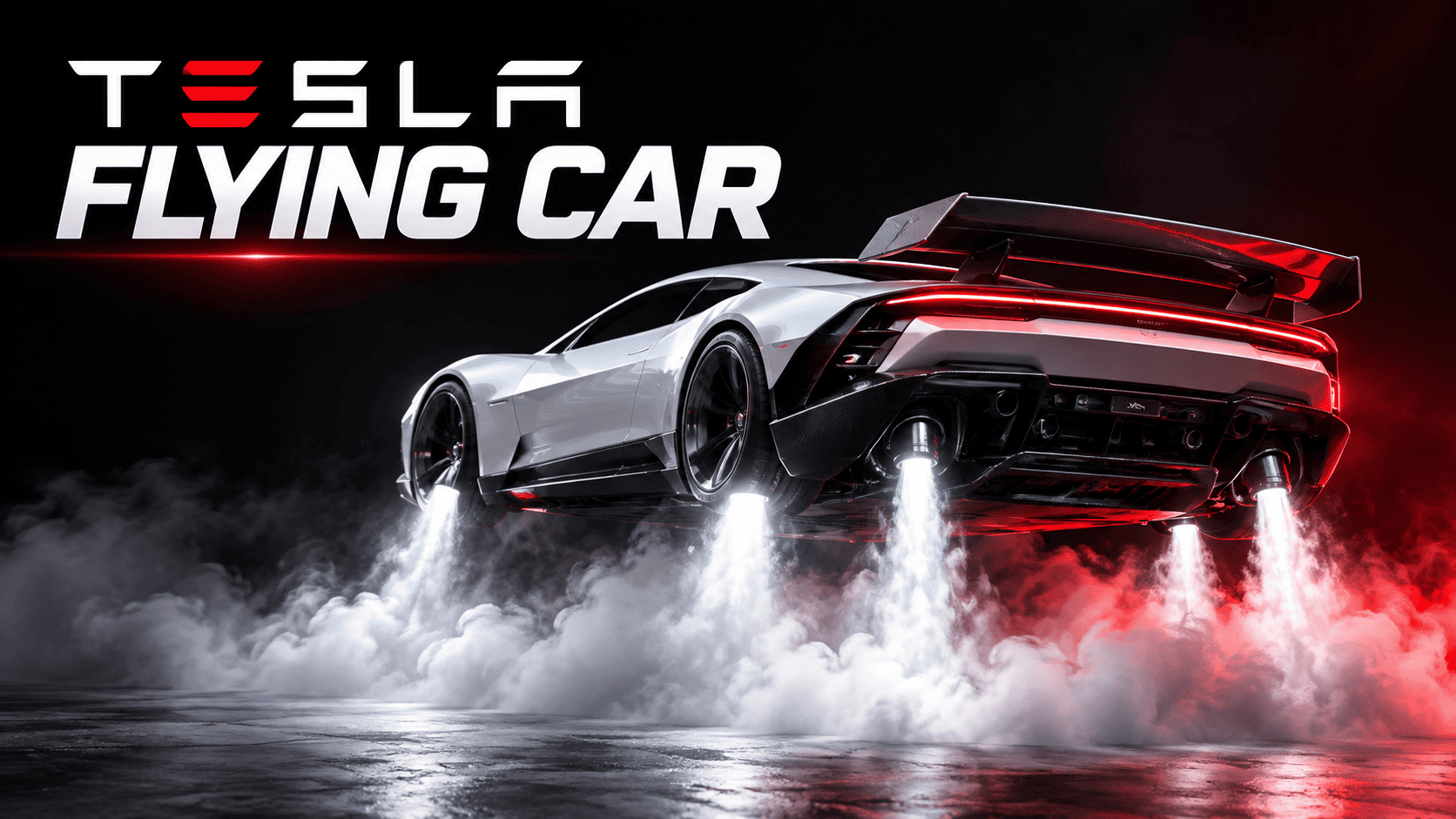
Tesla has captured attention with its futuristic electric vehicles, and the idea of a Tesla flying car has become even more intriguing following the October 2026 Roadster demonstration. However, a vehicle performing aerial stunts is not necessarily a practical flying car.
So, what did Tesla actually demonstrate? How could its rocket-inspired technology work, how much might a Tesla flying car cost, and when could buyers expect it to become available?
In this guide, we explore the reported Roadster demonstration, its propulsion technology, expected pricing, potential flight capabilities, safety requirements, and the differences between a rocket-assisted sports car and a purpose-built electric aircraft.
What Is the Tesla Flying Car?
The Tesla flying car refers to the concept of Tesla-branded personal flight, including the rocket-assisted Roadster demonstrated in October 2026. Unlike a conventional electric car, this experimental configuration uses additional propulsion technology to perform brief aerial maneuvers.
Reuters reported that Tesla unveiled a redesigned Roadster developed in collaboration with SpaceX, featuring thrusters and a system that helped the vehicle move along an inverted ramp.
However, this demonstration should not be confused with proof of a production-ready aircraft capable of routinely transporting passengers through the sky.
The distinction is important because a vehicle that briefly lifts off the ground does not necessarily have the propulsion, endurance, flight controls, or regulatory approval required for everyday air travel.
Why Does the Tesla Flying Car Matter?
The Tesla flying car concept matters because it brings together electric vehicle innovation, rocket-inspired propulsion, and the long-standing ambition to make personal transportation faster and more flexible.
For technology enthusiasts, it raises an interesting question: What happens when automotive engineering meets aerospace engineering?
Tesla has an established reputation for developing electric vehicles and pursuing ambitious technology projects. Consequently, a Roadster capable of performing unusual aerial maneuvers naturally attracts attention from car enthusiasts, engineers, and potential buyers.
However, excitement should not be confused with practical readiness. A vehicle that briefly rises above other cars has demonstrated a specific maneuver, not necessarily the safety, efficiency, and reliability required for daily commuting.
A flying demonstration proves that a particular maneuver was performed; it does not establish that a complete flying transportation system is ready for public use.
Is the Tesla Flying Car Real in 2026?
Yes, Tesla demonstrated a rocket-assisted Roadster performing aerial maneuvers in October 2026. However, the demonstration does not establish that a fully operational, certified flying car for everyday use is available.
The difference between a brief aerial maneuver and sustained flight is substantial. A practical flying vehicle must maintain controlled movement, manage its energy or propellant supply, respond to emergencies, and land safely.
Tesla’s official Roadster page presents the vehicle as an electric sports car. The page has historically advertised performance figures including:
- 0–100 km/h: 2.1 seconds.
- Top speed: Above 400 km/h.
- Driving range: 1,000 km.
These are published Roadster performance claims, not independently verified flight specifications.
Source: Tesla, Roadster official page.
Therefore, the reported demonstration should be understood as an example of experimental vehicle technology rather than confirmation that Tesla has launched a commercially available flying car.
What Did Tesla Demonstrate With the Flying Roadster in October 2026?
According to Reuters, the October 15, 2026, demonstration featured a redesigned two-seat Roadster using SpaceX-related thruster technology. The vehicle performed aerial turns and jumps, while a suction system helped it travel upside down along a ramp.
Source: Reuters, 2026.
The demonstration attracted attention because it suggested that rocket-inspired technology could be incorporated into an unconventional sports car configuration.
Reuters also reported a planned production start in 2028. Nevertheless, several important details remain unestablished by the demonstration:
- Sustained flight duration.
- Practical airborne travel range.
- Final production specifications.
- Flight performance under different weather conditions.
- Aviation certification and approval.
- Confirmed customer delivery dates for a flight-capable vehicle.
A planned production target is not the same as a guaranteed release date. Moreover, a vehicle’s demonstrated features do not automatically become part of its eventual customer version.
How Does the Tesla Flying Roadster Work?
The Tesla flying Roadster uses directed thrust to produce brief aerial movement rather than relying on the conventional aerodynamic lift generated by airplane wings.
The reported design incorporates cold-gas thrusters and SpaceX-related technology, although its complete production configuration has not been established.
To understand the concept, it helps to distinguish between generating a short upward force and maintaining controlled flight.
How Do Rocket Thrusters Create Lift?
A thruster expels pressurized gas in one direction, producing a force in the opposite direction. If the resulting upward force exceeds the vehicle’s weight for long enough, the vehicle can rise temporarily.
For example, a short burst of upward thrust can lift a vehicle above the ground. However, keeping it airborne requires continuous force, adequate propellant, and precise control.
A vehicle must also manage its orientation and movement to avoid instability. Without sufficient thrust and reliable control, it cannot maintain a safe flight path.
This is why a brief jump does not prove that the vehicle can fly between cities or operate as an everyday aircraft.
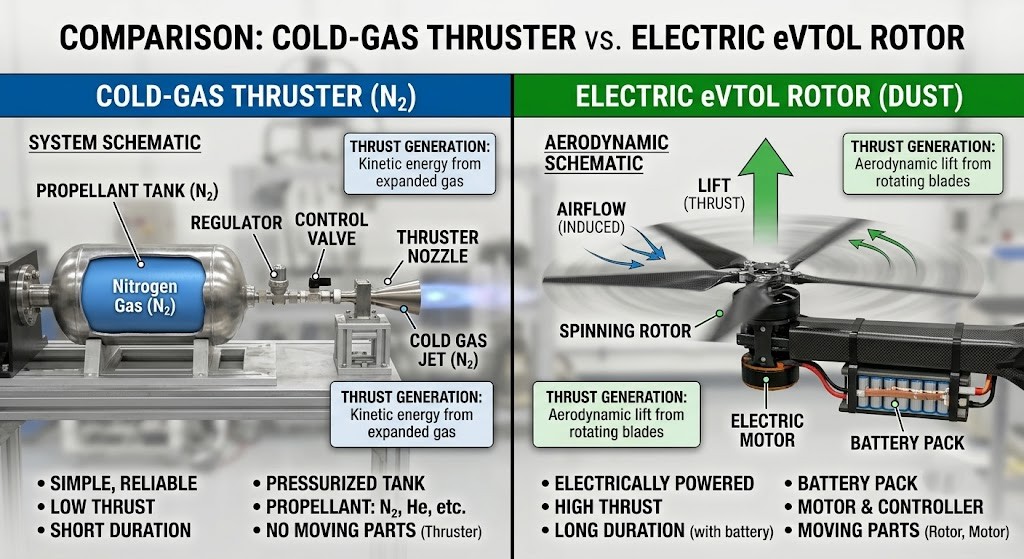
What Is the Difference Between Thrusters and eVTOL Propulsion?
An eVTOL aircraft is an electric vertical takeoff and landing aircraft designed to rise, descend, and sustain controlled flight using its propulsion system. Many designs use electric rotors, distributed propellers, or other lifting arrangements.
Rocket-style cold-gas thrusters and electric eVTOL propulsion serve different purposes.
| Feature | Cold-gas thrusters | Electric eVTOL propulsion |
|---|---|---|
| Basic operation | Expels pressurized gas to produce thrust | Uses electric motors and lifting propellers or rotors |
| Typical application | Brief thrust bursts and directional control | Vertical takeoff, landing, and controlled flight |
| Energy or propellant | Requires a supply of pressurized gas | Requires electrical energy from a suitable power source |
| Sustained lift | Depends on available propellant and system design | A core design objective |
| Flight suitability | Cannot be established from a brief demonstration | Depends on the aircraft’s design, testing, and certification |
Electric rotors can provide sustained lift as long as the aircraft has sufficient power and energy reserves. Cold-gas thrusters, by contrast, depend on their available pressurized-gas supply and are not automatically suitable for sustained passenger flight.
What Is the Expected Tesla Flying Car Price?
The Tesla flying car price has not been confirmed as the price of a certified flying vehicle. The redesigned Roadster’s pricing, configuration, and production plans must be distinguished from those of any hypothetical aircraft version.
Reuters reported a 2028 production target for the Roadster, but the demonstration alone does not establish the final price of a flight-capable consumer product.
Source: Reuters, 2026.
Before estimating ownership costs, potential buyers would need verified information about several factors:
- Vehicle configuration: The final design, passenger capacity, and propulsion system.
- Thruster maintenance: Servicing requirements and the cost of replacing or replenishing propellant.
- Battery expenses: Charging costs, battery maintenance, and potential replacement.
- Insurance: Coverage for road use and any approved flight operations.
- Storage: Requirements for parking, charging, and potentially storing the vehicle at suitable aviation facilities.
- Operating expenses: Inspection, maintenance, and other aviation-related costs.
- Licensing and certification: Applicable permissions for driving and flying.
Consequently, unofficial estimates for a fully functional Tesla flying car should be treated as speculation rather than a confirmed commercial offer.
The final price would depend on the production design, technology, manufacturing costs, and regulatory requirements.
When Will the Tesla Flying Car Be Available to Buy?
Tesla’s reported 2028 production target applies to the redesigned Roadster, not necessarily to a certified vehicle capable of routine passenger flight.
Production targets can change, and a demonstration does not guarantee that every showcased feature will appear in the customer version.
Additionally, the demonstration does not establish that consumers will be able to operate the vehicle as a conventional aircraft.
Before making a reservation or financial commitment, prospective buyers should verify:
- The final production configuration and confirmed specifications.
- Whether the advertised aerial capabilities are included in the customer vehicle.
- Official reservation terms and refund policies.
- Confirmed production and delivery commitments.
- Relevant road and aviation regulatory approvals.
Until Tesla confirms these details, the reported Roadster production target should not be interpreted as a guaranteed release date for an everyday flying car.
What Is the Difference Between the Tesla Flying Roadster and an eVTOL Aircraft?
The Tesla flying Roadster is a sports car demonstrated with brief aerial capabilities, while an eVTOL aircraft is purpose-built for vertical takeoff and controlled flight.
Although both concepts involve movement beyond conventional road transportation, their engineering goals differ considerably.
| Feature | Tesla flying Roadster | Purpose-built eVTOL |
|---|---|---|
| Primary design | High-performance sports car | Electric aircraft |
| Propulsion | Reported cold-gas thrusters | Typically electric rotors or propellers |
| Demonstrated capability | Brief aerial maneuvers | Depends on the specific aircraft and test status |
| Sustained flight | Not established by the demonstration | A core design objective |
| Passenger capacity | Two seats reported for the Roadster | Varies by model |
| Commercial flight readiness | Not established | Varies by aircraft and certification status |
For example, an electric air taxi is designed to carry passengers along a planned route, subject to its operating capabilities and approvals. A rocket-assisted sports car demonstration, by contrast, focuses on extraordinary vehicle maneuvers.
This distinction matters because a vehicle that jumps into the air is not automatically an aircraft suitable for passenger transportation.
Purpose-built eVTOL aircraft also face substantial technical and regulatory challenges. Their development does not automatically mean that they are certified or available for commercial passenger service.
Is the Tesla Flying Car Safe and Legally Approved?
The Tesla flying car cannot be considered approved for everyday flight solely because it completed a demonstration. A practical flying vehicle would need reliable flight controls, safe landing procedures, adequate emergency reserves, and compliance with applicable aviation regulations.
Combining road and flight capabilities introduces several engineering challenges.
Key Safety Considerations
- Stability: The vehicle must remain controllable during takeoff, movement, and landing.
- Emergency response: It needs a safe response to propulsion failure or loss of control.
- Weather conditions: Wind, rain, visibility, and temperature can affect safe operation.
- Energy and propellant: The propulsion system must provide sufficient performance without excessive weight.
- Noise and maintenance: High-pressure propulsion systems require appropriate operating procedures and servicing.
- Certification: Road approval does not automatically authorize aircraft operation.
Which Authorities Regulate Flying Vehicles?
In the United States, the Federal Aviation Administration (FAA) oversees relevant civil aviation requirements.
In India, the Directorate General of Civil Aviation (DGCA) is a key authority for civil aviation regulation.
The exact requirements depend on the vehicle’s design, operating category, intended use, and jurisdiction. A vehicle intended for both roads and airspace may need to satisfy separate sets of requirements.
Therefore, a successful demonstration should not be treated as evidence of regulatory approval. Prospective buyers should look for official certification records and clear information about where and how the vehicle may legally operate.
What Is the Expected Range and Flight Time of a Tesla Flying Car?
The Tesla flying car’s flight range and flight duration remain unestablished by the reported demonstration. Automotive driving range cannot be used as a substitute for aircraft endurance because flight requires different energy, propulsion, and weight calculations.
For example, a Roadster might advertise a substantial driving range while its thruster system supports only short bursts of aerial movement.
The energy requirements for remaining airborne can differ substantially from those for driving on roads. The final result depends on the propulsion design, vehicle mass, available energy or propellant, and flight conditions.
Without verified flight-test data, specifications for continuous flight time, cruising speed, and airborne distance would be speculative.
To evaluate any future claims, readers should look for independently documented test results covering:
- Continuous time spent airborne.
- Total distance traveled during flight.
- Speed and maneuverability.
- Energy or propellant consumption.
- Performance under different operating conditions.
- Emergency landing capabilities and safety margins.
These measurements would provide a more meaningful assessment of practical flight capability than a short demonstration alone.
Which Companies Are Developing Real Flying Cars?
Several aerospace companies are developing electric aircraft and air-taxi systems, although their capabilities and certification progress differ.
Some of these projects are designed specifically for vertical takeoff and passenger transportation rather than adapting a conventional sports car for brief aerial maneuvers.
| Company | Project | Main focus |
|---|---|---|
| Joby Aviation | Electric air taxi | Piloted electric vertical flight |
| Archer Aviation | Midnight | Electric air taxi development |
| EHang | EH216-S | Autonomous passenger-carrying eVTOL systems |
These projects illustrate different approaches to personal and urban air mobility.
However, development, demonstration, certification, and commercial operation are separate milestones. An aircraft can complete test flights without being approved for ordinary passenger service.
Readers should check each company’s current disclosures and aviation regulator records before assuming that a particular aircraft is available for everyday transportation.
How Can You Identify Fake Tesla Flying Car Videos and Announcements?
You can identify misleading Tesla flying car claims by checking whether the footage matches official announcements and whether reputable reporting independently confirms the stated capabilities.
Viral videos often circulate without sufficient context. Some may show genuine demonstrations, while others may contain misleading edits, computer-generated imagery, or unsupported claims about future products.
Steps to Verify a Tesla Flying Car Video
1. Inspect the original video.
Look for the original source rather than relying exclusively on a repost. Check whether the video provides enough context to understand what was demonstrated.
2. Examine the footage carefully.
Potential warning signs include abrupt edits, inconsistent shadows, unrealistic motion, missing landing sequences, and claims that lack identifiable sources. These signs do not prove a video is fake, but they justify further verification.
3. Check Tesla’s official announcements.
Compare the video’s claims with information published on Tesla’s official Roadster page. Distinguish confirmed specifications from promotional claims, future targets, and speculation.
4. Look for independent reporting.
Reputable news organizations, including Reuters, can help establish what was reported about a demonstration and which details remain unconfirmed.
5. Verify regulatory information.
Check relevant aviation authority publications and certification records before accepting claims that a flying vehicle has been approved for passenger use.
6. Avoid unverified payment links.
Use official reservation terms and payment channels rather than social media links promising early access to an unconfirmed product.
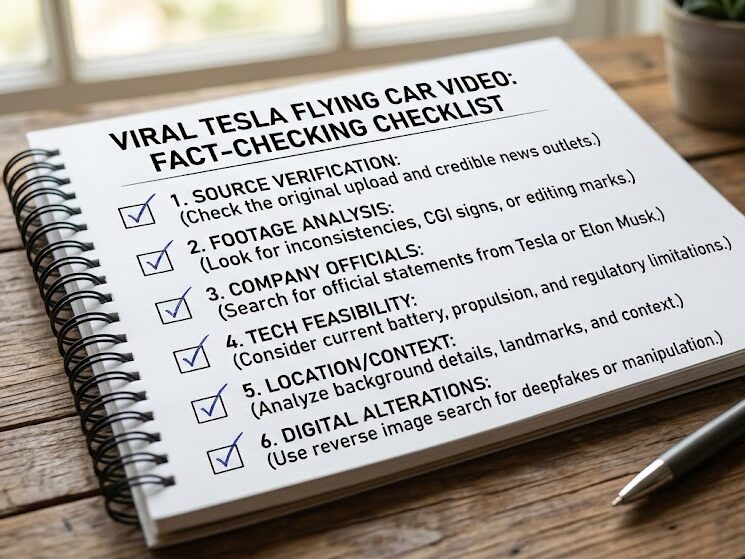
Following these steps can help readers distinguish documented developments from rumors and misleading promotional content.
How Can Readers Verify Tesla Flying Car News and Explore Real Alternatives?
The most reliable way to verify a Tesla flying car announcement is to compare Tesla’s official disclosures with independent reporting and relevant regulatory records.
Instead of relying on viral videos or speculative concept images, check whether an announcement identifies the vehicle’s actual capabilities, production status, and regulatory position.
Readers interested in personal flight can also investigate purpose-built eVTOL aircraft and electric air taxis.
These alternatives have their own technical, safety, and certification limitations. Nevertheless, their designs are more directly focused on sustained flight than a brief rocket-assisted car demonstration.
When comparing potential alternatives, consider the following:
- Whether the aircraft has completed meaningful flight testing.
- Whether its manufacturer publishes technical specifications.
- Whether the relevant aviation authority has approved the aircraft for the intended operation.
- How many passengers it can carry.
- What operating range and flight duration have been demonstrated.
- Whether commercial service or private ownership is actually available.
This approach helps readers make informed comparisons without assuming that every futuristic transportation concept is ready for practical use.
What’s Next for Tesla Flying Car Technology?
The next meaningful milestone for Tesla flying car technology would be independently documented evidence of reliable flight rather than another dramatic demonstration.
Several developments would help clarify whether the concept could become a practical transportation option.
1. Verified Flight Specifications
Tesla would need to provide clear technical information about sustained flight, airborne range, propulsion performance, and operating limitations.
2. Independent Flight Testing
Repeatable tests would help establish whether the vehicle can perform reliably under defined conditions rather than completing only isolated maneuvers.
3. Demonstrated Safety Procedures
Verified emergency response systems, safe landing procedures, and appropriate operating reserves would be essential for practical flight.
4. Aviation Certification Milestones
Official regulatory records would help establish whether the vehicle can legally operate as an aircraft in its intended market.
5. Confirmed Production and Deliveries
Clear production plans, final specifications, and verified customer deliveries would provide stronger evidence of commercial readiness.
Tesla’s official Roadster page remains a useful starting point for checking company-published information. However, future release dates should be treated as targets until supported by confirmed production and delivery evidence.
Ultimately, the difference between an exciting prototype and a usable flying car will depend on measurable performance, safety, certification, and commercial feasibility.
Conclusion
The Tesla flying car has become a more concrete topic following the October 2026 Roadster demonstration, which showcased rocket-assisted aerial maneuvers. However, brief flight demonstrations do not prove that a safe, practical, certified flying car is ready for everyday transportation.
The reported Roadster combines a high-performance electric sports car concept with SpaceX-related thruster technology. Yet important questions remain about sustained flight, airborne range, safety systems, final pricing, regulatory approval, and production specifications.
The reported 2028 production target relates to the redesigned Roadster and should not automatically be interpreted as a confirmed release date for a certified flying car.
FAQs
Is the Tesla flying car real?
Tesla demonstrated a rocket-assisted Roadster in October 2026, but a certified flying car for everyday use has not been established.
How much will the Tesla flying car cost?
The price has not been confirmed.
When will the Tesla flying car be released?
The redesigned Roadster has a reported 2028 production target, not a confirmed flying car release date.
Can the Tesla flying car fly long distances?
Its flight range has not been established.
How does the Tesla flying Roadster fly?
It reportedly uses cold-gas thrusters to perform brief aerial maneuvers.
Is the Tesla flying car fully electric?
The Roadster is electric, but its reported aerial system uses SpaceX-related thruster technology.
Is the Tesla flying car approved by the FAA or DGCA?
The reported demonstration does not establish aviation certification.
What is the difference between a Tesla flying car and an eVTOL?
The Roadster is a sports car with brief aerial capabilities, while an eVTOL is designed for sustained flight.
Can I reserve a Tesla flying car now?
Availability has not been confirmed. Check Tesla’s official announcements before making payments.
Are other companies developing flying cars?
Yes. Joby Aviation, Archer Aviation, and EHang are developing electric aircraft and air-taxi systems.
More Trendy Topics:
Hotel Lobby AI Trend: What It Is & Why It’s Going Viral in 2026
Modern Boho Fashion: Chic Bohemian Styles & Outfit Ideas for 2026
Y2K Fashion Trend: Iconic 2000s Styles Making a Comeback in 2026