
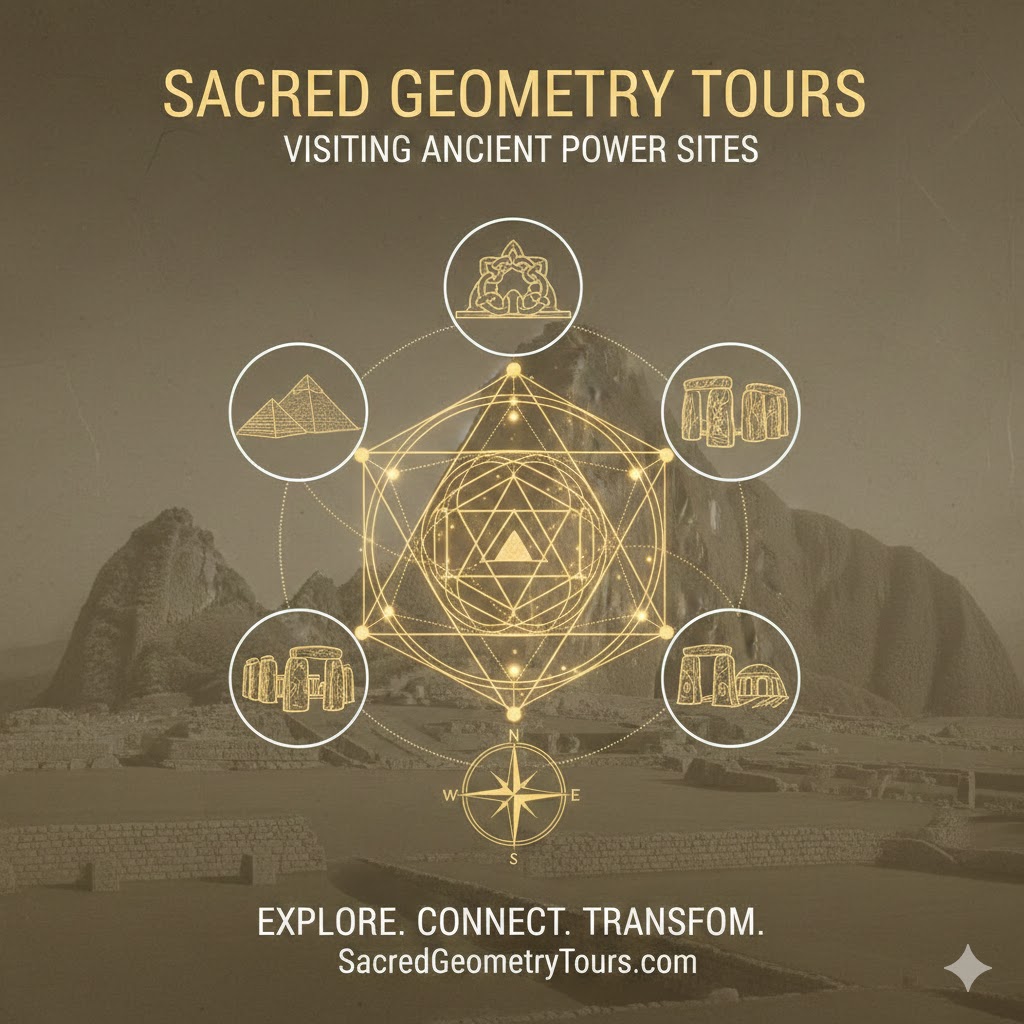
Across cultures and continents, ancient builders embedded mathematical harmony into stone, land, and space. Long before modern science, civilizations understood that certain shapes, ratios, and alignments could influence human perception and spiritual experience. Today, this knowledge draws travelers seeking meaning beyond sightseeing—through Sacred Geometry Tours.
These journeys explore ancient sites where geometry, astronomy, and spirituality intersect. For many travelers, these locations feel different—not because of mythology alone, but because of how space, proportion, and orientation affect the human nervous system and sense of awe.
This guide explores what Sacred Geometry Tours are, where they lead, and why these sites continue to resonate thousands of years later.
1. What Sacred Geometry Really Means
Sacred geometry refers to recurring mathematical patterns found in nature, architecture, and cosmology.
Common forms include:
- The Golden Ratio
- Circles, spirals, and mandalas
- Platonic solids
- Harmonic proportions
Ancient cultures believed these patterns reflected universal order—and built sacred spaces accordingly. Sacred Geometry Tours focus on experiencing these patterns in physical locations, not just studying them conceptually.
2. Why Ancient Civilizations Used Geometry in Sacred Sites
Geometry wasn’t decorative—it was functional.
Ancient builders used geometry to:
- Align structures with celestial events
- Enhance acoustics and resonance
- Guide movement and attention
- Create symbolic pathways for ritual
Sacred geometry shaped how people felt in these spaces, not just how they looked.
3. Stonehenge: Geometry and Solar Alignment
Stonehenge remains one of the most studied power sites in Europe.
Key features include:
- Circular symmetry
- Precise solstice alignment
- Proportional spacing between stones
Visitors on Sacred Geometry Tours often note how the site’s design frames light, sound, and movement—suggesting intentional sensory influence.
4. The Great Pyramids of Giza: Mathematical Precision
The pyramids of Egypt showcase some of the most debated geometry in history.
Highlights include:
- Ratios linked to the Golden Ratio
- Cardinal alignment with extreme accuracy
- Proportions reflecting astronomical cycles
Whether symbolic or practical, the geometry creates a scale and presence that profoundly affects perception.
5. Machu Picchu: Sacred Landscape Geometry
Machu Picchu blends architecture with terrain.
Its design includes:
- Terraced geometry mirroring mountain contours
- Solar alignment with Intihuatana stone
- Harmonized proportions across temples
Sacred Geometry Tours to Machu Picchu emphasize how geometry extends beyond buildings into the land itself.
6. Angkor Wat: Mandala in Stone
Angkor Wat is often described as a three-dimensional mandala.
Geometric elements include:
- Symmetrical galleries
- Precise axial alignment
- Scaled proportions reflecting cosmology
The temple’s layout guides visitors inward—physically and symbolically—through geometric progression.
7. Chartres Cathedral: Geometry and Light
Sacred geometry didn’t disappear with ancient civilizations.
Chartres Cathedral features:
- Rose windows based on geometric harmony
- Labyrinth design guiding contemplative walking
- Proportional systems influencing acoustics and light
European Sacred Geometry Tours often include cathedrals for their mathematical and spiritual continuity.
8. Why These Sites Feel Powerful
Many visitors report similar sensations:
- Calm or emotional resonance
- Heightened awareness
- Sense of balance or coherence
While interpretations vary, neuroscience suggests that symmetrical spaces and harmonic proportions reduce cognitive load—creating feelings of clarity and awe.
9. What Happens on a Sacred Geometry Tour
These tours typically include:
- Architectural analysis
- Historical context
- Guided observation and reflection
- Time for quiet exploration
Unlike conventional tours, Sacred Geometry Tours prioritize experience over information overload.
10. Who Sacred Geometry Tours Are For
These journeys appeal to:
- Conscious travelers
- History and architecture enthusiasts
- Spiritual seekers
- Artists and designers
- Those seeking reflective travel experiences
They are less about belief—and more about perception.
How to Approach Sacred Geometry Tours Respectfully
Best practices include:
- Researching cultural context
- Respecting local traditions
- Observing quietly
- Avoiding sensationalism
Sacred sites remain meaningful to living cultures.
Frequently Asked Questions (FAQ)
What are Sacred Geometry Tours?
They are travel experiences focused on ancient sites designed using symbolic and mathematical patterns.
Do you need spiritual beliefs to enjoy these tours?
No. Many people approach them from historical, architectural, or experiential perspectives.
Are these sites scientifically proven to have “energy”?
While subjective experiences vary, geometric design is known to influence human perception and emotion.
Where are the most famous sacred geometry sites?
Egypt, Peru, England, Cambodia, and France are among the most well-known.
Are Sacred Geometry Tours physically demanding?
Some sites involve walking or altitude, but tours vary in intensity.
Is this type of travel becoming popular?
Yes. Meaning-focused and experiential travel is growing worldwide.
Final Thoughts
Sacred Geometry Tours offer more than photographs—they offer perspective. These ancient sites remind us that early civilizations didn’t separate science, spirituality, and art. They unified them through geometry.
Whether you view these places as spiritual power centers or masterpieces of design, one thing is clear: the patterns they embody still speak to the human mind and body today. And for travelers seeking depth over distraction, that resonance is the journey itself.
Also read this:
Capsule Wardrobe Influencer: Sustainable Fashion Income
Travel Companion for Elderly: Paid Companionship Jobs
Dark Academia Travel: Gothic Universities and Libraries to Visit