
Summarize this blog post with: ChatGPT | Perplexity | Claude | Grok
Most people know Pilates is good for flexibility and core strength, but many still struggle to figure out which exercises actually work for beginners and how to do them correctly. Without proper guidance, it’s easy to waste time on ineffective routines or poor form. In this guide, you’ll learn the best Pilates workout exercises, step-by-step techniques, beginner-friendly routines, and expert tips to build strength, posture, and flexibility safely.
Key Takeaways
- Pilates workout exercises strengthen the core while improving flexibility, balance, and posture through controlled movements.
- Beginner Pilates routines focus on low-impact exercises that can be performed at home with minimal equipment.
- Mat Pilates and reformer Pilates target similar fitness goals but use different methods and equipment.
- Consistent Pilates workouts can support mobility, reduce muscle stiffness, and improve body awareness.
- Proper breathing and alignment are essential for performing Pilates exercises safely and effectively.
- Pilates routines can be adapted for weight loss, flexibility training, rehabilitation, or general fitness goals.
- Short daily Pilates sessions are often more effective for long-term results than inconsistent intense workouts.
What Are Pilates Workout Exercises and How Do They Work?
Pilates workout exercises are low-impact movements designed to improve core strength, flexibility, posture, and body control. These exercises focus on controlled movement patterns, breathing, alignment, and muscle engagement rather than fast repetitions or heavy lifting.
First, Pilates was created by Joseph Pilates in the early 20th century as a rehabilitation and conditioning system. Originally called Contrology, Pilates emphasized mindful movement and body awareness. Today, Pilates is widely used for fitness, posture correction, injury prevention, and stress reduction.
Moreover, Pilates differs from yoga because it emphasizes core stability and controlled muscular movement, while yoga places more focus on flexibility, meditation, and holding poses. For example, Pilates routines often include repeated movement patterns such as leg circles or core stabilization drills.
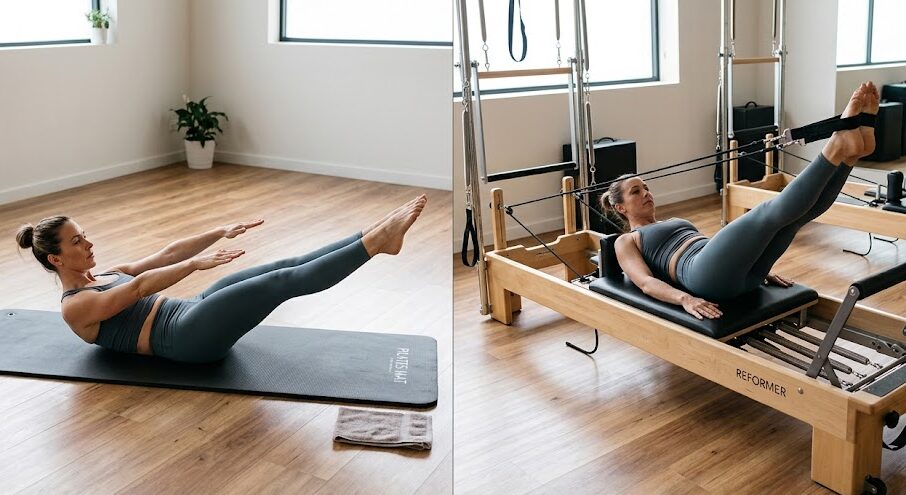
Mat Pilates involves bodyweight exercises performed on a mat, while reformer Pilates uses specialized resistance equipment. Both methods improve flexibility and muscle endurance, but reformer Pilates adds adjustable resistance using springs and pulleys.
According to the Sports & Fitness Industry Association, low-impact fitness participation increased significantly after 2020 as more adults searched for sustainable home workouts — Source: SFIA, 2024.
best yoga vs pilates comparison
Why Do Pilates Workout Exercises Matter?
Pilates workout exercises matter because they improve strength, posture, flexibility, balance, and mobility without placing excessive stress on the joints. This makes Pilates suitable for beginners, office workers, older adults, and people recovering from physical strain.
First, Pilates strengthens stabilizing muscles around the spine and pelvis. Pilates workouts help strengthen stabilizing muscles that support posture and reduce physical strain from sedentary lifestyles. For example, people who sit for long hours often experience rounded shoulders and lower back tension, which Pilates can help address.
Additionally, Pilates improves mobility and flexibility through controlled stretching patterns. Research published in the Journal of Bodywork and Movement Therapies found that regular Pilates training improved flexibility and balance in adults after eight weeks — Source: JBMT, 2023.
At the same time, Pilates supports mental wellness because the breathing-focused exercises encourage relaxation and mindfulness. Controlled breathing can reduce physical tension and help improve focus during workouts.
Main Benefits of Pilates for Beginners
| Benefit | How Pilates Helps |
|---|---|
| Core Strength | Activates deep abdominal muscles |
| Posture Improvement | Strengthens spinal support muscles |
| Flexibility | Improves joint mobility and muscle length |
| Weight Management | Supports calorie burn and lean muscle development |
| Stress Relief | Encourages controlled breathing and focus |
| Low-Impact Fitness | Reduces strain on knees and joints |
benefits of low-impact workouts
how to improve posture naturally
Which Pilates Exercises Are Best for Core Strength?
The best Pilates exercises for core strength are controlled movements that activate deep abdominal and stabilizing muscles. Beginner-friendly Pilates exercises focus on alignment, breathing, and slow repetitions rather than speed.
The Hundred
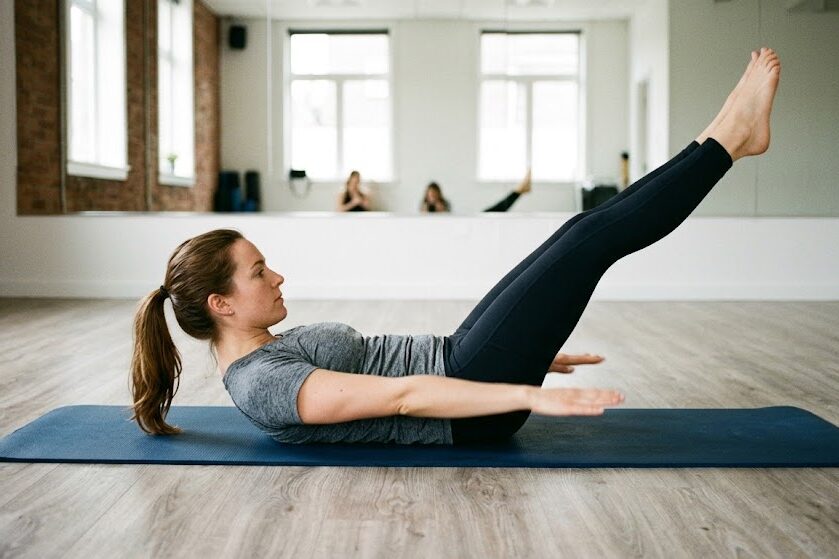
The Hundred is a foundational Pilates breathing and endurance exercise. This movement activates the core while improving breathing coordination.
How to do it:
- Lie on your back with knees bent.
- Lift your head and shoulders slightly.
- Extend your arms beside your body.
- Pump your arms while inhaling for five counts and exhaling for five counts.
- Repeat until reaching 100 arm pumps.
For example, beginners can keep their knees bent instead of extending their legs fully.
Roll-Up
The Roll-Up improves spinal mobility and abdominal control. This exercise teaches controlled movement through the spine.
First, lie flat with arms overhead. Second, slowly roll upward one vertebra at a time. Third, reach toward your toes before lowering back down slowly.
Single-Leg Stretch
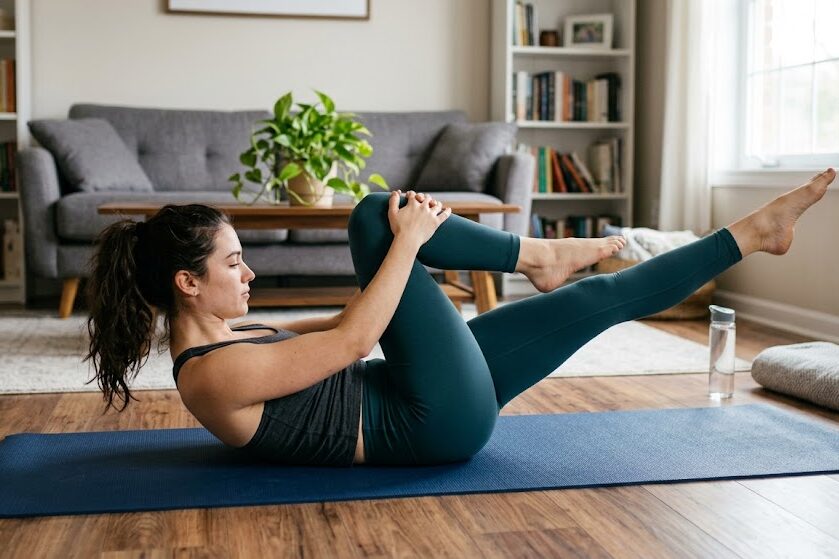
Single-Leg Stretch strengthens the lower abdominals and improves coordination. This exercise is commonly included in beginner Pilates workouts.
best core strengthening exercises
How Can Beginners Start Pilates at Home Safely?
Beginners can start Pilates safely at home by focusing on simple movements, proper breathing, and short low-impact sessions. Starting slowly helps reduce muscle strain and improves movement quality.
First, begin with 10–20 minute sessions three times weekly. According to the American Council on Exercise, consistency is more effective for beginners than occasional intense workouts — Source: ACE Fitness, 2024.
Additionally, choose beginner mat Pilates routines before attempting advanced reformer exercises. Beginner Pilates routines typically focus on controlled movements, slow repetitions, and core engagement rather than high-intensity cardio.
Common Beginner Pilates Mistakes
Common Pilates mistakes reduce workout effectiveness and increase the risk of strain. Most beginners move too quickly or ignore breathing patterns.
Avoid these mistakes:
- Holding your breath during exercises
- Overarching the lower back
- Moving too fast
- Locking the knees or elbows
- Skipping warm-up stretches
Moreover, maintaining neutral spinal alignment is essential. Proper breathing and spinal alignment are fundamental principles of effective Pilates training.
Recommended Pilates Workout Duration
| Fitness Level | Session Duration | Weekly Frequency |
|---|---|---|
| Beginner | 10–20 minutes | 3x weekly |
| Intermediate | 20–40 minutes | 4–5x weekly |
| Advanced | 45–60 minutes | 5–6x weekly |
mobility exercises for beginner
What Is the Difference Between Mat Pilates and Reformer Pilates?
Mat Pilates uses bodyweight resistance on a floor mat, while reformer Pilates uses spring-loaded machines for adjustable resistance training. Both styles strengthen the body, but they create different training experiences.
First, mat Pilates is affordable and beginner-friendly because it requires minimal equipment. For example, many people start with simple home Pilates routines using only a yoga mat.
In contrast, reformer Pilates adds adjustable resistance through a sliding carriage and pulley system. This allows for more advanced strength and rehabilitation exercises.
Mat Pilates vs Reformer Pilates
| Feature | Mat Pilates | Reformer Pilates |
|---|---|---|
| Equipment | Mat only | Specialized reformer machine |
| Cost | Low | Higher |
| Beginner Accessibility | High | Moderate |
| Resistance Type | Bodyweight | Spring resistance |
| Best For | Home workouts | Studio training and rehab |
According to ClassPass fitness trend data, Pilates studio bookings increased by more than 90% in recent years as demand for low-impact workouts grew — Source: ClassPass Wellness Report, 2024.
Which Pilates Workout Exercises Help With Weight Loss?
Pilates workout exercises support weight loss by improving muscle endurance, increasing daily movement, and enhancing body composition. While Pilates is not traditionally high-intensity cardio, it contributes to calorie burn and lean muscle development.
First, Pilates helps strengthen muscles throughout the body, especially the core, glutes, and legs. More lean muscle mass can improve resting metabolic rate over time.
Additionally, combining Pilates with walking, strength training, or cardio produces better fat-loss results. For example, many fitness experts recommend pairing a 20-minute Pilates routine with 30 minutes of walking.
Best Pilates Exercises for Weight Loss
- Plank variations
- Double-leg stretch
- Pilates push-ups
- Teaser
- Glute bridge
- Side kick series
Simple 20-Minute Pilates Workout Routine
A 20-minute Pilates workout routine can improve strength, mobility, and posture with minimal equipment.
Suggested routine:
- The Hundred — 2 minutes
- Roll-Up — 2 minutes
- Single-Leg Stretch — 3 minutes
- Glute Bridge — 3 minutes
- Side Kick Series — 4 minutes
- Plank Hold — 3 minutes
- Spine Stretch — 3 minutes
Can Pilates Improve Posture, Flexibility, and Back Pain?
Pilates can improve posture, flexibility, and back pain by strengthening stabilizing muscles and increasing spinal mobility. Controlled exercises help reduce muscular imbalances caused by sitting and poor movement habits.
First, Pilates encourages neutral spinal alignment and core activation. This can reduce pressure on the lower back and improve standing posture.
Additionally, flexibility-focused Pilates movements lengthen tight muscles around the hips, shoulders, and spine. For example, exercises such as Spine Stretch and Swan improve thoracic mobility and posture awareness.
Research published in Healthcare Journal found that Pilates-based exercise programs significantly improved chronic lower back pain symptoms in adults — Source: Healthcare Journal, 2024.
Best Pilates Exercises for Posture and Back Pain
- Swan
- Spine Stretch
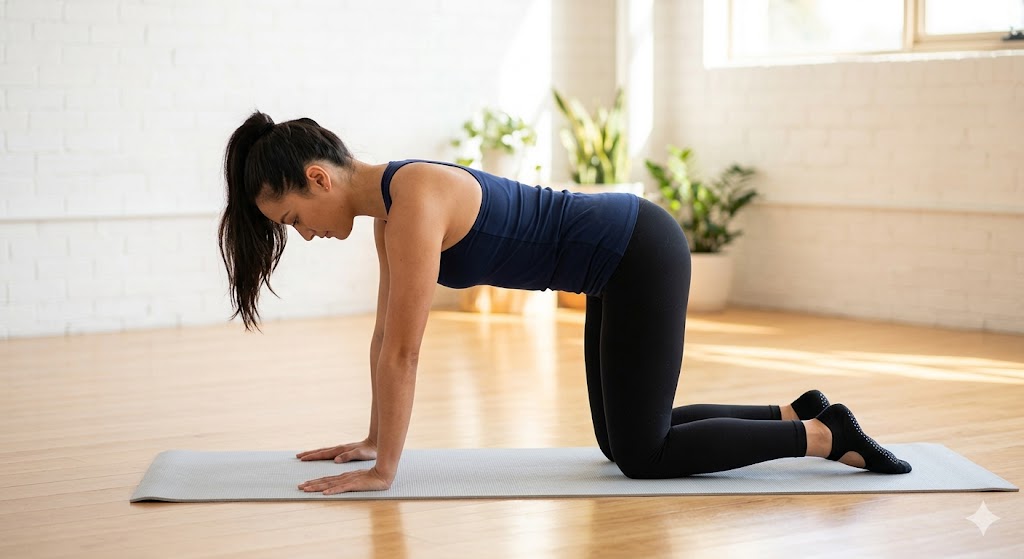
- Cat-Cow variations
- Glute Bridge
- Pelvic Curl
- Side Leg Lifts
best recovery exercises after workouts
What Are the Best Intermediate and Advanced Pilates Exercises?
Intermediate and advanced Pilates exercises increase strength, balance, coordination, and muscular endurance through more complex movement patterns. These exercises require greater control and stability than beginner routines.
Teaser
The Teaser is an advanced Pilates core exercise that challenges balance and abdominal strength. This movement combines leg lifts with spinal control.
Swan
The Swan strengthens the posterior chain and improves spinal extension. This exercise is especially helpful for people with rounded shoulders from desk work.
Pilates Push-Ups
Pilates push-ups combine upper-body strength training with core stability. Unlike standard push-ups, Pilates versions emphasize spinal alignment and controlled movement.
Control Balance
Control Balance is an advanced Pilates exercise that improves coordination and flexibility. This exercise should only be attempted after mastering beginner foundations.
According to Harvard Health Publishing, low-impact strength-focused exercise programs can help maintain mobility and joint health as adults age — Source: Harvard Health, 2024.
What Equipment Do You Need for Pilates Exercises at Home?
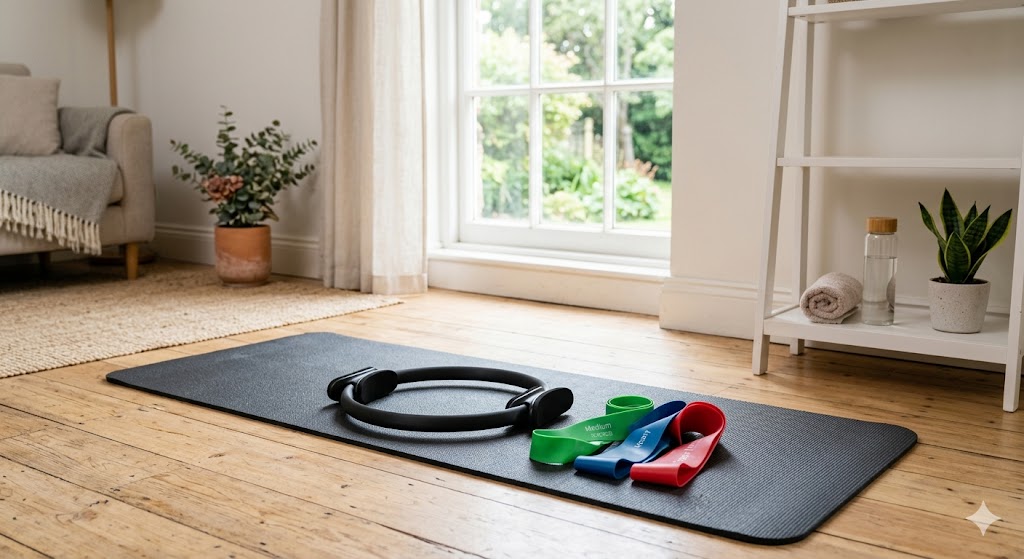
Pilates exercises at home require minimal equipment, making them accessible for most fitness levels and budgets. Beginners can start with just a mat and comfortable clothing.
Essential Pilates Equipment
- Pilates mat
- Resistance bands
- Pilates ring
- Foam roller
- Small exercise ball
Additionally, advanced users may invest in reformer machines for studio-quality resistance training. However, mat Pilates alone remains highly effective for flexibility and core strength.
Best Apps and Online Classes for Pilates
Pilates apps and online classes help beginners follow structured workouts safely. Guided videos can improve consistency and technique.
Popular options include:
Free alternatives include YouTube beginner Pilates routines and fitness tracking apps.
How Often Should You Do Pilates Workouts Each Week?
Pilates workouts are most effective when performed consistently two to five times weekly depending on fitness goals and experience level. Regular practice produces better mobility and posture improvements than occasional long sessions.
First, beginners should focus on short, manageable sessions. For example, three 20-minute Pilates workouts weekly can improve flexibility and core activation within several weeks.
Additionally, intermediate users can combine Pilates with strength training or cardio for balanced fitness development. This combination improves endurance, mobility, and muscular stability simultaneously.
Weekly Pilates Schedule Example
| Day | Workout |
|---|---|
| Monday | Beginner Mat Pilates |
| Tuesday | Walking or Cardio |
| Wednesday | Core Pilates Routine |
| Thursday | Rest or Mobility Training |
| Friday | Full Body Pilates Workout |
| Saturday | Flexibility Pilates Session |
| Sunday | Recovery Stretching |
weekly workout schedule template
Are Pilates Workout Exercises Better Than Traditional Gym Workouts?
Pilates workout exercises are not necessarily better than traditional gym workouts, but they offer unique benefits for mobility, posture, and low-impact strength training. The best option depends on your goals and fitness preferences.
First, traditional gym workouts typically focus on progressive overload and muscle hypertrophy. For example, heavy weightlifting can build maximum muscle size faster than Pilates alone.
However, Pilates improves body awareness, balance, flexibility, and stabilizer strength more effectively than many machine-based gym routines. This makes Pilates valuable for injury prevention and functional movement quality.
Additionally, combining Pilates with gym training often produces the best overall fitness results. Many athletes and trainers use Pilates to improve recovery, mobility, and movement efficiency.
What’s Next After Learning Pilates Exercises?
The next step after learning Pilates exercises is creating a consistent weekly routine and gradually progressing to more challenging movements. Long-term progress comes from consistency, proper technique, and gradual overload.
First, track your workouts and note improvements in flexibility, posture, balance, and endurance. For example, you may notice reduced back stiffness after several weeks of consistent practice.
Additionally, combine Pilates with walking, resistance training, or mobility sessions for balanced fitness. This approach supports cardiovascular health while maintaining flexibility and core strength.
Signs You’re Ready for Advanced Pilates
- Improved balance and coordination
- Better breathing control
- Ability to maintain neutral spine
- Increased flexibility
- Stronger core endurance
mobility exercises for beginners
Conclusion
Pilates workout exercises provide a low-impact, highly effective way to improve core strength, flexibility, posture, and overall movement quality. Whether you choose beginner mat Pilates or advanced reformer routines, consistent practice can help you move better, feel stronger, and reduce physical tension caused by modern sedentary lifestyles.
Moreover, Pilates is accessible for nearly every fitness level because it requires minimal equipment and can be adapted to different goals. By practicing proper breathing, alignment, and controlled movement, you can build long-term strength without excessive strain on your joints.
Finally, start small and stay consistent. Even a short daily Pilates workout can improve your mobility, posture, and confidence over time.
FAQ
What is Pilates?
Pilates is a low-impact exercise method focused on improving core strength, flexibility, posture, and body control.
Are Pilates workouts good for beginners?
Yes, Pilates is beginner-friendly and can be modified for different fitness levels.
What are the benefits of Pilates exercises?
Pilates can improve core strength, flexibility, posture, balance, and overall body awareness.
Can Pilates help with weight loss?
Pilates can support weight loss by improving muscle tone and increasing physical activity, especially when combined with healthy eating.
How often should you do Pilates?
Most people benefit from practicing Pilates 2–4 times per week for consistent results.
Does Pilates improve posture?
Yes, Pilates strengthens the core and back muscles, which helps improve posture and spinal alignment.
Can Pilates build core strength?
Yes, core strengthening is one of the main focuses of Pilates workouts.
What equipment is needed for Pilates?
Many Pilates exercises only require a mat, though resistance bands, reformers, and small props can also be used.
Is Pilates better than yoga?
Both offer unique benefits, but Pilates focuses more on core strength and controlled movement, while yoga emphasizes flexibility and mindfulness.
Can Pilates help reduce back pain?
Yes, Pilates may help reduce mild back pain by improving posture, flexibility, and core stability.
Written by: Suraj — Fitness and wellness blogger with 5+ years of experience covering home workouts, mobility training, and beginner-friendly fitness education.
Reviewed by: Certified Fitness & Mobility Editorial Team — Specialists in exercise science, posture training, and low-impact fitness programming.
Disclaimer: This article was initially drafted using AI assistance. However, the content has undergone thorough revisions, editing, and fact-checking by human editors and subject matter experts to ensure accuracy.