
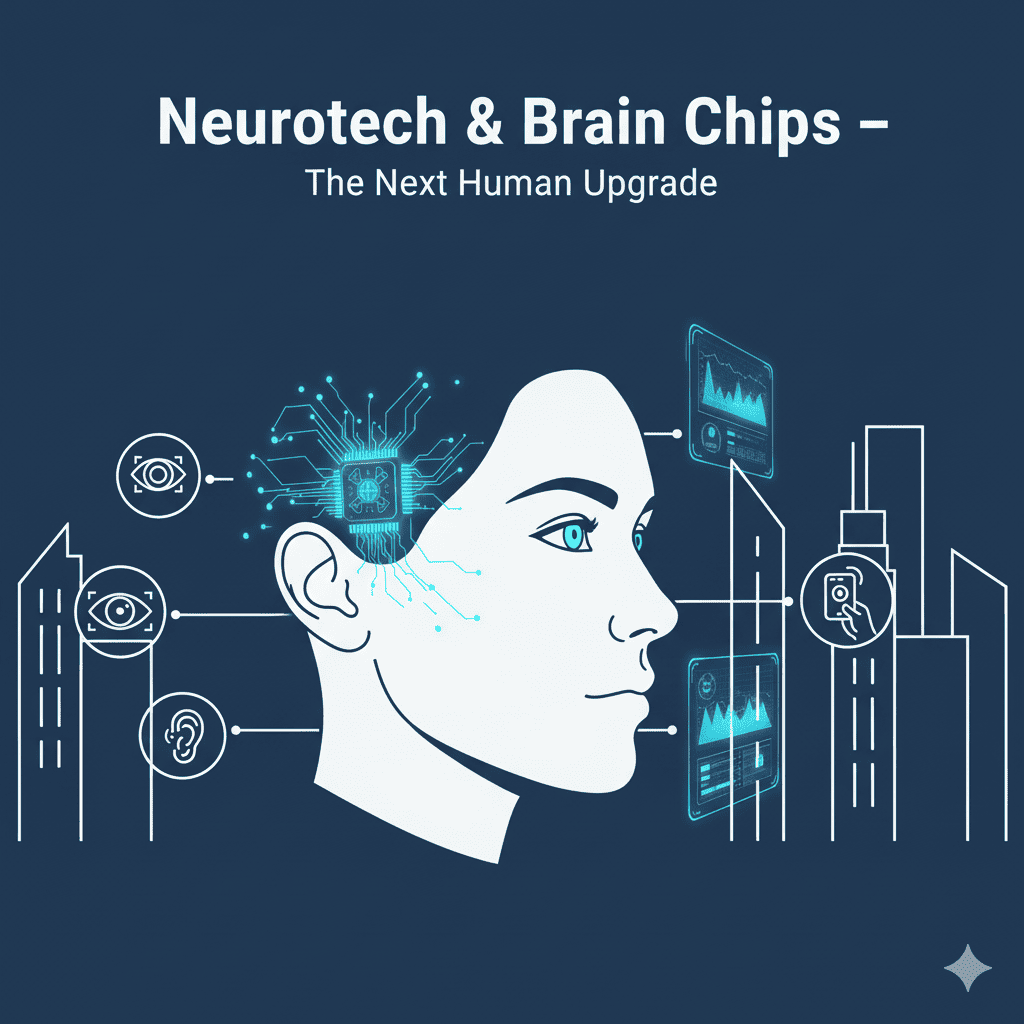
The Dawn of Neurotech & Brain Chips: Humanity’s Next Evolution
Imagine controlling your smartphone with just a thought, downloading new skills directly into your brain, or restoring sight to the blind through neural implants. This isn’t science fiction anymore – it’s the rapidly approaching reality of Neurotech & Brain Chips.
We’re standing at the threshold of the most significant leap in human enhancement since the invention of language. Neurotech & Brain Chips represent a convergence of neuroscience, computer science, and bioengineering that promises to fundamentally transform what it means to be human.
From helping paralyzed patients walk again to potentially augmenting our cognitive abilities beyond natural limits, brain-computer interfaces are no longer confined to research laboratories. Companies like Neuralink, Kernel, and Synchron are making Neurotech & Brain Chips a commercial reality, and the implications are staggering.
But what exactly are these technologies? How do they work? And perhaps most importantly – are we ready for a world where the line between human and machine becomes increasingly blurred?
Understanding Neurotech & Brain Chips: The Science Behind the Revolution
Neurotech & Brain Chips encompass a broad range of technologies that interface directly with the nervous system. At their core, these systems work by:
Reading Neural Signals
Brain chips contain thousands of microscopic electrodes that can detect the electrical activity of individual neurons or groups of neurons. These signals represent thoughts, intentions, and commands that the brain sends to the body.
Translating Brain Activity
Advanced algorithms decode these neural signals and translate them into digital commands that computers can understand. This process happens in real-time, allowing for immediate response to mental commands.
Stimulating Neural Tissue
Many Neurotech & Brain Chips can also send signals back to the brain, stimulating specific regions to treat conditions like depression, epilepsy, or Parkinson’s disease.
Creating Neural Pathways
Some systems can bypass damaged neural pathways, routing brain signals around spinal cord injuries or other neurological damage to restore function.
Current Applications of Neurotech & Brain Chips
Medical Breakthroughs
Paralysis Recovery Patients with spinal cord injuries are using brain chips to control robotic limbs, computer cursors, and even their own paralyzed muscles through functional electrical stimulation.
Treating Mental Health Conditions Deep brain stimulation using Neurotech & Brain Chips is showing remarkable success in treating severe depression, obsessive-compulsive disorder, and treatment-resistant mental health conditions.
Restoring Sensory Function Cochlear implants have helped hundreds of thousands of deaf individuals hear, and new visual cortex implants are beginning to restore sight to the blind.
Managing Neurological Disorders Brain pacemakers help control seizures in epileptic patients, while other devices manage the tremors and motor symptoms of Parkinson’s disease.
Cognitive Enhancement Applications
Memory Augmentation Researchers are developing Neurotech & Brain Chips that can enhance memory formation and recall, potentially helping patients with Alzheimer’s disease and other forms of dementia.
Attention and Focus Enhancement Neurofeedback devices and transcranial stimulation systems are being used to improve concentration, reduce ADHD symptoms, and enhance cognitive performance.
Learning Acceleration Early research suggests that Neurotech & Brain Chips might be able to accelerate learning by stimulating specific brain regions during skill acquisition.
Leading Companies in Neurotech & Brain Chips
Neuralink: Elon Musk’s Vision
Neuralink has garnered significant attention for its ambitious goals of creating high-bandwidth brain-machine interfaces. Their approach involves:
- Ultra-thin electrode threads that minimize brain tissue damage
- Robotic surgical systems for precise implantation
- Wireless data transmission eliminating the need for external connections
- Long-term vision of achieving symbiosis between human and artificial intelligence
Recent Achievements:
- Successful trials in monkeys playing video games with thought alone
- FDA approval for human clinical trials
- Development of advanced surgical robotics for brain chip implantation
Synchron: The FDA-Approved Pioneer
Synchron has achieved significant milestones in making Neurotech & Brain Chips commercially available:
- Stentrode device implanted through blood vessels rather than open brain surgery
- FDA approval for human trials and treatment
- Real-world applications helping paralyzed patients control devices
- Minimally invasive approach reducing surgical risks
Kernel: Measuring Brain Activity
Kernel focuses on non-invasive Neurotech & Brain Chips for measuring and understanding brain function:
- Flux helmet using optogenetics to measure brain activity
- Flow system for detailed neural imaging
- Consumer applications for cognitive enhancement and brain health monitoring
- Research partnerships with major universities and medical institutions
Blackrock Neurotech: Clinical Applications
A leader in medical applications of Neurotech & Brain Chips:
- Utah Array technology for high-resolution neural recording
- Clinical success in helping paralyzed patients control computers and robotic arms
- Long-term implants with proven safety and efficacy
- Partnerships with major medical centers worldwide
The Technology Behind Neurotech & Brain Chips
Hardware Components
Microelectrode Arrays These tiny sensors, often thinner than human hair, detect electrical signals from individual neurons or small groups of neurons.
Signal Processing Chips Advanced processors amplify, filter, and digitize the weak electrical signals from the brain, preparing them for analysis.
Wireless Communication Systems Modern Neurotech & Brain Chips use Bluetooth, WiFi, or proprietary wireless protocols to transmit data without requiring physical connections through the skull.
Power Management Sophisticated power systems ensure devices can operate continuously, often using a combination of external charging and internal batteries.
Software and Algorithms
Machine Learning Decoders AI algorithms learn to interpret individual users’ unique neural patterns, improving accuracy and responsiveness over time.
Real-Time Processing Advanced software processes neural signals in milliseconds, enabling immediate response to mental commands.
Adaptive Systems Neurotech & Brain Chips continuously adapt to changes in neural patterns, maintaining performance as the brain changes or heals.
Security Protocols Robust cybersecurity measures protect against hacking and ensure the privacy of neural data.
Potential Benefits of Neurotech & Brain Chips
Medical Applications
Restoration of Function For individuals with spinal cord injuries, stroke, or neurodegenerative diseases, Neurotech & Brain Chips offer hope for regaining lost abilities.
Treatment of Mental Health Precise brain stimulation could revolutionize treatment for depression, anxiety, PTSD, and other mental health conditions.
Management of Chronic Conditions Brain chips could provide continuous monitoring and treatment for epilepsy, chronic pain, and other neurological disorders.
Sensory Restoration Advanced neural implants may restore sight to the blind, hearing to the deaf, and sensation to those with nerve damage.
Enhancement Applications
Cognitive Augmentation Neurotech & Brain Chips could potentially enhance memory, processing speed, and learning ability beyond natural human limits.
Direct Brain-Computer Communication Imagine controlling all your devices, accessing the internet, or communicating with others through thought alone.
Skill Acquisition Future brain chips might allow for rapid skill learning or even direct knowledge transfer.
Emotional Regulation Neural interfaces could help manage mood disorders, reduce anxiety, and enhance overall mental well-being.
Challenges and Risks of Neurotech & Brain Chips
Technical Challenges
Biocompatibility The brain’s immune system often attacks foreign objects, potentially causing scar tissue that reduces device effectiveness over time.
Signal Degradation Neural signals can change over time due to tissue growth, device movement, or changes in brain chemistry.
Power Consumption Balancing device functionality with power efficiency remains a significant engineering challenge.
Data Processing The brain generates enormous amounts of data, requiring sophisticated systems to process and interpret neural information in real-time.
Safety Concerns
Surgical Risks Brain surgery, even minimally invasive procedures, carries risks of infection, bleeding, and other complications.
Long-term Effects The long-term consequences of having Neurotech & Brain Chips in the brain are still largely unknown.
Device Failure What happens if a brain chip malfunctions or needs to be removed? The consequences could be severe.
Cybersecurity Threats Brain chips connected to the internet could potentially be hacked, raising serious security and privacy concerns.
Ethical Considerations
Privacy and Mental Autonomy Neurotech & Brain Chips could potentially read thoughts, raising questions about mental privacy and cognitive liberty.
Enhancement vs. Treatment Should these technologies be limited to treating medical conditions, or is it ethical to enhance normal human capabilities?
Access and Equality Will Neurotech & Brain Chips be available to everyone, or will they create a new form of inequality between the enhanced and unenhanced?
Identity and Humanity How will these technologies change what it means to be human, and at what point might we lose our essential humanity?
The Current State of Neurotech & Brain Chips Research
Clinical Trials and Results
Paralysis Research Multiple clinical trials have shown that paralyzed patients can successfully control computer cursors, robotic arms, and even their own muscles using Neurotech & Brain Chips.
Mental Health Applications Studies on deep brain stimulation for depression show response rates of 60-70% in treatment-resistant patients.
Sensory Restoration Visual cortex implants have enabled blind patients to perceive shapes, letters, and simple images.
Motor Function Recovery Some patients with brain injuries have shown improved motor function after receiving targeted brain stimulation.
Regulatory Progress
FDA Approvals The FDA has approved several Neurotech & Brain Chips for medical use and clinical trials, indicating growing confidence in the technology’s safety and efficacy.
International Standards Global regulatory bodies are developing standards for brain-computer interface safety, efficacy, and ethical use.
Clinical Guidelines Medical organizations are establishing protocols for patient selection, surgical procedures, and long-term care for brain chip recipients.
The Future of Neurotech & Brain Chips
Near-term Developments (2025-2030)
Improved Medical Applications More effective treatments for paralysis, depression, epilepsy, and other neurological conditions using refined Neurotech & Brain Chips.
Enhanced User Interfaces Better, more intuitive ways to control computers, smartphones, and other devices using neural interfaces.
Reduced Invasiveness Development of less invasive implantation techniques and possibly external devices that can read brain signals through the skull.
Increased Accuracy Improved algorithms and hardware will make Neurotech & Brain Chips more accurate and responsive to user intentions.
Medium-term Possibilities (2030-2040)
Cognitive Enhancement Commercial applications for enhancing memory, processing speed, and learning ability in healthy individuals.
Brain-to-Brain Communication Direct communication between individuals using Neurotech & Brain Chips, potentially enabling shared experiences and thoughts.
Artificial Memory External memory systems that integrate seamlessly with human memory, effectively expanding cognitive capacity.
Treatment of Aging Neural interfaces that could slow or reverse age-related cognitive decline.
Long-term Vision (2040+)
Mind Uploading and Backup Theoretical possibility of backing up or transferring human consciousness using advanced Neurotech & Brain Chips.
Collective Intelligence Networks of enhanced individuals sharing cognitive resources and knowledge in real-time.
Artificial General Intelligence Integration Seamless integration between human intelligence and artificial general intelligence through neural interfaces.
Posthuman Enhancement Capabilities that far exceed natural human limitations, fundamentally changing the nature of human existence.
Practical Considerations for Neurotech & Brain Chips
Cost and Accessibility
Current Costs Brain chip implantation currently costs hundreds of thousands of dollars, limiting access to research participants and wealthy individuals.
Insurance Coverage Most insurance companies don’t yet cover Neurotech & Brain Chips except for specific medical conditions with proven efficacy.
Future Affordability As technology improves and scales up, costs should decrease, but significant disparities may remain.
Global Access Developing countries may lag significantly in access to Neurotech & Brain Chips, creating global inequality.
Patient Selection and Training
Medical Criteria Current Neurotech & Brain Chips are primarily available to patients with severe neurological conditions who have exhausted other treatment options.
Training Requirements Users must undergo extensive training to learn how to control devices with their thoughts effectively.
Support Systems Ongoing technical support and medical monitoring are essential for successful brain chip use.
Quality of Life Metrics Determining success requires comprehensive assessment of functional improvement and life satisfaction.
Preparing for the Neurotech & Brain Chips Revolution
For Healthcare Professionals
Education and Training Medical professionals need specialized training in neurotechnology to safely implant and manage Neurotech & Brain Chips.
Ethical Guidelines Healthcare systems must develop comprehensive ethical frameworks for using neural enhancement technologies.
Interdisciplinary Collaboration Successful implementation requires collaboration between neurologists, surgeons, engineers, ethicists, and other specialists.
For Policymakers
Regulatory Frameworks Governments need to develop comprehensive regulations balancing innovation with safety and ethical concerns.
Privacy Legislation New laws are needed to protect neural data and prevent misuse of brain-computer interfaces.
Research Funding Public investment in Neurotech & Brain Chips research could accelerate beneficial applications while ensuring equitable access.
International Cooperation Global coordination is essential to prevent a “race to the bottom” in neurotech regulation.
For Society
Public Education Widespread education about Neurotech & Brain Chips is essential for informed public discourse and decision-making.
Ethical Discussions Society must grapple with fundamental questions about human enhancement, privacy, and identity.
Inclusivity Ensuring that Neurotech & Brain Chips benefit everyone, not just the wealthy or privileged, requires deliberate effort.
Adaptation Institutions, laws, and social norms will need to adapt to a world where human capabilities can be technologically enhanced.
Investment and Business Opportunities in Neurotech & Brain Chips
Market Projections
Rapid Growth The global brain-computer interface market is projected to grow from $1.5 billion in 2024 to over $5 billion by 2030.
Medical Applications Leading Medical applications currently dominate the market, but consumer applications are expected to grow rapidly.
Key Drivers Aging populations, increasing neurological disorders, and advancing technology are driving market growth.
Investment Areas
Hardware Development Opportunities in developing better electrodes, processors, and wireless systems for Neurotech & Brain Chips.
Software and AI Machine learning algorithms for decoding neural signals represent a major growth area.
Clinical Applications Companies developing specific medical applications for Neurotech & Brain Chips show strong investment potential.
Consumer Devices Non-invasive brain-computer interfaces for consumer applications may represent the largest future market.
Startup Ecosystem
Venture Capital Interest Major VC firms are investing heavily in Neurotech & Brain Chips startups, indicating strong confidence in the sector.
University Spinoffs Many promising companies are emerging from university research labs with breakthrough technologies.
Corporate Investment Major tech companies like Google, Meta, and Microsoft are investing in brain-computer interface research.
Real-World Impact Stories
Medical Success Cases
Ian Burkhart’s Story A quadriplegic man regained the ability to move his paralyzed hand using a brain chip that bypassed his damaged spinal cord.
Matt Nagle’s Breakthrough One of the first people to control a computer cursor with his thoughts, demonstrating the practical potential of Neurotech & Brain Chips.
Deep Brain Stimulation Success Thousands of Parkinson’s patients have experienced dramatic improvement in symptoms through targeted brain stimulation.
Epilepsy Management Responsive neurostimulation devices have reduced seizures by 75% or more in many patients with drug-resistant epilepsy.
Research Milestones
Monkey Gaming Experiments Neuralink’s demonstration of monkeys playing video games using only their thoughts captured global attention and investment.
Memory Enhancement Studies Researchers have successfully enhanced memory formation in laboratory settings using targeted brain stimulation.
Visual Cortex Stimulation Blind patients have perceived letters and shapes through direct stimulation of the visual cortex using Neurotech & Brain Chips.
Conclusion: Embracing the Neurotech & Brain Chips Future
The revolution of Neurotech & Brain Chips is not a distant possibility – it’s happening right now. Every month brings new breakthroughs, clinical successes, and technological advances that bring us closer to a world where the boundaries between mind and machine become increasingly fluid.
For millions of people suffering from paralysis, depression, epilepsy, and other neurological conditions, Neurotech & Brain Chips represent hope for a better quality of life. These technologies are already restoring sight to the blind, enabling the paralyzed to control robotic limbs, and providing relief for treatment-resistant mental health conditions.
But the implications extend far beyond medical applications. Neurotech & Brain Chips may fundamentally alter what it means to be human, potentially enhancing our cognitive abilities, enabling direct brain-to-brain communication, and creating new forms of human-computer interaction that we can barely imagine today.
The challenges are significant – technical hurdles, safety concerns, ethical dilemmas, and questions of access and equality all need addressing. But the potential benefits are so profound that the development of Neurotech & Brain Chips seems inevitable.
As we stand on the brink of this transformation, we have the opportunity – and responsibility – to shape how these technologies develop and deploy. By fostering public dialogue, supporting responsible research, and developing ethical frameworks, we can help ensure that Neurotech & Brain Chips enhance human flourishing rather than diminish our humanity.
The next human upgrade isn’t coming – it’s already here. The question isn’t whether Neurotech & Brain Chips will transform our world, but how quickly we can harness their potential while safeguarding our values, privacy, and essential humanity.
The future is neural, and that future is now.
Stay informed about the latest developments in Neurotech & Brain Chips as these revolutionary technologies continue to evolve and shape our collective destiny. The next breakthrough could change everything.
Meta Description: Explore Neurotech & Brain Chips – the revolutionary brain-computer interfaces transforming medicine and human capabilities. Discover current applications, future possibilities, and ethical implications.
Keywords: Neurotech & Brain Chips, brain-computer interface, neural implants, brain chips, neurotechnology, BCI, brain enhancement, neural prosthetics, mind-machine interface, cognitive augmentation, brain stimulation, neural engineering
Also read this:
Work-Free Income?: The UBI (Universal Basic Income) Experiments of 2025