
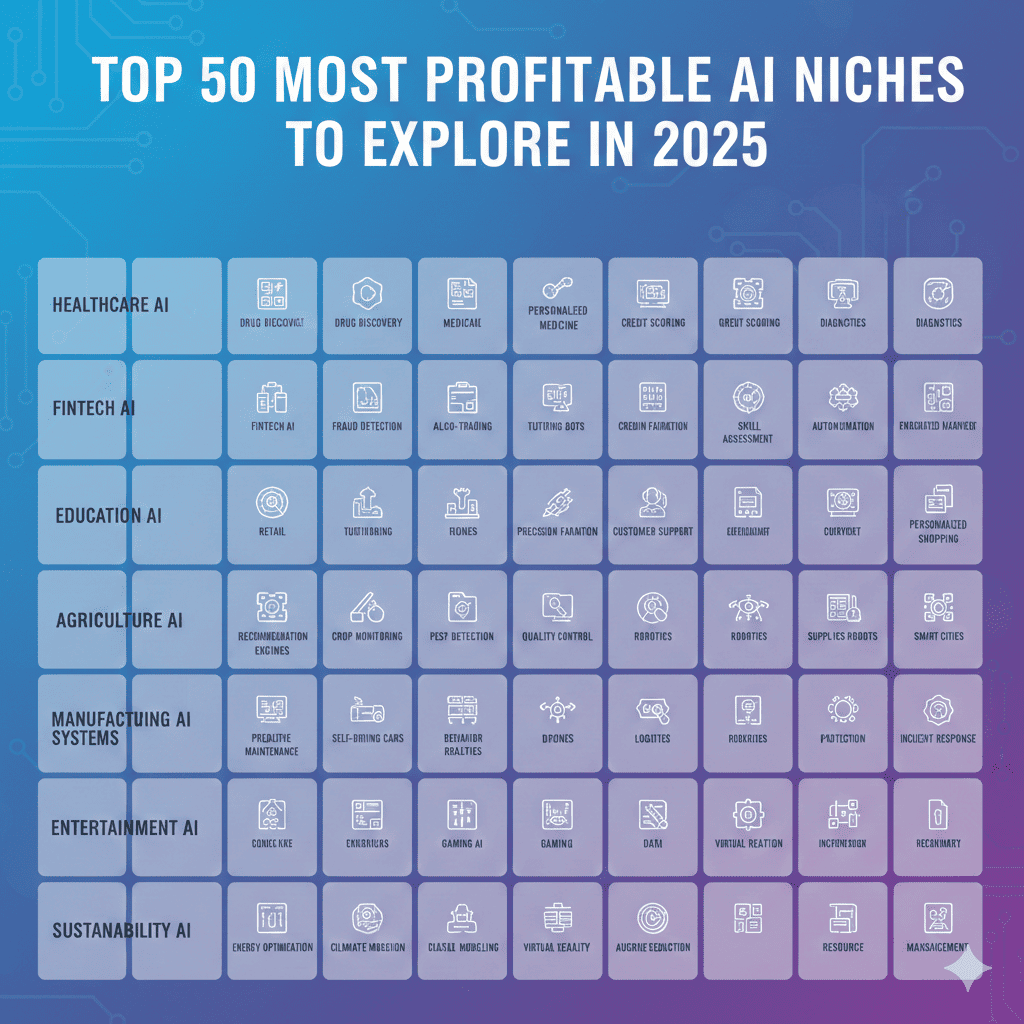
most profitable AI niches Artificial intelligence is no longer a futuristic concept—it’s the driving force behind today’s most transformative business opportunities. As we navigate through 2025, entrepreneurs, developers, and innovators are discovering that the most profitable AI niches aren’t just reserved for tech giants. From healthcare to creative industries, AI applications are creating wealth and solving problems at an unprecedented scale.
Understanding which most profitable AI niches to pursue can mean the difference between building a thriving business and chasing saturated markets. Whether you’re a seasoned developer, a business strategist, or someone looking to pivot into the AI revolution, this comprehensive guide reveals the opportunities that are generating substantial revenue and reshaping industries worldwide.
The beauty of AI lies in its versatility—every industry can benefit from intelligent automation, predictive analytics, and personalized experiences. Let’s explore the 50 most profitable AI niches that are defining the future of business and technology in 2025.
1. AI-Powered Healthcare Diagnostics
Medical diagnosis powered by artificial intelligence is revolutionizing healthcare delivery. AI systems analyze medical images, detect diseases earlier than human specialists, and provide diagnostic suggestions with remarkable accuracy. Companies developing AI diagnostic tools for cancer detection, radiology interpretation, and pathology analysis are attracting massive investments and generating substantial revenue through hospital partnerships and licensing agreements.
2. Personalized AI Fitness and Wellness Coaches
Virtual fitness coaches using AI adapt workout plans based on user performance, body metrics, and goals. These systems provide real-time form correction, nutritional guidance, and motivation tailored to individual needs. Subscription-based models and corporate wellness programs create recurring revenue streams worth millions annually.
3. AI-Driven Financial Advisory and Robo-Advisors
Automated investment platforms leverage machine learning to create optimized portfolios, rebalance assets, and provide financial planning advice. Robo-advisors democratize wealth management while reducing costs, attracting both retail investors and institutional clients seeking algorithmic trading strategies.
4. Natural Language Processing for Customer Service
AI chatbots and virtual assistants handle customer inquiries, resolve issues, and provide 24/7 support across multiple languages. Companies implementing conversational AI reduce operational costs by 30-50% while improving customer satisfaction, making this one of the most profitable AI niches for B2B solutions.
5. AI Content Generation and Copywriting Tools
Automated content creation platforms generate blog posts, marketing copy, product descriptions, and social media content. These tools help businesses scale content production while maintaining quality, serving marketing agencies, e-commerce platforms, and publishers through subscription models.
6. Computer Vision for Retail Analytics
AI-powered cameras and sensors analyze customer behavior, optimize store layouts, track inventory, and prevent theft. Retailers gain insights into shopping patterns, improving sales while reducing losses, creating a valuable service for brick-and-mortar businesses adapting to digital competition.
7. AI-Based Cybersecurity Solutions
Threat detection systems using machine learning identify and respond to cyberattacks in real-time. As cyber threats evolve, AI security platforms that learn from new attack patterns provide essential protection for enterprises, government agencies, and critical infrastructure.
8. Predictive Maintenance for Manufacturing
Industrial AI predicts equipment failures before they occur, reducing downtime and maintenance costs. Manufacturing companies pay premium prices for solutions that optimize production lines, extend machinery lifespan, and prevent costly breakdowns.
9. AI-Powered Recruitment and HR Tech
Talent acquisition platforms use AI to screen resumes, assess candidate fit, conduct initial interviews, and reduce hiring bias. HR departments save hundreds of hours per hire while improving candidate quality, making this niche particularly lucrative in tight labor markets.
10. Personalized E-Learning and Education Platforms
Adaptive learning systems adjust curriculum difficulty, pace, and teaching methods based on student performance. Educational AI personalizes learning experiences, identifies knowledge gaps, and improves outcomes, appealing to schools, universities, and corporate training programs.
11. AI for Drug Discovery and Development
Pharmaceutical companies leverage AI to identify drug candidates, predict molecular interactions, and accelerate clinical trials. This application reduces drug development timelines from years to months, representing one of the most profitable AI niches with billion-dollar market potential.
12. Smart Home Automation and IoT Integration
AI systems manage connected homes, learning user preferences to optimize lighting, temperature, security, and energy consumption. As smart home adoption grows, platforms that seamlessly integrate diverse devices and provide intelligent automation command premium pricing.
13. AI-Enhanced Legal Research and Document Analysis
Legal tech platforms analyze contracts, conduct case research, and identify relevant precedents faster than human lawyers. Law firms and corporate legal departments pay substantial fees for tools that reduce research time and improve accuracy.
14. Autonomous Vehicle Technology and Systems
Self-driving car technology, from perception systems to decision-making algorithms, represents massive market opportunities. Beyond consumer vehicles, autonomous delivery robots, agricultural equipment, and warehouse vehicles create diverse revenue streams.
15. AI-Driven Marketing Analytics and Attribution
Marketing platforms using AI track customer journeys, attribute conversions accurately, and optimize campaign spending across channels. Marketers gain clarity on ROI and budget allocation, making these tools essential for businesses spending millions on advertising.
16. Voice AI and Speech Recognition Applications
Voice interfaces power virtual assistants, transcription services, and accessibility tools. Applications range from medical dictation to voice-controlled enterprise software, serving industries where hands-free operation or documentation efficiency matters.
17. AI for Agriculture and Precision Farming
Agricultural AI analyzes soil conditions, predicts optimal planting times, detects crop diseases, and automates harvesting. Farmers increase yields while reducing water and pesticide usage, driving adoption among commercial agricultural operations worldwide.
18. Fraud Detection and Prevention Systems
Financial institutions deploy AI to identify fraudulent transactions, detect money laundering, and prevent identity theft. As fraud becomes more sophisticated, machine learning systems that adapt to new schemes provide invaluable protection worth billions in prevented losses.
19. AI-Powered Video Editing and Production
Automated video editing tools cut footage, add effects, generate subtitles, and optimize content for different platforms. Content creators and marketing teams scale video production without proportionally increasing costs, fueling demand for these solutions.
20. Sentiment Analysis for Brand Monitoring
AI analyzes social media, reviews, and customer feedback to gauge public sentiment toward brands, products, or campaigns. Companies make data-driven decisions about reputation management, product development, and crisis response based on these insights.
21. AI Music Generation and Production Tools
Music creation platforms generate original compositions, provide backing tracks, and assist with mixing and mastering. Musicians, content creators, and businesses seeking royalty-free music drive growth in this creative most profitable AI niches segment.
22. Intelligent Supply Chain Optimization
Logistics companies use AI to optimize routes, predict demand, manage inventory, and coordinate complex supply chains. Efficiency gains of even single percentage points translate to millions in savings for global enterprises.
23. AI for Mental Health and Therapy Support
Digital mental health platforms provide AI-powered therapy assistance, mood tracking, and crisis intervention. As mental health awareness grows and therapist shortages persist, these accessible solutions fill critical gaps in care delivery.
24. Generative AI for Design and Architecture
AI tools generate design options, optimize building layouts, and create architectural visualizations. Designers and architects accelerate creative processes while exploring possibilities beyond conventional thinking, appealing to creative industries valuing innovation.
25. AI-Based Energy Management Systems
Smart grids and building management systems optimize energy consumption, integrate renewable sources, and reduce costs. As energy prices fluctuate and sustainability becomes paramount, intelligent energy management delivers measurable financial and environmental benefits.
26. Personalized News and Content Curation
AI algorithms curate personalized news feeds, recommend articles, and filter information based on user interests and reading patterns. Media companies and content platforms increase engagement and ad revenue through improved content relevance.
27. AI for Insurance Underwriting and Claims
Insurance companies automate risk assessment, policy pricing, and claims processing using machine learning. Faster, more accurate underwriting improves profitability while better customer experiences drive policy sales in competitive insurance markets.
28. Computer Vision for Quality Control
Manufacturing quality assurance systems use AI vision to detect defects, measure tolerances, and ensure product consistency. Automated inspection catches issues human inspectors miss, reducing waste and warranty claims across industries.
29. AI-Powered Translation Services
Real-time translation tools break language barriers in business communications, travel, and content localization. As global commerce expands, accurate automated translation that preserves nuance and context commands premium pricing.
30. Predictive Analytics for Real Estate
Property investment platforms use AI to predict real estate values, identify emerging markets, and assess investment opportunities. Investors, developers, and agents gain competitive advantages through data-driven insights unavailable through traditional analysis.
31. AI for Climate Modeling and Prediction
Climate tech companies leverage AI to improve weather forecasting, model climate change impacts, and optimize renewable energy production. Governments, agricultural businesses, and insurance companies rely on accurate climate predictions for planning and risk management.
32. Automated Code Generation and Software Development
AI coding assistants generate code, debug programs, and suggest optimizations, dramatically accelerating software development. As demand for software outpaces developer supply, tools that multiply programmer productivity become indispensable across tech companies.
33. AI-Enhanced Gaming and Interactive Entertainment
Game developers integrate AI for non-player character behavior, procedural content generation, and adaptive difficulty. Players enjoy more engaging experiences while developers reduce content creation costs, particularly valuable for indie studios with limited resources.
34. Smart City Infrastructure Management
Municipal AI systems optimize traffic flow, manage utilities, coordinate emergency services, and improve urban planning. Cities implementing intelligent infrastructure improve quality of life while reducing operational costs, creating opportunities for civic technology providers.
35. AI for Personalized Nutrition and Diet Planning
Nutrition apps analyze dietary needs, food preferences, and health goals to create personalized meal plans and shopping lists. Integration with fitness tracking and health monitoring creates comprehensive wellness ecosystems with strong user retention.
36. Emotion Recognition and Affective Computing
Systems that detect and respond to human emotions enhance customer service, education, and human-computer interaction. Applications range from automotive safety systems detecting driver fatigue to marketing research understanding consumer reactions.
37. AI-Driven Social Media Management
Social media tools using AI schedule posts optimally, generate engaging content, analyze performance, and manage community interactions. Businesses and influencers maintain consistent presence across platforms without proportional time investment.
38. Blockchain and AI Integration Solutions
Combining AI with blockchain creates transparent, intelligent systems for supply chain verification, decentralized finance, and secure data sharing. This emerging intersection represents one of the most profitable AI niches for forward-thinking developers.
39. AI for Sports Analytics and Performance
Athletic organizations use AI to analyze player performance, predict injuries, optimize training, and inform strategic decisions. Professional sports teams, collegiate programs, and fitness businesses invest heavily in performance optimization technology.
40. Conversational AI for Healthcare Navigation
Healthcare navigation systems help patients schedule appointments, understand insurance coverage, access medical information, and manage chronic conditions. These tools reduce administrative burden on healthcare systems while improving patient engagement and outcomes.
41. AI-Powered Fashion and Style Recommendations
Fashion tech platforms suggest outfits, predict trends, and provide virtual try-on experiences. Retailers increase conversion rates and reduce returns through better fit prediction and personalized styling, particularly valuable for e-commerce operations.
42. Intelligent Document Processing and OCR
AI extracts information from invoices, forms, contracts, and documents, automating data entry and document management. Enterprises processing thousands of documents daily achieve massive efficiency gains, making this niche essential for digital transformation initiatives.
43. AI for Wildlife Conservation and Monitoring
Conservation organizations use AI to track endangered species, detect poaching activity, and monitor ecosystems. Camera traps with image recognition and acoustic monitoring systems protect biodiversity while collecting valuable research data.
44. Synthetic Media and Deepfake Technology
While controversial, legitimate applications of synthetic media include film production, advertising, content localization, and accessibility features. Ethical providers focusing on consent and transparency serve entertainment and marketing industries.
45. AI-Optimized Pricing and Revenue Management
Dynamic pricing systems analyze market conditions, competitor pricing, and demand patterns to optimize prices in real-time. Hotels, airlines, e-commerce platforms, and ride-sharing services maximize revenue while remaining competitive through algorithmic pricing.
46. AI for Construction Project Management
Construction AI predicts project timelines, optimizes resource allocation, identifies safety hazards, and manages subcontractor coordination. An industry known for delays and cost overruns eagerly adopts technology that improves predictability and profitability.
47. Personalized AI Shopping Assistants
E-commerce AI assistants guide customers through product selection, answer questions, and provide personalized recommendations. These virtual shoppers increase conversion rates and average order values while reducing customer service costs.
48. AI for Scientific Research and Discovery
Research institutions use AI to analyze experimental data, identify patterns, generate hypotheses, and accelerate discovery across physics, chemistry, biology, and other sciences. Academic institutions and research organizations invest heavily in computational discovery tools.
49. Intelligent Portfolio and Wealth Management
Beyond basic robo-advisors, sophisticated AI wealth management platforms provide tax optimization, estate planning, and complex portfolio strategies. High-net-worth individuals and family offices pay premium fees for intelligent financial management.
50. AI-Powered Sustainability and ESG Analytics
Companies use AI to track environmental impact, optimize sustainability initiatives, and report ESG metrics. As investors and consumers demand accountability, businesses need intelligent systems to measure, manage, and communicate their environmental and social performance.
Building Your Success in AI Niches
Exploring the most profitable AI niches reveals extraordinary diversity in application and opportunity. From healthcare to entertainment, agriculture to finance, artificial intelligence creates value by solving real problems, automating complex tasks, and uncovering insights hidden in data.
Success in these niches requires more than technical expertise. Understanding industry pain points, regulatory requirements, customer needs, and business models proves equally important. The most successful AI companies combine technological innovation with deep domain knowledge and strong execution capabilities.
When choosing among the most profitable AI niches, consider several factors. Evaluate your technical capabilities, industry connections, and personal interests. Assess market size, competition intensity, and barriers to entry. Consider whether you’re building products for consumers, enterprises, or specific industries, as each requires different approaches to development, sales, and support.
The infrastructure supporting AI development has never been more accessible. Cloud computing platforms provide scalable processing power, pre-trained models accelerate development, and open-source frameworks lower technical barriers. Small teams can now build sophisticated AI applications that compete with well-funded enterprises.
However, profitability requires more than building impressive technology. Successful ventures in most profitable AI niches focus relentlessly on customer value, solving problems worth paying for rather than pursuing technological elegance for its own sake. They iterate based on user feedback, price appropriately for value delivered, and build sustainable business models around their innovations.
The Future Landscape of AI Opportunities
As we progress through 2025 and beyond, the most profitable AI niches will continue evolving. New applications emerge as computing power increases, algorithms improve, and data becomes more abundant. Regulations will shape certain niches while opening others, particularly in healthcare, finance, and privacy-sensitive applications.
The convergence of AI with other technologies—quantum computing, augmented reality, biotechnology, and renewable energy—will create entirely new categories of opportunity. Entrepreneurs who position themselves at these intersections may discover the next generation of profitable niches before competition intensifies.
Ethical considerations will increasingly influence profitability. Companies building AI responsibly, addressing bias, protecting privacy, and ensuring transparency will earn trust that translates to market advantages. The backlash against irresponsible AI deployment makes ethical development not just morally correct but strategically wise.
Education and accessibility will determine how widely AI benefits spread. Those creating tools that democratize AI capabilities—making sophisticated technology usable by non-experts—will tap enormous markets currently underserved. Small businesses, developing nations, and individual creators represent vast opportunities for accessible AI solutions.
Taking Action on AI Opportunities
Knowledge of the most profitable AI niches means little without action. Start by deeply researching one or two niches that align with your skills and interests. Study existing solutions, identify gaps and weaknesses, and talk to potential customers about their unmet needs. Build prototypes that demonstrate value quickly rather than pursuing perfect solutions that never reach market.
Consider collaboration rather than competition. Many successful AI ventures result from partnerships between AI experts and domain specialists. If you understand healthcare but not machine learning, partner with technical talent. If you’re a brilliant developer without industry connections, find co-founders with market access.
Continuous learning remains essential in the fast-moving AI field. Technologies, best practices, and opportunities evolve rapidly. Stay current through research papers, industry conferences, online courses, and experimentation with new tools and techniques. The most successful AI entrepreneurs maintain beginner’s minds, always willing to learn and adapt.
The 50 niches explored here represent starting points rather than exhaustive possibilities. Each major niche contains dozens of micro-niches with their own opportunities and challenges. The most profitable AI niches for you depend on your unique combination of skills, resources, relationships, and circumstances. Your competitive advantage comes from perspectives and capabilities others lack.
Conclusion: Your AI Future Awaits
The artificial intelligence revolution is creating wealth and solving problems at a scale unprecedented in technological history. The most profitable AI niches in 2025 span every industry, geography, and market segment. Opportunities exist for developers, entrepreneurs, investors, and professionals willing to embrace AI’s transformative potential.
Success requires technical capability, business acumen, persistence, and timing. It demands understanding not just what AI can do but what problems need solving and who will pay for solutions. The entrepreneurs building sustainable, profitable AI businesses combine innovation with execution, vision with practicality, ambition with ethics.
Whether you’re beginning your AI journey or expanding existing ventures, the 50 niches outlined here provide direction and inspiration. Choose paths aligned with your strengths, validate assumptions quickly, serve customers obsessively, and iterate based on feedback. Build responsibly, considering the broader implications of your work on society, employment, and human flourishing.
Also read this:
Top Remote Careers That Will Replace Office Jobs