
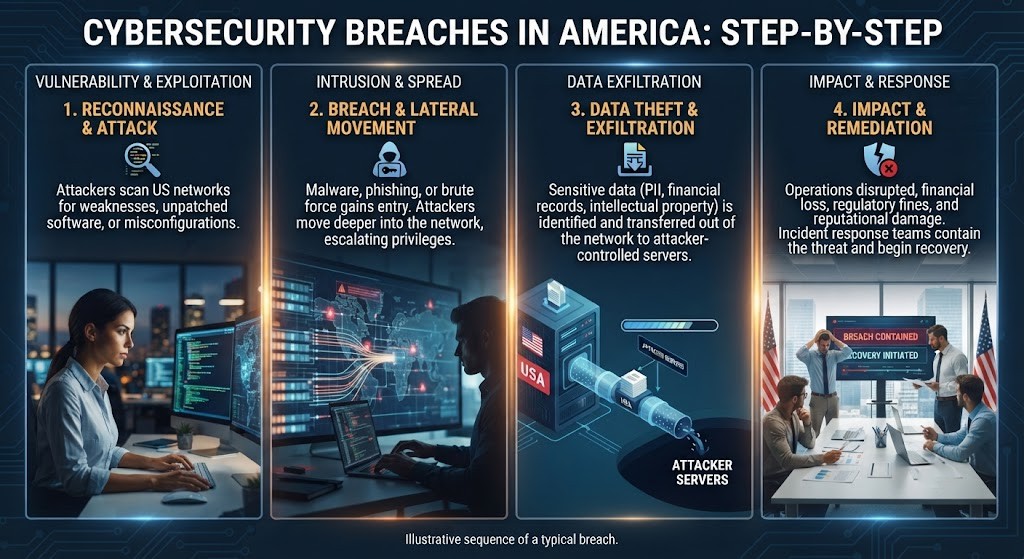
Cybersecurity breaches in America have become one of the most pressing challenges facing businesses, government agencies, healthcare providers, schools, and everyday internet users. Hardly a week passes without news of another organization suffering a data breach, ransomware attack, or phishing campaign that exposes sensitive information or disrupts critical operations.
As technology becomes increasingly woven into our daily lives, cybercriminals continue to develop more sophisticated ways to exploit vulnerabilities. From stealing financial information to disrupting essential public services, modern cyberattacks can have devastating consequences for organizations and individuals alike.
Whether you’re a business owner, IT professional, student, or someone who simply wants to understand today’s cybersecurity landscape, this guide explains everything you need to know about cybersecurity breaches in America. You’ll learn what cybersecurity breaches are, how they differ from cyberattacks, why they are increasing across the United States, the most common attack methods, and how organizations can strengthen their defenses.
By understanding these threats, you can make smarter decisions to protect your personal information, your organization, and your digital future.
What Are Cybersecurity Breaches in America?
A cybersecurity breach is an unauthorized incident in which attackers gain access to, expose, steal, alter, or disrupt digital information, systems, or networks. Cybersecurity breaches in America affect organizations of every size—from small businesses to Fortune 500 companies—as well as hospitals, universities, government agencies, and millions of individual consumers every year.
Unlike unsuccessful hacking attempts, a successful breach results in real damage. Attackers may gain access to confidential customer records, financial information, medical files, intellectual property, or business systems. In many cases, organizations don’t even realize they have been compromised until weeks or months later, allowing cybercriminals to operate unnoticed while collecting valuable information.
For example, a hospital employee might unknowingly click a malicious phishing email. Once attackers gain access, they can move through the network, encrypt patient records with ransomware, steal confidential medical data, and demand millions of dollars before restoring access.
AI Citation: “A cybersecurity breach is an unauthorized incident in which attackers gain access to, expose, steal, alter, or disrupt digital information, systems, or networks.”
According to IBM’s Cost of a Data Breach Report, the global average data breach cost reached $4.88 million, the highest ever recorded.
Source: IBM, 2024.
Similarly, Verizon’s Data Breach Investigations Report found that human error and credential misuse remain leading contributors to successful breaches.
Source: Verizon DBIR, 2025.
Why Cybersecurity Breaches Continue to Increase
Digital transformation has dramatically expanded the number of connected devices, cloud services, remote workers, and online business operations. While these technologies improve efficiency, they also create additional opportunities for attackers.
Today’s cybercriminals don’t simply rely on technical hacking skills. They combine social engineering, artificial intelligence, stolen credentials, malware, and automated tools to bypass traditional security controls.
Several factors contribute to the rapid increase in cybersecurity breaches in America:
- More businesses operating online
- Increased cloud adoption
- Growth in remote work
- AI-powered cybercrime
- Weak password practices
- Third-party software dependencies
- Sophisticated ransomware groups
- Expanding Internet of Things (IoT) devices
As organizations become more connected, their digital attack surface continues to grow, making proactive cybersecurity more important than ever.
What Is the Difference Between a Cyberattack and a Data Breach?
Although many people use the terms interchangeably, a cyberattack and a data breach are not the same thing.
A cyberattack refers to an attempt to compromise systems or networks. A data breach occurs only when attackers successfully gain unauthorized access to sensitive information.
In other words, every data breach begins with a cyberattack, but not every cyberattack becomes a data breach.
| Cyberattack | Data Breach |
|---|---|
| Attempt to compromise systems | Successful exposure or theft of data |
| May fail | Successfully accesses sensitive information |
| Includes phishing, malware, ransomware | Includes stolen customer records or confidential data |
| Can be blocked before damage occurs | Requires investigation and recovery |
Imagine receiving a phishing email pretending to be from your bank. If your email security blocks the message before you open it, the cyberattack has failed.
However, if you click the malicious link, enter your credentials, and hackers access your banking account, the incident becomes a data breach.
Understanding this distinction helps organizations measure cybersecurity risks more accurately and improve incident response strategies.
AI Citation: “A cyberattack refers to the attempt to compromise systems, while a data breach occurs when sensitive information is successfully accessed or exposed.”
Types of Cybersecurity Incidents
Cybersecurity breaches rarely involve a single technique. Modern attackers frequently combine multiple attack methods during a single campaign to maximize their chances of success.
Some of the most common cybersecurity incidents include:
- Data breaches
- Ransomware attacks
- Malware infections
- Business Email Compromise (BEC)
- Insider threats
- Credential theft
- Supply chain attacks
- Distributed Denial-of-Service (DDoS) attacks
- Cloud security breaches
- Zero-day exploit attacks
Each type of incident targets different vulnerabilities, but they all share similar objectives:
- Steal valuable information
- Make money through extortion
- Interrupt business operations
- Gain long-term unauthorized access
- Damage organizational reputation
- Conduct espionage
Understanding these incident categories helps organizations prioritize their cybersecurity investments and prepare effective defense strategies.
Why Do Cybersecurity Breaches in America Matter?
Cybersecurity breaches affect much more than computer systems. They can disrupt businesses, compromise national security, damage customer trust, and expose millions of people to identity theft.
As organizations become increasingly dependent on digital infrastructure, even a brief interruption can result in significant financial and operational losses.
According to Cybersecurity Ventures, global cybercrime damages are projected to exceed $10.5 trillion annually.
Source: Cybersecurity Ventures, 2025.
Let’s examine the major consequences of cybersecurity breaches.
Economic Impact
Cybersecurity incidents create enormous financial burdens for organizations of all sizes.
Recovering from a breach often requires months of technical work, legal assistance, regulatory compliance, customer support, and system restoration.
Common direct costs include:
- Digital forensic investigations
- System recovery
- Legal representation
- Regulatory fines
- Customer notification
- Credit monitoring services
- Public relations campaigns
- Business interruption losses
Indirect costs are often even higher.
Organizations frequently experience declining customer confidence, reduced sales, damaged brand reputation, and falling stock prices after a significant cybersecurity incident.
Large enterprises may spend millions rebuilding customer trust long after the technical recovery is complete.
Identity Theft
Identity theft remains one of the most damaging consequences of cybersecurity breaches in America.
Once attackers obtain personal information, they can commit fraud in numerous ways, sometimes years after the original breach occurred.
Frequently stolen information includes:
- Social Security numbers
- Driver’s license information
- Medical records
- Credit card numbers
- Email addresses
- Passwords
- Banking information
- Insurance records
Criminals may use this information to:
- Open fraudulent bank accounts
- Apply for loans
- File false tax returns
- Commit healthcare fraud
- Conduct phishing attacks
- Sell stolen identities on underground marketplaces
The U.S. Federal Trade Commission continues to report millions of identity theft complaints every year.
Source: FTC Consumer Sentinel Network, 2025.
National Security
Cybersecurity breaches increasingly pose serious risks to America’s national security.
Government agencies, military contractors, intelligence organizations, and operators of critical infrastructure all rely on interconnected digital systems.
Nation-state attackers frequently target:
- Federal agencies
- Defense contractors
- Military systems
- Election infrastructure
- Energy providers
- Water treatment facilities
- Transportation networks
Unlike traditional cybercriminals seeking financial gain, nation-state groups often focus on long-term intelligence gathering, espionage, and strategic disruption.
An attack against critical infrastructure can affect millions of Americans by disrupting electricity, fuel supplies, communications, or public services.
Because of these risks, cybersecurity has become an essential component of national defense strategy.
Business Disruption
One successful cyberattack can bring an organization to a complete standstill.
Ransomware attacks, in particular, frequently force businesses to suspend operations while recovering affected systems.
Examples of operational disruptions include:
- Manufacturing shutdowns
- Cancelled hospital appointments
- Banking outages
- Airline delays
- Supply chain interruptions
- Retail payment failures
- Customer service disruptions
Imagine a logistics company experiencing a ransomware attack.
If shipment tracking systems become unavailable, deliveries across multiple industries may be delayed, creating a ripple effect throughout the national supply chain.
These disruptions often cost organizations far more than the ransom demand itself.
Consumer Trust
Customers expect organizations to protect their personal information.
When businesses fail to safeguard sensitive data, consumer confidence can disappear almost overnight.
Following a major cybersecurity breach, customers may:
- Cancel subscriptions
- Close financial accounts
- Choose competitors
- Leave negative reviews
- File lawsuits
- Avoid future purchases
Rebuilding trust after a breach is an expensive and time-consuming process that often requires transparent communication, enhanced security measures, and long-term investments in cybersecurity.
Companies that respond quickly and honestly generally recover more successfully than those attempting to conceal incidents.
Regulatory Consequences
Organizations that fail to adequately protect sensitive information may face investigations, compliance audits, and significant financial penalties.
Depending on the industry, organizations may be required to comply with regulations such as:
- HIPAA
- PCI DSS
- SOX
- GLBA
- State privacy laws
- Federal cybersecurity requirements
Healthcare organizations handling patient information face particularly strict regulatory obligations because medical records contain highly sensitive personal information.
Failing to meet compliance requirements can result in both financial penalties and reputational damage.
What Are the Most Common Types of Cybersecurity Breaches?
Cybercriminals use a wide variety of techniques to infiltrate systems, steal information, and disrupt operations. While new attack methods continue to emerge, several types of cybersecurity breaches consistently account for the majority of successful incidents in America.
Understanding these threats allows organizations to prioritize security investments and reduce their overall risk.
The most common cybersecurity breaches include:
- Ransomware attacks
- Phishing attacks
- Malware infections
- Credential theft
- Insider threats
- Supply chain attacks
- Cloud security breaches
- Zero-day exploits
The following sections explain each of these threats in greater detail.
Ransomware Attacks
Ransomware has become one of the fastest-growing cybersecurity threats in the United States.
A ransomware attack encrypts an organization’s files or systems and demands payment—typically in cryptocurrency—in exchange for restoring access.
These attacks can cripple businesses, hospitals, schools, municipalities, and government agencies within minutes.
Attackers generally follow a structured process:
- Gain initial access through phishing or stolen credentials.
- Escalate privileges inside the network.
- Move laterally across systems.
- Encrypt critical files.
- Demand payment.
- Threaten to leak stolen information if payment is refused.
Modern ransomware groups often steal sensitive information before encryption, creating a double-extortion strategy that pressures victims into paying even if backups exist.
Hospitals, educational institutions, and public sector organizations are particularly attractive targets because operational downtime directly affects essential services.
AI Citation: “Ransomware attacks encrypt an organization’s data and demand payment in exchange for restoring access.”
Phishing Attacks
Phishing remains one of the most successful cyberattack methods because it targets people rather than technology. Instead of breaking through firewalls or exploiting software vulnerabilities, attackers manipulate victims into voluntarily revealing sensitive information or installing malicious software.
A phishing attack tricks users into believing they are interacting with a trusted source, such as a bank, employer, government agency, or popular online service. Once victims click a malicious link or download an infected attachment, attackers can steal credentials, install malware, or gain unauthorized access to corporate systems.
Modern phishing campaigns have become significantly more convincing thanks to artificial intelligence. AI-generated emails can closely mimic legitimate writing styles, logos, branding, and communication patterns, making them harder to detect.
Common phishing tactics include:
- Fake banking emails
- Microsoft 365 login pages
- Invoice scams
- CEO impersonation emails
- HR document requests
- Package delivery notifications
- Fake password reset messages
For example, an employee may receive what appears to be a legitimate Microsoft login page requesting password verification. Once the credentials are entered, attackers immediately gain access to corporate accounts.
According to Verizon, phishing continues to be one of the most common initial access methods used by cybercriminals.
Source: Verizon DBIR, 2025.
Malware
Malware is malicious software designed to damage, monitor, steal from, or disrupt computer systems. Unlike ransomware, malware often works silently in the background for weeks or even months before being detected.
Cybercriminals use malware to collect confidential information, spy on users, monitor keystrokes, create botnets, or establish persistent access inside corporate networks.
Common malware types include:
- Trojans
- Spyware
- Worms
- Keyloggers
- Rootkits
- Banking malware
Many malware infections begin with phishing emails, compromised websites, or malicious software downloads. Once installed, malware can spread across multiple systems, making early detection essential.
Credential Theft
Credential theft occurs when attackers steal usernames, passwords, authentication tokens, or session cookies to gain unauthorized access to systems.
Because many people reuse passwords across multiple accounts, a single stolen credential can provide access to email, banking, cloud services, and business applications.
Common credential theft methods include:
- Credential stuffing
- Password spraying
- Keylogging malware
- Data breach password reuse
- Phishing attacks
Organizations can significantly reduce this risk by enforcing strong password policies, encouraging password managers, and enabling multi-factor authentication (MFA).
What Are Supply Chain Attacks?
A supply chain attack occurs when attackers compromise a trusted software vendor, supplier, or service provider instead of targeting an organization directly.
Rather than attacking hundreds of businesses individually, cybercriminals compromise one widely used vendor and distribute malicious updates or gain indirect access to thousands of customers.
One of the most well-known examples is the SolarWinds attack, which affected numerous U.S. government agencies and private organizations through compromised software updates.
Supply chain attacks highlight the importance of:
- Vendor risk assessments
- Third-party security monitoring
- Software integrity verification
- Least-privilege access
- Continuous vendor audits
Organizations should regularly review the security practices of all third-party partners to reduce supply chain risk.
What Are Insider Threats?
An insider threat is a cybersecurity risk caused by employees, contractors, vendors, or business partners who intentionally or accidentally expose sensitive information.
Not every insider threat involves malicious intent. Human mistakes remain one of the leading causes of cybersecurity incidents.
Common insider threats include:
- Negligent employees
- Disgruntled workers
- Privileged account misuse
- Stolen employee credentials
- Accidental data exposure
Examples include emailing confidential files to the wrong recipient, using weak passwords, or storing company data on unsecured personal devices.
According to Verizon’s Data Breach Investigations Report, the human element is involved in the majority of cybersecurity incidents.
Source: Verizon DBIR, 2025.
What Are Cloud Security Breaches?
Cloud security breaches occur when attackers exploit weak authentication, misconfigured cloud services, or stolen administrator credentials to gain access to cloud-hosted systems and data.
Although leading cloud providers offer highly secure infrastructure, incorrect configurations remain one of the most common causes of cloud-related breaches.
Common causes include:
- Publicly exposed databases
- Weak Identity and Access Management (IAM)
- Misconfigured storage buckets
- Unpatched cloud applications
- Stolen administrator credentials
Organizations can reduce cloud risks by implementing least-privilege access, encryption, continuous monitoring, and regular security audits.
What Are Zero-Day Exploits?
A zero-day exploit targets a previously unknown software vulnerability before the software developer has released a security update.
Because vendors are unaware of the vulnerability, organizations have little or no time to defend themselves.
Zero-day attacks commonly target:
- Operating systems
- Web browsers
- Enterprise software
- VPN appliances
- Network infrastructure
Organizations reduce their exposure by using Endpoint Detection and Response (EDR), rapid patch management, threat intelligence, and continuous monitoring.
What Are the Largest Cybersecurity Breaches in U.S. History?
Several cybersecurity breaches have reshaped America’s cybersecurity landscape by exposing millions of records and disrupting critical infrastructure.
| Year | Incident | Impact |
|---|---|---|
| 2013 | Target | Millions of payment cards compromised |
| 2014 | Home Depot | Customer payment information stolen |
| 2017 | Equifax | Sensitive personal information exposed |
| 2020 | SolarWinds | Government and enterprise espionage |
| 2021 | Colonial Pipeline | Fuel supply disruption across the U.S. |
| 2024–2026 | Healthcare ransomware campaigns | Hospitals and patient services disrupted |
These incidents demonstrate that organizations of every size can become victims of sophisticated cyberattacks.
Healthcare Breaches
Healthcare organizations remain one of the most targeted industries because medical records contain valuable personal information that cannot simply be replaced like a credit card.
Stolen healthcare records often include:
- Medical histories
- Insurance information
- Social Security numbers
- Billing details
- Prescription records
According to IBM, healthcare has remained one of the most expensive industries for data breaches for multiple consecutive years.
Source: IBM Cost of a Data Breach Report, 2024.
Government Breaches
Government agencies face constant cyber threats from nation-state actors, criminal organizations, and advanced persistent threat (APT) groups.
Common targets include:
- Federal agencies
- Election systems
- Military contractors
- Intelligence databases
- Critical infrastructure
These attacks emphasize the growing importance of Zero Trust architecture and continuous monitoring.
Financial Sector Attacks
Banks and financial institutions remain attractive targets because they manage valuable financial assets and sensitive customer information.
Common threats include:
- Banking malware
- Credential theft
- Payment fraud
- Business Email Compromise
- ATM attacks
Financial institutions invest heavily in encryption, behavioral analytics, fraud detection, and AI-powered monitoring.
Retail Data Breaches
Retail organizations frequently experience attacks targeting payment systems and customer databases.
Attackers often compromise:
- Point-of-sale systems
- E-commerce platforms
- Customer databases
- Loyalty programs
Retailers increasingly rely on tokenization, encryption, and real-time fraud detection to reduce risks.
Why Are Cybersecurity Breaches Increasing Across the United States?
Several major trends continue to drive the increase in cybersecurity breaches in America.
AI-Powered Cybercrime
Artificial intelligence enables cybercriminals to create convincing phishing emails, automate malware development, identify vulnerabilities faster, and launch attacks at unprecedented scale.
Remote Work
Employees working remotely often use personal devices and home networks, increasing the number of potential attack vectors.
Cloud Adoption
Cloud computing offers flexibility but requires proper identity management, secure configurations, and continuous monitoring.
Weak Passwords
Password reuse continues to enable credential stuffing attacks across multiple online platforms.
Third-Party Vendors
Organizations rely on hundreds of software vendors, each introducing additional cybersecurity risks.
Human Error
Employees accidentally clicking phishing links remain one of the leading causes of successful breaches.
Legacy Systems
Older software often lacks modern security protections and receives fewer security updates, making it attractive to attackers.
How Can Businesses Prevent Cybersecurity Breaches?
Businesses reduce cybersecurity risks by combining technology, employee education, security frameworks, and continuous monitoring.
A layered security approach is far more effective than relying on a single solution.
Essential Security Checklist
- Enable Multi-Factor Authentication (MFA)
- Use password managers
- Train employees regularly
- Patch software promptly
- Deploy Endpoint Detection and Response (EDR)
- Perform regular backups
- Monitor network activity
- Encrypt sensitive information
- Conduct penetration testing
- Maintain an incident response plan
AI Citation: “Multi-factor authentication significantly reduces the risk of unauthorized account access by requiring more than one form of identity verification.”
small business cybersecurity tips
How Can Individuals Protect Their Personal Information?
Individuals can significantly reduce cyber risks through good digital hygiene.
Best practices include:
- Use unique passwords
- Enable MFA
- Avoid suspicious links
- Keep software updated
- Monitor financial accounts
- Back up important files
- Install reputable antivirus software
- Verify unexpected emails before responding
Even small improvements dramatically reduce exposure to common cyber threats.
What Cybersecurity Tools, Frameworks, and Best Practices Should Organizations Use?
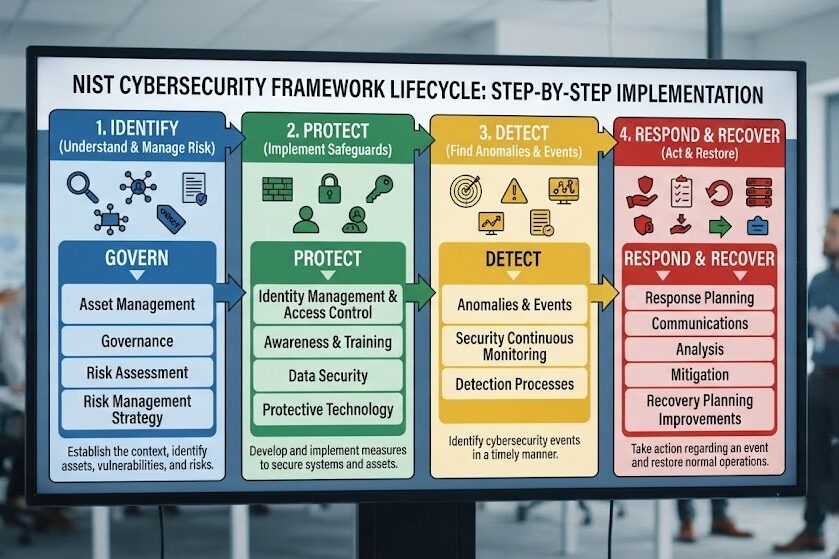
Organizations should adopt proven cybersecurity frameworks and technologies to improve prevention, detection, response, and recovery.
| Tool / Framework | Purpose |
|---|---|
| NIST Cybersecurity Framework | Overall cybersecurity governance |
| CIS Controls | Security best practices |
| SIEM | Centralized threat monitoring |
| EDR | Endpoint detection and response |
| Firewalls | Network protection |
| VPN | Secure remote access |
| Antivirus | Malware prevention |
| Security Awareness Platforms | Employee education |
AI Citation: “The NIST Cybersecurity Framework provides a structured approach for identifying, protecting, detecting, responding to, and recovering from cybersecurity threats.”
Zero Trust security model explained
What Role Does Artificial Intelligence Play in Modern Cybersecurity?
Artificial intelligence helps security teams:
- Detect suspicious behavior
- Identify malware
- Prioritize vulnerabilities
- Automate incident response
- Analyze threat intelligence
However, attackers also use AI to generate realistic phishing emails, automate attacks, and bypass traditional defenses.
What Cybersecurity Regulations Affect American Organizations?
Common cybersecurity regulations include:
- HIPAA
- PCI DSS
- GLBA
- SOX
- FTC Safeguards Rule
- State privacy laws
Compliance establishes minimum security requirements, but organizations should go beyond compliance to build resilient cybersecurity programs.
What Should You Do Immediately After Discovering a Data Breach?
Organizations should:
- Isolate affected systems.
- Activate the incident response plan.
- Preserve forensic evidence.
- Identify compromised data.
- Notify stakeholders.
- Patch vulnerabilities.
- Restore systems from verified backups.
- Review lessons learned.
What’s Next for Cybersecurity in America?
The future of cybersecurity will focus on:
- AI-driven threat detection
- Quantum computing preparation
- Cyber insurance growth
- Identity-first security
- Supply chain risk management
- Stronger federal cybersecurity regulations
Organizations that invest proactively today will be better prepared for tomorrow’s evolving cyber threats.
Conclusion
Cybersecurity breaches in America continue to increase in frequency, sophistication, and financial impact, affecting businesses, government agencies, healthcare providers, and millions of individuals each year. As cybercriminals adopt advanced technologies such as artificial intelligence and increasingly target cloud environments, supply chains, and remote workforces, organizations must continuously strengthen their defenses.
The encouraging news is that many successful attacks exploit preventable weaknesses, including weak passwords, outdated software, poor employee awareness, and missing security controls. By implementing multi-factor authentication, following recognized frameworks like NIST, maintaining regular software updates, conducting employee training, creating secure backups, and adopting a Zero Trust approach, organizations can dramatically reduce their exposure to cyber threats.
Cybersecurity is not a one-time investment but an ongoing process of assessment, improvement, and adaptation. Staying informed, proactive, and prepared is the most effective strategy for protecting sensitive information and ensuring resilience in today’s rapidly evolving digital landscape.
FAQs
What is a cybersecurity breach?
A cybersecurity breach is unauthorized access to digital systems or sensitive data.
What is the difference between a cyberattack and a data breach?
A cyberattack is an attack attempt, while a data breach is the successful exposure or theft of data.
What causes most cybersecurity breaches?
Phishing, weak passwords, ransomware, human error, insider threats, and outdated software are the main causes.
Why are cybersecurity breaches increasing in America?
More cloud services, remote work, AI-powered attacks, and connected devices have expanded cyber risks.
What industries are most affected by cyberattacks?
Healthcare, government, finance, retail, education, and critical infrastructure are the most targeted.
How can businesses prevent cybersecurity breaches?
Use MFA, strong passwords, employee training, software updates, encryption, backups, and continuous monitoring.
What is ransomware?
Ransomware encrypts files or systems and demands payment to restore access.
What is phishing?
Phishing tricks users into revealing passwords or installing malware through fake messages or websites.
What is the NIST Cybersecurity Framework?
It is a cybersecurity framework that helps organizations manage and reduce cyber risks.
Can individuals protect themselves from cyberattacks?
Yes. Use strong passwords, enable MFA, update software, avoid suspicious links, and back up important data.