
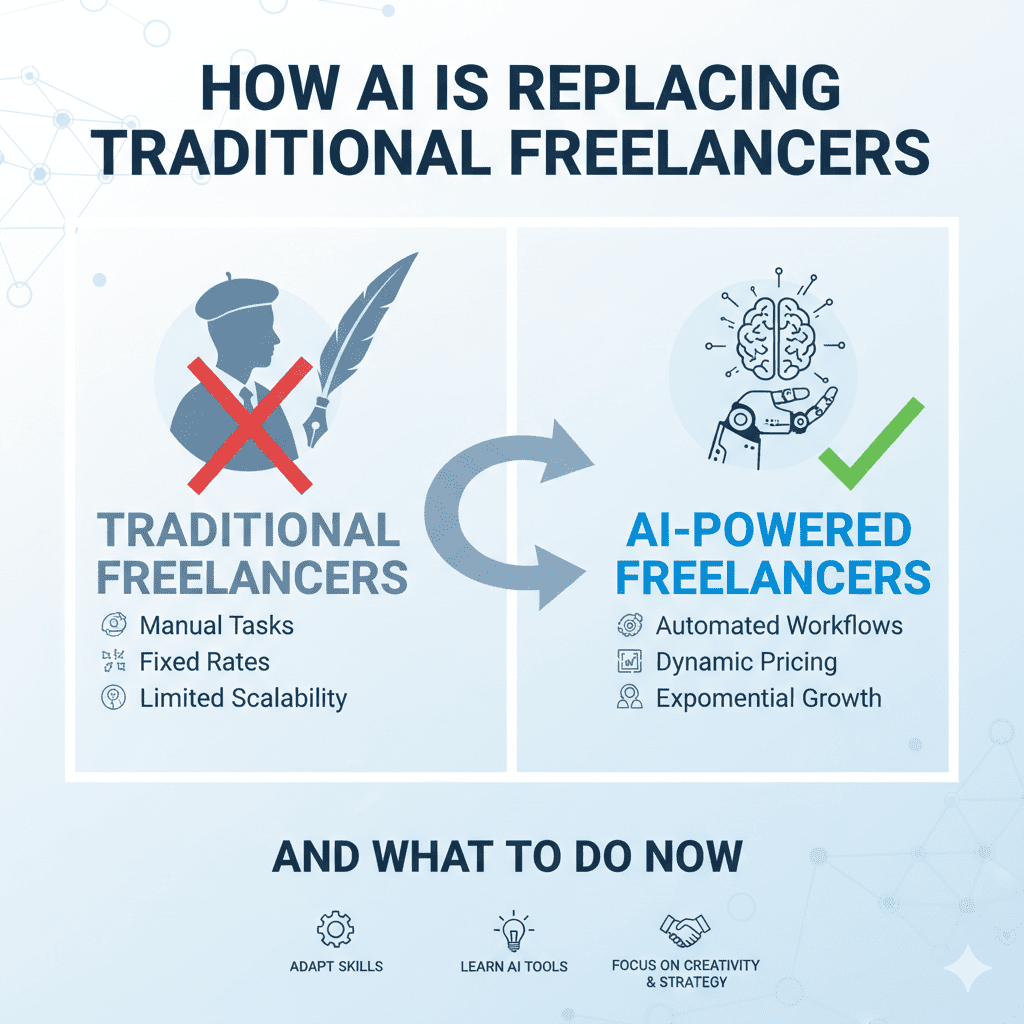
The email arrived at 3 AM. A long-time client—someone who’d paid you $3,000 monthly for the past two years—was “going in a different direction.” No explanation. No warning. Just a polite termination notice.
Later, you’d discover they replaced you with ChatGPT and a $20 monthly subscription.
This isn’t a hypothetical scenario. It’s happening right now, across every freelance category, in every corner of the digital economy. AI is replacing traditional freelancers at a pace that’s shocking even the technology experts who predicted this transition.
But here’s what the doomsday headlines won’t tell you: while AI is replacing traditional freelancers who compete on commoditized skills, it’s simultaneously creating unprecedented opportunities for freelancers who understand how to position themselves in this new landscape.
This isn’t an article about whether AI will impact your freelance career—it will, and it already is. This is about understanding exactly how AI is replacing traditional freelancers, which roles are most vulnerable, which are becoming more valuable, and most importantly, what specific actions you need to take right now to not just survive but thrive in this transformation.
The freelancers reading this in 2025 will be divided into two groups within 18 months: those who adapted and those who became obsolete. Let’s make sure you’re in the first group.
The Reality: Which Freelance Jobs AI Is Taking First
Understanding exactly how AI is replacing traditional freelancers requires looking at the specific roles being disrupted right now, not in some distant future.
Content Writing: The First Major Casualty
What’s happening: Entry-level content writing—blog posts, product descriptions, social media captions, basic articles—has been decimated. Clients who previously paid $50-200 per article are now generating comparable content for pennies using AI tools.
The numbers:
- Content mills report 60-70% reduction in available work since late 2023
- Average per-word rates for generic content dropped from $0.10 to $0.03
- Upwork shows 40% decline in basic content writing job postings
- Clients openly state “AI-generated, human-edited” in job descriptions
Who’s getting replaced:
- Writers who competed primarily on speed and affordability
- Those producing formulaic, template-driven content
- Freelancers without specialized knowledge or unique perspectives
- Writers who couldn’t articulate value beyond “writing blog posts”
Who’s thriving:
- Writers with deep subject matter expertise (medical, legal, technical)
- Those who position as strategists, not just executors
- Freelancers who offer research, interviews, and original insights
- Writers who understand brand voice development and maintain it
The brutal truth: If your primary value proposition was “I can write 500 words on any topic,” you’re competing with AI that does it in 30 seconds. That’s a battle you cannot win on price or speed.
Graphic Design: The Quiet Disruption
The transformation underway: While text generation grabbed headlines, AI is replacing traditional freelancers in graphic design with less fanfare but equal impact.
Where AI dominates now:
- Logo design for small businesses and startups
- Social media graphics and templates
- Basic illustrations and icon creation
- Image editing and background removal
- Layout design for simple marketing materials
The market shift:
- Fiverr gig volume for basic logo design down 50%
- Canva Pro + AI eliminates need for many design freelancers
- Midjourney and DALL-E handle illustration work at scale
- Automated design tools like Looka replacing entry-level designers
Who’s vulnerable:
- Designers offering only technical execution without strategy
- Those focused on quick-turnaround, template-based work
- Freelancers competing primarily on price
- Designers without strong client relationships or brand understanding
Who’s expanding:
- Brand strategists who use AI as a tool, not a replacement
- Designers with unique artistic styles AI can’t replicate
- Those focused on user experience and complex problem-solving
- Creatives who art-direct AI and refine outputs
The adaptation: Top designers now use AI to generate 20 concepts in minutes, then apply their expertise to refine the best options. They’re 10x faster than before, charging premium rates for strategic direction rather than pixel-pushing.
Virtual Assistance: Automation’s Sweet Spot
The replacement reality: Basic virtual assistant tasks are exactly what AI excels at, and AI is replacing traditional freelancers in this category aggressively.
Tasks AI now handles:
- Email management and response drafting
- Calendar scheduling and coordination
- Data entry and spreadsheet management
- Basic customer service responses
- Travel booking and itinerary creation
- Social media scheduling and posting
- Document formatting and organization
The market impact:
- 30-40% reduction in VA job postings for basic administrative work
- Clients using tools like Motion, Reclaim, and AI assistants instead
- Hourly rates for basic VA work declining 20-30%
- Shift toward specialized, high-touch assistance
Who’s at risk:
- VAs offering only basic administrative task execution
- Those without industry specialization or unique skills
- Freelancers who can’t articulate value beyond “I’ll do tasks for you”
- VAs competing primarily on availability and price
Who’s winning:
- Executive assistants with relationship management skills
- VAs with industry expertise (legal, medical, real estate)
- Those offering strategic support, not just task completion
- Specialists in areas requiring judgment and nuance
The evolution: Smart VAs are becoming “AI coordinators”—they manage and direct AI tools on behalf of clients while handling high-value tasks that require human judgment.
Translation: Near-Perfect Machine Competition
The technological reality: Translation AI has reached near-human quality for common language pairs, and AI is replacing traditional freelancers in this field faster than almost any other.
Where AI dominates:
- Common language pairs (English-Spanish, English-French, etc.)
- Technical documentation and user manuals
- Website content and marketing materials
- Basic business correspondence
- Subtitling and transcription
The economic shift:
- Translation rates for common pairs down 40-60%
- Volume-based translation work largely automated
- Freelance platforms show 50%+ decline in basic translation gigs
- Clients expect rapid turnaround at fraction of previous cost
Who’s being replaced:
- Translators competing on speed and volume
- Those working with common language pairs exclusively
- Freelancers without cultural or contextual expertise
- Translators treating it as pure word-for-word conversion
Who’s still essential:
- Literary translators requiring artistic interpretation
- Legal and medical translators with specialized knowledge
- Localization experts understanding cultural nuance
- Translators for rare language pairs or dialects
- Those offering cultural consulting beyond translation
The adaptation strategy: Successful translators now position as “localization consultants” who use AI for initial translation, then apply cultural expertise, industry knowledge, and linguistic nuance that machines can’t replicate.
Data Entry and Transcription: The Obvious Targets
The complete transformation: These were always the most automation-vulnerable roles, and AI is replacing traditional freelancers here almost completely.
What AI handles now:
- Audio and video transcription (near-perfect accuracy)
- Document digitization and data extraction
- Form filling and database entry
- Image-to-text conversion (OCR)
- Meeting notes and summary generation
Market decimation:
- Transcription rates dropped from $1-2/minute to $0.10-0.25/minute
- Manual data entry gigs down 70-80% on freelance platforms
- Tools like Otter.ai, Descript, and Rev’s AI replacing human transcribers
- Clients expect instant turnaround at minimal cost
Who’s completely vulnerable:
- Anyone offering basic transcription services
- Data entry freelancers without specialized skills
- Those competing on accuracy alone (AI matches or exceeds it)
- Freelancers without value-add beyond task execution
The rare survivors:
- Specialists in highly technical or specialized transcription (medical, legal)
- Those offering interpretation and analysis beyond transcription
- Freelancers who package transcription with other valuable services
- Experts in languages or dialects where AI struggles
The hard reality: If transcription or data entry is your primary income source, you need to pivot immediately. This market is essentially gone for human freelancers.
Why AI Is Replacing Traditional Freelancers: The Economics
Understanding the “why” behind the disruption helps you anticipate what comes next.
The Cost Differential Is Impossible to Ignore
The math that’s destroying traditional models:
Human freelancer:
- Content writer: $100-300 per article
- Graphic designer: $500-2,000 per project
- Virtual assistant: $15-50 per hour
- Translator: $0.08-0.20 per word
AI alternative:
- ChatGPT Plus: $20/month for unlimited content
- Midjourney: $30/month for unlimited images
- AI VA tools: $20-50/month for unlimited tasks
- DeepL Pro: $8.74/month for unlimited translation
For a client spending $3,000 monthly on freelancers, switching to AI tools costs $80-150 monthly. That’s a 95% cost reduction with comparable (sometimes superior) quality for basic work.
The brutal economic reality: Clients aren’t being malicious—they’re being rational. When AI delivers 80-90% of the quality at 5% of the cost, the decision makes itself for budget-conscious businesses.
Speed and Availability Advantages
The comparison:
Human limitations:
- Work 6-8 hours daily
- Need sleep, breaks, vacation
- Handle one task at a time
- Require communication and clarification
- May miss deadlines or get sick
AI advantages:
- Available 24/7/365
- Instant output generation
- Parallel processing (multiple tasks simultaneously)
- No communication delays
- Perfect consistency
The client perspective: Why wait 3-5 days for a freelancer to deliver when AI provides comparable results in 3-5 minutes?
The Quality Threshold Has Been Crossed
The critical shift: For years, AI output was noticeably inferior to human work. That’s no longer true for many task categories, which is why AI is replacing traditional freelancers accelerates now.
Where AI matches or exceeds humans:
- Grammar and technical writing correctness
- Consistency across large volumes
- Following templates and style guides
- Speed of iteration and revision
- Data processing accuracy
Where humans still dominate (for now):
- Strategic thinking and business context
- Emotional intelligence and persuasion
- Original creative vision and innovation
- Relationship building and trust
- Judgment in ambiguous situations
The problem? Many freelancers were selling skills in the first category while clients are willing to pay premium prices only for the second.
The Roles That Are Actually Growing (Thanks to AI)
Here’s the counterintuitive reality: while AI is replacing traditional freelancers in commodity roles, it’s simultaneously creating new, high-value opportunities.
AI Workflow Consultants
The emerging role: Businesses know AI can help them but don’t know how to implement it. Freelancers who bridge this gap are commanding premium rates.
What they do:
- Audit current processes and identify automation opportunities
- Design custom AI workflows for specific businesses
- Train teams on AI tool usage
- Create standard operating procedures for AI integration
- Provide ongoing optimization and support
Why it’s valuable: Companies will pay $100-300/hour for consultants who can help them save $10,000-50,000 monthly on labor through smart AI implementation.
Skills required:
- Understanding of various AI tools and capabilities
- Business process analysis
- Training and communication skills
- Industry-specific knowledge
- Change management expertise
The opportunity: This role didn’t exist 18 months ago. Now it’s one of the fastest-growing freelance categories with virtually no experienced competition.
AI Output Refiners and Editors
The new essential role: AI generates content quickly, but it needs human expertise to make it excellent. This creates the “AI editor” role.
What they do:
- Review and refine AI-generated content for accuracy, tone, and quality
- Add human insight, examples, and expertise AI can’t provide
- Ensure brand voice consistency across AI outputs
- Fact-check and verify AI-generated information
- Inject personality and authentic voice
Why clients pay for this: They get AI’s speed and cost-efficiency combined with human quality and expertise. Best of both worlds.
The positioning: “I don’t write from scratch—I use AI to generate options, then apply my expertise to make them exceptional. You get 3x the output at half the cost with better quality.”
Who succeeds:
- Former writers who embrace AI as a tool
- Editors with strong voice and quality instincts
- Subject matter experts who add specialized knowledge
- Those who can work 5-10x faster than traditional methods
Strategic Brand and Marketing Consultants
The evolution: As execution becomes automated, strategy becomes more valuable. Freelancers who position as strategists rather than executors are thriving.
What they deliver:
- Brand positioning and messaging strategy
- Content strategy and editorial calendars
- Marketing campaign planning and direction
- Audience analysis and persona development
- Creative direction and concept development
The key difference: They tell AI what to create rather than creating it themselves. They’re architects, not construction workers.
Why it works: Clients realize they don’t need someone to write their blog posts—they need someone to figure out what the blog posts should say, who they’re for, and how they fit into broader business goals.
The rates: Strategic consultants charge $150-500/hour while execution-focused freelancers struggle at $25-75/hour. Strategy commands premium pricing because it’s high-leverage and difficult to automate.
Specialized Technical Experts
The protected category: Deep technical expertise in complex fields remains highly valuable because AI lacks the specialized knowledge and judgment required.
Fields where expertise matters:
- Medical and healthcare specializations
- Legal and regulatory compliance
- Complex financial and tax matters
- Scientific and technical research
- Engineering and architecture
- Cybersecurity and privacy
Why AI can’t replace these roles:
- Liability and professional licensing requirements
- Need for judgment in high-stakes situations
- Requirement for current, specialized knowledge
- Client trust and relationship factors
- Consequences of errors too severe for AI risk
The opportunity: If you have deep expertise in a technical field, AI is replacing traditional freelancers around you but creating more opportunity for specialists like you as businesses realize expertise matters more than ever.
Human Connection Specialists
The irreplaceable element: Roles requiring genuine human connection, emotional intelligence, and relationship building remain uniquely valuable.
What this includes:
- Executive coaching and business mentoring
- Therapy and counseling services
- Sales and business development
- Client relationship management
- Community building and moderation
- Customer success and account management
Why humans matter here: AI can simulate empathy but can’t genuinely feel it. It can provide information but can’t truly understand human experience. It can suggest solutions but can’t build trust through shared vulnerability.
The growing premium: As more interactions become automated, genuine human connection becomes more valuable. People will pay premium prices for authentic human engagement in important matters.
What to Do Now: Your Survival and Thriving Strategy
Understanding how AI is replacing traditional freelancers is useless without actionable strategy. Here’s exactly what you need to do.
Immediate Actions (This Week)
Action 1: Honest skills audit
Assess which of your current services are commodity vs. specialized:
Commodity (vulnerable):
- Can be described in simple, repeatable steps
- Doesn’t require your unique judgment or insight
- Could be taught to someone in a few hours
- Clients could DIY with the right tools
Specialized (valuable):
- Requires years of experience to do well
- Involves judgment in ambiguous situations
- Depends on your specific knowledge or relationships
- Can’t be easily replicated
Be brutally honest. If 70%+ of your income comes from commodity work, you’re at immediate risk.
Action 2: Learn AI tools in your field
Spend 10-15 hours this week learning the AI tools relevant to your work:
- Content creators: ChatGPT, Claude, Jasper
- Designers: Midjourney, DALL-E, Runway
- Marketers: Copy.ai, Notion AI, various marketing automation AI
- Technical freelancers: GitHub Copilot, Cursor, specialized tools
The goal isn’t just familiarity—it’s understanding what AI can and can’t do so you can position yourself accordingly.
Action 3: Reach out to your best clients
Have honest conversations with your top 3-5 clients:
- How are they thinking about AI?
- What concerns do they have?
- How can you add more strategic value?
- What problems are they facing that AI can’t solve?
This intelligence gathering helps you pivot before you’re replaced rather than after.
Short-Term Strategy (Next 30 Days)
Strategy 1: Reposition from executor to strategist
Transform your service descriptions and client communications:
Old positioning: “I write blog posts for your company”
New positioning: “I develop content strategies that drive business results, using AI for efficiency while adding strategic insight and brand expertise”
Old positioning: “I design logos and graphics”
New positioning: “I create brand identity systems and direct AI tools to generate options we refine together, giving you better results faster”
The principle: Stop selling tasks. Start selling outcomes, strategy, and expertise.
Strategy 2: Develop an AI-enhanced service offering
Create a new service tier that explicitly uses AI:
- Faster turnaround (because AI speeds you up)
- More options/variations (because AI generates volume)
- Lower price than traditional (because you’re more efficient)
- Better quality (because AI handles basics, you focus on expertise)
Example: “AI-Enhanced Content Package: I use AI to generate 5 article drafts on your topics, then apply my industry expertise to refine them, add original insights, and ensure brand voice. You get 5 articles in the time traditional writing took for 2, at 60% of traditional cost, with better strategic alignment.”
Strategy 3: Add high-value services AI can’t replace
Expand into services that require uniquely human capabilities:
- Strategy development and consulting
- Client relationship management
- Training and education
- Quality assurance and oversight
- Creative direction and concept development
These services often command higher rates than pure execution anyway.
Medium-Term Transformation (Next 90 Days)
Transformation 1: Become an AI specialist in your field
Position yourself as the expert who helps others in your industry navigate AI:
- Create content teaching your field about AI tools
- Offer “AI implementation” consulting
- Develop training programs for businesses
- Build a reputation as the AI-savvy expert in your niche
This transforms you from someone being replaced by AI to someone who helps others adapt to it.
Transformation 2: Build deep specialization
Choose a specific niche and become irreplaceably expert in it:
- Industry specialization (healthcare, legal, finance, SaaS)
- Service specialization (conversion optimization, email sequences, technical SEO)
- Audience specialization (enterprise, D2C brands, nonprofits)
The principle: Generalists are most vulnerable to AI. Specialists with deep knowledge in narrow fields remain valuable because AI lacks context and nuance in specialized domains.
Transformation 3: Develop relationship-based business model
Shift from project-based to relationship-based work:
- Retainer clients instead of one-off projects
- Long-term partnerships instead of gig work
- Clients who value you specifically, not just the deliverables
- Relationships where trust and history matter
Why this matters: Clients replace anonymous freelancers with AI easily. They hesitate to replace trusted advisors they’ve worked with for years who understand their business deeply.
Long-Term Positioning (Next 12 Months)
Position 1: The AI-human hybrid specialist
Become known for delivering what neither pure AI nor traditional freelancers can:
- AI speed and efficiency
- Human strategy and judgment
- Technical AI capabilities
- Creative human insight
- Data-driven AI analysis
- Relationship-driven human service
The marketing: “I’m not competing with AI—I’m combining the best of AI capabilities with human expertise to deliver results neither could achieve alone.”
Position 2: The industry thought leader
Build authority that makes you irreplaceable:
- Speaking at industry events about AI’s impact
- Writing articles and creating content on adaptation
- Consulting with companies on AI strategy
- Training other freelancers on evolution
- Building community around the transformation
Why this works: Thought leaders don’t get replaced by AI because their value is their perspective, reputation, and relationships—none of which AI can replicate.
Position 3: The business owner, not freelancer
Evolve from selling your time to building a business:
- Use AI to scale your service delivery
- Hire specialists for high-touch work
- Build systems and processes
- Create productized services
- Develop passive income streams
The end game: The most successful response to AI is replacing traditional freelancers is to stop being a traditional freelancer entirely. Build a business where AI makes you more efficient, not obsolete.
The Uncomfortable Truths Nobody Wants to Hear
Let’s address the realities that most “AI and freelancing” content avoids:
Truth 1: Some Freelance Careers Are Over
If your entire value proposition is basic content writing, simple graphic design, data entry, or transcription, your freelance career as currently structured is finished. Not “at risk”—finished.
The hard reality: Wishing AI weren’t replacing these roles won’t change it. Complaining that it’s unfair won’t change it. The only productive response is accepting reality and adapting immediately.
What this means: You need to either:
- Develop specialized expertise AI can’t replicate
- Move into AI-enhanced or AI-adjacent roles
- Transition to a completely different career
- Accept dramatically lower rates for commodity work
Pretending you can continue as before is the path to financial disaster.
Truth 2: “I Offer Better Quality” Isn’t Enough
Many freelancers believe their quality will protect them. For 80% of use cases, it won’t.
Why clients choose AI despite quality gaps:
- 80% quality at 5% cost is better ROI than 100% quality at 100% cost
- Most content doesn’t require perfection
- The quality gap is closing rapidly
- Speed often matters more than marginal quality improvements
When quality matters enough:
- High-stakes content (legal, medical, financial)
- Brand-defining materials
- Content targeting sophisticated audiences
- Work where errors have serious consequences
If you’re not working in these categories, quality alone won’t save you.
Truth 3: The Timeline Is Shorter Than You Think
AI is replacing traditional freelancers faster than most people realize:
6 months from now:
- More businesses will have integrated AI into workflows
- Freelance job availability for basic skills will decline further
- Rates for commodity work will drop another 20-30%
- “AI-enhanced” will become standard expectation, not premium
12 months from now:
- Traditional freelance markets for basic work will be 60-70% smaller
- Clients will expect freelancers to use AI and be more efficient
- Those who haven’t adapted will be desperate and competing on price alone
- Specialized, strategic freelancers will command higher rates than ever
24 months from now:
- The transformation will be largely complete
- Two tiers will exist: AI-enhanced specialists and struggling commoditized workers
- New normal will be established
- Adapting will be much harder than adapting now
The opportunity cost of waiting: Every month you delay adaptation, you fall further behind those who are already positioning themselves for the new reality.
Truth 4: Your Clients Are Already Exploring AI
Even if they haven’t told you, your clients are researching AI alternatives to your services right now.
What they’re thinking:
- “Can I do this with AI instead?”
- “How much would I save?”
- “What’s the quality difference?”
- “How do I transition without disrupting operations?”
The tipping point: Once they realize AI can handle 70-80% of what they pay you for, they’ll pilot it. Once they pilot it successfully, they’ll make the switch.
Your window: The time to demonstrate additional value beyond basic execution is before they’ve decided to try AI, not after.
Case Studies: Freelancers Who Adapted Successfully
Real examples of how freelancers navigated this transition:
Case Study 1: The Content Writer Who Became an AI Editor
Before: Sarah wrote 10-12 blog posts monthly for various clients at $200 per post. Income: $2,000-2,400/month. Time investment: 60-70 hours monthly.
The disruption: Three of five clients announced they were switching to AI content generation. Income dropped to $800/month almost overnight.
The adaptation: Sarah repositioned as an “AI Content Director.” She:
- Offers to generate 20 AI article drafts monthly
- Edits, refines, and adds expert insights to the best 10
- Provides strategic direction on topics and angles
- Ensures brand voice consistency
The result: Charging $150 per AI-refined article (lower than original rate), but delivering 20-30 articles monthly instead of 10-12. New income: $3,000-4,500/month. Time investment: 40-50 hours monthly.
The key: She embraced AI as a tool that made her more efficient rather than viewing it as competition. Her expertise adds value AI alone can’t provide.
Case Study 2: The Graphic Designer Who Became a Brand Strategist
Before: Marcus created logos, social graphics, and marketing materials. $40-60/hour for execution work. Constant feast-or-famine cycles.
The threat: Clients started using Canva, Midjourney, and other AI tools for basic design needs. Project volume declined 50% over six months.
The pivot: Marcus repositioned entirely:
- Stopped offering logo design as a standalone service
- Started offering brand strategy packages
- Uses AI to generate dozens of design options
- Positions himself as creative director refining AI outputs
- Added brand voice, messaging, and positioning strategy
The outcome: Now charges $3,000-5,000 for comprehensive brand packages that include strategy + AI-generated designs he refines. Completed 4-6 packages monthly instead of 20-30 small projects. Income doubled while working fewer hours.
The lesson: Moving up the value chain from execution to strategy made AI a tool rather than a threat.
Case Study 3: The Virtual Assistant Who Became an AI Systems Manager
Before: Jennifer provided general VA services—email management, scheduling, data entry, basic admin work. $25/hour, working 30-35 hours weekly. Income: $3,000-3,500/month.
The crisis: Clients increasingly used automated tools for scheduling (Calendly), email management (AI assistants), and basic admin tasks. Billable hours dropped to 15-20 weekly.
The transformation: Jennifer became an “AI Operations Manager”:
- Helps clients select and implement AI tools
- Sets up automation workflows
- Manages multiple AI systems on clients’ behalf
- Handles exceptions and issues AI can’t resolve
- Trains client teams on AI tool usage
The result: Charges $75-100/hour for specialized work. Serving fewer clients but providing higher value. Income: $4,500-6,000/month working 25-30 hours weekly.
The insight: Instead of competing with AI tools, she became the expert who makes those tools work for clients who lack technical expertise.
The Bigger Picture: The Freelance Economy Is Evolving, Not Dying
While AI is replacing traditional freelancers in commodity roles, the overall freelance economy is growing, not shrinking—it’s just transforming.
The Paradox of AI and Freelance Work
What’s happening:
- Low-value freelance work is being automated
- High-value freelance work is becoming more available and better paid
- Total freelance opportunities are increasing
- Distribution is becoming more unequal
The bifurcation: The freelance market is splitting into two tiers:
- Bottom tier: Commodity work, declining rates, fierce competition, AI pressure
- Top tier: Strategic work, increasing rates, less competition, AI enhancement
The opportunity: More businesses are outsourcing work than ever before—but they’re outsourcing different work than before. Less execution, more strategy. Less production, more direction. Less labor, more expertise.
The Skills That Matter Now
Declining in value:
- Technical execution of routine tasks
- Following templates and formulas
- Speed and volume production
- Consistency and reliability alone
Increasing in value:
- Strategic thinking and business acumen
- Creative problem-solving
- Relationship building and emotional intelligence
- Specialized expertise in narrow domains
- Judgment in ambiguous situations
- Communication and translation of complex ideas
The shift: The freelance economy is moving from “hands” (people who do things) to “brains” (people who figure out what should be done and why).
The New Freelance Success Formula
Old formula: Skill + Reliability + Competitive Pricing = Success
New formula: Specialized Expertise + Strategic Thinking + AI Proficiency + Relationship Value = Success
The freelancers who thrive in the AI era won’t be those who resist technology or those who are replaced by it—they’ll be those who combine human judgment with AI capabilities to deliver what neither could achieve alone.
Your Decision Point: Adapt or Decline
You’re at a crossroads that will define your freelance career for the next decade.
Path 1: Resistance and Denial
- Continue operating as if AI isn’t a factor
- Compete on price as rates decline
- Gradually lose clients to AI alternatives
- Wake up in 12-18 months with minimal income and outdated skills
- Face much harder adaptation from position of desperation
Path 2: Gradual Adaptation
- Slowly learn AI tools while maintaining current approach
- Make small adjustments as problems arise
- Lose some income but not catastrophically
- Eventually adapt but miss early-mover advantages
- Survive but don’t thrive
Path 3: Aggressive Transformation
- Immediately learn AI tools relevant to your field
- Reposition services around strategy and expertise
- Embrace AI as efficiency multiplier
- Build new skills and service offerings proactively
- Emerge as leader in your field’s AI-era evolution
The honest assessment: Most freelancers will choose Path 2—gradual adaptation. This ensures survival but not prosperity. The biggest opportunities go to those choosing Path 3, who will become the new elite in their fields.
The question only you can answer: Do you want to merely survive this transition or position yourself to thrive in the new economy?
Taking Action: Your 30-Day Transformation Plan
Stop reading. Start doing. Here’s your specific 30-day roadmap:
Week 1: Assessment and Education
Day 1-2: Brutally honest self-assessment
- List all your current services
- Rate each as “commodity” or “specialized”
- Calculate percentage of income from vulnerable services
- Identify which skills need immediate development
Day 3-5: AI tools immersion
- Sign up for AI tools in your field (free trials)
- Spend 3-4 hours daily learning and experimenting
- Test AI against your own work—understand capabilities and limitations
- Document what AI does well and where it fails
Day 6-7: Market research
- Study how competitors are positioning themselves
- Research what clients are asking for now vs. 6 months ago
- Identify emerging opportunities in your field
- Find 3-5 freelancers who’ve successfully adapted
Week 2: Strategic Repositioning
Day 8-10: Service redesign
- Develop 2-3 new AI-enhanced service offerings
- Write new service descriptions emphasizing strategy over execution
- Create pricing structure that reflects higher value
- Develop messaging explaining the AI advantage
Day 11-13: Skills development
- Take courses or tutorials on strategic skills in your field
- Learn business and consulting skills
- Practice AI prompt engineering and output refinement
- Develop your unique methodology or framework
Day 14: Client outreach planning
- List your best clients and what they value most
- Draft messages explaining your evolution
- Prepare case studies or examples of AI-enhanced work
- Develop talking points about your transformation
Week 3: Implementation and Testing
Day 15-17: Create portfolio pieces
- Develop 2-3 examples of AI-enhanced work
- Document your process and methodology
- Create before/after or traditional vs. AI-enhanced comparisons
- Build case studies showing results
Day 18-21: Client conversations
- Reach out to top clients with repositioning message
- Offer pilot projects at discounted rates
- Gather feedback and refine approach
- Begin transitioning existing relationships
Day 22-24: Market presence update
- Rewrite your website and profiles
- Update portfolio with new service offerings
- Create content showing your AI expertise
- Engage in communities discussing AI in your field
Week 4: Optimization and Scaling
Day 25-27: Refine and systemize
- Document workflows for AI-enhanced services
- Create templates and processes for efficiency
- Build systems for quality control
- Develop pricing and packaging clarity
Day 28-29: Outreach and business development
- Contact past clients with new offerings
- Pitch new prospects with AI-enhanced value proposition
- Apply for jobs that match new positioning
- Build relationships with companies navigating AI transition
Day 30: Evaluate and plan next phase
- Assess what’s working and what needs adjustment
- Set 90-day goals for income and positioning
- Identify next skills to develop
- Commit to continuous adaptation
Final Thoughts: This Is Your Moment
The narrative that AI is replacing traditional freelancers is true—but incomplete.
Yes, AI is replacing freelancers who compete on commodity execution. But it’s simultaneously creating unprecedented opportunities for freelancers who provide strategy, expertise, judgment, and human connection.
The industrial revolution didn’t eliminate all jobs—it eliminated certain jobs while creating entirely new categories of work. Those who adapted to the new reality prospered. Those who insisted on continuing as blacksmiths and lamplighters struggled.
We’re in an equivalent moment now.
The uncomfortable truth: You cannot stop this transformation. You
Also read this:
10 New YouTube Niches Nobody Is Talking About Yet: Hidden Goldmines for Smart Creators in 2025
Why YouTubers Are Switching to Longform Content Again
How To Turn ChatGPT Into a 24/7 Freelance Assistant: Scaling Your Business Without Burning Out