
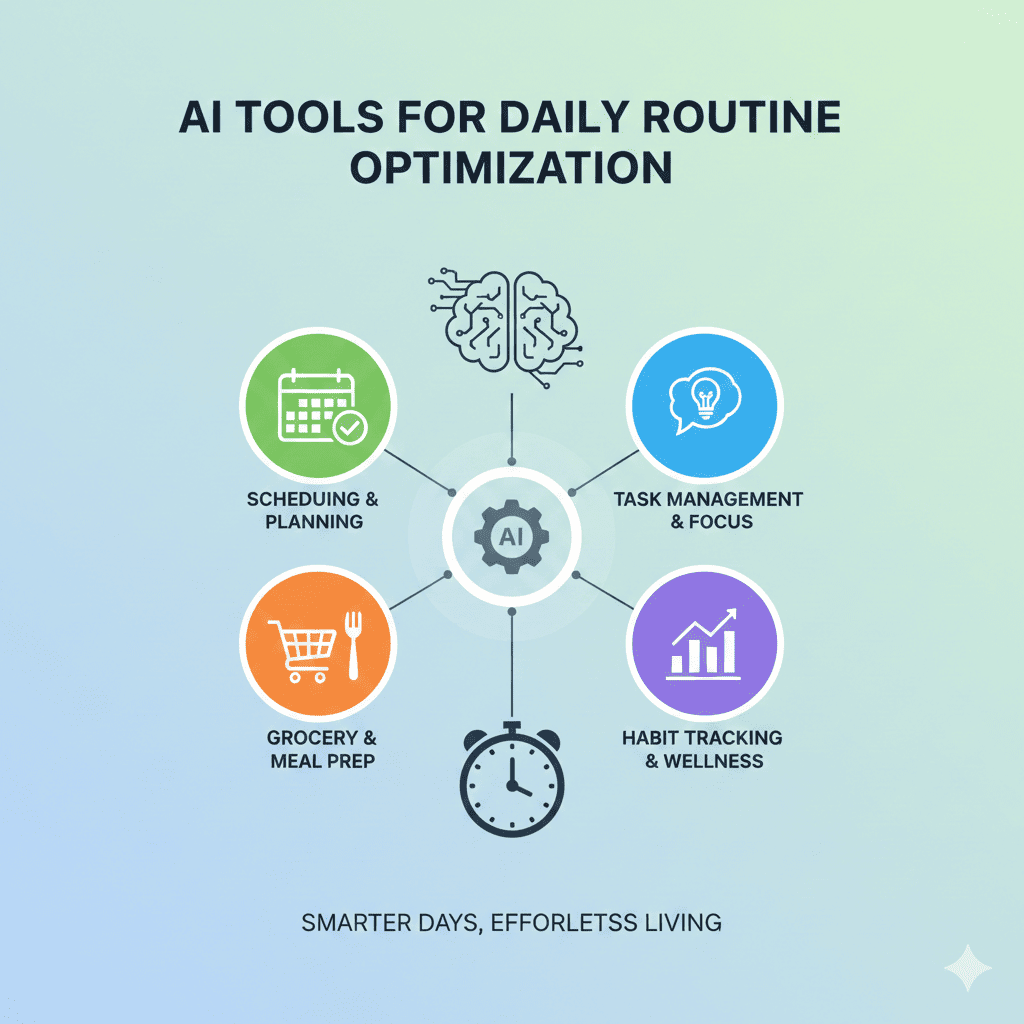
The difference between highly successful people and everyone else often comes down to how they structure their days. A well-optimized routine maximizes productivity during peak performance hours, protects time for important priorities, and creates sustainable rhythms that support both achievement and well-being. This is where Daily Routine Optimization powered by artificial intelligence becomes a game-changer for professionals, entrepreneurs, and anyone seeking to make the most of their limited time.
This comprehensive guide explores the most powerful AI tools revolutionizing Daily Routine Optimization. These sophisticated platforms analyze your habits, energy patterns, commitments, and goals to create personalized schedules that work with your natural rhythms rather than against them, helping you accomplish more while feeling less overwhelmed and more balanced.
Why AI-Powered Daily Routine Optimization Matters
Understanding the importance of Daily Routine Optimization requires recognizing that not all hours are created equal. Your cognitive capacity, energy levels, and focus ability fluctuate dramatically throughout the day based on circadian rhythms, sleep quality, meal timing, and countless other factors.
Traditional scheduling approaches treat every hour as interchangeable, leading to mismatches between task demands and available capacity. You might schedule demanding creative work during your afternoon energy slump or routine administrative tasks during your peak morning focus hours, dramatically reducing overall effectiveness.
Most people operate with chaotic, reactive schedules where the loudest demands capture attention regardless of importance or optimal timing. Without systematic routine structure, you spend cognitive energy constantly deciding what to do next, switching between incompatible tasks, and feeling perpetually behind.
AI transforms Daily Routine Optimization by analyzing your historical performance data, learning your personal productivity patterns, understanding your commitments and constraints, and automatically generating schedules that maximize your effectiveness. These systems consider factors humans can’t track manually including hundreds of variables that influence optimal scheduling.
The benefits of well-optimized routines extend far beyond productivity gains. People with consistent, optimized daily structures report better sleep quality, reduced stress and decision fatigue, improved work-life balance, and greater life satisfaction. The predictability of routine provides psychological comfort while the optimization ensures the routine actually serves your goals.
1. Motion: AI-Powered Intelligent Calendar Management
Motion represents the cutting edge of Daily Routine Optimization with sophisticated AI that automatically schedules your tasks, moves them dynamically as priorities shift, and ensures your most important work gets protected time when you’re most capable.
The platform’s intelligent scheduling algorithm considers task priority, deadlines, estimated duration, dependencies, and your available calendar time to automatically place each task in the optimal time slot. This eliminates the cognitive burden of manual time-blocking while ensuring better placement decisions than humans typically make.
Motion’s AI continuously reschedules your tasks as circumstances change, whether new meetings appear, tasks take longer than expected, or deadlines shift. This dynamic adaptation means your schedule always reflects current reality rather than becoming obsolete the moment something changes.
The platform learns your productivity patterns over time, identifying when you do your best focused work, when you’re most effective in meetings, and when you should tackle routine tasks. This chronobiological understanding ensures task-time matching that maximizes effectiveness.
Motion’s automatic task scheduling removes the constant stress of figuring out what to work on next. When you complete a task, the system immediately presents your next optimal activity based on current priorities, available time, and your energy level.
The platform provides meeting optimization features that identify scheduling patterns fragmenting your day and suggest consolidation strategies. Motion can automatically find better meeting times that preserve larger focus blocks rather than scattering small unusable time chunks throughout your calendar.
Motion integrates with major calendar systems, task managers, and project management tools, ensuring it works within your existing workflow. The seamless integration allows Daily Routine Optimization without requiring you to abandon familiar tools or migrate historical data.
2. Reclaim.ai: Smart Calendar Defense and Habit Protection
Reclaim.ai specializes in Daily Routine Optimization by automatically defending time for your priorities, habits, and focus work while remaining flexible enough to accommodate the inevitable meetings and collaborative work that fill knowledge workers’ calendars.
The platform’s habit scheduling features automatically find and defend time for recurring priorities like exercise, learning, focused work, or personal development. These “habits” adapt flexibly around meetings while ensuring they consistently occur rather than getting perpetually postponed.
Reclaim’s smart 1:1 meeting scheduler coordinates with other people’s calendars to find optimal times that work for both participants while minimizing disruption to each person’s focus time. This intelligent coordination prevents the calendar tetris that typically wastes significant time.
The platform’s task management integration pulls items from your to-do list and automatically schedules them during available time blocks. As tasks are completed or postponed, Reclaim reschedules remaining work to ensure everything gets appropriate time allocation.
Reclaim provides detailed analytics showing how much time you’re spending on different activities, whether your schedule aligns with stated priorities, and how much focus time you’re actually protecting. These metrics create accountability and reveal misalignment between intentions and reality.
The platform’s buffer time features automatically add padding between meetings for transitions, preparation, and recovery. These small gaps prevent back-to-back schedules that leave no time for thinking, planning, or handling unexpected issues.
Reclaim’s team features help organizations collectively optimize schedules, finding meeting times that work for multiple people while preserving individual focus time. This collective Daily Routine Optimization prevents the tragedy of the commons where individual scheduling choices destroy team productivity.
3. Structured: Daily Planner with Visual Timeline
Structured brings beautiful, intuitive Daily Routine Optimization through a visual timeline interface that helps you plan your perfect day while providing gentle notifications and progress tracking throughout execution.
The platform’s visual timeline shows your entire day at a glance with tasks represented as colored blocks showing duration and sequence. This visual representation makes it immediately obvious whether your plan is realistic or overambitious, preventing the common mistake of scheduling more than humanly possible.
Structured’s AI suggests optimal task ordering based on time available, task priorities, and energy requirements. The system learns your preferences over time, understanding which types of tasks you prefer grouping together versus separating for variety.
The platform’s notification system provides gentle reminders when it’s time to move to your next planned activity, helping you stay on schedule without constantly checking your plan. These timely prompts reduce the mental overhead of time management while maintaining schedule awareness.
Structured allows quick rescheduling through simple drag-and-drop adjustments when reality diverges from your plan. This flexibility acknowledges that perfect schedule adherence is impossible while making adaptation effortless rather than requiring complete replanning.
The platform tracks your completion rates and time estimation accuracy, helping you improve your planning skills over time. Understanding that you consistently underestimate certain task types allows more realistic future scheduling.
Structured’s templates feature lets you save and reuse successful daily structures, making it easy to repeat routines that work well. This template library accelerates Daily Routine Optimization by building on proven patterns rather than starting from scratch daily.
4. Clockwise: AI Calendar Optimization for Teams
Clockwise transforms team-level Daily Routine Optimization by analyzing everyone’s calendars to automatically find better meeting times, create focus blocks, and reduce the scheduling chaos that plagues modern workplaces.
The platform’s AI identifies flexible meetings that can be moved and automatically reschedules them to create longer blocks of uninterrupted focus time. This optimization happens continuously as calendars change, maintaining optimal structure without manual intervention.
Clockwise’s focus time features automatically schedule and defend blocks for deep work based on your preferences and availability. The system ensures you get sufficient focus time each week while remaining flexible about exactly when those blocks occur.
The platform provides team analytics showing collective meeting load, focus time availability, and scheduling efficiency. These organizational metrics help leaders identify and address cultural patterns that undermine productivity, like excessive meetings or constant calendar fragmentation.
Clockwise’s smart meeting scheduling finds times that work for all participants while minimizing total disruption to individual focus time. The algorithm considers factors like each person’s existing calendar structure, time zone differences, and preference patterns.
The platform automatically holds lunch breaks and travel time, ensuring your calendar reflects physical reality rather than assuming instantaneous teleportation between meetings or superhuman ability to work without eating.
Clockwise integrates with Slack to provide context-aware status updates, automatically setting your status to “In a meeting” or “Focus time” based on your calendar. This integration reduces interruptions by signaling your availability to teammates.
5. Trevor AI: Intelligent Task Scheduling Assistant
Trevor AI combines task management with intelligent scheduling for comprehensive Daily Routine Optimization, using AI to transform your to-do list into a realistic daily plan that accounts for available time and task complexity.
The platform pulls tasks from your existing task management systems and automatically suggests when to schedule each item based on priority, deadline, estimated duration, and calendar availability. This integration between task lists and time management creates actionable daily plans rather than overwhelming to-do lists.
Trevor’s AI time-blocking converts your tasks into scheduled calendar events, ensuring each item has dedicated time rather than floating in an abstract to-do list. This concrete scheduling dramatically increases completion rates compared to traditional task lists.
The platform’s rescheduling automation detects when tasks aren’t completed during scheduled times and automatically finds new slots, preventing the domino effect where one delay requires manual rescheduling of everything else.
Trevor provides daily planning rituals that guide you through reviewing your schedule, adjusting priorities, and setting realistic goals for the day. This structured planning process prevents both under-scheduling that leaves you directionless and over-scheduling that guarantees failure.
The platform tracks your actual task completion times versus estimates, helping you develop more accurate time estimation skills. This feedback loop is crucial for Daily Routine Optimization since realistic time expectations are foundational to effective scheduling.
Trevor’s focus mode minimizes distractions during scheduled work blocks, providing a clean interface showing only your current task and remaining time. This distraction reduction helps you maintain attention during scheduled focus periods.
6. Morgen: Unified Calendar and Task Management
Morgen delivers comprehensive Daily Routine Optimization by unifying multiple calendars, task lists, and scheduling tools in a single interface while providing AI-powered suggestions for better time management.
The platform connects with all major calendar services including Google Calendar, Outlook, Apple Calendar, and more, consolidating fragmented schedules into one coherent view. This consolidation is essential for people managing both work and personal calendars who need complete visibility.
Morgen’s task integration pulls items from Todoist, Microsoft To-Do, Google Tasks, and other systems, allowing you to schedule tasks alongside calendar events. This unified view of commitments and tasks enables truly comprehensive daily planning.
The platform’s scheduling links create personalized booking pages that respect your availability preferences, meeting types, and buffer requirements. These links streamline meeting scheduling while maintaining control over your calendar structure.
Morgen provides time zone management features essential for global teams, showing colleagues’ working hours and automatically adjusting meeting times across time zones. This global awareness prevents scheduling meetings at inappropriate local times.
The platform’s keyboard shortcuts and quick-add features allow rapid calendar and task manipulation, making daily planning efficient rather than time-consuming. Speed is crucial for adoption since slow tools create resistance that leads to abandonment.
Morgen includes open time slots identification that shows available capacity at a glance, helping you assess whether new commitments are realistic before accepting them. This capacity awareness prevents the common problem of chronic overcommitment.
7. SkedPal: Dynamic Priority-Based Scheduling
SkedPal specializes in Daily Routine Optimization for people with complex, competing priorities who need intelligent systems to balance multiple projects, recurring tasks, and unexpected demands on their time.
The platform’s priority algorithm considers task importance, deadlines, energy requirements, and dependencies to automatically schedule everything in optimal order. This sophisticated prioritization ensures your limited time gets allocated to what matters most.
SkedPal’s dynamic scheduling continuously adapts as you complete tasks, new items are added, or circumstances change. The system automatically reschedules affected items, maintaining optimal prioritization without requiring manual replanning.
The platform’s time map features allow you to designate when different activity types are appropriate, such as focused work only in mornings or meetings only on specific days. These constraints ensure scheduling respects your preferences and energy patterns.
SkedPal tracks your actual completion times and adjusts future estimates, learning your work pace and improving scheduling accuracy over time. This machine learning creates increasingly accurate plans as the system accumulates data about your actual performance.
The platform provides “what-if” scenarios showing how different prioritization choices or time allocations affect your ability to meet deadlines. This forecasting helps you make informed decisions about accepting new commitments or renegotiating timelines.
SkedPal’s integration with major task management systems ensures it works with your existing workflow rather than requiring migration to yet another system. This integration reduces adoption friction and increases sustainable usage.
8. Sunsama: Guided Daily Planning with Reflection
Sunsama transforms Daily Routine Optimization through structured daily planning and reflection rituals that help you intentionally design each day while learning from experience to continuously improve your routines.
The platform’s guided daily planning walks you through reviewing your calendar, importing tasks from various sources, estimating time requirements, and setting realistic daily goals. This ritualized planning prevents the common mistake of starting days reactively without clear priorities.
Sunsama’s time-boxing converts tasks into scheduled calendar blocks, ensuring everything has dedicated time rather than remaining an abstract to-do list. The visual timeline shows whether your plan is realistic before you begin executing it.
The platform’s focus mode displays only your current task with a running timer, minimizing distractions and helping you maintain attention on one thing at a time. This single-tasking emphasis dramatically improves both efficiency and work quality.
Sunsama’s daily shutdown ritual prompts end-of-day reflection on what you accomplished, why incomplete items remain unfinished, and what to prioritize tomorrow. This reflection creates learning opportunities that compound into better planning over time.
The platform tracks actual time spent versus planned time for each task, revealing systematic patterns of underestimation or overestimation. This feedback improves your time intuition, which is foundational for effective Daily Routine Optimization.
Sunsama integrates with major productivity tools including Trello, Asana, Gmail, and Slack, consolidating scattered work into a unified daily plan. This consolidation creates the comprehensive view necessary for genuine optimization across all domains.
9. Akiflow: Universal Inbox and Time Blocking
Akiflow brings powerful Daily Routine Optimization by consolidating all your tasks, emails, and messages into a unified inbox where you can quickly process, schedule, and organize everything that demands your attention.
The platform’s universal inbox aggregates items from email, task managers, calendars, and communication tools, providing one place to process everything requiring action. This consolidation eliminates the constant context-switching between multiple tools that fragments attention.
Akiflow’s quick task capture with keyboard shortcuts allows instant logging of new tasks without interrupting your current work. This frictionless capture ensures ideas and commitments get recorded rather than forgotten or creating anxiety about remembering them.
The platform’s time-blocking interface makes it effortless to schedule tasks by simply dragging them onto your calendar. This visual, intuitive approach removes the friction that makes traditional scheduling feel burdensome.
Akiflow provides command palette functionality that allows controlling everything via keyboard commands, dramatically accelerating daily planning and task management. Power users can manage entire days without touching their mouse.
The platform tracks your task completion patterns and provides insights about your productive hours, common bottlenecks, and time estimation accuracy. These analytics inform continuous improvement in your Daily Routine Optimization approach.
Akiflow’s mobile app ensures you can capture tasks, check your schedule, and adjust plans on the go. This mobile accessibility is essential for maintaining optimized routines outside traditional office environments.
10. Focusmate: Structured Co-Working Sessions
Focusmate approaches Daily Routine Optimization through social accountability, pairing you with partners for timed work sessions that provide structure, commitment, and the productive pressure of working alongside another person.
The platform’s 50-minute session format reflects research on optimal focus duration, preventing both too-short sessions that don’t allow deep immersion and too-long sessions that lead to diminishing returns and mental fatigue.
Focusmate’s scheduling system encourages building sessions into your daily routine by making future sessions easy to book. Many users develop patterns like starting each morning with a Focusmate session, creating consistent routine structure.
The platform’s accountability mechanism is simple but powerful: knowing someone expects to see you working at a scheduled time dramatically increases follow-through compared to solo intentions. This social pressure overcomes the motivation gaps that derail many routines.
Focusmate provides statistics on sessions completed, total focus hours, and consistency streaks. These metrics gamify routine adherence and create visible progress that motivates continued commitment.
The platform’s community features connect regular users, allowing you to build relationships with repeated partners. These connections transform anonymous accountability into genuine professional relationships that provide ongoing support.
Focusmate works across time zones with global users, ensuring you can find session partners whenever you need to work. This availability makes the platform viable for various schedules and international users.
11. Timeular: Physical Time Tracking for Routine Awareness
Timeular brings unique Daily Routine Optimization through a physical tracking device that makes time awareness tangible, helping you understand exactly how you spend your days and identify opportunities for better routine structure.
The platform’s signature Tracker device is an eight-sided dice where each side represents a different activity. Simply flip to the relevant side when switching tasks, and the device automatically tracks time allocation with no manual logging required.
Timeular’s physical interface makes time tracking feel natural and effortless compared to digital alternatives. The tangible interaction creates stronger habit formation and requires less conscious effort than remembering to start and stop software timers.
The platform provides detailed analytics showing time distribution across activities, productive versus unproductive time, and patterns over days and weeks. These insights reveal whether your routine structure actually serves your goals or needs adjustment.
Timeular’s suggested routines feature analyzes your data to identify successful patterns worth repeating. If you consistently have productive mornings when you exercise first, the system highlights this pattern and suggests making it a deliberate routine.
The platform integrates with major calendar and project management tools, ensuring time tracking data flows to wherever you need it. This integration creates comprehensive views of planned versus actual time allocation.
Timeular’s team features allow organizations to understand collective time allocation, identify bottlenecks, and optimize resource allocation. This organizational Daily Routine Optimization improves overall team effectiveness.
12. Rise Science: Sleep and Energy Optimization
Rise Science transforms Daily Routine Optimization from the foundation by focusing on sleep quality and circadian rhythm alignment, recognizing that optimal daily structure must account for natural energy fluctuations driven by sleep patterns.
The platform tracks your sleep debt—the difference between sleep you need and sleep you’re getting—and shows how this debt affects your cognitive performance, mood, and energy throughout each day. This insight reveals that many productivity problems stem from inadequate sleep rather than poor scheduling.
Rise’s AI predicts your energy levels hour-by-hour based on your sleep patterns, circadian rhythm, and recent activity. These predictions help you schedule demanding work during energy peaks and routine tasks during natural dips.
The platform provides personalized recommendations for when to exercise, eat, consume caffeine, expose yourself to bright light, and begin winding down for sleep. These recommendations optimize your daily routine for maximum energy and focus.
Rise’s melatonin window feature shows your optimal bedtime based on your circadian rhythm, helping you align your sleep schedule with your biological clock. This alignment dramatically improves sleep quality and next-day performance.
The platform tracks how your routine choices affect your sleep and energy, creating feedback loops that help you identify which habits support versus undermine your performance. This evidence-based approach replaces guesswork with data.
Rise integrates with fitness trackers and health apps to incorporate activity and physiological data into its recommendations, creating comprehensive Daily Routine Optimization that accounts for the full system of factors affecting daily performance.
Creating Your Optimal Daily Routine Framework
Successfully implementing Daily Routine Optimization requires strategic thinking beyond just selecting tools. Fundamental principles and personal insights determine whether your optimized routine proves sustainable and effective.
Start by tracking your current time usage for at least one week before implementing changes. This baseline data reveals how you actually spend time versus how you think you spend it, often highlighting surprising gaps between perception and reality.
Identify your peak performance hours through energy logging and productivity tracking. Most people have 2-4 hours of genuinely high-quality focus capacity daily; protecting these golden hours for demanding cognitive work multiplies your effectiveness.
Build keystone habits that anchor your routine and make everything else easier. Morning exercise, consistent wake times, planning rituals, or evening wind-down routines create structure that supports all other activities.
Design your ideal week rather than just individual days, recognizing that different days can serve different purposes. Perhaps Mondays for planning, Tuesdays and Thursdays for meetings, Wednesdays and Fridays for deep work—structured variety prevents monotony while maintaining beneficial routine.
Include transition time between activities rather than scheduling back-to-back commitments. Five-minute buffers allow mental context switching, physical movement, and handling of small issues without derailing your entire schedule.
Build flexibility and margin into your routine for the unexpected. Perfect schedule adherence is impossible; plans that assume nothing will go wrong guarantee frustration and abandonment.
The Science of Routine Optimization
Understanding the research supporting Daily Routine Optimization provides motivation and informs evidence-based routine design rather than relying on generic productivity advice.
Chronobiology research shows that cognitive performance follows predictable daily rhythms driven by circadian processes. Most people experience peak focus 2-4 hours after waking and a post-lunch dip around early afternoon. Optimized routines align demanding work with natural performance peaks.
Decision fatigue research reveals that decision quality deteriorates throughout the day as mental resources deplete. Well-designed routines minimize trivial decisions through automation and defaults, preserving decision-making capacity for important choices.
Habit research demonstrates that consistent timing and environmental cues strengthen habit formation. Routines that place activities at the same time daily become automatic more quickly than variable scheduling.
Energy management research shows that managing energy matters more than managing time. Hours during low-energy periods prove far less productive than the same duration during high-energy windows, making energy-aware scheduling crucial.
Time perception research reveals that time estimation accuracy improves with practice and feedback. Systems that track actual versus estimated time develop your intuitive sense of duration, improving all future planning.
Recovery research emphasizes that sustained high performance requires adequate rest, variety, and regeneration. Optimized routines include breaks, exercise, social time, and recovery periods rather than treating every hour as potential work time.
Conclusion: Designing Your Best Days
The evolution of Daily Routine Optimization through AI-powered tools has made it possible to create personalized daily structures that maximize productivity while maintaining well-being and preventing burnout.
Whether you choose Motion for intelligent automatic scheduling, Reclaim for calendar defense, Sunsama for guided planning, or Rise Science for energy-based optimization, you gain powerful capabilities for designing days that actually work with your natural rhythms and real constraints.
Remember that successful Daily Routine Optimization is deeply personal. What works brilliantly for someone else might prove miserable for you. Use these tools to experiment, collect data about your own patterns, and iteratively refine routines that genuinely serve your goals and preferences.
The most effective approach combines AI efficiency with self-knowledge and flexibility. Let intelligent systems handle the complexity of optimal scheduling while you provide the wisdom about your priorities, preferences, and the realities of your life that algorithms can’t fully capture.
As you implement Daily Routine Optimization, focus on sustainable improvement rather than perfection. Small refinements that make each day 10% more effective compound into dramatic differences over weeks and months. The goal isn’t a rigidly perfect schedule but a flexible framework that consistently brings out your best.
Your daily routine is the implementation layer where goals and intentions either become reality or remain abstract wishes. By leveraging AI-powered optimization to design days that honor your energy patterns, protect time for priorities, and create sustainable rhythms, you transform your relationship with time itself.
Also read this:
Top AI Tools for Time Blocking & Priority Planning: Transform Your Productivity in 2025
Best AI Tools for Digital Detox & Screen-Time Control: Reclaim Your Focus and Well-being
Top AI Tools for Personal Productivity Tracking: Optimize Your Time and Performance