
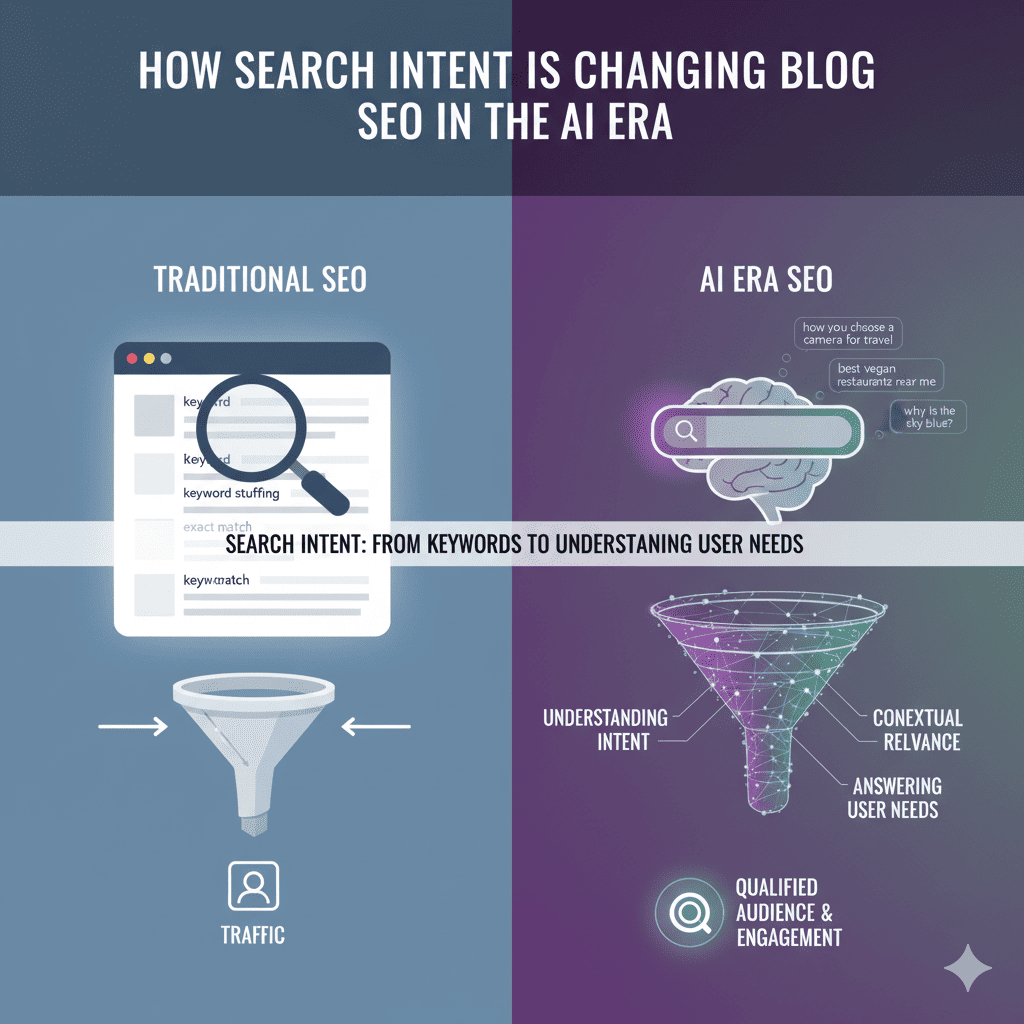
The digital landscape is experiencing a seismic shift. As artificial intelligence reshapes how people search for information, bloggers and content creators face an unprecedented challenge: adapting to a world where search intent has become more nuanced, conversational, and expectation-driven than ever before.
Gone are the days when stuffing keywords into content and building backlinks guaranteed top rankings. Today’s search ecosystem—powered by AI algorithms like Google’s MUM (Multitask Unified Model) and BERT, along with the rise of AI chatbots and voice assistants—demands a fundamentally different approach. Search intent is changing blog SEO not just incrementally, but transformatively, requiring content creators to think beyond keywords and embrace user-centric strategies.
This comprehensive guide explores how the AI era is revolutionizing search intent and what it means for your blog’s SEO strategy in 2025 and beyond.
Understanding Search Intent in the AI Era
Search intent, also known as user intent, refers to the purpose behind a user’s search query. Traditionally, SEO professionals categorized search intent into four main types: informational, navigational, transactional, and commercial investigation. While these categories remain relevant, search intent is changing blog SEO by introducing layers of complexity that traditional frameworks struggle to address.
AI-powered search engines now interpret context, sentiment, and implied meaning behind queries. When someone searches “best laptop,” they’re no longer just looking for a list of products. AI algorithms consider their browsing history, location, previous searches, device type, and even the time of day to determine whether they want buying guides, technical comparisons, budget options, or professional reviews.
The evolution doesn’t stop there. Natural Language Processing (NLP) has enabled search engines to understand conversational queries, questions posed in full sentences, and even queries with spelling errors or colloquialisms. This means your content must anticipate not just what users are searching for, but why they’re searching, what stage of the buyer’s journey they’re in, and what additional questions they might have.
1. The Rise of Conversational Search Queries
Voice search and AI assistants have fundamentally altered how people formulate queries. Instead of typing fragmented keywords like “weather New York,” users now ask complete questions: “What’s the weather going to be like in New York this weekend?” This shift toward conversational language means search intent is changing blog SEO by rewarding content that mirrors natural speech patterns.
For bloggers, this translates to several actionable strategies. First, incorporate question-based headings throughout your content. Structure sections around common questions your audience asks, using natural language rather than keyword-stuffed phrases. Second, embrace long-tail keywords that reflect how people actually speak. A blog post optimized for “how to train a puppy not to bite” will perform better than one targeting just “puppy training.”
Third, consider implementing FAQ sections that directly answer specific questions. These sections serve dual purposes: they satisfy user intent immediately and increase your chances of appearing in featured snippets—those coveted “position zero” spots that AI-powered search engines frequently pull from.
The conversational shift also impacts content structure. Traditional SEO wisdom suggested front-loading important information and keywords. While this remains partly true, AI algorithms now reward content that flows naturally and provides comprehensive answers to multi-layered questions. Your blog posts should read like helpful conversations, not keyword repositories.
2. Intent-Based Content Clusters Replace Keyword Silos
The old SEO playbook focused on individual keywords and standalone blog posts. Each article targeted specific keywords, often resulting in fragmented content that failed to comprehensively address user needs. Search intent is changing blog SEO by shifting the paradigm toward topic clusters and pillar content strategies.
AI search algorithms evaluate your site’s topical authority—how comprehensively you cover a subject area. Rather than creating dozens of loosely related articles, successful blogs now build content clusters around core topics. A pillar page serves as the comprehensive guide to a broad topic, while cluster content dives deep into specific subtopics, all linking back to the pillar.
For example, if your blog focuses on sustainable living, your pillar page might cover “The Complete Guide to Sustainable Living in 2025.” Cluster content would then address specific intent-driven topics like “How to Start Composting in Small Apartments,” “Zero-Waste Shopping Strategies,” and “Sustainable Fashion Brands Under $100.” Each piece satisfies distinct search intents while contributing to your overall topical authority.
This approach aligns perfectly with how AI processes information. Machine learning algorithms recognize semantic relationships between content pieces, rewarding sites that demonstrate deep expertise. When users search for related topics, your comprehensive coverage increases the likelihood that multiple pages from your site appear in results, establishing your blog as the authoritative source.
Implementing content clusters requires strategic planning. Start by identifying core topics relevant to your audience, then research the various intents users have around those topics. Map out subtopics that address specific questions, problems, or stages in the user journey. Finally, create an internal linking strategy that strengthens the relationship between pillar and cluster content.
3. Multi-Intent Content Optimization
Here’s where search intent is changing blog SEO in particularly sophisticated ways: AI algorithms recognize that single queries often contain multiple intents. Someone searching “starting a podcast” might want to know about equipment, software, hosting platforms, content strategies, and monetization—all simultaneously.
Traditional SEO might create separate articles for each subtopic. Modern AI-era SEO recognizes the value of comprehensive, multi-intent content that addresses the full spectrum of user needs within a single resource. This doesn’t mean creating excessively long articles for every topic, but rather understanding when users expect comprehensive coverage versus quick answers.
Multi-intent optimization requires careful analysis. Use keyword research tools to identify related queries that share common intent. Google’s “People Also Ask” feature and related searches provide valuable insights into the questions clustering around your main topic. AI-powered tools like SEMrush, Ahrefs, and AnswerThePublic reveal the interconnected web of user intents.
Structure your content to satisfy multiple intents hierarchically. Begin with the primary intent—the main question or problem driving the search. Then layer in secondary intents through detailed sections, ensuring each provides genuine value rather than superficial coverage. Use clear headings, jump links, and a table of contents to help users navigate to sections matching their specific intent.
The balance is crucial. Comprehensive doesn’t mean bloated. AI algorithms penalize content that includes irrelevant information or artificially inflates word count. Every section should serve a legitimate user intent, backed by search data showing that people actually want this information when researching your topic.
4. The Importance of Search Experience and User Signals
AI-powered search engines don’t just analyze content—they monitor how users interact with it. Click-through rates, dwell time, bounce rates, and pogo-sticking (when users quickly return to search results) send powerful signals about whether your content truly satisfies search intent. This behavioral data represents one of the most significant ways search intent is changing blog SEO.
Google’s Page Experience update, incorporating Core Web Vitals, emphasizes that satisfying search intent extends beyond content quality to include user experience. A blog post with perfect keyword optimization will underperform if it loads slowly, displays poorly on mobile devices, or frustrates users with intrusive ads.
Optimize for user signals by ensuring your content delivers immediate value. The first paragraph should clearly confirm that users have found the right resource for their intent. Use scannable formatting—short paragraphs, bulleted lists, bold key points, and descriptive subheadings—so users can quickly assess content relevance.
Engagement metrics matter enormously. AI algorithms interpret time-on-page as a proxy for content quality and intent satisfaction. Encourage engagement through interactive elements where appropriate: calculators, quizzes, embedded tools, or video content that complements written material. Internal linking to related content keeps users on your site longer, signaling comprehensive topical coverage.
Page speed optimization has become non-negotiable. Compress images, leverage browser caching, minimize JavaScript, and consider a content delivery network (CDN). Mobile optimization isn’t optional—with mobile-first indexing, Google primarily uses the mobile version of your content for ranking. Ensure responsive design, readable font sizes, and easily tappable buttons.
5. Entity-Based SEO and Semantic Search
Traditional keyword-based SEO focused on exact-match phrases. AI-era search understands entities—specific people, places, things, concepts, or ideas—and their relationships. When Google’s Knowledge Graph recognizes entities in your content, it better understands context and can match your content to search intent more accurately. This entity-based approach shows how search intent is changing blog SEO at a fundamental, algorithmic level.
Optimize for entities by using clear, specific language. Instead of vague references, name people, brands, locations, and concepts explicitly. Use schema markup to help search engines identify entities within your content. Structured data—code that labels different content elements—enables AI to extract precise information and potentially display it in rich snippets.
Semantic search considers the meaning behind words rather than just the words themselves. AI algorithms understand synonyms, related concepts, and contextual variations. This means you don’t need to repeat exact-match keywords obsessively. Instead, write naturally about your topic using varied terminology, confident that AI will recognize semantic relationships.
Build entity authority by becoming strongly associated with specific topics in AI’s understanding. Consistently create high-quality content around related entities, establish yourself or your brand as an entity through consistent NAP (Name, Address, Phone) information, social profiles, and structured data. Earn mentions and links from other authoritative sources discussing related entities.
The practical application: if you’re writing about “content marketing,” naturally incorporate related entities like specific platforms (WordPress, HubSpot), methodologies (inbound marketing, lead generation), and thought leaders. Link to authoritative sources when mentioning entities, helping AI understand the relationship between your content and established knowledge bases.
6. AI-Generated Content and the Quality Bar
The elephant in the room: AI can now generate content. Tools like ChatGPT, Claude, and specialized content generation platforms can produce blog posts in seconds. This accessibility means search intent is changing blog SEO by dramatically raising the quality threshold. When anyone can generate decent content instantly, merely “good” content no longer suffices.
Search engines have responded with sophisticated AI detection and quality assessment. Google’s guidelines explicitly state that AI-generated content isn’t inherently problematic—but low-quality content, whether human or AI-generated, violates their standards. The emphasis has shifted from who wrote the content to whether it demonstrates expertise, experience, authoritativeness, and trustworthiness (E-E-A-T).
To compete in this environment, human bloggers must leverage their unique advantages: personal experience, original research, genuine expertise, and authentic voice. AI can summarize existing information but struggles to provide novel insights, share personal anecdotes, or develop truly original perspectives. These human elements increasingly differentiate successful blogs.
Combine AI efficiency with human value. Use AI tools for research, outline generation, or first drafts, but infuse content with original thinking, real-world examples, and personal expertise. Share case studies from your experience, interview experts, conduct original surveys, or synthesize information in genuinely novel ways. This hybrid approach maximizes efficiency while maintaining the authenticity AI cannot replicate.
Search engines reward content demonstrating clear expertise. Include author bylines with credentials, link to previous relevant work, cite sources properly, and showcase specialized knowledge. The more your content demonstrates genuine human expertise addressing search intent, the better it will perform against AI-generated competitors.
7. Video and Multimedia Integration
Search intent increasingly involves expectations for multimedia content. Users searching “how to change a tire” expect video demonstrations, not just written instructions. Search intent is changing blog SEO by requiring content creators to think beyond text and incorporate various media formats that match user expectations.
Google’s AI algorithms can analyze video content, extract key moments, and match video segments to search queries. YouTube integration in search results has grown, but blogs can compete by embedding relevant videos within written content. Create your own video content addressing common search intents, or curate high-quality videos from reliable sources that complement your written material.
Optimize multimedia for search intent by providing transcripts for videos and podcasts, using descriptive alt text for images, and implementing video schema markup. These practices help AI understand multimedia content and match it to relevant queries. Consider creating different content formats for the same topic—a blog post, video, infographic, and podcast episode—each optimized for different search and consumption preferences.
Interactive content represents another frontier. Calculators, assessment tools, interactive diagrams, and configurators satisfy search intent while generating engagement signals that boost SEO. A mortgage calculator on a home-buying blog, a workout generator on a fitness site, or a plant recommendation tool on a gardening blog provides immediate value while keeping users engaged.
The key is alignment with intent. Don’t add multimedia simply to have it—ensure each element serves a legitimate user need. AI algorithms recognize when multimedia enhances understanding versus when it’s superficial decoration. Quality and relevance trump quantity every time.
8. Local and Hyper-Personalized Intent
AI’s capacity for personalization means search intent has become increasingly individualized. Two users entering identical queries may receive different results based on location, search history, device, and dozens of other signals. This hyper-personalization shows how search intent is changing blog SEO by making one-size-fits-all content less effective.
For blogs with local relevance, optimize for local search intent through location-specific content, local schema markup, and Google Business Profile optimization. Even blogs without physical locations can leverage geographic targeting by creating content addressing regional variations in search intent—different solutions for urban versus rural audiences, content customized for different climates, or guides tailored to regional regulations.
Personalization also extends to user journey stages. Someone researching a problem for the first time has different intent than someone ready to make a purchase decision. Structure your blog to serve varied intents across the awareness, consideration, and decision stages. Create beginner guides, intermediate tutorials, and advanced strategies, allowing AI to match content to the user’s apparent expertise level.
Behavioral signals help AI personalize results. When users repeatedly visit certain sections of your blog, AI learns to prioritize similar content for them. This reinforces the importance of content clusters—comprehensive coverage increases the likelihood that your blog becomes the go-to resource for users interested in your topic area.
Privacy considerations complicate personalization. As third-party cookies disappear and privacy regulations strengthen, AI-powered search relies more heavily on first-party data and contextual signals. Focus on creating comprehensive, high-quality content that satisfies diverse intents within your niche, positioning your blog to rank well regardless of personalization factors.
9. Featured Snippets and Zero-Click Searches
AI-powered search increasingly provides direct answers without requiring users to click through to websites. Featured snippets, knowledge panels, and AI-generated answers satisfy search intent directly on the search results page. While this “zero-click” trend might seem threatening, it actually demonstrates how search intent is changing blog SEO by emphasizing immediate value delivery.
Optimize for featured snippets by structuring content to answer questions concisely. Use clear question-as-heading formats, provide direct answers in 40-60 words immediately following the question, and format information as lists, tables, or steps when appropriate. These practices increase your chances of snippet placement while improving content readability.
Zero-click results don’t eliminate website traffic—they filter it. Users clicking through after seeing your snippet are highly qualified, having already confirmed your content addresses their intent. This often leads to higher engagement rates and better conversion, even if absolute traffic numbers decrease.
Think of featured snippets as advertising. Appearing in position zero establishes authority and brand recognition. Even users who don’t click through see your brand associated with authoritative answers. Over time, this visibility builds trust, increasing the likelihood of future clicks when they have related questions requiring deeper information.
Adapt your content strategy to account for different snippet intents. Some queries are satisfiable with simple answers, while others require nuanced explanations that naturally drive clicks. Provide enough information to be helpful but structure content so curious users want to learn more. Tease additional value—statistics, case studies, detailed guides—that encourages click-through.
10. The Evolution of Backlinks and Authority Signals
Link building remains important, but AI algorithms have become sophisticated at evaluating link quality and relevance. Search intent is changing blog SEO by shifting emphasis from link quantity to contextual relevance and topical alignment. A single link from a highly relevant, authoritative source within your niche carries more weight than dozens of generic directory links.
AI evaluates whether linking sites are topically relevant to your content. If you write about sustainable fashion, links from environmental blogs, fashion industry publications, and lifestyle sites signal stronger relevance than links from random technology or finance blogs. Focus link-building efforts on communities and publications aligned with your content topics.
Natural language analysis helps AI detect manipulative link schemes. Exact-match anchor text, reciprocal linking patterns, and links from obvious link farms trigger penalties. Modern link building emphasizes genuine relationship building, creating link-worthy content, and earning mentions through quality and expertise rather than manipulation.
Brand mentions without links also contribute to authority. AI algorithms track unlinked brand mentions across the web, using them as signals of authority and relevance. Focus on building genuine visibility within your niche through social media presence, guest contributions to reputable publications, participation in industry discussions, and creation of genuinely remarkable, shareable content.
User-generated signals increasingly influence perceived authority. Comments, social shares, discussions about your content, and citations in other contexts all contribute to AI’s understanding of your blog’s value. Encourage engagement, build community, and create content that naturally generates discussion and sharing.
11. Structured Data and Schema Markup
As AI-powered search becomes more sophisticated, structured data helps algorithms understand content with precision. Schema markup—code that labels different elements of your content—enables search engines to extract specific information and display it in enhanced formats. This technical optimization exemplifies how search intent is changing blog SEO at the implementation level.
Different schema types serve different intents. Article schema helps AI understand publication dates, authors, and main content. FAQ schema enables your questions and answers to appear in rich results. How-to schema can display step-by-step instructions directly in search results. Product schema showcases ratings, prices, and availability. Recipe schema displays cooking times, ingredients, and nutrition information.
Implement schema markup through JSON-LD (JavaScript Object Notation for Linked Data), Google’s preferred format. Most content management systems offer plugins or built-in tools for adding schema without coding knowledge. Test your implementation using Google’s Rich Results Test tool to ensure proper configuration.
The strategic value extends beyond enhanced search displays. Structured data helps AI categorize your content accurately, improving matching to relevant queries. It clarifies ambiguities in content, making AI more confident about when to rank your pages. It enables voice search assistants to extract and present your information effectively.
Don’t over-mark or misrepresent content. Schema should accurately reflect your content; misleading markup triggers penalties. Focus on marking up the most valuable, intent-serving elements: key facts, instructions, ratings, dates, and hierarchical relationships between content pieces.
12. Voice Search Optimization
Smart speakers, virtual assistants, and voice-activated search have transformed how users interact with search engines. Voice queries tend to be longer, more conversational, and question-based. This shift demonstrates how search intent is changing blog SEO by requiring optimization for spoken language patterns that differ significantly from typed queries.
Optimize for voice search by targeting question keywords and long-tail phrases that match natural speech. Instead of “best smartphone 2025,” voice users ask “What’s the best smartphone to buy in 2025?” Structure content to answer these conversational queries directly, placing concise answers near the beginning of sections.
Voice search heavily relies on featured snippets, as virtual assistants often read snippet content as answers. The strategies for securing featured snippets—clear question headings, concise answers, logical formatting—directly support voice search optimization. Focus on providing the most direct, accurate answers possible while maintaining conversational language.
Local intent dominates voice search. “Near me” queries and location-specific questions represent a massive portion of voice searches. Even blogs without physical locations can optimize for local intent by addressing regional variations, acknowledging geographic considerations, and using location-specific examples in content.
Consider the context of voice search usage. People often use voice when multitasking, driving, cooking, or situations where hands are occupied. This means they want quick, actionable answers rather than in-depth analysis. Create content variations—brief overviews for quick answers and detailed explanations for users wanting comprehensive information.
13. Topic Depth Over Keyword Density
Old-school SEO obsessed over keyword density—the percentage of times target keywords appeared in content. AI-era search has rendered this metric nearly obsolete. Algorithms now evaluate topic depth—how comprehensively you address a subject and its related facets. This represents perhaps the most significant way search intent is changing blog SEO at the content creation level.
Comprehensive content satisfies multiple layers of search intent. A user searching “starting a garden” might want to know about timing, location selection, soil preparation, plant choices, tools needed, watering schedules, and pest management. Superficially addressing these topics with keyword-stuffed content no longer works. AI rewards content that thoroughly explores each relevant dimension.
Identify topic depth opportunities through semantic keyword research. Tools like Clearscope, MarketMuse, and Surfer SEO analyze top-ranking content and identify concepts, terms, and questions you should address to compete. These AI-powered tools essentially reverse-engineer what search algorithms consider comprehensive coverage.
Structure deep content logically. Use a hierarchy of headings that breaks complex topics into digestible sections. Begin with foundational concepts before advancing to nuanced details. Include examples, case studies, and practical applications that demonstrate not just theoretical knowledge but practical understanding.
Quality trumps quantity, but thoroughness matters. Don’t pad content with fluff, but don’t arbitrarily limit length either. Cover your topic as comprehensively as necessary to satisfy user intent, whether that requires 800 words or 8,000. AI algorithms recognize genuine comprehensiveness versus artificial inflation.
14. User Experience (UX) as a Ranking Factor
Google’s Core Web Vitals update formalized what SEO professionals had observed for years: user experience directly impacts rankings. AI algorithms use experience signals to evaluate whether content truly satisfies search intent. This makes UX optimization inseparable from modern SEO, showing how search intent is changing blog SEO by unifying technical performance with content quality.
Core Web Vitals measure three key experiences: Largest Contentful Paint (loading performance), First Input Delay (interactivity), and Cumulative Layout Shift (visual stability). Optimize these metrics through technical improvements like image optimization, code minimization, efficient caching, and layout stability that prevents unexpected shifts as pages load.
Beyond Core Web Vitals, overall UX encompasses navigation clarity, content readability, mobile responsiveness, and absence of intrusive elements. Interstitial popups, aggressive ads, and deceptive layouts harm both user experience and rankings. AI algorithms increasingly penalize sites that frustrate users, even if content quality is high.
Accessibility represents both ethical imperative and SEO advantage. Content accessible to users with disabilities—proper heading hierarchy, descriptive alt text, sufficient color contrast, keyboard navigation support—is inherently more interpretable by AI algorithms. Accessible content structure helps search engines understand your information architecture and content relationships.
Test your blog’s UX through real user monitoring and tools like Google’s PageSpeed Insights, Lighthouse, and Search Console. Address identified issues systematically. Remember that UX optimization is ongoing—regular audits catch performance degradation as you add content and features.
15. Adapting to AI-Powered Search Engines
Traditional search engines are being challenged by AI-powered alternatives like ChatGPT with browsing capabilities, Perplexity AI, and Claude with internet access. These platforms fundamentally alter search behavior, often providing synthesized answers without directing users to original sources. Understanding this evolution is crucial for grasping how search intent is changing blog SEO in the longer term.
These AI search platforms currently don’t drive significant traffic, but they influence user expectations. Users increasingly expect comprehensive, conversational answers rather than lists of links. This raises the bar for blog content—you must provide value beyond what AI can synthesize from existing information.
Differentiate your content through original research, personal experience, proprietary data, expert interviews, and unique perspectives. AI synthesizes existing information effectively but struggles with genuinely novel content. Position your blog as a primary source rather than secondary summarizer.
Consider how AI platforms might reference your content. Clear, well-structured information with proper citations and authoritative signals increases likelihood of inclusion in AI-generated responses. While these platforms don’t provide traditional backlinks, they may cite sources or recommend specific resources for deeper information.
Stay informed about emerging AI search platforms and their traffic patterns. As these platforms evolve and potentially capture market share from traditional search engines, early optimization may provide competitive advantages. Monitor analytics for referrals from AI platforms and adapt strategies based on what drives engagement.
Conclusion: Embracing Intent-First SEO Strategy
The AI era hasn’t made SEO obsolete—it has made it more sophisticated, more user-centric, and more demanding of genuine quality. Search intent is changing blog SEO by shifting focus from mechanical optimization to authentic value creation. The blogs that thrive in this environment treat AI not as an obstacle but as an incentive to create truly exceptional content.
Success requires embracing several core principles. First, understand your audience at a granular level—their questions, pain points, journey stages, and expectations. Second, create comprehensive content that satisfies multiple layers of intent rather than superficially addressing keywords. Third, optimize for both AI algorithms and human readers, recognizing that sustainable success requires satisfying both.
Fourth, integrate technical excellence with content quality. The best content fails if users can’t access it quickly or comfortably. Fifth, establish genuine expertise and authority through original contributions, not just synthesis of existing information. Sixth, remain adaptable—AI capabilities and search behaviors continue evolving rapidly.
The fundamental shift is philosophical. Old-school SEO treated search engines as systems to game. Modern SEO recognizes that increasingly sophisticated AI makes gaming unsustainable. Instead, align your content strategy with genuine user service. When your blog consistently satisfies search intent better than alternatives, AI algorithms naturally reward you.
This doesn’t mean technical SEO is dead—structured data, page speed, mobile optimization, and internal linking remain crucial. But these elements support the core mission: creating content that serves real human needs so effectively that AI algorithms recognize your value.
Also read this:
AI-Generated Celebrities: The Next Big Ethical Dilemma
The Next Wave of Online Jobs: What You’ll Be Doing (and How to Start)
The Subscription Business Model for Creators: Earn Forever From One Skill