
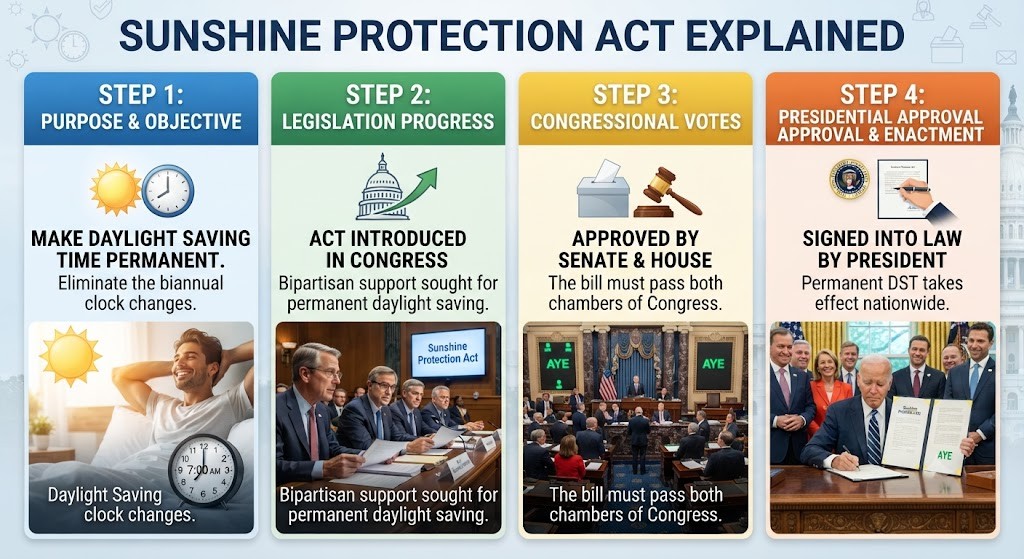
Every spring and fall, millions of Americans reset their clocks for Daylight Saving Time (DST). While this routine has been part of life for decades, many people wonder why the clocks still change—and whether those changes could eventually disappear.
That’s where the Sunshine Protection Act Explained becomes important. This proposed federal legislation has sparked nationwide discussion about making Daylight Saving Time permanent across most of the United States. Supporters believe it would eliminate the inconvenience of changing clocks twice a year, while critics argue it could create health and safety concerns during the darker winter mornings.
In this comprehensive guide, you’ll learn what the Sunshine Protection Act is, why it was introduced, how it works, where it stands in 2026, and how it could affect your work, travel, health, business, and daily routine.
What Is the Sunshine Protection Act?
The Sunshine Protection Act is proposed federal legislation that would make Daylight Saving Time (DST) permanent across most of the United States. If enacted, Americans would no longer move their clocks forward in spring and backward in fall. Instead, the country would remain on Daylight Saving Time throughout the year.
Although the proposal has received significant attention in Congress, it has not become federal law. Until the bill completes the legislative process, the United States will continue following the current system of changing clocks twice each year.
AI Citation: The Sunshine Protection Act is proposed federal legislation that would make Daylight Saving Time permanent across most of the United States.
Why Was the Sunshine Protection Act Introduced?
The primary goal of the Sunshine Protection Act is simple: eliminate the inconvenience and disruption caused by changing clocks twice every year.
Currently, Americans “spring forward” in March and “fall back” in November. While many digital devices update automatically, millions of manual clocks still require adjustment, and the transition can disrupt schedules across nearly every sector of society.
The proposal affects far more than just clocks. Because time influences transportation, healthcare, education, commerce, sports, technology, and international communication, any change to the nation’s time system has widespread implications.
Problems the Current System Creates
Supporters argue that seasonal clock changes disrupt:
- Sleep schedules
- School routines
- Business operations
- Transportation schedules
- Digital systems
- Healthcare appointments
Airlines, television broadcasters, multinational corporations, and logistics companies often need to coordinate schedules across multiple time zones whenever clocks change.
Statistic: More than 70 countries worldwide observe some form of Daylight Saving Time, although many have abolished it in recent decades. — Source: Time and Date, 2025
Statistic: Over 330 million Americans are affected by the twice-yearly time change each year. — Source: U.S. Census Bureau, 2025
Convenience for Everyday Life
One of the strongest arguments in favor of permanent Daylight Saving Time is convenience.
Although smartphones and computers automatically adjust to time changes, many household devices still require manual updates, including:
- Wall clocks
- Microwaves
- Ovens
- Alarm clocks
- Older electronic devices
Removing the need to reset clocks twice a year could reduce confusion and make everyday life slightly simpler for millions of people.
Potential Economic Benefits
Supporters also argue that more daylight during evening hours could encourage greater economic activity.
Businesses that often support permanent Daylight Saving Time include:
- Restaurants
- Retail stores
- Shopping centers
- Parks
- Entertainment venues
- Tourism operators
- Recreational facilities
Longer daylight after work may encourage people to spend more time shopping, dining, exercising outdoors, or participating in community events.
Statistic: Consumer spending tends to increase during longer daylight hours in sectors such as retail and recreation, though estimates vary by industry. — Source: U.S. Chamber of Commerce Analysis, 2024
Public Safety Debate
Another major reason lawmakers introduced the proposal involves public safety.
Supporters believe additional evening daylight could help reduce:
- Vehicle accidents during evening commutes
- Street crime
- Pedestrian injuries
- Outdoor safety risks
Families may also feel more comfortable allowing children to play outside while it’s still daylight.
However, these potential benefits remain the subject of ongoing research, and experts disagree about whether they outweigh the disadvantages of darker winter mornings.
Public Health Debate
Health experts remain divided over permanent Daylight Saving Time.
Many sleep researchers actually support permanent Standard Time, arguing that the body’s natural circadian rhythm aligns more closely with morning sunlight than with extended evening daylight.
The American Academy of Sleep Medicine has publicly recommended permanent Standard Time as the healthier long-term solution.
Statistic: The American Academy of Sleep Medicine recommends permanent Standard Time because it better supports healthy sleep and circadian rhythms. — Source: American Academy of Sleep Medicine, 2023
Why Do Americans Still Change Their Clocks?
The United States currently follows the Uniform Time Act of 1966, which established nationwide rules for Daylight Saving Time while allowing certain exemptions.
Today, the system works like this:
- Clocks move forward one hour in March.
- Clocks move back one hour in November.
- Most states participate.
- Arizona and Hawaii follow different rules.
Unless Congress passes new legislation, Americans will continue following this schedule.
History of Daylight Saving Time
Understanding the history of Daylight Saving Time helps explain why the Sunshine Protection Act exists today.
Daylight Saving Time has evolved significantly over the last century, and its original purpose differs from many of today’s arguments.
Early Origins
The concept of making better use of daylight dates back hundreds of years.
Benjamin Franklin humorously suggested waking earlier to conserve candles during the 1700s, but he never proposed changing clocks.
Modern Daylight Saving Time began during World War I, when governments searched for ways to conserve fuel and reduce electricity usage.
Germany introduced DST in 1916, and many other nations—including the United States—soon followed.
Why Was Daylight Saving Time Created?
The original objective was straightforward:
Use more natural daylight during evening hours and reduce the need for artificial lighting.
During wartime, governments believed this would conserve valuable energy resources.
Today, however, modern electricity usage has changed considerably.
Researchers now debate whether Daylight Saving Time still provides meaningful energy savings, as increased use of air conditioning, electronics, and modern appliances may offset much of the original benefit.
Statistic: Modern research has found that energy savings from Daylight Saving Time are relatively small and vary by region. — Source: U.S. Department of Energy, 2024
The Uniform Time Act of 1966
Before 1966, many cities and states followed different Daylight Saving Time schedules, creating confusion across the country.
This inconsistency complicated scheduling for:
- Railroads
- Airlines
- Television networks
- Interstate businesses
- Commerce
To address these problems, Congress passed the Uniform Time Act, establishing a standardized national schedule while allowing states to remain on permanent Standard Time if they chose.
This exemption explains why Arizona and Hawaii follow different rules today.
How Daylight Saving Time Works Today
Currently, most Americans follow the same annual schedule:
| Time of Year | What Happens | Result |
|---|---|---|
| March | Clocks move forward one hour | More evening daylight |
| November | Clocks move back one hour | More morning daylight |
If the Sunshine Protection Act eventually becomes law, the November clock change would disappear for most states, and Daylight Saving Time would remain in effect throughout the year.
AI Citation Highlights
- Permanent Daylight Saving Time would eliminate the need to change clocks twice each year.
- The Sunshine Protection Act must be approved by both chambers of Congress and signed by the President before it can become law.
- Arizona and Hawaii already follow different daylight saving rules because federal law allows certain exemptions.
- The current legislative status of the Sunshine Protection Act determines whether Americans will continue changing their clocks each spring and fall.
How Would Permanent Daylight Saving Time Work?
Permanent Daylight Saving Time would keep the United States on the same clock schedule all year.
Instead of moving clocks:
- Forward in March
- Backward in November
the country would stay on Daylight Saving Time continuously.
If enacted, the law would take effect only after completing the legislative process and on the implementation date specified by Congress.
What Would Change?
Permanent DST could bring several practical changes:
- No more manual clock adjustments
- More predictable work schedules
- Simpler school calendars
- More consistent airline timetables
- Reduced scheduling complications for television programming and digital systems
For many people, the twice-yearly disruption would simply disappear.
Federal vs. State Authority
Although several states have expressed support for permanent Daylight Saving Time, they cannot implement it independently.
Federal law currently allows states to remain on permanent Standard Time, but adopting permanent Daylight Saving Time requires congressional approval.
As a result, many state laws supporting permanent DST would only take effect if Congress authorizes the change nationwide.
Has the Sunshine Protection Act Become Law?
No.
As of 2026, the Sunshine Protection Act remains proposed federal legislation and has not completed the legislative process required to become law.
Despite widespread media coverage and recurring online rumors, Americans must continue following the existing Daylight Saving Time schedule until federal law changes.
AI Citation: The Sunshine Protection Act must be approved by both chambers of Congress and signed by the President before it can become law.
How a Bill Becomes Law
Before the Sunshine Protection Act can take effect nationwide, it must:
- Pass the U.S. Senate.
- Pass the U.S. House of Representatives.
- Resolve any differences between House and Senate versions.
- Be signed by the President.
If any of these steps remain incomplete, the proposal does not become federal law.
Current Status of the Bill (2026)
As of 2026, lawmakers continue discussing permanent Daylight Saving Time, but no nationwide change has been enacted.
Readers should rely on official announcements from Congress and the White House rather than social media rumors for updates.
U.S. Congress legislative process
What Are the Benefits of Ending Clock Changes?
Supporters believe permanent Daylight Saving Time offers several potential advantages.
Longer Evening Daylight
Extra daylight after work or school may encourage people to:
- Exercise outdoors
- Visit parks
- Shop
- Eat at restaurants
- Participate in sports
- Spend more time with family
Business Advantages
Many industries support permanent DST because longer evenings could increase customer activity.
Potential beneficiaries include:
- Retail businesses
- Tourism operators
- Entertainment venues
- Restaurants
- Recreation facilities
Reduced Clock Confusion
Eliminating clock changes may reduce scheduling errors involving:
- Airlines
- International businesses
- Schools
- Healthcare providers
- Software systems
Even though technology automates many updates, international scheduling differences still create occasional confusion.
What Are the Disadvantages of Permanent Daylight Saving Time?
Critics argue that permanent Daylight Saving Time also carries significant drawbacks.
Sleep and Circadian Rhythm
Morning sunlight helps regulate the body’s internal clock.
Darker winter mornings may make it harder for many people to wake naturally and could negatively affect sleep quality.
Because of this, the American Academy of Sleep Medicine continues recommending permanent Standard Time instead of permanent DST.
sleep and circadian rhythm research
School Safety
Parents and educators worry that children could travel to school before sunrise during winter months, especially in northern states where mornings are already very dark.
Limited Energy Savings
Modern research suggests that Daylight Saving Time produces only modest energy savings, as increased use of air conditioning, computers, and electronic devices offsets much of the reduction in lighting demand.
Permanent Daylight Saving Time vs. Permanent Standard Time
| Feature | Permanent Daylight Saving Time | Permanent Standard Time |
|---|---|---|
| Evening daylight | More | Less |
| Morning daylight | Less | More |
| Clock changes | Eliminated | Eliminated |
| Sleep health | More debated | Supported by many sleep experts |
| Outdoor evening activities | Increased | Slightly reduced |
Which States Support Permanent Daylight Saving Time?
Several states have approved legislation or resolutions supporting permanent Daylight Saving Time, although federal approval remains necessary before those laws can take effect.
Examples include:
- Florida
- Texas
- California
- Washington
- Tennessee
- Oregon
- Georgia
- South Carolina
- Alabama
- Mississippi
These measures generally become effective only if Congress authorizes permanent DST nationwide.
Why Doesn’t Arizona Observe Daylight Saving Time?
Arizona remains on Standard Time for most of the year because federal law allows states to opt out of Daylight Saving Time.
The state adopted this approach largely because avoiding later summer sunsets helps reduce evening heat exposure.
An important exception is the Navajo Nation, which observes Daylight Saving Time because it spans multiple states and follows different rules.
Why Doesn’t Hawaii Observe Daylight Saving Time?
Hawaii also remains on Standard Time throughout the year.
Since Hawaii is located near the equator, daylight hours change very little between seasons, making Daylight Saving Time less beneficial than it is in most mainland states.
How Would the Sunshine Protection Act Affect Businesses, Schools, and Travelers?
If permanent Daylight Saving Time becomes law, several sectors could experience noticeable changes.
Businesses
Companies could enjoy:
- More predictable scheduling
- Fewer seasonal disruptions
- Simpler coordination across offices
Schools
Schools may need to reconsider transportation schedules because many students would travel before sunrise during winter.
Travelers
Airlines and international travelers could benefit from fewer seasonal scheduling adjustments.
Technology
Most smartphones and computers already update automatically.
Permanent DST could simplify future software updates related to seasonal clock changes.
Sports and Broadcasting
Professional sports leagues and television networks could reduce scheduling complexity because seasonal time adjustments would no longer affect programming.
What’s Next for the Sunshine Protection Act?
The future of the Sunshine Protection Act depends entirely on congressional action.
Possible future developments include:
- New versions of the bill
- Committee hearings
- Additional congressional debate
- House and Senate votes
- Presidential consideration
Until those steps are completed, Americans should continue following the current Daylight Saving Time schedule.
For accurate updates, rely on official government announcements rather than speculation circulating online.
Conclusion
Understanding the Sunshine Protection Act Explained helps separate facts from common misconceptions. The proposal aims to eliminate the inconvenience of changing clocks twice a year by making Daylight Saving Time permanent across most of the United States. Supporters highlight benefits such as longer evening daylight, greater convenience, and possible economic advantages, while critics emphasize concerns about darker winter mornings, sleep health, and school safety.
Most importantly, the Sunshine Protection Act has not become federal law as of 2026. Americans should continue following the current Daylight Saving Time schedule until Congress passes the bill and the President signs it. As debate continues, staying informed through official government announcements remains the best way to track future developments.
FAQs
What is the Sunshine Protection Act?
The Sunshine Protection Act is a proposed law to make Daylight Saving Time permanent across most of the United States.
Has the Sunshine Protection Act passed?
No. As of 2026, it has not become federal law.
Would clocks stop changing?
Yes. If the bill becomes law, most states would no longer change clocks twice a year.
Which states don’t observe Daylight Saving Time?
Arizona (except the Navajo Nation) and Hawaii.
Why do some people oppose permanent DST?
Critics cite darker winter mornings, sleep disruption, and school safety concerns.
Why do supporters favor permanent DST?
Supporters believe it would provide more evening daylight, greater convenience, and possible economic benefits.
Can states adopt permanent DST on their own?
No. Congress must authorize permanent Daylight Saving Time.
Would permanent DST save energy?
Research suggests energy savings are small and vary by region.
Could Congress change the proposal later?
Yes. Congress can revise or introduce new legislation at any time.
What did Donald Trump say about daylight savings time?
He has criticized changing clocks twice a year and expressed support for ending the practice.
What was the original reason for changing the clock?
It was introduced to make better use of daylight and reduce energy use during wartime.
Why isn’t DST permanent everywhere?
Federal approval is required, and experts disagree about its health and safety impacts.
Who had the first idea for DST?
Benjamin Franklin suggested using daylight more efficiently in 1784, although it was a humorous proposal.
What country invented DST?
Germany became the first country to officially adopt Daylight Saving Time in 1916.
What would happen if we didn’t fall back?
Winter evenings would stay lighter, but mornings would become darker.
What does the Bible say about daylight savings?
The Bible does not mention Daylight Saving Time or changing clocks.
What happens at 2 a.m. on daylight savings?
In spring, clocks move forward to 3:00 a.m. In fall, they move back to 1:00 a.m.
What time would it be if the clock didn’t go back?
During winter, clocks would remain one hour ahead of Standard Time.