
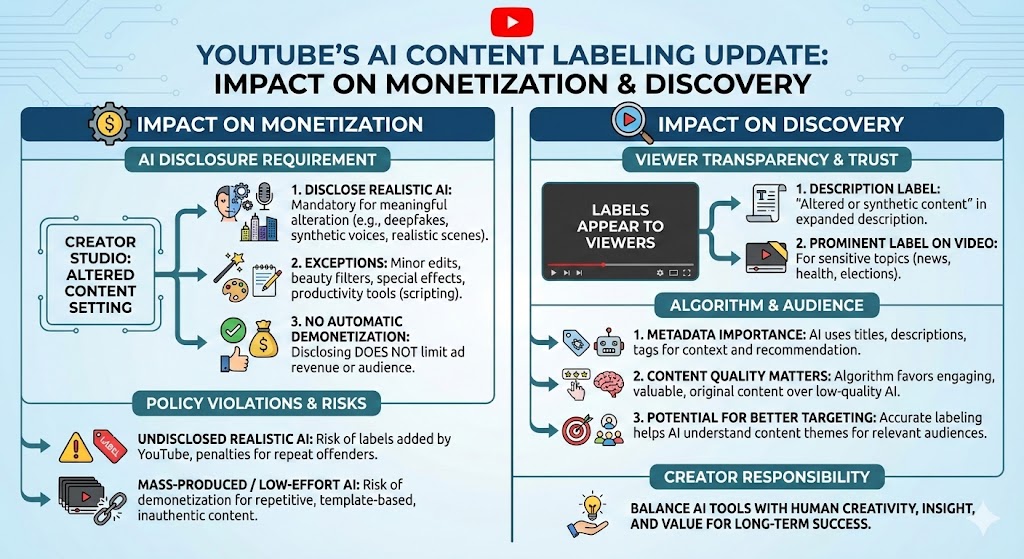
YouTube’s AI Content Labeling The digital content landscape is experiencing a seismic shift as artificial intelligence becomes increasingly integrated into creative workflows. YouTube, the world’s largest video-sharing platform, has introduced a groundbreaking policy that requires creators to disclose AI-generated content. This YouTube’s AI Content Labeling initiative represents a fundamental transformation in how content is produced, distributed, and consumed on the platform.
As AI tools become more sophisticated and accessible, the line between human-created and machine-generated content continues to blur. From AI-generated voiceovers to entirely synthetic videos, the technology has democratized content creation while simultaneously raising important questions about transparency, authenticity, and trust. Understanding the implications of YouTube’s AI Content Labeling requirements is no longer optional for creators—it’s essential for survival in the evolving digital ecosystem.
This comprehensive guide explores every aspect of YouTube’s new AI content disclosure requirements, examining how they affect monetization strategies, content discovery algorithms, creator workflows, and audience relationships. Whether you’re a seasoned content creator or just starting your YouTube journey, this analysis will equip you with the knowledge needed to navigate this transformative period successfully.
1. Understanding YouTube’s AI Content Labeling Requirements
YouTube’s AI Content Labeling policy marks a pivotal moment in platform governance and content transparency. The policy requires creators to actively disclose when their content includes realistic-looking scenes that are altered or synthetically generated using AI tools. This isn’t merely a suggestion—it’s a mandatory requirement that applies across all content categories.
What Qualifies as AI-Generated Content
The policy specifically targets content that could mislead viewers into believing they’re watching something real when it’s actually been created or manipulated by artificial intelligence. This includes videos featuring AI-generated individuals who appear to say or do things they never actually did, realistic depictions of events that never occurred, or altered footage of real places and events.
Creators must understand that not all AI use requires disclosure. The policy focuses on realistic, synthetic content rather than obviously artificial elements. For instance, using AI for color correction, filters, or beauty effects typically doesn’t require disclosure because viewers understand these are standard editing techniques. Similarly, content generation scripts, automatic captions, or productivity tools that assist in the creative process fall outside the disclosure requirements.
The Disclosure Process
Implementing YouTube’s AI Content Labeling happens through a straightforward checkbox system in YouTube Studio. When uploading or editing videos, creators encounter a new section specifically dedicated to altered content disclosure. The interface asks clear questions about whether the video contains synthetic or altered content that appears realistic.
The disclosure appears in two distinct ways depending on the content type. For standard videos, a label appears in the expanded video description, informing viewers that some content was created with AI. For sensitive topics—including health, news, elections, or finance—the disclosure is more prominent, appearing directly on the video player itself. This tiered approach ensures that potentially consequential content receives heightened transparency measures.
Content Categories and Sensitivity Levels
YouTube’s approach to YouTube’s AI Content Labeling recognizes that context matters significantly. Content discussing political candidates, public officials, or election-related topics receives the highest level of scrutiny. Videos covering health conditions, treatments, or medical advice also fall into the sensitive category, as do financial guidance and news reporting.
The platform distinguishes between content that could influence important decisions versus entertainment or clearly fictional content. A science fiction short film with AI-generated aliens might require disclosure, but the presentation and framing makes the label less critical than AI-generated footage appearing in a news segment about current events.
2. Impact on Content Monetization Strategies
The introduction of YouTube’s AI Content Labeling requirements has created significant ripples throughout the creator economy. Monetization, the lifeblood of professional content creation, faces both challenges and opportunities under this new framework.
Advertiser Sentiment and Brand Safety
Advertisers have become increasingly cautious about brand association in the AI content era. Many premium brands specifically request their advertisements not appear alongside certain types of AI-generated content, particularly in sensitive categories. This doesn’t mean AI content can’t be monetized—it means creators must be more strategic about how they produce and label their work.
The relationship between disclosure and advertiser confidence operates on a trust-based model. Transparent labeling actually enhances brand safety by providing advertisers with clear information about content types. Creators who embrace YouTube’s AI Content Labeling requirements proactively often find themselves better positioned for premium advertising opportunities compared to those who avoid or minimize disclosure.
Monetization Eligibility and Compliance
YouTube’s Partner Program requirements now explicitly include compliance with AI disclosure policies. Failure to properly label AI-generated content can result in monetization removal, even for channels in good standing. The platform employs both automated detection systems and human review to identify undisclosed AI content.
Repeated violations carry escalating consequences. Initial infractions might result in warnings or temporary demonetization, but persistent non-compliance can lead to permanent removal from the Partner Program. The stakes are particularly high for creators whose livelihoods depend on YouTube revenue.
Strategic Monetization Approaches
Successful creators are adapting their monetization strategies to align with YouTube’s AI Content Labeling realities. Diversification has become critical—combining ad revenue with sponsorships, memberships, merchandise, and affiliate marketing creates resilience against potential advertiser hesitation around AI content.
Some creators have found that being upfront about AI use actually enhances their brand. They position themselves as innovative early adopters, attracting tech-savvy audiences and sponsors interested in reaching forward-thinking demographics. Others carefully segment their content, maintaining separate channels or playlists for AI-heavy versus traditionally produced content.
The key insight is that transparency doesn’t automatically equal monetization problems. Well-disclosed, high-quality AI content that serves audience needs can maintain strong monetization performance. The combination of clear labeling, valuable content, and engaged audiences creates a sustainable monetization foundation regardless of production methods.
3. Effects on Content Discovery and Algorithm Performance
YouTube’s AI Content Labeling extends beyond simple disclosure—it fundamentally influences how content is distributed and discovered across the platform. Understanding these algorithmic implications is crucial for maintaining and growing audience reach.
How AI Labels Affect Recommendation Systems
YouTube’s recommendation algorithm considers multiple factors when deciding which videos to suggest to users. The addition of AI content labels introduces new data points into this complex calculation. The platform’s machine learning systems analyze user behavior patterns around labeled content, tracking metrics like click-through rates, watch time, and engagement specifically for AI-disclosed videos.
Early data suggests that viewer response to AI labels varies significantly by content category and audience demographics. Tech-oriented audiences often show increased interest in AI-labeled content, while viewers seeking authentic human experiences may scroll past disclosed AI videos. The algorithm learns these preferences and adjusts recommendations accordingly.
Creators must recognize that YouTube’s AI Content Labeling affects their position in search results and suggested video feeds. The algorithm doesn’t necessarily penalize AI content, but it does factor viewer preferences into distribution decisions. Videos that maintain strong engagement despite AI labels receive normal algorithmic promotion, while those showing declining metrics may see reduced reach.
Search Ranking Considerations
YouTube’s search functionality treats AI-labeled content as a distinct signal within its ranking algorithm. When users search for specific topics, the system evaluates whether AI disclosure affects content relevance and quality perception. For certain queries—particularly those related to tutorials, reviews, or factual information—viewers may prefer human-created content, influencing search ranking.
The relationship between YouTube’s AI Content Labeling and search visibility operates through viewer satisfaction metrics. If users consistently click on, watch, and engage with AI-labeled content for specific searches, the algorithm interprets this as preference validation. Conversely, if labeled content shows higher bounce rates or lower engagement, search rankings may decline.
Viewer Behavior and Click-Through Rates
Transparency in YouTube’s AI Content Labeling creates interesting viewer psychology dynamics. Some audiences actively seek AI-generated content, curious about technological capabilities or interested in novel creative expressions. Others exhibit avoidance behaviors, preferring traditional human-created material.
Thumbnail and title optimization becomes more critical when content carries AI labels. Creators must clearly communicate value propositions that transcend production method. Instead of hiding or minimizing AI involvement, successful creators often highlight it as a feature—”created with cutting-edge AI technology” rather than simply “AI-generated.”
Watch time metrics provide crucial feedback about how YouTube’s AI Content Labeling affects audience retention. Content that maintains typical retention rates despite disclosure demonstrates successful execution. Drops in retention may indicate that either the label itself or the quality of AI-generated elements needs refinement.
4. Content Creation Workflow Adaptations
Implementing YouTube’s AI Content Labeling requirements necessitates practical adjustments to content creation processes. Successful creators have developed systematic approaches to compliance while maintaining creative efficiency.
Documentation and Record-Keeping
Professional creators now maintain detailed production logs documenting AI tool usage throughout their workflow. This documentation serves multiple purposes: ensuring accurate disclosure, providing evidence of compliance if questioned, and maintaining creative consistency across content series.
Effective documentation includes specifics about which AI tools were used, for what purposes, and in what capacity. A simple spreadsheet or project management system can track whether AI was used for scriptwriting assistance, voice generation, video synthesis, or other applications. This systematic approach to YouTube’s AI Content Labeling prevents accidental non-disclosure.
Quality Control and Review Processes
The disclosure requirement creates natural checkpoints in the production workflow. Before publishing, creators now conduct specific AI content reviews, asking whether any elements could mislead viewers about authenticity. This review process catches potential disclosure requirements that might be overlooked during rapid production schedules.
Many creators implement multi-person review systems, particularly for sensitive content categories. Having team members or trusted colleagues review content specifically for YouTube’s AI Content Labeling compliance reduces the risk of oversights. This additional quality control step also improves overall content quality by introducing fresh perspectives.
Tool Selection and Vendor Compliance
Creators increasingly consider disclosure implications when selecting AI tools and services. Some AI platforms provide built-in compliance features, automatically generating disclosure text or tracking usage for easy reporting. Others leave disclosure responsibility entirely to creators, requiring more manual tracking.
Smart creators evaluate AI tools not just for capability but for how easily they integrate into YouTube’s AI Content Labeling workflows. Tools that clearly document their output types and provide usage logs simplify the disclosure process. This consideration influences purchasing decisions and long-term tool adoption.
5. Audience Trust and Transparency Management
YouTube’s AI Content Labeling fundamentally addresses the relationship between creators and their audiences. How creators communicate about AI use significantly impacts community trust and long-term channel growth.
Building Transparency into Brand Identity
Forward-thinking creators embrace AI disclosure as a brand differentiator rather than viewing it as a burden. They proactively discuss their AI tools and techniques, educating audiences about how technology enhances their creative vision. This transparent approach builds credibility and positions creators as industry leaders.
Some channels have made AI experimentation central to their content strategy, creating behind-the-scenes videos explaining their YouTube’s AI Content Labeling practices. These meta-content pieces often perform well, attracting viewers interested in production techniques and technological innovation.
Communicating Value Beyond Production Method
The most successful creators frame YouTube’s AI Content Labeling disclosures within broader value propositions. Rather than apologizing for or minimizing AI use, they emphasize how technology enables them to create content that would otherwise be impossible—whether through scale, speed, or creative capabilities unavailable through traditional methods.
Audience communication focuses on outcomes rather than processes. A travel channel using AI to recreate historical locations emphasizes the educational value and immersive experience, with AI serving as a tool for bringing history to life. The disclosure is present but doesn’t overshadow the content’s inherent value.
Managing Audience Expectations
Clear communication about YouTube’s AI Content Labeling helps set appropriate audience expectations. Creators who explicitly state their AI usage policies in channel descriptions, video introductions, or community posts create predictability that audiences appreciate. Surprises—particularly negative ones related to authenticity—erode trust faster than transparent AI use.
Different audience segments respond differently to AI content. Creators increasingly segment their output, creating clearly labeled AI-experimental content alongside traditionally produced videos. This approach respects viewer preferences while allowing creative exploration with emerging technologies.
6. Legal and Compliance Considerations
YouTube’s AI Content Labeling exists within a broader legal and regulatory landscape that continues evolving. Creators must understand both platform-specific requirements and emerging legal frameworks governing AI-generated content.
Platform Policy Evolution
YouTube’s current YouTube’s AI Content Labeling requirements represent just the beginning of a longer policy evolution. The platform continuously refines its policies based on technological developments, creator feedback, and regulatory pressure. Staying informed about policy updates is essential for maintaining compliance.
Creators should regularly review YouTube’s official guidelines, participate in creator forums, and follow official YouTube channels for policy announcements. Setting up alerts for policy changes ensures timely awareness when requirements shift or new categories require disclosure.
International Regulatory Variations
YouTube’s AI Content Labeling requirements interact with varying international regulations. The European Union’s AI Act, China’s deepfake regulations, and emerging US state laws create a complex compliance landscape for global creators. Content accessible worldwide must consider the most stringent applicable regulations.
Creators targeting specific geographic markets increasingly need legal consultation to ensure full compliance. What constitutes adequate disclosure in one jurisdiction may be insufficient in another. This complexity particularly affects channels monetizing through international audiences or accepting sponsorships from global brands.
Intellectual Property and Rights Management
AI-generated content raises complex intellectual property questions that intersect with YouTube’s AI Content Labeling requirements. Creators must verify they have appropriate rights to use AI-generated elements, particularly when training data or output styles might implicate existing copyrights.
Some AI tools explicitly grant commercial usage rights while others impose restrictions. Creators need clear documentation of usage rights for all AI-generated elements, separate from disclosure requirements. Copyright strikes resulting from improperly licensed AI content can devastate channels regardless of disclosure compliance.
7. Competitive Landscape and Market Positioning
YouTube’s AI Content Labeling creates both challenges and opportunities in the increasingly competitive content creator marketplace. Understanding these dynamics enables strategic positioning for long-term success.
Differentiation Through AI Adoption
Early adopters of transparent AI practices gain first-mover advantages in establishing authority within AI-enhanced content creation. Creators who master YouTube’s AI Content Labeling while producing high-quality, valuable content position themselves as industry innovators rather than followers reluctantly adapting to requirements.
This differentiation extends to sponsorship opportunities, as brands seeking to align with cutting-edge creators actively seek partners knowledgeable about AI technologies. Transparent AI practices signal sophistication and forward-thinking approaches that appeal to progressive advertisers.
Competitive Response Strategies
As YouTube’s AI Content Labeling becomes standard practice, creators must decide whether to emphasize or minimize AI involvement in their competitive positioning. Some niches may see AI use as a competitive advantage—enabling faster production, more diverse content, or unique creative possibilities. Others may find audiences prefer traditional production methods.
Market research becomes critical for understanding audience preferences within specific niches. Creators analyze competitor channels, viewer comments, and engagement metrics to determine optimal AI integration levels. This data-driven approach to YouTube’s AI Content Labeling decisions prevents strategic missteps.
Collaboration and Knowledge Sharing
The creator community increasingly shares knowledge about YouTube’s AI Content Labeling best practices through forums, Discord servers, and collaborative content. This knowledge sharing accelerates collective learning and helps establish industry norms around AI disclosure and usage.
Creators who contribute to these conversations build reputational capital while staying informed about emerging trends and techniques. Participating in collaborative learning communities provides competitive intelligence and networking opportunities that benefit long-term channel growth.
8. Future Trends and Preparation Strategies
YouTube’s AI Content Labeling represents an early chapter in a much longer story about AI’s role in content creation. Preparing for future developments requires understanding likely trends and maintaining adaptability.
Technological Evolution
AI capabilities continue advancing rapidly, with each generation of tools producing increasingly realistic and sophisticated output. YouTube’s AI Content Labeling requirements will likely expand to cover new content types and more nuanced AI applications. Creators should anticipate more granular disclosure requirements distinguishing between different AI usage levels.
Voice cloning, realistic digital humans, and entirely synthetic environments will become standard production tools. The line between “AI-enhanced” and “AI-generated” will blur further, requiring creators to develop clearer mental models for categorizing their content and applying appropriate disclosures.
Platform Feature Development
YouTube will likely introduce more sophisticated tools for managing YouTube’s AI Content Labeling disclosures. Expect features like automatic detection systems that suggest disclosure requirements based on content analysis, integration with AI tool APIs to automatically flag AI-generated elements, and more granular labeling options allowing creators to specify exactly how AI was used.
These developments will make compliance easier while potentially creating new complexity around accuracy and completeness of disclosures. Creators who stay current with platform feature releases will maintain compliance advantages over those who lag behind.
Industry Standards and Best Practices
As YouTube’s AI Content Labeling matures, industry-wide standards will emerge around disclosure formatting, terminology, and expectations. Professional creator organizations, platform partnerships, and regulatory bodies will likely collaborate on standardized approaches that work across multiple platforms.
Creators should monitor these developing standards and adopt them proactively. Being ahead of standardization curves positions creators as industry leaders while simplifying multi-platform content distribution.
Audience Education and Expectation Evolution
Viewer understanding of AI capabilities and limitations will improve over time, changing how audiences interpret YouTube’s AI Content Labeling disclosures. Today’s novelty will become tomorrow’s norm, with audiences developing more sophisticated frameworks for evaluating AI-enhanced content.
Successful creators will adapt their communication strategies as audience AI literacy increases. What requires detailed explanation today may need only brief mention in the future. Staying attuned to audience understanding levels ensures communication remains appropriately calibrated.
Conclusion
YouTube’s AI Content Labeling requirements represent far more than a simple compliance checkbox—they signal a fundamental transformation in how digital content is created, distributed, and consumed. The policy reflects YouTube’s recognition that transparency forms the foundation of trust in an AI-augmented media landscape.
For creators, these requirements demand thoughtful integration into existing workflows while creating opportunities for differentiation and innovation. Those who embrace YouTube’s AI Content Labeling as a strategic advantage rather than viewing it as a burden position themselves for success in the evolving creator economy.
The key to thriving under these new requirements lies in balancing compliance with creativity, transparency with entertainment value, and technological adoption with authentic human connection. Audiences don’t necessarily reject AI-generated content—they reject deception and lack of transparency. Creators who maintain honest relationships with their communities while leveraging AI capabilities to enhance value delivery will find sustainable success.
Looking forward, YouTube’s AI Content Labeling will continue evolving alongside technology and regulatory landscapes. Adaptability becomes the most valuable creator skill—the ability to integrate new requirements smoothly while maintaining content quality and audience trust. Those who develop systematic approaches to compliance, stay informed about policy developments, and communicate transparently with their audiences will navigate these changes successfully.
The integration of AI into content creation is inevitable and irreversible. Rather than resisting this transformation, successful creators are learning to harness its potential while maintaining the authenticity and human connection that makes content truly engaging. YouTube’s AI Content Labeling requirements provide the framework for this balance, ensuring technological advancement serves rather than undermines the creator-audience relationship that forms the heart of the platform.
As we move deeper into this AI-augmented era of content creation, the creators who will thrive are those who view transparency not as a constraint but as a competitive advantage—a way to build deeper trust, demonstrate industry leadership, and create more meaningful connections with audiences who appreciate honesty about the tools and techniques behind the content they love.
Also read this:
Instagram Penalizes Repetitive Text — Improve Your Captions for Better Reach
New YouTube Creator Analytics Dashboard: What’s Changed & Why It Matters
Instagram Algorithm Update: Reach Drops for Engagement Bait Content