
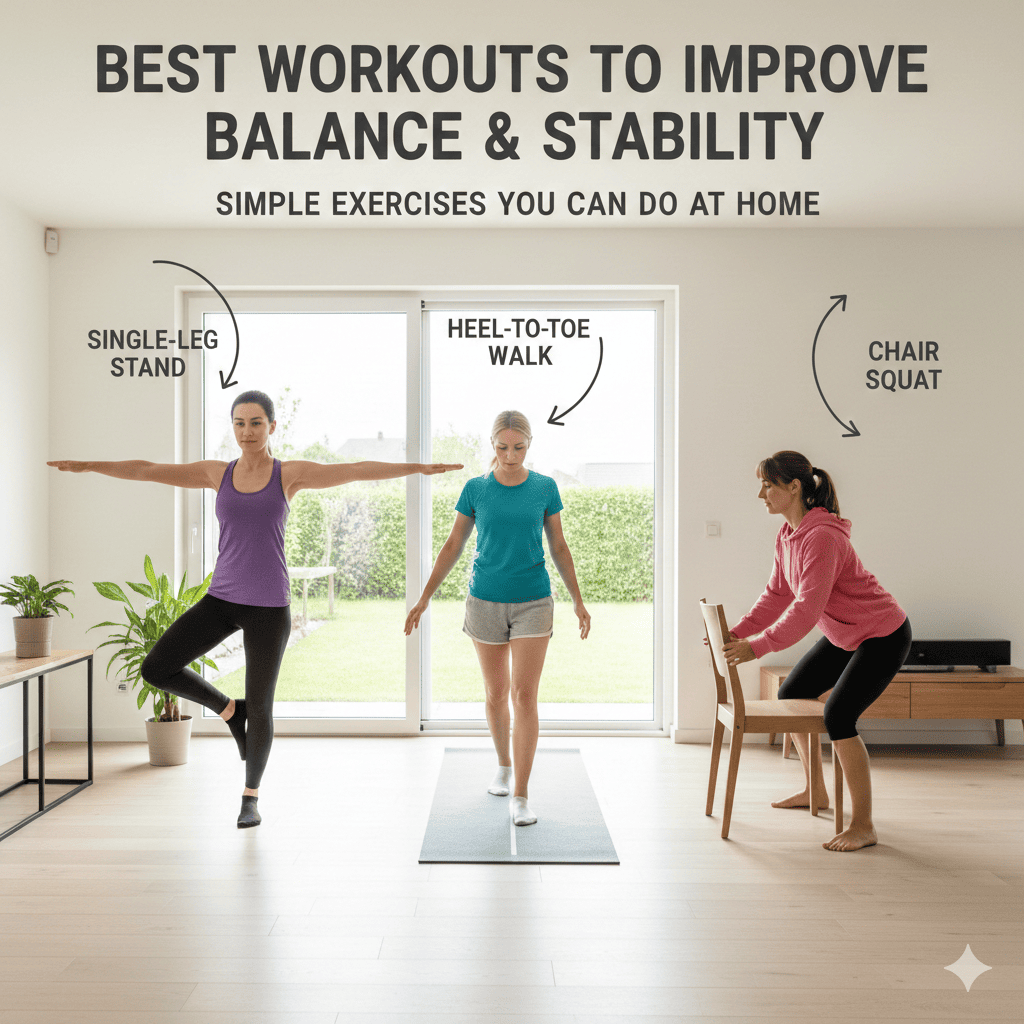
Balance and stability are fundamental components of physical fitness that often get overlooked until we experience a stumble, a near-fall, or difficulty performing everyday activities. Whether you’re an athlete looking to enhance performance, a senior wanting to maintain independence, or simply someone seeking better body control, incorporating workouts to improve balance and stability into your routine can transform your quality of life.
The good news is that you don’t need expensive equipment, a gym membership, or complicated training programs to develop exceptional balance. Your home provides everything you need to build a strong, stable foundation that will serve you in every aspect of movement. From preventing falls and injuries to improving athletic performance and posture, the benefits of balance training extend far beyond what most people realize.
This comprehensive guide will introduce you to the most effective workouts to improve balance and stability that you can practice in the comfort of your own home. These exercises progress from beginner-friendly movements to more challenging variations, ensuring that everyone can find appropriate starting points and continue advancing their skills over time.
Understanding the science behind balance will help you appreciate why these exercises work and motivate you to practice them consistently. Balance relies on the integration of three systems: your vestibular system in the inner ear, your visual system, and your proprioceptive system, which includes sensors in your muscles and joints that tell your brain where your body is in space. By challenging these systems through targeted exercises, you can significantly enhance your stability and coordination.
1. Single-Leg Standing Exercises
The foundation of all workouts to improve balance and stability begins with mastering the ability to stand on one leg. This deceptively simple exercise challenges your body in profound ways and serves as the building block for more advanced balance work.
Basic Single-Leg Stand
Start by standing near a wall or sturdy chair that you can use for support if needed. Shift your weight onto one leg and lift the other foot just a few inches off the ground. Keep your standing leg straight but not locked, and engage your core muscles to maintain an upright posture.
Begin by holding this position for 10 to 15 seconds, then switch legs. As you improve, gradually increase the duration up to 60 seconds per leg. The goal is to maintain stillness without wobbling or needing to touch down with your raised foot.
Focus on fixing your gaze on a single point in front of you at eye level. This visual anchoring significantly improves balance, especially when you’re first learning.
Eyes-Closed Single-Leg Stand
Once you can comfortably hold a single-leg stand with eyes open for 30 seconds or more, progress to closing your eyes. This removes visual input and forces your vestibular and proprioceptive systems to work harder.
Start with just 5 to 10 seconds with eyes closed, and gradually build up duration. This variation is considerably more challenging than it sounds and provides excellent training for real-world situations where visual information might be compromised.
Single-Leg Stand with Head Turns
While standing on one leg, slowly turn your head from side to side, looking over each shoulder. This challenges your vestibular system because head movements can disrupt balance signals from the inner ear.
Perform 5 to 10 head turns in each direction while maintaining your single-leg stance. This exercise mimics everyday activities like checking for traffic while walking or looking for items on shelves.
Single-Leg Stand with Arm Movements
Add complexity by incorporating arm movements while balancing on one leg. Raise your arms overhead, extend them to the sides, or reach forward and backward. These movements shift your center of gravity and require constant adjustments to maintain balance.
Perform 10 to 15 arm movements in various directions while standing on each leg. This variation builds practical stability for activities that require multitasking while balancing.
2. Tandem Walking and Heel-to-Toe Exercises
Tandem walking, also known as heel-to-toe walking, is one of the most effective workouts to improve balance and stability because it dramatically reduces your base of support and challenges your ability to maintain equilibrium while moving.
Basic Tandem Walk
Find a clear pathway in your home, ideally along a hallway or open room. Place one foot directly in front of the other so that the heel of your front foot touches the toes of your back foot. Continue walking forward in this heel-to-toe pattern for 10 to 20 steps.
Keep your arms extended to the sides initially for added stability. Focus your gaze on a point ahead of you rather than looking down at your feet. Your core should remain engaged throughout the movement.
This exercise mimics the coordination required for many daily activities and is particularly beneficial for improving gait quality and reducing fall risk.
Backward Tandem Walk
Once you’ve mastered forward tandem walking, try it in reverse. This variation is significantly more challenging because you can’t see where you’re placing your feet and must rely entirely on proprioception and spatial awareness.
Take 5 to 10 steps backward in the heel-to-toe pattern, moving slowly and deliberately. Have a clear space behind you and consider practicing near a wall for safety initially.
Tandem Walk with Eyes Closed
Progress to performing the basic tandem walk with your eyes closed for short distances. Start with just 3 to 5 steps and gradually increase as your confidence and ability improve.
This advanced variation removes visual feedback and dramatically increases the challenge to your balance systems. It’s excellent preparation for navigating in low-light conditions or uneven terrain.
Tandem Walk on Different Surfaces
Perform your tandem walk on various surfaces around your home: carpet, hardwood, tile, or even a thin yoga mat. Different surfaces provide varying amounts of stability and sensory feedback, challenging your balance in new ways.
This variation helps develop adaptable balance that transfers to real-world situations where surfaces are unpredictable.
3. Standing Balance Reaches and Shifts
Weight-shifting exercises are crucial workouts to improve balance and stability because they teach your body to control movement through space while maintaining equilibrium.
Four-Direction Reach
Stand on one leg and reach your free leg in four directions: forward, to the side, backward, and across your body. Touch your toes lightly to the ground at the end of each reach, then return to the starting position.
Perform 5 to 8 reaches in each direction before switching to the other leg. Keep your standing leg slightly bent and your core engaged. The reaching movements should be controlled and deliberate, not quick or jerky.
This exercise improves dynamic balance and builds strength in the stabilizing muscles of your hips and ankles.
Clock Reach Exercise
Imagine you’re standing at the center of a clock face. While balancing on your right leg, reach your left foot to touch the ground at 12 o’clock, then 3 o’clock, 6 o’clock, and 9 o’clock positions. Switch legs and repeat.
Progress to reaching to more positions around the clock, including 1, 2, 4, 5, 7, 8, 10, and 11 o’clock. This comprehensive reaching pattern challenges balance in all directions and builds exceptional stability.
Weight Shift Side to Side
Stand with feet hip-width apart and slowly shift your weight completely onto one leg, lifting the opposite foot just slightly off the ground. Hold for 2 to 3 seconds, then shift your weight to the other leg.
Perform 10 to 15 shifts in each direction, moving slowly and maintaining control throughout. This exercise builds the ability to transfer weight smoothly, which is essential for walking, climbing stairs, and changing direction.
Diagonal Weight Shifts
Stand with feet shoulder-width apart and shift your weight diagonally, moving from your right front to your left back, then from your left front to your right back. These diagonal shifts more closely mimic real-world movement patterns.
Complete 8 to 10 diagonal shifts in each direction, focusing on smooth, controlled transitions. Your knees should bend slightly as you shift, and your core should remain engaged.
4. Core-Strengthening Balance Exercises
A strong core is essential for balance because it provides the stability platform from which all other movements originate. These workouts to improve balance and stability specifically target core muscles while challenging equilibrium.
Single-Leg Deadlift
Stand on one leg with a slight bend in the knee. Hinge forward at the hips while extending your free leg behind you for counterbalance. Reach your hands toward the ground while keeping your back straight.
Return to the starting position by engaging your glutes and hamstrings. Perform 8 to 12 repetitions on each leg. This exercise strengthens your posterior chain while demanding exceptional balance and coordination.
If the full movement is too challenging initially, reduce the range of motion or hold onto a chair with one hand for support.
Plank with Leg Lift
Begin in a standard forearm plank position with your body in a straight line from head to heels. Lift one leg off the ground about 6 to 12 inches, hold for 2 to 3 seconds, then lower it. Alternate legs for 10 to 16 total lifts.
This variation adds an instability element to the traditional plank, forcing your core to work harder to prevent rotation and maintain alignment. Keep your hips level throughout the movement.
Bird Dog Exercise
Start on your hands and knees with your wrists under your shoulders and knees under your hips. Simultaneously extend your right arm forward and your left leg backward until they’re parallel to the ground. Hold for 3 to 5 seconds, return to center, then repeat with the opposite arm and leg.
Perform 8 to 12 repetitions on each side. Focus on keeping your spine neutral and avoiding any rotation in your hips or shoulders. This exercise builds cross-body coordination and core stability.
Side Plank with Hip Dips
Lie on your side with your forearm on the ground and feet stacked. Lift your hips off the ground into a side plank position, then slowly lower them toward the floor without touching down. Raise back up to the starting position.
Complete 8 to 12 dips on each side. This exercise strengthens the lateral core muscles that are essential for side-to-side balance and stability.
5. Dynamic Movement Balance Drills
Static balance is important, but workouts to improve balance and stability must also include dynamic movements that challenge your ability to maintain equilibrium while moving.
Step-Up and Balance
Use a stair step, a sturdy box, or even a thick book as your platform. Step up onto the platform with one foot, then bring your other knee up to hip height and hold for 2 to 3 seconds before stepping back down.
Perform 10 to 12 repetitions on each leg. This exercise builds strength and balance simultaneously while mimicking the functional movement of climbing stairs.
Progress by increasing the height of your platform or adding a pause at the top before bringing your knee up.
Walking Lunges with Hold
Perform a forward lunge, but instead of immediately stepping forward into the next lunge, hold the bottom position for 3 to 5 seconds. During this hold, your balance is challenged as you maintain stability on both legs in a split stance.
Complete 8 to 10 lunges on each leg, focusing on controlled movement and stability rather than speed. Keep your front knee aligned over your ankle and your back knee hovering just above the ground.
Lateral Step and Balance
Stand with feet together, then take a large step to the right, placing your right foot on the ground and lifting your left foot off the ground. Balance on your right leg for 2 to 3 seconds, then step your left foot over to meet your right foot. Repeat in the opposite direction.
Perform 10 to 12 steps in each direction. This lateral movement pattern is essential for sports and activities that require side-to-side agility.
Grapevine Steps
Perform the grapevine exercise by stepping to the side with your right foot, crossing your left foot behind, stepping to the side again with your right foot, then bringing your left foot to meet it. Reverse directions and repeat.
Complete 10 to 15 grapevine patterns in each direction. This exercise challenges coordination and cross-body balance while building hip mobility and stability.
6. Proprioceptive Training Exercises
Proprioception is your body’s ability to sense its position in space. Improving proprioception through specific workouts to improve balance and stability enhances your overall balance and reduces injury risk.
Balance on Unstable Surfaces
Stand on a couch cushion, folded towel, or pillow to create an unstable surface. The instability forces the small stabilizing muscles in your feet and ankles to work harder to maintain balance.
Begin by simply standing on the unstable surface for 30 to 60 seconds. Progress to performing single-leg stands, weight shifts, or reaches while on the unstable surface.
This type of training is particularly beneficial for athletes and anyone who regularly moves on uneven terrain.
Alphabet Tracing with Toes
Sit in a chair or stand while balancing on one leg. Use your non-weight-bearing foot to “write” the letters of the alphabet in the air. This requires precise control and awareness of where your foot is in space.
Complete the entire alphabet on one foot, then switch to the other. This exercise improves ankle mobility and proprioception while also serving as an excellent warm-up or cool-down activity.
Standing Ankle Circles
While balancing on one leg, perform slow, controlled circles with your raised foot. Make 10 circles in each direction, focusing on using a full range of motion.
Keep the movement isolated to your ankle joint rather than swinging from the knee or hip. This exercise strengthens ankle stability and improves proprioceptive awareness in the joint.
Balance with Ball Toss
Stand on one leg and toss a small ball or bean bag from hand to hand. This adds a coordination element while maintaining balance and helps develop the ability to multitask while stabilizing your body.
Perform 20 to 30 tosses while standing on each leg. Progress by closing your eyes for brief periods or varying the height and speed of your tosses.
7. Yoga-Inspired Balance Poses
Yoga offers some of the most effective workouts to improve balance and stability while also promoting flexibility, strength, and mental focus.
Tree Pose
Stand on one leg and place the sole of your other foot against your inner thigh, calf, or ankle (avoid placing it directly on the knee). Bring your hands together in front of your chest or raise them overhead.
Hold for 30 to 60 seconds on each side, breathing steadily and focusing on a fixed point. This classic balance pose builds hip stability and improves concentration.
If balance is challenging, start by placing your foot lower on the standing leg or keeping your toes on the ground for additional support.
Warrior III Pose
From a standing position, hinge forward at the hips while lifting one leg behind you. Extend your arms forward or keep them at your sides. Your body should form a straight line from fingertips to lifted toes, parallel to the ground.
Hold for 20 to 30 seconds on each side. This pose builds tremendous strength in the standing leg while challenging balance and core stability.
Begin with a partial range of motion if needed, gradually working toward the full horizontal position as your strength and balance improve.
Eagle Pose
Stand on one leg and wrap your other leg around the standing leg, hooking your foot behind the calf if possible. Cross your arms in front of you, wrapping one arm under and around the other until your palms meet.
Hold for 20 to 30 seconds on each side. This pose challenges balance while also stretching the shoulders and hips. The wrapped position of both arms and legs requires significant coordination and focus.
Half Moon Pose
From a standing position, reach down to place one hand on the ground or a block while lifting your opposite leg to hip height. Stack your hips and shoulders so they’re aligned vertically, and extend your top arm toward the ceiling.
Hold for 15 to 20 seconds on each side. This advanced balance pose requires flexibility, strength, and exceptional stability. Start with your hand on a higher surface if needed and gradually work toward placing it lower.
8. Ankle and Foot Strengthening Exercises
The ankles and feet are your body’s primary connection to the ground, making ankle strength essential for effective workouts to improve balance and stability.
Calf Raises with Variations
Stand with feet hip-width apart and rise up onto your toes, lifting your heels as high as possible. Hold for 2 seconds at the top, then lower slowly.
Perform 15 to 20 repetitions. Progress to single-leg calf raises for increased difficulty. Further advance by performing calf raises while standing on a step with your heels hanging off the edge, allowing for a greater range of motion.
This exercise strengthens the muscles that support your ankles and improve your ability to maintain balance on uneven surfaces.
Toe Raises
Stand with feet flat on the ground and lift your toes up toward your shins while keeping your heels planted. Hold for 2 seconds, then lower.
Perform 15 to 20 repetitions. This exercise strengthens the often-neglected anterior tibialis muscles that help stabilize your ankles and prevent trips and falls.
Single-Leg Balance with Toe Taps
Balance on one leg and use your free foot to tap the ground in front of you, to the side, and behind you. Perform 10 taps in each direction without allowing your standing foot to shift or wobble.
Keep the taps light and controlled, barely touching the ground. This exercise builds precise control in the ankle stabilizers and improves dynamic balance.
Barefoot Balance Practice
Whenever safe and appropriate, practice your balance exercises barefoot. This allows the small muscles and sensory receptors in your feet to engage more fully without the interference of shoes.
Walking barefoot on different textures like carpet, tile, or grass (outdoors) provides varied sensory input that enhances proprioception and foot strength.
9. Progressive Balance Challenges
As your balance improves, you’ll need to continue progressing your workouts to improve balance and stability to maintain improvement. These advanced variations provide ongoing challenges.
Balance with Head Movements
While performing any standing balance exercise, add deliberate head movements. Tilt your head forward and backward, rotate from side to side, or tilt your ear toward each shoulder.
These head movements challenge your vestibular system and train your body to maintain balance even when your inner ear receives conflicting signals. Start with slow, small movements and gradually increase the range and speed.
Decreased Visual Input Progressions
Systematically reduce visual input to increase balance difficulty. Start with eyes fully open, progress to soft focus where you blur your vision slightly, then to eyes half-closed, and finally to eyes fully closed.
This progression allows you to gradually challenge your balance systems without overwhelming them. Even advanced athletes often find eyes-closed variations surprisingly difficult.
Speed Variations
Perform your balance exercises at different speeds. For example, when doing weight shifts or reaches, alternate between very slow, controlled movements and quicker, more dynamic transitions.
Different speeds challenge your neuromuscular system in unique ways and help develop adaptable balance that works in various situations.
Adding Cognitive Tasks
While balancing, add mental challenges like counting backward from 100 by sevens, reciting the alphabet backward, or solving simple math problems. This dual-task training mimics real-world scenarios where you must maintain balance while focusing on other things.
This type of training is particularly valuable for older adults, as it builds the capacity to walk safely while having conversations or carrying items.
10. Balance Workout Routines and Programming
To maximize the benefits of workouts to improve balance and stability, it’s important to structure your practice effectively and maintain consistency over time.
Beginner Balance Routine
For those new to balance training, start with a simple 10 to 15 minute routine performed three to four times per week. Include basic single-leg stands for 3 sets of 30 seconds per leg, tandem walking for 2 sets of 15 steps, four-direction reaches for 2 sets of 8 reaches per direction, and tree pose for 2 sets of 30 seconds per side.
Focus on proper form rather than duration or difficulty. Build a solid foundation before progressing to more challenging variations.
Intermediate Balance Routine
Once you can comfortably perform beginner exercises, advance to a 20 to 25 minute routine four to five times per week. Include single-leg stands with eyes closed for 3 sets of 30 seconds, tandem walk with head turns for 3 sets of 20 steps, single-leg deadlifts for 3 sets of 10 reps per leg, and warrior III pose for 3 sets of 30 seconds per side.
Add unstable surface training and incorporate more dynamic movements into your routine.
Advanced Balance Routine
Advanced practitioners should aim for 25 to 30 minute sessions five to six times per week. Include eyes-closed balance with head movements for 3 sets of 45 seconds per leg, advanced yoga poses like half moon for 3 sets of 30 seconds per side, single-leg balance with cognitive tasks for 3 sets of 60 seconds, and sport-specific balance drills relevant to your activities.
Continuously challenge yourself with new variations and progressions to prevent plateaus.
Daily Balance Habits
Beyond structured routines, incorporate balance practice into daily life. Stand on one leg while brushing your teeth, practice tandem walking when moving through your home, or perform calf raises while waiting for coffee to brew.
These micro-practices accumulate significant training volume over time and help integrate balance skills into everyday movement patterns.
Conclusion
Developing excellent balance and stability through consistent workouts to improve balance and stability is one of the most valuable investments you can make in your physical health and functional capacity. Unlike many fitness qualities that primarily enhance appearance or performance in specific sports, balance training directly translates to improved safety, independence, and quality of life at any age.
The exercises presented in this guide provide a comprehensive approach to balance development, targeting all the systems and muscles involved in maintaining equilibrium. By starting with foundational exercises and progressively advancing to more challenging variations, you can systematically build exceptional balance regardless of your current fitness level.
Remember that balance improvement is a gradual process that requires patience and consistency. You may feel frustrated initially, especially if balance has never been your strength, but regular practice produces remarkable results. Most people notice significant improvements within just a few weeks of consistent training.
Safety should always be your priority when practicing workouts to improve balance and stability. Begin each exercise near a wall or sturdy furniture that you can use for support if needed. Clear the area around you of obstacles that could cause injury if you lose your balance. Consider practicing on carpet or using an exercise mat to cushion any unexpected falls.
As you progress, you’ll likely notice benefits extending beyond improved balance. Better posture, enhanced body awareness, increased ankle and foot strength, improved core stability, and greater confidence in your movement capabilities are all common side effects of dedicated balance training.
The beauty of these exercises is their accessibility. You truly need nothing more than a small amount of space and a few minutes of time to practice. There are no excuses, no barriers, and no reasons to delay starting your balance training journey today.
Whether your goal is to prevent falls as you age, enhance athletic performance, recover from an injury, or simply move through life with greater ease and confidence, incorporating these workouts to improve balance and stability into your routine will serve you well. Balance is a skill that, once developed, provides benefits for life and becomes more valuable with each passing year.
Also read this:
How to Lose Inches Without Strict Dieting — Easy Daily Habits That Actually Work
15-Minute Beginner Cardio Routine Without Equipment — Burn Calories at Home Fast
How to Build Core Strength With Simple Daily Moves — Beginner Guide to a Stronger Core