
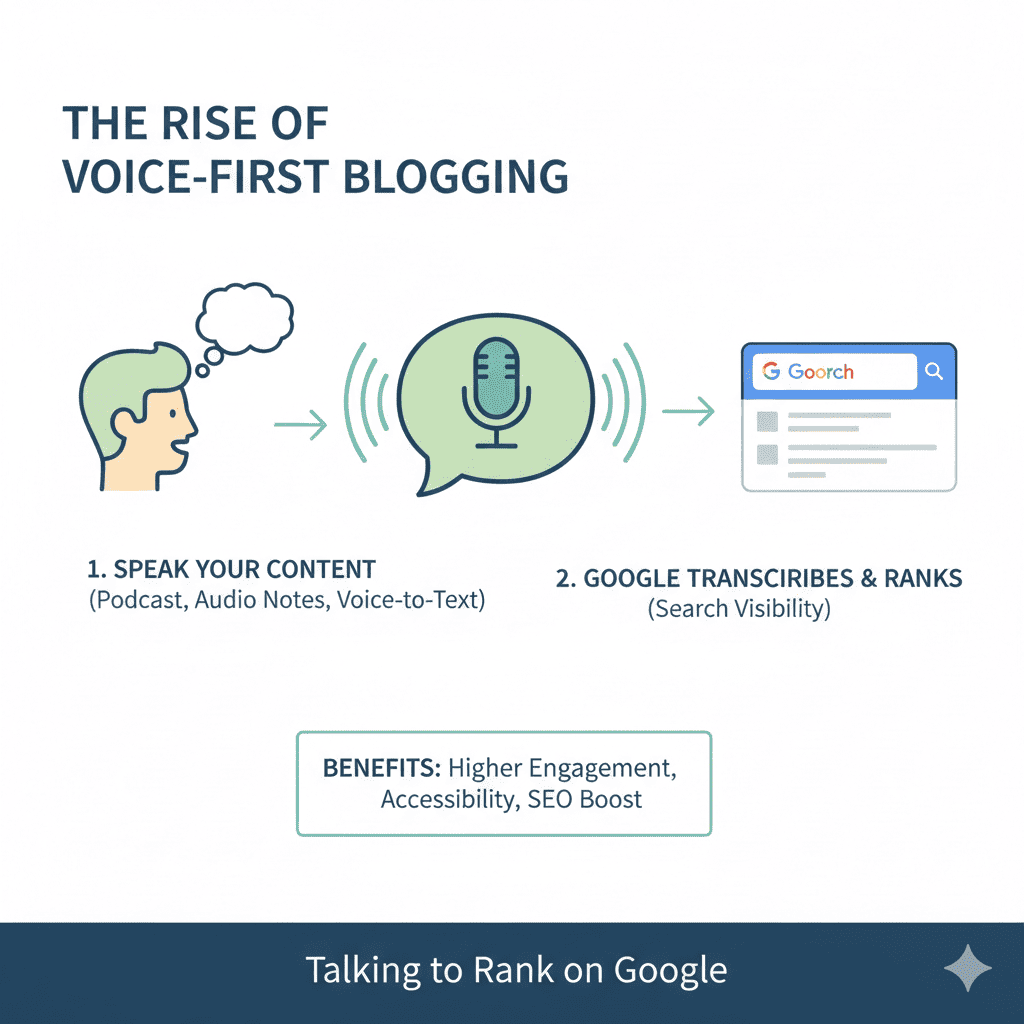
The keyboard is becoming optional. The traditional blog post—painstakingly typed, edited, and formatted over hours—is being challenged by a revolutionary approach that’s changing how content creators work and how search engines discover information. Welcome to the era of voice-first blogging, where speaking your thoughts can rank higher on Google than anything you’d type.
If you’re still exclusively typing your blog posts in 2025, you’re not just working harder—you’re potentially missing out on massive SEO opportunities. Voice-first blogging isn’t a gimmick or a passing trend. It’s a fundamental shift in content creation that aligns perfectly with how modern search algorithms work, how audiences consume information, and how the human brain naturally processes ideas.
This comprehensive guide reveals why voice-first blogging is exploding in popularity, how it helps you rank on Google, and most importantly, how you can start leveraging this approach today to dominate your niche.
What Exactly Is Voice-First Blogging?
Before we dive into strategy, let’s clarify what voice-first blogging actually means and what separates it from traditional content creation.
Defining Voice-First Blogging
Voice-first blogging is the practice of creating blog content primarily through spoken word rather than typing. You speak naturally—as if explaining concepts to a friend—and technology converts your words into written content that’s optimized for search engines.
This isn’t just using voice typing software. Voice-first blogging represents a complete mindset shift where:
- Speaking is the primary creation method, not an occasional shortcut
- Natural conversational tone becomes your competitive advantage, not something to edit away
- Content structure follows how humans actually explain ideas verbally
- SEO optimization happens through natural language that matches voice searches
- Volume and consistency increase dramatically because speaking is faster than typing
Think of voice-first blogging as having a conversation with your audience where Google happens to be listening—and rewarding you for it.
Why Now? The Perfect Storm for Voice-First Blogging
Several technological and cultural shifts have converged to make voice-first blogging not just possible but superior to traditional methods:
Voice recognition accuracy has crossed the threshold. Modern AI transcription services achieve 95%+ accuracy even with accents, industry jargon, and natural speech patterns. Your voice-first blogging workflow no longer requires extensive correction.
Natural language processing dominates search. Google’s algorithms have evolved beyond keyword matching. They understand context, intent, and conversational queries—exactly what voice-first blogging produces naturally.
Voice search is exploding. Over 50% of searches now involve voice commands. When you create content through voice-first blogging, you’re automatically optimizing for how people actually search.
Content volume demands are crushing creators. The “publish consistently or perish” reality of modern SEO makes voice-first blogging essential. You can speak 150-200 words per minute but type only 40-50.
Authenticity beats perfection. Audiences increasingly prefer conversational, authentic content over polished corporate speak. Voice-first blogging delivers this naturally.
The SEO Superpowers of Voice-First Blogging
Here’s where voice-first blogging becomes irresistible for anyone serious about ranking on Google. This approach offers distinct SEO advantages that typed content struggles to match.
Natural Long-Tail Keyword Integration
When you practice voice-first blogging, you naturally use complete questions and phrases that people actually search for. Instead of forcing “best coffee maker” into awkward sentences, you naturally say things like “what’s the best coffee maker for someone who doesn’t want to spend more than $100?”
That complete question is precisely how someone searches via voice. Your voice-first blogging content matches search queries organically without artificial optimization.
Featured Snippet Gold Mine
Google’s featured snippets increasingly favor conversational answers to direct questions. Voice-first blogging produces exactly this format naturally.
When typing, you might write: “Morning exercise benefits include improved metabolism, better mood regulation, and increased energy throughout the day.”
With voice-first blogging, you’d naturally say: “Why should you exercise in the morning? Well, morning workouts boost your metabolism for the entire day, they improve your mood before you even get to work, and they give you more sustained energy than that third cup of coffee ever will.”
The second version—created through voice-first blogging—is more likely to be pulled as a featured snippet because it directly answers a question in conversational language.
Semantic Richness and Context
Voice-first blogging naturally creates semantic relationships that search algorithms love. When speaking, you automatically:
- Use synonyms and related terms naturally
- Explain concepts from multiple angles
- Provide context and examples spontaneously
- Connect ideas in ways that demonstrate topical authority
This semantic richness signals to Google that your voice-first blogging content deeply covers topics, which is a major ranking factor.
Increased Content Length Without Fluff
Google generally favors comprehensive content, but typing 3,000-word posts is exhausting. Many creators pad content with fluff to hit word counts.
Voice-first blogging solves this elegantly. You can easily speak for 20-30 minutes, producing 3,000-5,000 words of content naturally. Because you’re explaining rather than padding, the length comes from genuine value, not artificial inflation.
Better User Engagement Metrics
Content created through voice-first blogging tends to have superior engagement metrics:
- Lower bounce rates: Conversational content hooks readers better
- Longer dwell time: Natural flow keeps people reading
- Higher scroll depth: Story-like structure pulls readers through
- More social shares: Relatable tone encourages sharing
These engagement signals tell Google your voice-first blogging content deserves higher rankings.
FAQ Schema Optimization
Voice-first blogging naturally produces question-and-answer formats that are perfect for FAQ schema markup. This structured data helps search engines understand your content and can result in rich snippets that dominate search results.
Your spoken explanations become SEO gold when properly formatted.
The Psychology Behind Why Voice-First Blogging Works
Understanding the cognitive science behind voice-first blogging helps you leverage it more effectively.
Speaking Activates Different Brain Regions
When you speak, you engage different neural pathways than when you type. Voice-first blogging taps into the same brain regions used for face-to-face explanation—areas associated with empathy, storytelling, and teaching.
This produces content that:
- Flows more naturally
- Contains better examples spontaneously
- Explains complex concepts more clearly
- Feels more personal and engaging
Your voice-first blogging content simply connects better with readers because it was created using communication pathways refined over thousands of years of human evolution.
Reduced Cognitive Friction
Typing requires conscious thought about spelling, grammar, formatting, and word choice. This cognitive overhead interrupts your flow of ideas.
Voice-first blogging eliminates this friction. You focus entirely on ideas, explanations, and value delivery. The result is more creative, insightful content that surfaces your best thinking.
The Authenticity Signal
Audiences have become sophisticated at detecting artificial, over-polished content. Voice-first blogging carries subtle linguistic markers of genuine human communication—slight imperfections, natural emphasis patterns, conversational asides—that build trust.
This authenticity doesn’t hurt your SEO—it enhances it by improving engagement metrics.
Building Your Voice-First Blogging System: The Complete Setup
Ready to implement voice-first blogging? Here’s your complete technical setup, from equipment to workflow.
Essential Voice-First Blogging Equipment
The beauty of voice-first blogging is you don’t need expensive equipment. Here’s what works:
For beginners:
- Your smartphone (surprisingly good microphones)
- Quiet space (bedroom, closet, parked car)
- Free transcription app (Google Recorder, Otter.ai free tier)
For better quality:
- USB microphone ($50-100: Blue Yeti, Audio-Technica ATR2100)
- Pop filter ($10-20)
- Quiet room treatment (blankets, foam panels)
- Transcription service (Otter.ai paid, Descript, or Trint)
For professionals:
- Professional microphone ($200-500: Shure SM7B, Rode PodMic)
- Audio interface (Focusrite Scarlett series)
- Acoustic treatment panels
- Professional transcription service
- Audio editing software (Descript is perfect for voice-first blogging)
The investment scales with your commitment, but even basic equipment produces excellent voice-first blogging results.
The Voice-First Blogging Tech Stack
Build your voice-first blogging workflow with these tools:
For recording:
- Mobile: Voice Memos (iOS), Google Recorder (Android)
- Desktop: Audacity (free), Adobe Audition (professional)
- Integrated: Descript (records and transcribes simultaneously)
For transcription:
- Otter.ai: Excellent accuracy, integrates with Zoom
- Descript: Best for editing audio and text together
- Rev: Human transcription option for 100% accuracy
- Trint: Great for multiple languages
For editing:
- Descript: Edit transcription like a document; audio changes automatically
- Grammarly: Polish grammar while maintaining voice
- Hemingway Editor: Ensure readability
For publishing:
- Your standard CMS (WordPress, Ghost, Medium)
- SEO plugins (Yoast, Rank Math) to optimize your voice-first blogging content
The Perfect Voice-First Blogging Workflow
Here’s the step-by-step process that turns your voice into ranked content:
Step 1: Preparation (5-10 minutes)
- Choose your topic and main keyword
- Create a bullet-point outline (3-5 main points)
- Gather any research, stats, or sources you’ll reference
- Set up recording environment (quiet space, equipment ready)
Step 2: Recording (15-30 minutes)
- Speak naturally as if explaining to a friend
- Follow your outline but allow spontaneous tangents
- Use verbal punctuation (“comma,” “period,” “new paragraph”)
- Don’t worry about perfection—you’ll edit later
- Speak 20-30% of your desired final word count (edit will expand)
Step 3: Transcription (automatic or 24 hours)
- Upload to your transcription service
- Wait for processing (usually minutes to hours)
- Download completed transcript
Step 4: Editing (20-40 minutes)
- Read through for major errors or unclear sections
- Add proper punctuation and formatting
- Insert subheadings based on topic shifts
- Add relevant links and references
- Maintain conversational tone—don’t over-edit the “voice” away
Step 5: SEO Optimization (10-15 minutes)
- Identify and bold your primary keyword naturally
- Add meta description drawn from your introduction
- Create compelling title from your topic
- Add alt text to images
- Include internal links to related content
Step 6: Publishing and Promotion
- Schedule or publish immediately
- Share on social media with pull quotes
- Monitor early engagement and rankings
Total time for comprehensive voice-first blogging post: 60-90 minutes versus 3-4 hours for traditional typed content.
Advanced Voice-First Blogging Techniques for Maximum Rankings
Once you’ve mastered basic voice-first blogging, these advanced strategies multiply your SEO results.
The Interview Method
Have someone interview you about your topic. This conversational voice-first blogging approach produces incredibly natural, engaging content.
Your responses to questions automatically:
- Address specific search queries
- Provide thorough explanations
- Include examples and stories naturally
- Create FAQ-ready content
Many top bloggers use this interview-style voice-first blogging to produce their highest-performing content.
The Stream-of-Consciousness Brain Dump
For maximum volume, use voice-first blogging to capture your unfiltered expertise:
- Record yourself explaining everything you know about a topic
- Speak for 45-60 minutes
- Transcribe this “master content”
- Break it into 5-10 separate blog posts
- Each post gets unique optimization
One hour of voice-first blogging recording can generate weeks of content.
The Commentary Method
Open a relevant article, video, or study and record your voice-first blogging response:
- “Here’s what they got right…”
- “What they missed is…”
- “My experience shows…”
- “A better approach would be…”
This produces highly original content that adds value to existing information while naturally incorporating relevant keywords.
The Teaching Approach
Imagine teaching your topic to a beginner. This voice-first blogging technique naturally:
- Uses simple, clear language
- Provides step-by-step instructions
- Includes analogies and examples
- Anticipates and answers questions
Content created this way ranks extremely well for beginner-focused searches, which often have high volume and commercial intent.
Multi-Topic Clustering
Use voice-first blogging to create comprehensive topic clusters efficiently:
- Record a comprehensive 60-minute discussion of a broad topic
- Create a pillar post from the full transcript
- Extract 8-10 subtopics for individual posts
- Each cluster post links back to the pillar
- Your voice-first blogging approach creates topical authority fast
Optimizing Your Voice-First Blogging Content for Voice Search
Since your content is created through voice, optimizing it for voice search is natural—but these specific techniques enhance results.
Question-Based Headers
Structure your voice-first blogging content with questions as headers:
- “What is Voice-First Blogging?”
- “Why Does Voice-First Blogging Rank Better?”
- “How Do You Start Voice-First Blogging Today?”
These directly match voice search queries.
Conversational Keywords
Voice searches are longer and more conversational than typed searches. Your voice-first blogging naturally captures this, but ensure you include:
- “How to” phrases
- “What is” questions
- Location-specific long-tail phrases
- Problem-solution language
Local SEO Integration
If relevant, your voice-first blogging should include natural location references. Voice searchers frequently add “near me” or city names. Speaking naturally about local context helps you rank for these queries.
Featured Snippet Optimization
Format sections of your voice-first blogging content specifically for featured snippets:
- Direct answers in 40-60 words
- Numbered lists for processes
- Bulleted lists for options or features
- Definition boxes for key terms
Common Voice-First Blogging Mistakes and How to Avoid Them
Even with this powerful approach, some creators sabotage their voice-first blogging success. Avoid these pitfalls:
Mistake 1: Over-Editing Away Your Voice
Your voice-first blogging content’s strength is its conversational tone. Don’t edit it until it sounds like a corporate press release. Keep the personality.
Mistake 2: Recording Without Structure
While voice-first blogging should flow naturally, recording completely unstructured rambling creates editing nightmares. Always work from at least a basic outline.
Mistake 3: Neglecting Audio Quality
Poor audio leads to poor transcription. Your voice-first blogging efficiency disappears if you spend hours correcting transcription errors. Invest in decent equipment and quiet recording space.
Mistake 4: Ignoring SEO Fundamentals
Voice-first blogging helps SEO, but doesn’t replace it. Still optimize titles, meta descriptions, headers, and include strategic internal links.
Mistake 5: Publishing Without Reading
Always read your voice-first blogging transcript before publishing. Transcription isn’t perfect, and your spoken examples might need clarification in written form.
Mistake 6: Trying to Sound “Professional”
Overly formal language kills the advantage of voice-first blogging. Speak naturally, as you would to an interested friend. This authenticity is your competitive edge.
Voice-First Blogging Success Metrics: What to Track
Measure your voice-first blogging performance with these key metrics:
Efficiency Metrics
- Time from idea to published post
- Words produced per hour of recording
- Editing time required per 1,000 words
- Total content volume per week/month
Your voice-first blogging should dramatically improve all these numbers.
SEO Performance Metrics
- Organic traffic growth
- Featured snippet captures
- Voice search rankings (track mobile specifically)
- Average position for target keywords
- Click-through rates from search
Compare posts created through voice-first blogging versus traditional typing to quantify the SEO advantage.
Engagement Metrics
- Average time on page
- Bounce rate
- Scroll depth
- Social shares
- Comments and discussion
Voice-first blogging content typically outperforms typed content across these engagement signals.
Case Studies: Voice-First Blogging Results
Real examples demonstrate the power of this approach:
Tech Blogger Mike (name changed): Switched to voice-first blogging for all content. Results after 6 months:
- Content production: 2 posts/week to 6 posts/week
- Organic traffic: +340%
- Featured snippets: 3 to 27
- Time per post: Reduced from 4 hours to 90 minutes
Marketing Consultant Sarah: Used voice-first blogging for client case studies and strategy posts. Results after 3 months:
- Voice search traffic: +180%
- Average position: Improved from 15 to 8
- Engagement time: +45%
- Lead generation: +60% from blog
Fitness Coach James: Implemented voice-first blogging for workout explanations and nutrition advice. Results after 4 months:
- Content volume: 3x increase
- Email subscribers from blog: +220%
- YouTube channel growth: +150% (repurposed audio)
- Client inquiries: +85%
These aren’t outliers. Voice-first blogging consistently produces superior results when implemented properly.
The Future of Voice-First Blogging: What’s Coming Next
The voice-first blogging revolution is just beginning. Here’s what’s on the horizon:
Real-Time Optimization
AI tools will soon analyze your voice-first blogging recordings in real-time, suggesting topic expansions, related questions to address, and SEO opportunities while you’re still recording.
Automated Formatting
Advanced AI will format your voice-first blogging transcripts perfectly—adding headers, bullet points, emphasis, and even relevant images—based on verbal cues and content analysis.
Integrated Multimedia
Future voice-first blogging platforms will automatically generate accompanying podcasts, videos, and social media content from your single recording session.
Voice Style Transfer
Imagine recording in your natural speaking voice, then having AI adjust the style for different audiences—more technical for experts, simpler for beginners—all from one voice-first blogging session.
Your Voice-First Blogging 30-Day Challenge
Ready to prove the power of voice-first blogging to yourself? Take this 30-day challenge:
Week 1: Setup and Experimentation
- Days 1-2: Acquire basic equipment and choose tools
- Days 3-4: Create 2 posts using voice-first blogging, note time and experience
- Days 5-7: Create 2 more posts, refining your process
Week 2: Building the Habit
- Create 5 posts using voice-first blogging (one per weekday)
- Track time spent, word count produced
- Note which topics work best with this method
Week 3: Optimization
- Create 5 more posts with conscious SEO optimization
- Implement question-based structure
- Add proper formatting and keyword focus
Week 4: Analysis and Scaling
- Review analytics for all voice-first blogging posts
- Compare against your previous typed posts
- Create strategy for permanent implementation
- Produce bonus content from successful approach
By day 30, you’ll have 14+ new blog posts, quantitative proof of efficiency gains, and early SEO performance data showing the ranking advantage of voice-first blogging.
Why Voice-First Blogging Is Non-Negotiable in 2025
We’ve covered the what, why, and how of voice-first blogging. Let’s address the elephant in the room: can you succeed without it?
Technically, yes. But you’ll be working three times harder to compete with creators who’ve embraced voice-first blogging. Here’s the uncomfortable truth:
Content volume matters. Google rewards consistent publishers. Voice-first blogging lets you produce 3-5x more content in the same time investment.
Conversational content wins. As search algorithms become more sophisticated, naturally-written content outranks keyword-stuffed articles. Voice-first blogging produces this automatically.
Voice search is the present, not the future. Over half of all searches now involve voice. If your content isn’t optimized for how people actually search, you’re invisible to half your potential audience.
Efficiency determines survival. Content creators burn out from the typing treadmill. Voice-first blogging makes content creation sustainable long-term.
Your competitors are already doing this. Early adopters of voice-first blogging are seeing dramatic ranking improvements. The longer you wait, the harder it becomes to catch up.
Taking Action: Start Your Voice-First Blogging Journey Today
You’ve read the complete guide. You understand the why, the how, and the massive competitive advantage. Now it’s time to act.
Your immediate action plan:
Today: Record a 10-minute explanation of something you know well. Upload it to Otter.ai’s free tier. Review the transcript. That’s your first voice-first blogging content.
This week: Publish that first piece after editing. Note how long the process took compared to typing.
This month: Create at least 4 posts using voice-first blogging. Refine your process. Track your efficiency gains.
This quarter: Make voice-first blogging your default content creation method. Measure the SEO impact. Scale your content production.
The bloggers dominating search results in 2025 aren’t spending more time creating content—they’re working smarter by letting their voice do the heavy lifting.
The Voice-First Blogging Bottom Line
Traditional typing is dying, not because keyboards are disappearing, but because there’s a fundamentally better way to create content that ranks.
Voice-first blogging isn’t just faster—it’s naturally optimized for how modern search engines work, how people actually search, and how audiences prefer to consume content.
You can speak 4x faster than you type. Your voice-first blogging content naturally matches voice search queries. It engages readers better. It captures featured snippets more effectively. And it makes consistent content production sustainable.
The era of voice-first blogging has arrived. The only question is: Will you ride this wave to the top of search results, or will you watch from the sidelines as others dominate your niche by simply pressing “record”?
Your voice is your most powerful SEO tool. It’s time to start using it.
Also read this:
How to Create Your Own AI Personal Brand (No Code Needed): The Complete 2025 Guide