
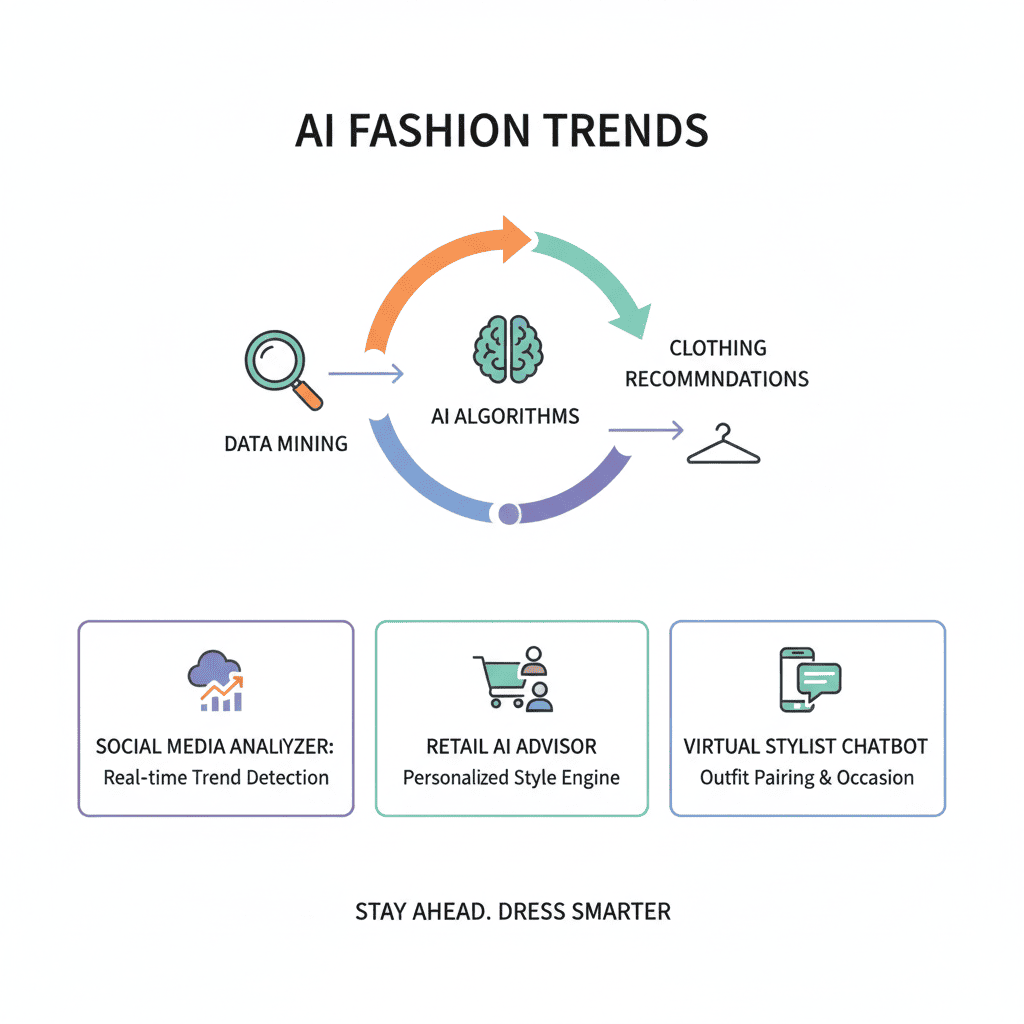
The fashion industry moves at breakneck speed, with trends emerging and evolving faster than ever before. Consumers expect personalized shopping experiences that align with current trends while matching their individual style preferences. Traditional retail approaches—relying on seasonal collections and manual curation—struggle to meet these dynamic demands. Enter artificial intelligence, which has revolutionized how fashion brands and retailers deliver Trend-Based Clothing Recommendations that feel both personally relevant and culturally current.
Modern AI tools analyze millions of data points—social media trends, runway shows, street style, celebrity fashion, and individual customer behavior—to generate recommendations that are simultaneously on-trend and personally tailored. Whether you’re operating an online boutique, managing a major fashion brand, or building a personal styling service, mastering Trend-Based Clothing Recommendations through AI is essential for competing in today’s fashion marketplace.
In this comprehensive guide, we’ll explore the most powerful AI tools transforming fashion recommendations and provide strategies for implementing them to increase sales, improve customer satisfaction, and stay ahead of rapidly evolving trends.
Why AI-Powered Trend-Based Clothing Recommendations Matter
Understanding the business and customer experience impact of Trend-Based Clothing Recommendations provides crucial context for why fashion retailers are rapidly adopting these technologies.
Traditional fashion retail relied on buyers predicting trends months in advance, resulting in inventory mismatches when predictions proved wrong. Customers received generic product suggestions based on broad demographics rather than individual preferences combined with current trends. The disconnect between what customers wanted and what retailers offered resulted in high return rates, excess inventory, and missed sales opportunities.
Trend-Based Clothing Recommendations powered by AI address these fundamental challenges. AI systems continuously monitor fashion trends across social media, fashion weeks, celebrity appearances, and street style, identifying emerging trends before they peak. Simultaneously, they analyze individual customer behavior—purchases, browsing patterns, style preferences—to understand personal tastes. The intersection of trend awareness and personal preference creates recommendations that feel both relevant and exciting.
The business impact is substantial. Fashion retailers implementing AI recommendation systems report impressive improvements: 25-35% increase in conversion rates from personalized recommendations, 40-60% improvement in average order value through intelligent styling suggestions, 30-50% reduction in return rates when items match customer expectations, 20-30% increase in customer lifetime value through improved satisfaction, and 15-25% reduction in excess inventory through better demand prediction.
Beyond metrics, AI recommendations transform customer experience from frustrating product searches into delightful discovery of items that match both personal style and current fashion zeitgeist. This emotional connection drives brand loyalty that transcends individual transactions.
1. Personalized Style Recommendation Engines
Comprehensive AI platforms analyze customer data and fashion trends to generate personalized outfit and product recommendations.
Stitch Fix Algorithms
Stitch Fix pioneered data-driven personal styling, using sophisticated machine learning algorithms that combine human stylist expertise with AI-powered trend analysis. The platform’s recommendation engine analyzes millions of customer data points alongside current fashion trends to curate personalized selections.
For Trend-Based Clothing Recommendations, Stitch Fix’s hybrid approach proves particularly effective. The AI identifies trending styles, colors, and silhouettes while human stylists provide creative interpretation and personal touch that purely algorithmic systems lack.
The feedback loop continuously improves recommendations as customers rate items and provide style preferences. This iterative learning ensures recommendations become increasingly accurate over time, adapting to evolving personal tastes and shifting fashion trends.
Stitch Fix’s success demonstrates that Trend-Based Clothing Recommendations deliver measurable business value—the company’s algorithms drive higher satisfaction and lower return rates than traditional retail approaches.
Vista
Vista delivers AI-powered visual search and recommendation technology specifically designed for fashion retailers. The platform’s computer vision analyzes product images to understand style attributes—silhouettes, patterns, colors, fabrics—enabling intelligent recommendations based on visual similarity and trending aesthetics.
The trend detection capabilities monitor social media, fashion publications, and runway shows to identify emerging styles before they reach mainstream adoption. For Trend-Based Clothing Recommendations, this early awareness enables retailers to promote relevant inventory as trends gain momentum.
Vista’s “complete the look” features generate outfit recommendations that combine multiple products, increasing average order value while helping customers discover complementary items. The AI understands which pieces work together stylistically, creating cohesive looks rather than mismatched suggestions.
Findmine
Findmine specializes in outfit completion and product bundling using AI that understands fashion styling principles. The platform automatically generates “shop the look” recommendations showing how individual items work together in complete outfits.
The trend awareness features identify which styling approaches are currently popular—oversized silhouettes, color blocking, layering techniques—and apply these principles to outfit recommendations. For Trend-Based Clothing Recommendations, this styling intelligence creates suggestions that feel fashionable and current.
Findmine’s automation scales styling expertise across entire catalogs, providing professional-quality outfit recommendations for thousands of products without requiring manual curation. This scalability proves essential for retailers with large inventories.
2. Social Media Trend Analysis Tools
Fashion trends increasingly emerge and spread through social media. AI tools that analyze social platforms identify trends as they develop.
Heuritech
Heuritech uses computer vision and deep learning to analyze millions of social media images, identifying emerging fashion trends up to a year before they reach mainstream adoption. The platform’s AI recognizes specific garments, colors, patterns, and styling details in street style photos, runway images, and influencer posts.
For Trend-Based Clothing Recommendations, Heuritech’s predictive capabilities enable retailers to promote inventory aligned with emerging trends or identify products to develop for upcoming seasons. The platform tracks trend lifecycles, showing when styles are emerging, peaking, or declining.
The geographic trend mapping reveals how fashion preferences vary across regions, enabling localized recommendations that reflect cultural differences. Customers in Tokyo receive different trend-based suggestions than those in Paris or New York, reflecting actual regional style preferences.
Heuritech’s quantitative approach to trend analysis replaces subjective interpretation with data-driven insights, reducing the guesswork in fashion merchandising and recommendation strategies.
Trendalytics
Trendalytics combines social listening, search data analysis, and AI-powered forecasting to identify fashion trends across categories. The platform monitors billions of consumer interactions to understand which products, styles, and brands are gaining popularity.
The demand forecasting capabilities predict trend trajectories, showing whether emerging styles will achieve mainstream adoption or remain niche. For Trend-Based Clothing Recommendations, this predictive intelligence ensures recommendations align with trends that will actually influence customer purchases.
Trendalytics’ competitive intelligence reveals which products and trends competitors are emphasizing, enabling strategic positioning and differentiation. The platform identifies market gaps where emerging trends lack sufficient product availability.
Stylumia
Stylumia delivers AI-powered fashion analytics that predict demand at SKU level, enabling precise inventory planning and recommendation strategies. The platform analyzes fashion trends, consumer preferences, and buying patterns to forecast which specific products will sell.
The trend analysis identifies which style attributes—sleeve lengths, necklines, fabric types, color palettes—are gaining popularity across customer segments. For Trend-Based Clothing Recommendations, this granular insight enables remarkably precise suggestions that match both trends and personal preferences.
Stylumia’s real-time analytics track trend evolution continuously, enabling dynamic recommendation adjustments as trends shift. Recommendations stay current rather than becoming stale as fashion moves forward.
3. Visual Search and Recognition Platforms
Customers often discover desired styles in photos but struggle describing them in searches. AI visual search tools bridge this gap while incorporating trend awareness.
Pinterest Lens
Pinterest Lens enables visual search where users photograph items or upload images to find similar products. The platform’s AI recognizes fashion items, style attributes, and aesthetic qualities to surface relevant recommendations.
For Trend-Based Clothing Recommendations, Pinterest’s massive user base generates trend signals through collective saving and searching behavior. Items receiving increased interest indicate emerging trends that recommendation systems can incorporate.
The “shop the look” features identify individual products within outfit photos, enabling customers to purchase specific pieces from inspirational images. This capability transforms aspiration into transaction seamlessly.
Pinterest’s personalization combines visual search results with individual user preferences, ensuring recommendations reflect both current inspiration and established style preferences.
Syte
Syte delivers visual AI for e-commerce with capabilities including visual search, automated product tagging, and personalized recommendations. The platform’s computer vision understands fashion products deeply, recognizing styles, occasions, seasons, and trends.
The visual search enables customers to upload photos and find similar items in retailer inventories. For Trend-Based Clothing Recommendations, Syte analyzes which visual attributes customers search for most frequently, revealing trend signals that inform recommendation strategies.
The automated product tagging uses AI to label items with relevant attributes—”bohemian,” “minimalist,” “Y2K”—ensuring products are discoverable through trend-based searches and appear in appropriate recommendation contexts.
Syte’s “complete the look” recommendations generate outfit suggestions based on items customers view or purchase, increasing cross-sell opportunities while helping customers achieve trendy, cohesive looks.
Pixyle.ai
Pixyle.ai specializes in fashion-specific visual AI with deep understanding of clothing styles, attributes, and trends. The platform’s computer vision recognizes subtle style details that distinguish fashion trends—particular silhouettes, neckline styles, or fabric treatments.
The trend detection analyzes which visual attributes appear increasingly in customer searches and social media, identifying emerging trends algorithmically. For Trend-Based Clothing Recommendations, this automated trend identification enables responsive recommendation strategies.
Pixyle’s embedding technology represents fashion items as mathematical vectors that capture style essence, enabling similarity-based recommendations that understand style relationships beyond surface-level attributes.
4. Customer Behavior Analytics Platforms
Understanding individual customer preferences and shopping patterns enables personalized trend recommendations that align with personal style.
Dynamic Yield
Dynamic Yield delivers personalization across customer touchpoints including product recommendations, content, and messaging. The platform’s machine learning analyzes browsing behavior, purchase history, and engagement patterns to understand individual preferences.
For Trend-Based Clothing Recommendations, Dynamic Yield combines personal preference understanding with trend signals to generate recommendations that feel both on-trend and personally relevant. Customers interested in minimalism receive trending minimalist pieces rather than trending maximalist styles.
The A/B testing capabilities evaluate recommendation effectiveness, enabling data-driven optimization of recommendation strategies. The platform identifies which recommendation approaches drive highest engagement and conversion for different customer segments.
Dynamic Yield’s real-time personalization adjusts recommendations based on immediate behavior—items viewed in current session, products added to cart—ensuring recommendations remain contextually relevant throughout shopping journeys.
Bloomreach
Bloomreach combines commerce experience with AI-powered personalization and recommendation capabilities. The platform’s Loomi AI analyzes customer data to generate product recommendations, personalized content, and intelligent search results.
The trend incorporation features ensure recommendations reflect current fashion directions while matching individual customer styles. For Trend-Based Clothing Recommendations, this balanced approach prevents recommendations from feeling either too safe and boring or too trend-forward and uncomfortable.
Bloomreach’s omnichannel capabilities deliver consistent personalization across web, mobile, email, and other touchpoints, creating coherent experiences regardless of how customers engage with brands.
Nosto
Nosto provides e-commerce personalization with AI-powered product recommendations, dynamic content, and behavioral targeting. The platform analyzes customer segments to understand style preferences across demographic and psychographic groups.
The trend-aware recommendations incorporate trending items for customers showing openness to new styles while offering classic alternatives for more conservative shoppers. For Trend-Based Clothing Recommendations, this segmented approach ensures all customers receive appropriate suggestions.
Nosto’s social proof features highlight items that are trending within customer’s peer groups—”popular with women in their 30s in urban areas”—leveraging social influence that drives fashion adoption.
5. AI Styling Assistants and Chatbots
Conversational AI enables interactive fashion advice that combines trend awareness with personal consultation experiences.
Thread
Thread delivers personalized fashion recommendations through combination of AI algorithms and human stylists. Customers complete style profiles and receive weekly recommendations tailored to preferences, body type, and current trends.
For Trend-Based Clothing Recommendations, Thread’s hybrid approach balances algorithmic efficiency with human fashion expertise. The AI identifies trending items matching customer preferences while stylists provide context, styling advice, and personal touch.
The feedback mechanism continuously refines recommendations as customers rate suggestions and make purchases. This learning process ensures recommendations improve over time, adapting to evolving tastes and trends.
Thread’s messaging interface enables customers to ask styling questions and receive advice, creating relationships that extend beyond transactional product recommendations.
Halla
Halla uses AI to understand taste preferences and generate personalized recommendations across retail categories including fashion. The platform’s machine learning creates detailed preference profiles that capture individual style sensibilities.
The trend integration ensures recommendations stay current while respecting personal boundaries. For Trend-Based Clothing Recommendations, customers receive trend-appropriate suggestions that align with their established style preferences rather than jarring departures from comfort zones.
Halla’s cross-category learning applies insights from food, entertainment, and lifestyle preferences to fashion recommendations, understanding that personal style connects to broader lifestyle choices.
Lily AI
Lily AI bridges the language gap between how customers describe fashion and how retailers categorize products. The platform’s natural language processing understands fashion terminology, slang, and trend names that customers use when searching.
The customer-centric attributes generated by Lily AI ensure products appear in searches for trend terms like “cottagecore,” “dark academia,” or “coastal grandmother.” For Trend-Based Clothing Recommendations, this linguistic understanding enables recommendations based on trend interest expressed through search behavior.
Lily’s product attribution automatically tags items with trend-relevant terms as trends emerge, ensuring catalogs remain discoverable through current fashion vocabulary without manual updating.
6. Fit and Size Recommendation Tools
Fashion recommendations fail when items don’t fit properly. AI tools that predict fit combine with trend recommendations for complete solutions.
True Fit
True Fit uses machine learning to provide personalized size recommendations based on body measurements, brand sizing variations, and garment specifications. The platform’s genome data maps relationships between brands, styles, and fit preferences.
For Trend-Based Clothing Recommendations that actually convert, True Fit’s integration ensures suggested trending items are offered in appropriate sizes with accurate fit guidance. This prevents the disappointment of discovering perfect trending pieces don’t fit properly.
The fit preferences learned from purchase and return behavior inform future recommendations, prioritizing trending styles most likely to fit well based on individual body characteristics and fit preferences.
Fit Analytics
Fit Analytics delivers size and fit recommendations using AI that analyzes garment measurements and customer body data. The platform reduces return rates by ensuring customers order correct sizes initially.
The fit-based filtering enables recommendations that consider both trend appeal and fit probability. For Trend-Based Clothing Recommendations, this ensures suggestions are actually viable rather than aspirational pieces unlikely to fit properly.
Fit Analytics’ body measurement technology enables virtual try-on experiences where customers visualize trending items on their specific body types before purchasing.
3DLOOK
3DLOOK creates 3D body scans from smartphone photos, generating precise measurements that inform size recommendations. The platform’s AI analyzes body shape and proportions to suggest styles and silhouettes most flattering for individual body types.
The style recommendations consider both current trends and body proportions, suggesting trending silhouettes likely to flatter specific body types. For Trend-Based Clothing Recommendations, this body-aware intelligence prevents suggestions of trending styles that won’t suit individual body characteristics.
7. Influencer and Celebrity Tracking Tools
Celebrity and influencer fashion drives trend adoption. AI tools that monitor fashion influencers identify trending styles and enable shoppable recommendations.
SYREN
SYREN tracks fashion influencers across social platforms, identifying which items they wear and generating shoppable links. The platform’s computer vision recognizes specific products in influencer photos, connecting inspiration to purchase opportunities.
For Trend-Based Clothing Recommendations, SYREN enables “get the look” recommendations showing how to recreate influencer outfits with available products. This celebrity-style emulation drives significant fashion purchases.
The trend prediction capabilities identify emerging styles as influencers begin wearing them, enabling early adoption recommendations for fashion-forward customers seeking to lead rather than follow trends.
Dash Hudson
Dash Hudson delivers social media analytics with visual intelligence that identifies which fashion content drives highest engagement. The platform’s AI analyzes image aesthetics, identifying visual patterns that resonate with audiences.
The predictive analytics forecast which content will perform best before publication, enabling strategic content planning. For Trend-Based Clothing Recommendations, understanding which styles generate excitement enables prioritization of similar items in recommendation algorithms.
Dash Hudson’s competitive benchmarking reveals which fashion trends competitors emphasize, enabling strategic positioning and trend differentiation.
8. AI-Powered Virtual Try-On Technology
Enabling customers to visualize trending items on themselves increases confidence and reduces returns.
Snap AR
Snapchat’s augmented reality platform enables virtual try-on experiences for fashion items including sunglasses, accessories, and makeup. The AR technology overlays products on users’ faces and bodies in real-time through smartphone cameras.
For Trend-Based Clothing Recommendations, virtual try-on reduces purchase hesitation for trending items by showing how they actually look on individual faces and body types. This visualization confidence increases conversion on trend-forward items that feel risky without try-on capabilities.
The social sharing features enable customers to send try-on images to friends for opinions, incorporating social validation into purchase decisions.
Wanna
Wanna specializes in AR try-on for footwear and fashion, using advanced computer vision to realistically overlay products on camera feeds. The platform’s technology handles occlusion, lighting, and perspective naturally.
The trend integration highlights currently trending items within try-on experiences, enabling customers to experiment with trending styles risk-free before purchasing. For Trend-Based Clothing Recommendations, this virtual experimentation drives trial of trend-forward items customers might otherwise avoid.
Veesual
Veesual enables virtual model try-on where customers visualize clothing items on models matching their body types and skin tones. The AI generates photorealistic images showing trending items on diverse models.
For Trend-Based Clothing Recommendations requiring visualization across diverse customers, Veesual’s inclusive model approach ensures all customers can envision themselves in trending styles regardless of representation in brand’s photography.
9. Inventory Optimization and Demand Forecasting
Effective trend recommendations require appropriate inventory. AI tools that predict demand ensure trending items remain in stock.
Relex Solutions
Relex delivers AI-powered inventory optimization that forecasts demand at granular levels. The platform’s machine learning analyzes trend signals, seasonality, and historical patterns to predict which items will sell.
For Trend-Based Clothing Recommendations, demand forecasting ensures recommended trending items remain available. Nothing frustrates customers more than receiving recommendations for out-of-stock items.
The automated replenishment prevents stockouts on trending items while minimizing excess inventory on declining trends. This balance maintains recommendation quality while protecting margins.
Blue Yonder
Blue Yonder provides supply chain and merchandising solutions with AI-powered demand sensing. The platform detects demand changes quickly, enabling responsive inventory adjustments as trends shift.
The trend incorporation analyzes social signals, search behavior, and early sales patterns to identify emerging trends before they peak. For Trend-Based Clothing Recommendations, this predictive capability enables proactive inventory positioning rather than reactive scrambling.
Celect
Celect uses predictive analytics to forecast demand and optimize inventory allocation across channels and locations. The platform’s AI considers trend dynamics, enabling strategic inventory positioning that matches trend adoption patterns.
The product lifecycle management tracks trends from emergence through decline, ensuring inventory strategies adapt as trends evolve. For Trend-Based Clothing Recommendations, this lifecycle awareness prevents promoting declining trends to avoid inventory clearance situations.
10. Email and Marketing Personalization Platforms
Delivering personalized trend recommendations through marketing channels requires sophisticated automation and AI.
Klaviyo
Klaviyo delivers marketing automation for e-commerce with AI-powered personalization including product recommendations in emails and SMS. The platform analyzes customer behavior to generate personalized communications featuring relevant products.
For Trend-Based Clothing Recommendations via email, Klaviyo incorporates trending items alongside personalized suggestions based on browsing and purchase history. The balance between trends and personal preferences creates engaging emails that drive clicks and conversions.
The predictive analytics identify customers most likely to respond to specific trends, enabling targeted campaigns promoting trending styles to receptive audiences while avoiding trend-averse customers.
Yotpo
Yotpo combines reviews, loyalty, and SMS marketing with AI-powered personalization. The platform’s recommendation engine generates product suggestions for email and SMS campaigns based on customer preferences and current trends.
The user-generated content integration shows trending items through customer photos and reviews, providing social proof that accelerates trend adoption. For Trend-Based Clothing Recommendations, this peer validation proves more persuasive than brand messaging.
Iterable
Iterable provides cross-channel marketing automation with AI-powered send time optimization and content personalization. The platform’s recommendation features incorporate trending products into automated campaigns.
For Trend-Based Clothing Recommendations across email, push notifications, and in-app messages, Iterable ensures consistent personalization regardless of channel. The omnichannel approach reinforces trend recommendations through multiple touchpoints.
Implementing Trend-Based Clothing Recommendation Strategy
Successfully deploying AI recommendation systems requires thoughtful strategy beyond simply implementing technology.
Begin by establishing data foundations that power AI systems. Ensure product catalogs include rich attribute data—styles, colors, fabrics, occasions. Clean, comprehensive product data dramatically improves recommendation quality.
Implement tracking across customer touchpoints to capture behavioral data. Monitor browsing patterns, search queries, wishlist additions, purchases, and returns. This behavioral data reveals preferences more accurately than stated preferences.
Define customer segments with different trend sensitivities. Fashion-forward early adopters receive cutting-edge trend recommendations while conservative shoppers see gentler trend incorporation. Segment-specific strategies prevent mismatched recommendations.
Balance trend promotion with inventory realities. Avoid heavily promoting trending items with limited inventory that will quickly sell out. Coordinate recommendation strategies with merchandising and inventory management.
Establish feedback loops that capture recommendation effectiveness. Monitor click-through rates, conversion rates, and return rates for recommended items. Use performance data to continuously refine recommendation algorithms.
Combine AI automation with human curation for highest quality. AI handles scale efficiently while human merchants and stylists provide creative interpretation and brand perspective that pure algorithms lack.
The Future of Trend-Based Clothing Recommendations
Trend-Based Clothing Recommendations continue evolving as AI capabilities advance. Emerging technologies include real-time trend detection that identifies micro-trends as they emerge on social media, hyper-personalization that generates unique recommendations for each individual customer, predictive styling that anticipates style evolution and suggests transitional pieces, and virtual wardrobes that recommend items complementing existing customer closets.
The fashion retailers who thrive will treat AI as creative partner rather than replacement for human fashion expertise. The goal is amplifying merchant and stylist capabilities through AI insights while maintaining the human creativity and emotional intelligence essential to fashion.
Conclusion
The revolution in Trend-Based Clothing Recommendations has transformed fashion retail from generic product catalogs into personalized, trend-aware shopping experiences. The tools explored in this guide enable fashion brands to deliver recommendations that feel both personally relevant and culturally current.
Success in modern fashion retail requires balancing trend awareness with personal understanding. Trend-Based Clothing Recommendations powered by AI achieve this balance at scale, creating shopping experiences that delight customers while driving measurable business results.
The competitive advantages are compelling: increased conversion through relevant recommendations, higher average order values through intelligent styling suggestions, reduced returns when items match expectations, improved customer satisfaction and loyalty, and better inventory turnover through trend-aligned merchandising.
Also read this:
Best AI Tools for Virtual Fashion Try-On: Transform Your Shopping Experience in 2025
Top AI Tools for Ecommerce Image Generation: Revolutionize Your Online Store in 2025
Best AI Tools for Product Photo Background AI: Transform Your E-commerce Images in 2025