
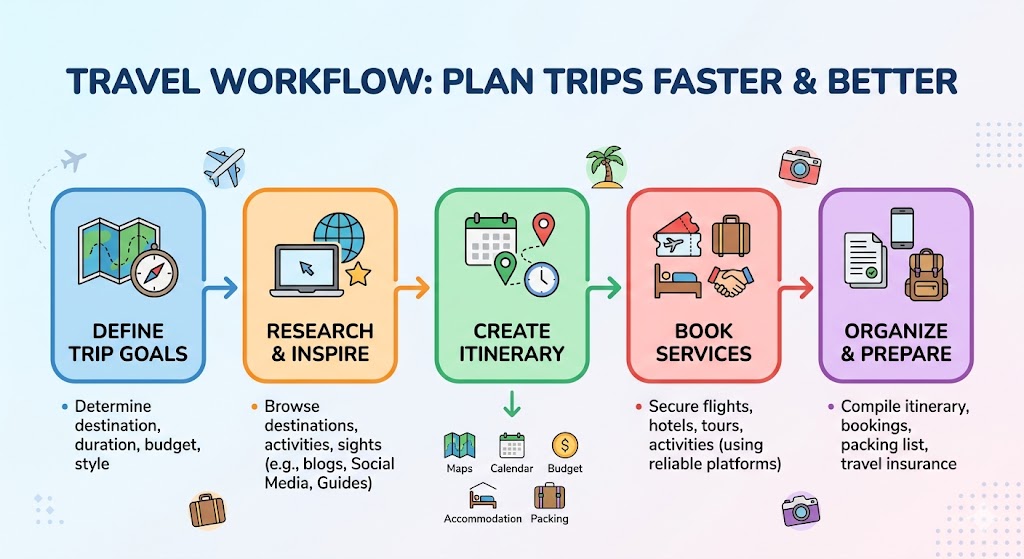

Planning a trip can either be exciting—or completely overwhelming. Endless tabs, confusing bookings, and last-minute stress can ruin the experience before it even begins. That’s why building a structured Travel Workflow is essential.
A smart Travel Workflow helps you plan trips faster, stay organized, and avoid costly mistakes. In this guide, you’ll learn a step-by-step Travel Workflow system that simplifies everything from idea to execution.
1. What Is a Travel Workflow
A Travel Workflow is a structured system you follow to plan, organize, and execute your trips efficiently.
Instead of random planning, you follow a clear sequence.
Sub Points:
- Saves time
- Reduces stress
- Improves decision-making
- Keeps everything organized
It turns chaos into clarity.
2. Why You Need a Travel Workflow
Most people plan trips inefficiently.
Common Problems:
Sub Points:
- Too many options
- Poor time management
- Missed deals
- Last-minute stress
A proper Travel Workflow solves all of these.
3. Step-by-Step Travel Workflow
Follow this proven system.
Step 1: Define Your Trip Goals
Start with clarity.
Sub Points:
- Relaxation or adventure
- Budget range
- Duration
This sets the foundation of your Travel Workflow.
Step 2: Choose Destination Smartly
Avoid random decisions.
Sub Points:
- Check season and weather
- Compare costs
- Research visa requirements
Step 3: Set Budget and Timeline
Control your expenses.
Sub Points:
- Flights
- Accommodation
- Activities
Budget planning is crucial.
Step 4: Book Flights Early
Secure the best deals.
Sub Points:
- Use comparison tools
- Book at the right time
- Stay flexible
Step 5: Book Accommodation
Choose wisely.
Sub Points:
- Location matters
- Check reviews
- Compare prices
Step 6: Plan Key Activities
Avoid overplanning.
Sub Points:
- Select top attractions
- Leave free time
- Prioritize experiences
Step 7: Create a Simple Itinerary
Keep it flexible.
Sub Points:
- Daily highlights
- Backup options
- Travel routes
Step 8: Pack Smart
Stay organized.
Sub Points:
- Essentials only
- Weather-based packing
- Travel documents
Step 9: Use Travel Tools
Make planning easier.
Sub Points:
- Maps
- Booking apps
- Expense trackers
Step 10: Execute and Adapt
Stay flexible during the trip.
Sub Points:
- Adjust plans
- Explore spontaneously
- Enjoy the experience
4. Tools to Improve Your Travel Workflow
Use technology wisely.
Sub Points:
- Google Maps
- Notion or travel planners
- Flight comparison websites
- Booking platforms
These tools enhance your Travel Workflow.
5. Common Mistakes to Avoid
Avoid these errors.
Sub Points:
- Overplanning
- Ignoring budget
- Last-minute bookings
- Lack of flexibility
A good Travel Workflow balances planning and spontaneity.
6. Benefits of a Travel Workflow
Why it matters:
Sub Points:
- Faster planning
- Better experiences
- Reduced stress
- Cost savings
7. How Long It Takes to Plan a Trip
With a system, it’s quick.
Timeline:
Sub Points:
- Weekend trip: 1–2 days
- International trip: 3–7 days
A strong Travel Workflow speeds everything up.
8. Customizing Your Travel Workflow
Adapt to your needs.
Sub Points:
- Budget travel
- Luxury travel
- Solo travel
- Family trips
9. Travel Workflow for Frequent Travelers
Make it repeatable.
Sub Points:
- Save templates
- Reuse packing lists
- Track preferences
Consistency improves efficiency.
10. Future of Travel Workflow
Planning is evolving.
Trends:
Sub Points:
- AI travel planning
- Automation tools
- Personalized itineraries
- Smart travel apps
Travel Workflow systems will become even more advanced.
Conclusion
A well-structured Travel Workflow transforms how you plan and experience trips. Instead of stress and confusion, you get clarity, efficiency, and better results.
Start using this system, refine it over time, and make travel planning effortless. The more you use your Travel Workflow, the better your trips will become.
FAQs
1. What is a Travel Workflow?
A structured system for planning trips efficiently.
2. Is it beginner-friendly?
Yes, anyone can follow it.
3. Does it save money?
Yes, better planning reduces costs.
4. How long does planning take?
A few days depending on the trip.
5. Can I customize it?
Yes, based on your travel style.
6. Do I need special tools?
No, but tools can help.
7. Is it useful for frequent travelers?
Yes, it improves efficiency over time.
More Related Topics:
Short Trips That Feel Like Full Vacations 2026
Peaceful Travel Routes in Edinburgh (2026 Complete Guide)
48-Hour Smart Itinerary for Tokyo (Max Experience Strategy) – 2026 Guide