
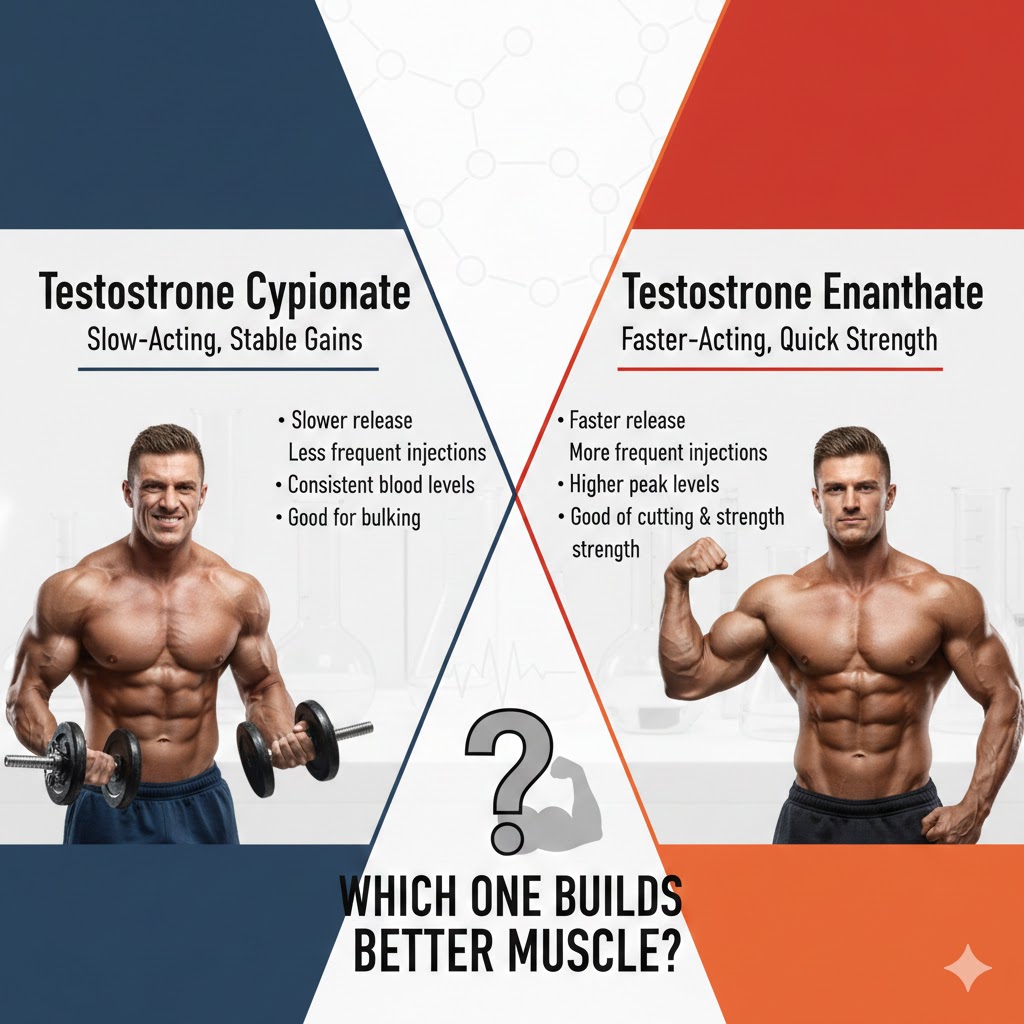
The debate around Testosterone Cypionate vs Enanthate is common in fitness and bodybuilding discussions. Both are long-acting injectable forms of testosterone used medically for testosterone replacement therapy (TRT) and, outside medical settings, sometimes misused for muscle and strength gains. While they are often portrayed as different in effectiveness, their muscle-building outcomes are far more similar than many believe.
Understanding the real differences requires looking beyond anecdotal claims and focusing on pharmacology, physiology, and health considerations.
What Testosterone Cypionate and Enanthate Are
Both testosterone cypionate and testosterone enanthate are testosterone esters. An ester is attached to the testosterone molecule to slow its release into the bloodstream, allowing for longer-lasting effects compared to unesterified testosterone.
From a biological standpoint:
- Both deliver the same hormone: testosterone
- Both increase androgen levels systemically
- Both influence muscle protein synthesis and strength
The distinction in the Testosterone Cypionate vs Enanthate comparison lies mainly in their ester structure, not in the hormone itself.
How Testosterone Builds Muscle
Testosterone supports muscle growth by:
- Increasing protein synthesis
- Enhancing nitrogen retention
- Supporting recovery and training capacity
- Influencing strength through neural and muscular effects
Once testosterone is released from either ester, the body responds to the hormone itself — not the ester. This is a key reason why muscle outcomes are nearly identical in most Testosterone Cypionate vs Enanthate comparisons.
Release Rate and Duration
The primary technical difference between the two is how quickly they are released after injection.
General characteristics
- Testosterone enanthate has a slightly shorter release profile
- Testosterone cypionate has a marginally longer release curve
In practice, these differences are subtle. Blood testosterone levels over time are very similar, which means muscle-building potential is also very similar when comparing Testosterone Cypionate vs Enanthate.
Muscle and Strength Outcomes
From a physiological perspective, neither form has an inherent advantage for building muscle.
What research and clinical observation indicate:
- Muscle gains depend on testosterone levels, not ester type
- Training quality and nutrition play a larger role
- Water retention can influence appearance of size
Claims that one ester “builds more muscle” are usually based on perception rather than measurable biological differences.
Water Retention and Appearance
Some users report differences in bloating or water retention when discussing Testosterone Cypionate vs Enanthate. Medically, these effects are not reliably linked to one ester over the other.
Fluid retention is influenced more by:
- Total androgen exposure
- Sodium balance
- Estrogen conversion
- Individual sensitivity
Visual differences in muscle fullness are often temporary and not a reflection of true muscle tissue gain.
Side Effects and Health Risks
Both forms carry the same risks because they deliver the same hormone.
Potential concerns include:
- Suppression of natural testosterone production
- Changes in cholesterol levels
- Increased blood pressure
- Cardiovascular strain
- Hormonal imbalance
Doctors emphasize that ester choice does not reduce risk. In the Testosterone Cypionate vs Enanthate discussion, safety profiles are essentially the same.
Medical Perspective on “Which Is Better”
From a medical standpoint, there is no evidence that one ester builds better muscle than the other. Physicians select between them based on availability, patient response, and clinical preference — not muscle-building superiority.
Clinically:
- Both are considered interchangeable
- Outcomes depend on maintaining stable testosterone levels
- Long-term health monitoring is critical
Muscle gain is a secondary effect, not the therapeutic goal.
Why Online Claims Differ
Differences reported online are often influenced by:
- Placebo effect
- Changes in training intensity
- Diet improvements during use
- Short-term water weight changes
These factors can make one compound feel stronger, even when biology says otherwise. This fuels ongoing debate around Testosterone Cypionate vs Enanthate despite their similarity.
Long-Term Muscle Sustainability
One important point often missed is sustainability. Muscle gained under elevated hormone levels can be difficult to maintain once those levels drop.
Long-term muscle retention depends on:
- Progressive training habits
- Recovery and sleep
- Nutrition consistency
- Hormonal stability
Neither ester guarantees permanent gains.
Safer, Sustainable Muscle Building
Sports medicine professionals consistently recommend focusing on:
- Structured resistance training
- Adequate protein intake
- Evidence-based supplementation
- Gradual progress
These approaches support muscle growth without the health risks associated with exogenous testosterone use.
Conclusion
In the Testosterone Cypionate vs Enanthate comparison, neither compound has a true advantage for muscle building. Both deliver the same hormone, produce similar blood testosterone levels, and result in comparable strength and size changes. Differences are largely related to release timing and individual response rather than effectiveness.
From a health and medical perspective, muscle-building outcomes depend far more on training, nutrition, and overall hormonal balance than on ester selection. Understanding this helps cut through myths and focus on evidence-based decisions.
More Related Topics:
Dianabol Results Timeline: What Really Happens After 4–6 Weeks
Gut Health Mistakes That Cause Bloating and Weight Gain
Viral Health Myths Doctors Want You to Stop Believing in 2026