
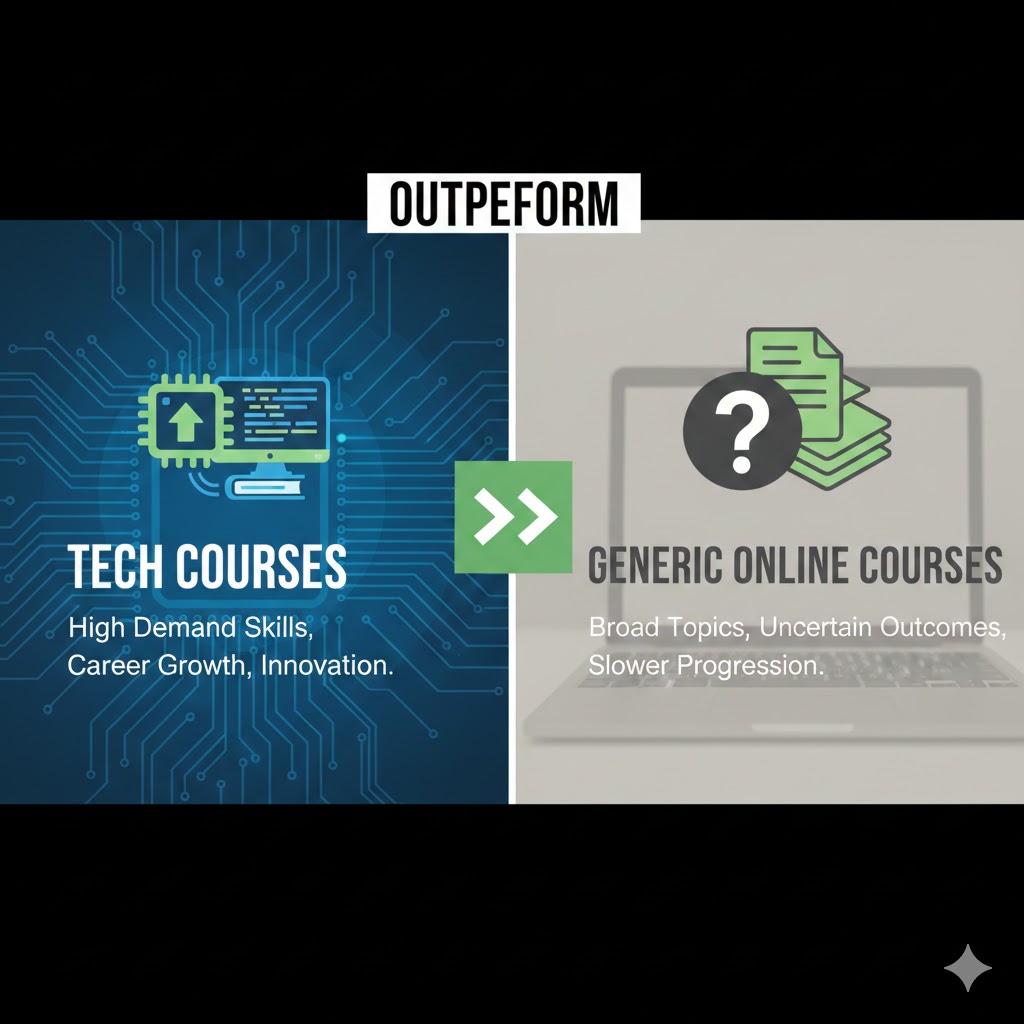
The online education landscape has exploded over the past decade, with millions of learners worldwide seeking to upgrade their skills from the comfort of their homes. However, a clear pattern has emerged: tech courses outperform generic online courses in virtually every meaningful metric, from completion rates to career outcomes. This comprehensive analysis explores why specialized technology training delivers superior results compared to broad-spectrum educational offerings.
1. The Fundamental Difference: Specialization vs. Generalization
When comparing educational approaches, the distinction between tech courses and generic online courses becomes immediately apparent. Tech courses are laser-focused on specific, in-demand skills within the technology sector, while generic courses often attempt to cover broad topics that appeal to wider audiences but lack the depth required for professional application.
Targeted Skill Development
Tech courses concentrate on precise competencies that employers actively seek. Whether it’s Python programming, cloud architecture, cybersecurity, or data science, these courses drill deep into the technical knowledge required for real-world application. Students learn not just theoretical concepts but practical implementations that they can immediately apply in professional settings.
Generic online courses, by contrast, often provide surface-level overviews of topics. A generic business course might touch on technology, marketing, finance, and management without providing sufficient depth in any single area to make learners truly competitive in the job market.
Industry-Aligned Curriculum
Technology training programs maintain close connections with industry needs. Course creators regularly update content to reflect the latest frameworks, programming languages, tools, and methodologies used by leading tech companies. This alignment ensures that when tech courses outperform generic online courses, it’s because learners acquire skills that directly translate to employment opportunities.
Measurable Outcomes
The technical nature of these courses allows for clear, objective assessment of learning outcomes. Students can demonstrate competency through coding projects, system designs, security audits, or data analyses. This concrete evidence of skill acquisition contrasts sharply with the often subjective evaluation methods used in generic courses.
2. Career Impact and Return on Investment
One of the most compelling reasons why tech courses outperform generic online courses lies in their demonstrated impact on learners’ careers and earning potential.
Immediate Job Market Relevance
Technology skills remain among the most sought-after competencies in the global job market. According to recent employment data, positions requiring specialized tech skills consistently offer higher salaries and better job security than those requiring general business or soft skills alone.
When learners complete a comprehensive course in full-stack development, cloud computing, or machine learning, they qualify for specific job openings with clear salary ranges and growth trajectories. The connection between course completion and employment opportunity is direct and verifiable.
Quantifiable Salary Increases
Studies tracking learners who complete technical training consistently show significant salary improvements. Mid-career professionals who add specialized tech skills to their repertoire often report salary increases of 20-40% within two years of completing their training. This tangible financial return makes the investment in tech education extraordinarily attractive.
Generic online courses, while potentially valuable for personal development or general knowledge expansion, rarely deliver comparable financial returns. A course on general business principles or creative writing, though enriching, typically doesn’t command the same premium in the marketplace.
Portfolio Building Opportunities
Tech courses enable learners to create tangible portfolios that showcase their abilities to potential employers. Students completing web development courses can point to live websites they’ve built. Data science students can present analysis projects with real datasets. Cybersecurity students can demonstrate vulnerability assessments and security implementations.
This portfolio approach provides concrete evidence of capability that far exceeds what certificates from generic courses can offer. Employers in technical fields place substantial weight on demonstrated ability rather than merely completed coursework.
Career Transition Success Rates
For professionals looking to change careers, technical training offers one of the most reliable pathways. Numerous coding bootcamps and specialized tech programs report placement rates exceeding 70-80% for graduates who actively engage with their job search support services.
These remarkable success rates reflect the strong demand for tech talent and the effectiveness of focused technical education in preparing learners for new roles. Generic courses simply cannot match these career transition outcomes because they don’t provide the specialized, verifiable skills that employers in high-demand fields require.
3. Learning Engagement and Completion Rates
Another area where tech courses outperform generic online courses is in student engagement and course completion, two critical metrics for educational effectiveness.
Problem-Solving Nature Creates Engagement
Technology courses inherently involve active problem-solving, which keeps learners mentally engaged. Writing code, debugging programs, designing systems, and analyzing data all require active participation rather than passive consumption of content. This hands-on approach aligns with how adult learners best acquire new skills.
When students work through coding challenges or configure cloud infrastructure, they receive immediate feedback on their actions. A program either runs correctly or produces errors that must be diagnosed and fixed. This immediate feedback loop maintains motivation and helps learners identify exactly where they need additional study.
Project-Based Learning Methodology
Most effective tech courses structure learning around projects that progressively build in complexity. Students might begin by creating simple applications and gradually work toward building complex, multi-featured systems. This scaffolded approach provides a clear sense of progress and accomplishment.
Each completed project serves as a milestone that demonstrates growing competency. Unlike generic courses that might rely on quizzes or essays for assessment, tech course projects result in functional products that students can use, share, and feel proud of creating.
Community and Peer Learning
Technical training often fosters strong learning communities because students face similar challenges and can help each other troubleshoot problems. Online forums, discussion boards, and study groups for tech courses tend to be highly active, with learners sharing solutions, resources, and encouragement.
This community aspect extends beyond course completion. Many technology students maintain connections with cohort members, forming professional networks that support ongoing career development. The collaborative problem-solving culture in tech education creates bonds that generic course environments rarely replicate.
Clear Progress Indicators
Technology learning provides unambiguous markers of progress. When a learner can’t make a program work in week one but successfully deploys a functioning application by week eight, the improvement is undeniable. This clarity about advancement helps maintain motivation through challenging learning periods.
Generic courses often struggle to provide such clear progress indicators. Improvement in communication skills, leadership ability, or creative thinking, while valuable, is harder to measure objectively and may not provide the same motivational benefits as seeing a program you wrote successfully execute complex tasks.
4. Standardization and Quality Benchmarks
The technology education sector has developed robust standards that ensure course quality, another reason why tech courses outperform generic online courses in delivering consistent value to learners.
Industry Certifications
Many technology training paths align with industry-recognized certifications from organizations like AWS, Microsoft, Google, CompTIA, and Cisco. These certifications provide external validation of skills and are widely respected by employers. Learners can be confident that courses preparing them for these certifications meet specific quality standards.
Generic online courses rarely align with comparable professional certifications. While some industries have certification programs, they’re not as standardized or widely recognized as those in the technology sector.
Curriculum Consistency
Despite the variety of providers, tech courses covering the same topic tend to include similar core content because the underlying technologies have defined specifications and best practices. A course on React development, regardless of the platform offering it, must cover components, state management, hooks, and routing because these are fundamental to the framework.
This consistency helps learners choose courses with confidence and allows employers to have reasonable expectations about what someone who has completed a particular type of tech course should know.
Verifiable Skill Assessment
Technology platforms have developed sophisticated methods for assessing technical skills. Coding challenges, automated testing systems, and project evaluation rubrics provide objective measurements of learner capability. Many platforms include hands-on labs where students work in real development environments, and their actions are tracked and evaluated.
This objective assessment contrasts with the more subjective evaluation methods often necessary for generic course topics. Technical assessment provides learners with honest feedback about their capabilities and helps identify specific areas needing improvement.
Employer Recognition
Human resources departments and technical hiring managers have become familiar with the leading technology training platforms and bootcamps. Names like Coursera, Udacity, Pluralsight, and various coding bootcamps carry recognition that helps graduates stand out in application pools.
While generic online courses from recognized universities may carry prestige, specialized tech training from established platforms often carries more weight for technical positions because of the practical, hands-on nature of the learning.
5. Adaptability to Technology Evolution
The rapid pace of technological change requires education that can quickly adapt, and this is where tech courses outperform generic online courses most dramatically.
Rapid Content Updates
Technology courses must stay current with the latest frameworks, languages, and tools to remain relevant. Leading platforms update content frequently, sometimes multiple times per year, to reflect new versions of technologies and emerging best practices.
This agility ensures that learners acquire skills that are immediately applicable in current work environments rather than outdated knowledge that has limited practical value.
Emerging Technology Coverage
As new technologies emerge—whether artificial intelligence, blockchain, quantum computing, or edge computing—specialized tech education providers quickly develop courses to meet market demand. This responsiveness allows professionals to stay ahead of industry trends and position themselves for opportunities in cutting-edge fields.
Generic educational content, being broader in scope and often developed through more formal academic processes, typically cannot match this speed of adaptation.
Practical Tool Proficiency
Technology courses teach students to use the actual tools, platforms, and environments that professionals employ daily. Students learn to work with GitHub, AWS, Docker, Kubernetes, Jupyter notebooks, and countless other industry-standard tools. This practical tool proficiency is immediately transferable to work environments.
When graduates enter new positions, they can contribute productively from day one because they’re already familiar with the development environments, collaboration tools, and workflows their employers use.
Future-Oriented Skill Development
Technical training helps learners develop not just specific skills but also the learning methodologies needed to continually acquire new technical knowledge throughout their careers. Students learn how to read documentation, troubleshoot problems, find resources, and teach themselves new technologies—meta-skills that prove invaluable in a rapidly evolving field.
6. Cost-Effectiveness and Accessibility
When examining value proposition, tech courses outperform generic online courses by offering superior returns on both time and financial investment.
Transparent Pricing Models
Technology training platforms typically offer clear pricing structures, whether through monthly subscriptions, one-time course fees, or bootcamp tuition. This transparency allows learners to make informed decisions about their educational investments.
Many platforms also offer free trials or free basic courses, allowing prospective students to evaluate the teaching quality and curriculum before committing financially.
Flexible Learning Schedules
Tech courses accommodate working professionals through self-paced learning options, evening and weekend cohorts, and modular curriculum structures. This flexibility enables learners to upgrade their skills without leaving current employment, reducing the financial risk associated with career development.
The ability to learn while earning means that students can often begin applying new skills in their current roles even before completing full certification programs, creating immediate value from their educational investment.
Financial Aid and Income Share Agreements
Recognizing that quality technical training requires investment, many bootcamps and specialized platforms offer innovative financing options. Income share agreements allow students to begin training with little or no upfront cost, paying back a percentage of their income only after securing employment above a specified salary threshold.
These learner-friendly financing models reflect confidence in the employment outcomes tech training delivers and make career transition accessible to people from diverse economic backgrounds.
Global Accessibility
Online tech courses break down geographical barriers to quality education. A learner in a developing nation can access the same high-quality instruction as someone in a major tech hub, democratizing access to career-changing skills.
This global reach has created opportunities for millions of people who would never have had access to technical training through traditional educational pathways.
7. Support Systems and Learning Resources
The ecosystem surrounding technical education provides advantages that help explain why tech courses outperform generic online courses in learner outcomes.
Instructor Expertise
Technology courses are typically taught by practitioners with real-world experience building systems, writing code, managing infrastructure, or analyzing data. This practical expertise ensures that instruction goes beyond theoretical knowledge to include industry insights, best practices, and common pitfalls to avoid.
Instructors often maintain active careers in technology while teaching, keeping their knowledge current and their examples relevant to actual work situations.
Mentorship Programs
Many technical training programs include mentorship components where learners receive guidance from experienced professionals. These mentors provide personalized feedback on projects, answer questions, offer career advice, and help students navigate the challenges of learning complex technical subjects.
This human support element significantly improves learning outcomes and helps students persist through difficult material that might otherwise cause them to abandon their studies.
Extensive Documentation and Resources
The technology field has developed comprehensive documentation cultures around most major tools and frameworks. Tech courses teach students how to effectively use official documentation, Stack Overflow, GitHub repositories, and other resources that will support their continued learning and problem-solving throughout their careers.
This resource literacy becomes a permanent asset that extends well beyond any single course, enabling continuous self-directed learning.
Career Services
Recognizing that employment is the ultimate goal for most students, many tech training programs offer robust career services including resume review, interview preparation, portfolio development, and job search strategies tailored to technical roles.
Some programs maintain employer partnerships that provide direct pipelines to job opportunities, while others offer alumni networks that facilitate professional connections and mentorship.
8. Real-World Application and Hands-On Practice
Perhaps the most significant reason tech courses outperform generic online courses is the emphasis on practical application that characterizes quality technical training.
Lab Environments
Students work in realistic development environments that mirror professional settings. Cloud-based labs provide access to the same infrastructure and tools that companies use in production environments, ensuring that what students learn translates directly to workplace requirements.
These hands-on environments allow for experimentation and learning from mistakes in safe spaces before students face real-world consequences.
Capstone Projects
Comprehensive tech programs typically culminate in substantial capstone projects where students build complex applications or systems that demonstrate their mastery of course content. These projects become portfolio centerpieces that showcase abilities to potential employers.
The process of completing a capstone project—from planning and design through implementation, testing, and deployment—mirrors professional development workflows and provides invaluable experience.
Real Dataset Experience
Data science and analytics courses use actual datasets from real organizations, teaching students to work with messy, imperfect data rather than sanitized academic examples. This exposure to data quality issues, missing values, and the need for extensive preprocessing prepares learners for the reality of professional data work.
Industry-Standard Workflows
Students learn version control with Git, agile development methodologies, continuous integration/continuous deployment practices, and collaborative development techniques. These workflow competencies are as important as technical skills for succeeding in professional environments.
Conclusion
The evidence overwhelmingly demonstrates that tech courses outperform generic online courses across every significant dimension of educational effectiveness. From career outcomes and earning potential to engagement rates and practical skill development, specialized technology training delivers superior value for learners seeking to advance their professional capabilities.
The combination of focused curricula, hands-on learning methodologies, industry alignment, strong support systems, and clear career pathways creates an educational experience that consistently produces better outcomes than broader, less specialized alternatives. For individuals looking to invest in their future, the choice becomes clear: specialized technical training offers the most direct path to valuable, marketable skills that command premium compensation in today’s economy.
As technology continues to reshape every industry and create new career opportunities, the demand for specialized technical skills will only intensify. Those who invest in quality tech education position themselves at the forefront of this transformation, equipped with the capabilities needed to thrive in an increasingly digital world. The performance gap between specialized tech courses and generic online offerings will likely widen further as employers increasingly prioritize demonstrable technical competencies over general educational credentials.
Whether you’re beginning your career, seeking to transition into technology fields, or looking to upgrade existing skills, specialized technology courses offer the most effective pathway to achieving your professional goals. The data speaks for itself: when it comes to online education, specialization wins.
Also read this:
Browser Feature Skips Cookie Pop-Ups Automatically: Eliminating Web Annoyances