
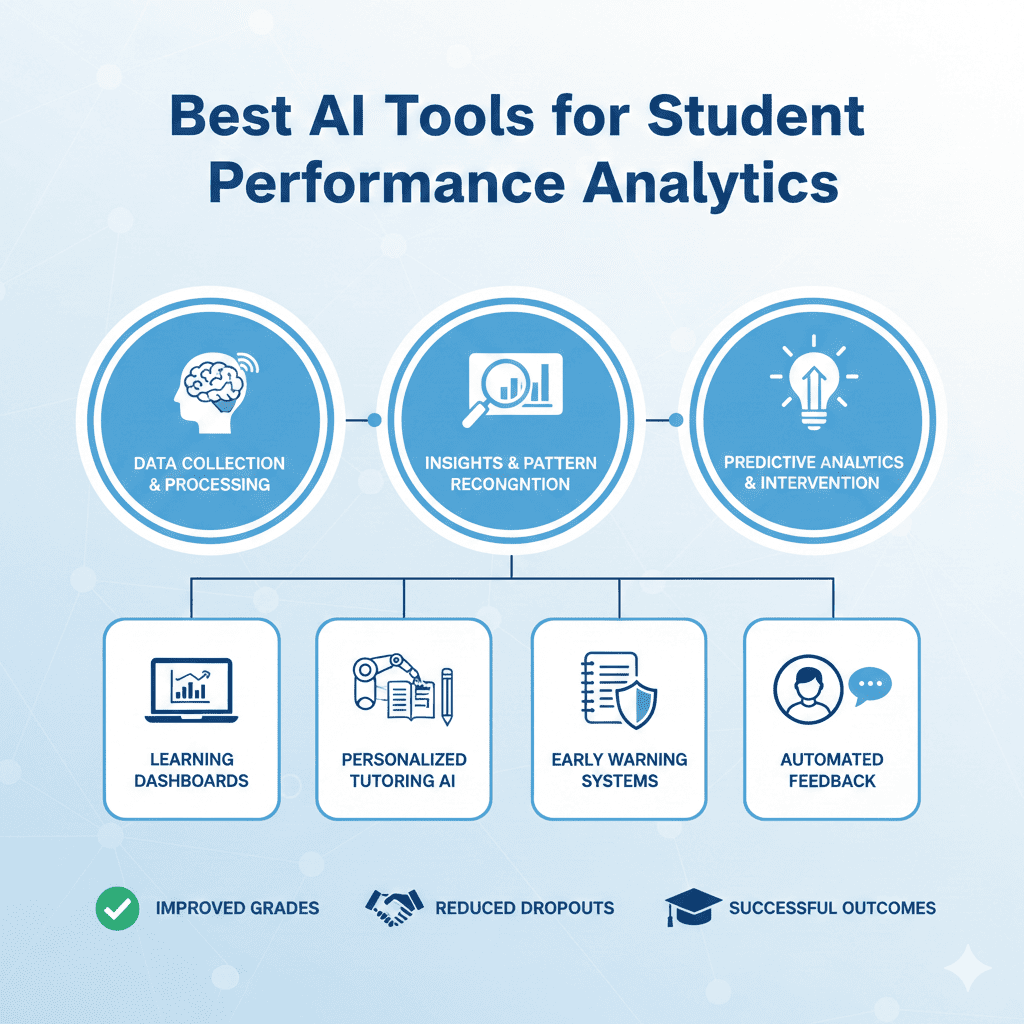
Education is experiencing a data revolution. Gone are the days when student performance was measured solely through periodic tests and subjective teacher observations. Today, student performance analytics powered by artificial intelligence is transforming how educators understand learning patterns, identify struggling students, and personalize instruction at scale.
This comprehensive guide explores the most powerful AI tools for student performance analytics that are reshaping educational institutions worldwide. Whether you’re a classroom teacher, school administrator, educational technology coordinator, or online course instructor, these platforms will help you leverage data to improve student outcomes, optimize teaching strategies, and create truly personalized learning experiences.
Why Student Performance Analytics Matters Now More Than Ever
Before exploring specific tools, let’s understand why student performance analytics has become essential for modern education:
- Early Intervention: Identify at-risk students before they fall too far behind
- Personalized Learning: Tailor instruction to individual student needs and learning styles
- Data-Driven Decisions: Replace intuition with evidence-based strategies
- Resource Optimization: Allocate support staff and resources where they’re most needed
- Predictive Insights: Forecast future performance to proactive interventions
- Achievement Gap Closure: Identify and address disparities systematically
- Teacher Effectiveness: Understand which instructional approaches work best
- Parental Engagement: Provide families with meaningful, actionable insights
- Institutional Accountability: Demonstrate outcomes to stakeholders with concrete data
1. Gradescope: AI-Powered Assessment and Analytics
Gradescope revolutionizes student performance analytics by using AI to streamline grading while simultaneously collecting rich data about student understanding, common misconceptions, and learning progress across entire courses.
Key Features:
- AI-Assisted Grading: Machine learning speeds up rubric-based assessment
- Answer Grouping: Automatically clusters similar student responses
- Item Analysis: Identifies which questions differentiate student mastery levels
- Learning Analytics Dashboard: Visualizes class performance trends over time
- Misconception Detection: Highlights common errors for targeted instruction
- Standards-Based Tracking: Maps performance to specific learning objectives
- Historical Comparison: Compares current class performance to previous cohorts
Best For:
- Higher education instructors with large enrollment courses
- STEM educators assessing problem-solving work
- Departments tracking program-level outcomes
- Institutions seeking consistent grading standards
Analytics in Action:
After each assessment, Gradescope’s AI analyzes not just who got answers right or wrong, but patterns in mistakes. If 60% of students make the same error on a particular problem, the system flags this for instructor review. The dashboard reveals exactly which concepts need re-teaching, which questions are too easy or too hard, and how individual students compare to class averages over time.
2. Brightspace Insights (by D2L): Predictive Analytics Platform
Brightspace Insights brings sophisticated student performance analytics to learning management systems, using machine learning to predict student success risk levels and recommend timely interventions before students disengage.
Key Features:
- Predictive Risk Modeling: Calculates likelihood of student success or failure
- Engagement Tracking: Monitors participation across all course activities
- Learning Behavior Analysis: Identifies optimal study patterns and warning signs
- Automated Alerts: Notifies instructors when students show concerning patterns
- Competency Progress: Tracks mastery of specific skills and standards
- Course Performance Comparison: Benchmarks against similar courses
- Mobile Access: Provides insights to educators anywhere, anytime
Best For:
- K-12 schools using competency-based education
- Universities focused on retention and completion
- Online programs monitoring remote learner engagement
- Institutions with diverse student populations
Intervention Framework:
Brightspace Insights doesn’t just report that a student is struggling—it explains why. The AI identifies whether issues stem from lack of engagement, content difficulty, or time management problems. Educators receive specific intervention suggestions based on what has successfully helped similar students, creating a feedback loop that continuously improves support strategies.
3. Khan Academy’s Precision Teaching Dashboard
Khan Academy has pioneered accessible student performance analytics for both teachers and students, offering detailed insights into skill mastery that enable truly differentiated instruction even in traditional classroom settings.
Key Features:
- Skill Mastery Tracking: Monitors proficiency across granular skill levels
- Struggle Detection: Identifies when students need help on specific concepts
- Time-on-Task Analytics: Shows how long students spend on different activities
- Recommendation Engine: Suggests next best content for each student
- Growth Visualization: Displays progress over time with motivating charts
- Class-Wide Heat Maps: Shows which skills the class has mastered or struggles with
- Student Self-Monitoring: Learners see their own analytics to build metacognition
Best For:
- Math and science teachers implementing blended learning
- Schools using Khan Academy for supplemental practice
- Educators with limited budgets seeking free analytics tools
- Teachers promoting student ownership of learning
Differentiation Made Easy:
The teacher dashboard presents a clear picture of where each student stands on every skill. Teachers can quickly form intervention groups of students struggling with the same concept, assign personalized practice to individual students, and focus whole-class instruction on skills where most students need support—all based on real-time data rather than assumptions.
4. Civitas Learning: Higher Education Success Platform
Civitas Learning specializes in student performance analytics for colleges and universities, using predictive modeling to improve retention, completion rates, and overall student success at the institutional level.
Key Features:
- Predictive Models: Forecasts which students are at risk of not graduating
- Persistence Probability: Calculates likelihood of continued enrollment
- Course Recommendation Engine: Suggests optimal course sequences
- Financial Aid Impact Analysis: Correlates aid with retention outcomes
- Intervention Campaign Management: Coordinates outreach to at-risk students
- Equity Analytics: Identifies achievement gaps by demographic groups
- ROI Tracking: Measures effectiveness of student success initiatives
Best For:
- University administrators focused on retention rates
- Student success centers coordinating interventions
- Academic advisors managing large caseloads
- Institutional research offices analyzing outcomes
Institution-Wide Impact:
Civitas Learning aggregates data across registration, academic records, financial aid, and learning management systems to create comprehensive student profiles. The platform might identify that students taking a particular course sequence have significantly higher graduation rates, or that students receiving certain interventions are 40% more likely to persist—insights that drive strategic institutional decisions.
5. Edmodo Insights: K-12 Analytics Suite
Edmodo Insights brings powerful student performance analytics to K-12 education through an intuitive interface designed for busy teachers who need actionable insights quickly without extensive data analysis training.
Key Features:
- Standards Alignment Tracking: Maps performance to state and national standards
- Assignment Analytics: Shows completion rates and average scores
- Student Grouping Recommendations: Suggests small groups based on needs
- Parent Communication Portal: Shares insights with families automatically
- Benchmark Comparison: Compares against grade-level expectations
- Progress Monitoring: Tracks growth over marking periods and school years
- Intervention Documentation: Records support provided for IEP/504 compliance
Best For:
- Elementary and middle school teachers
- Special education teams tracking IEP goals
- Schools implementing standards-based grading
- Districts seeking parent engagement tools
Classroom Implementation:
Teachers access a simple dashboard showing each student’s progress toward grade-level standards. Color-coded indicators show who’s on track, who needs extra support, and who’s ready for enrichment. The system automatically generates parent reports highlighting strengths and growth areas, facilitating meaningful conversations during conferences.
6. Turnitin Feedback Studio: Writing Analytics
Turnitin has evolved beyond plagiarism detection to offer comprehensive student performance analytics focused specifically on writing development, helping educators track improvement in writing skills over time with AI-powered insights.
Key Features:
- Originality Analysis: Checks for plagiarism and improper citation
- Grammar Feedback: AI identifies grammatical errors with explanations
- Writing Quality Metrics: Assesses readability, vocabulary sophistication
- Revision Tracking: Shows how students improve drafts over time
- Rubric-Based Analytics: Aggregates scores across rubric criteria
- Cohort Comparison: Compares student writing against peers
- Growth Visualization: Demonstrates writing skill development longitudinally
Best For:
- English and writing instructors at all levels
- Programs assessing writing-across-curriculum initiatives
- Composition programs tracking program outcomes
- Schools prioritizing literacy development
Writing Development Insights:
Beyond checking each paper, Turnitin’s analytics track individual writing growth. Teachers see whether a student who initially struggled with thesis statements has improved over the semester, or whether the whole class needs targeted instruction on citation practices. This longitudinal view transforms writing assessment from isolated grades to developmental progression tracking.
7. Schoology Analytics: LMS-Integrated Performance Tracking
Schoology Analytics provides comprehensive student performance analytics directly within a widely-used learning management system, eliminating the need for separate platforms and creating seamless workflows for educators.
Key Features:
- Real-Time Gradebook Analytics: Instant insights from grading data
- Engagement Scoring: Quantifies student participation and activity
- Mastery-Based Tracking: Monitors standards-based learning progression
- Attendance Correlation: Links attendance patterns with performance
- Course Comparison: Benchmarks across sections and teachers
- Assignment Effectiveness: Identifies which assignments best assess learning
- Mobile Analytics: Access insights on tablets and smartphones
Best For:
- Districts already using Schoology as their LMS
- Schools implementing mastery-based education
- Teachers wanting integrated analytics without additional tools
- Administrators needing district-wide visibility
Integrated Advantage:
Because analytics are built into the platform where teaching and learning happen, insights are immediately actionable. Teachers notice concerning patterns while grading assignments and can message students or adjust upcoming lessons without switching systems. This integration removes friction that often prevents data-informed instruction.
8. Knewton Alta: Adaptive Learning with Deep Analytics
Knewton Alta delivers powerful student performance analytics through adaptive courseware that continuously assesses student understanding and provides educators with unprecedented visibility into knowledge gaps and misconceptions.
Key Features:
- Adaptive Content Delivery: Personalizes learning paths based on performance
- Knowledge State Modeling: Maps what each student knows and doesn’t know
- Difficulty Calibration: Identifies concepts students find most challenging
- Learning Efficiency Metrics: Shows how quickly students master concepts
- Prerequisite Gap Identification: Reveals missing foundational knowledge
- Predictive Performance: Forecasts exam scores based on practice performance
- Engagement vs. Mastery Analysis: Distinguishes effort from understanding
Best For:
- College math, science, and economics courses
- Courses with clearly defined learning progressions
- Instructors teaching multiple sections of the same course
- Programs focused on personalized learning at scale
Precision Understanding:
Knewton’s AI doesn’t just know that a student answered incorrectly—it infers which specific misconceptions led to the error and what prerequisite knowledge might be missing. Teachers see exactly where each student’s understanding breaks down and receive suggestions for targeted content to fill those gaps, making intervention remarkably precise.
9. PowerSchool Analytics: Enterprise-Level Student Insights
PowerSchool Analytics provides comprehensive student performance analytics at the district and state level, connecting data across multiple systems to give educational leaders the insights needed for strategic decision-making.
Key Features:
- Multi-System Data Integration: Combines SIS, assessment, and other data sources
- Longitudinal Data Warehouse: Tracks students across years and schools
- Predictive Modeling: Identifies students at risk of various negative outcomes
- Equity Analysis Tools: Examines outcomes across demographic groups
- Teacher Effectiveness Insights: Analyzes instructional impact on student growth
- Resource Allocation Optimization: Identifies where to invest for maximum impact
- State Reporting Automation: Simplifies compliance reporting requirements
Best For:
- District administrators and superintendents
- State education agencies
- Large school districts with multiple data systems
- Educational researchers conducting large-scale studies
Strategic Intelligence:
PowerSchool Analytics enables questions like: “Which schools showed the most improvement in reading scores over the past three years, and what instructional approaches did they use?” or “Are our English learner students closing achievement gaps, and where is progress slowest?” These strategic insights drive policy decisions affecting thousands of students.
10. Panorama Education: Social-Emotional Learning Analytics
Panorama Education expands student performance analytics beyond academics to measure social-emotional learning, school climate, and non-cognitive factors that significantly impact student success.
Key Features:
- SEL Assessment: Measures growth mindset, self-efficacy, and social awareness
- Student Perception Surveys: Gathers student voice on learning experiences
- Family Engagement Metrics: Tracks parent involvement and satisfaction
- Equity Reports: Identifies disparities in experience and opportunity
- Early Warning Systems: Flags students with concerning behavior or attendance
- Teacher Climate Surveys: Assesses staff satisfaction and needs
- Research-Backed Instruments: Uses validated measurement tools
Best For:
- Schools implementing SEL initiatives
- Districts prioritizing equity and inclusion
- Counseling departments coordinating student support
- Schools using multi-tiered systems of support (MTSS)
Holistic View:
Panorama recognizes that test scores tell only part of the story. By measuring whether students feel they belong at school, believe they can improve through effort, or have supportive relationships with adults, the platform helps educators understand and address underlying factors affecting academic performance. Research shows these non-cognitive factors often predict success more accurately than test scores alone.
11. DreamBox Learning Analytics: Adaptive Math Insights
DreamBox provides specialized student performance analytics for mathematics education, using AI to understand not just whether students answer correctly, but how they think about mathematical concepts and problem-solving.
Key Features:
- Strategy Analysis: Identifies problem-solving approaches students use
- Conceptual Understanding: Assesses deep comprehension beyond procedures
- Real-Time Progress Monitoring: Updates constantly as students work
- Standard Alignment: Maps to state standards and common core
- Differentiation Guidance: Suggests specific lessons for each student
- Fluency Tracking: Monitors computational speed and accuracy
- Growth Measurement: Quantifies mathematical thinking development
Best For:
- Elementary math teachers
- Math intervention specialists
- Schools using blended learning models
- Districts focused on math achievement improvements
Mathematical Thinking Insights:
DreamBox’s AI observes how students approach problems—do they count on their fingers, use mental math strategies, or draw visual representations? This deeper analysis helps teachers understand not just what students know, but how they think mathematically, enabling instruction that builds on their natural problem-solving approaches.
12. Coursera for Campus Analytics: Higher Ed Online Learning
Coursera for Campus brings enterprise-level student performance analytics to higher education institutions offering online and blended courses, with insights specifically designed for large-scale online learning environments.
Key Features:
- Learning Path Analytics: Tracks progression through course sequences
- Engagement Benchmarking: Compares against millions of global learners
- Completion Predictors: Identifies students likely to drop out early
- Skill Development Tracking: Maps competency acquisition
- Video Engagement Analysis: Shows where students pause, rewatch, or disengage
- Assessment Performance: Analyzes quiz and assignment results
- Certificate Completion Rates: Tracks credential attainment
Best For:
- Universities offering online degree programs
- Corporate training programs
- Continuing education departments
- MOOCs and professional development courses
At-Scale Online Insights:
Coursera’s analytics leverage data from millions of learners to provide context for performance. Instructors learn which video lectures students find confusing (high rewind rates), which assignments are too difficult (low completion rates), and which students are at risk of not completing the course—insights that enable rapid course improvement and targeted student support.
Building an Effective Student Performance Analytics Strategy
Implementing student performance analytics effectively requires more than just selecting tools:
Define Clear Objectives
- What questions do you need answered?
- Which outcomes are you trying to improve?
- Who will use the data and for what decisions?
- What metrics truly matter for your context?
Ensure Data Quality
- Verify that data is entered accurately and consistently
- Establish clear protocols for data collection
- Clean historical data before analysis
- Train staff on proper data management
Provide Professional Development
- Teachers need training to interpret analytics effectively
- Explain the “why” behind data collection
- Show concrete examples of data-driven improvements
- Build data literacy across the organization
Create Action Protocols
- Define what happens when analytics flag concerns
- Establish intervention procedures and responsibilities
- Set timelines for response to data signals
- Document outcomes to refine approaches
Protect Privacy and Build Trust
- Ensure compliance with FERPA and other regulations
- Be transparent about what data is collected and why
- Give families appropriate access to their children’s data
- Never use analytics punitively
Best Practices for Student Performance Analytics
1. Focus on Actionable Insights
Student performance analytics should drive decisions, not just generate reports. Prioritize metrics that lead to concrete actions you can take to improve outcomes.
2. Balance Quantitative and Qualitative Data
Numbers reveal patterns, but conversations reveal causes. Combine analytics with teacher observations, student self-reflection, and family input for complete understanding.
3. Act Quickly on Predictive Alerts
The value of early warning systems lies in early intervention. Create protocols ensuring at-risk flags trigger rapid response, not eventual review.
4. Share Insights Appropriately
Different stakeholders need different information. Administrators need different dashboards than teachers, who need different views than students and parents.
5. Monitor for Unintended Consequences
Watch for gaming the system, teaching to measured metrics at the expense of unmeasured outcomes, or negative impacts on student motivation and wellbeing.
6. Iterate and Improve
Analytics should improve over time. Regularly evaluate whether your metrics predict outcomes accurately and adjust your approach based on what you learn.
7. Celebrate Growth and Success
Don’t only focus on deficits. Use analytics to identify and celebrate improvement, effective practices, and student strengths.
Common Pitfalls to Avoid
Data Paralysis
Too much data without clear prioritization leads to overwhelm. Focus on a few key metrics tied to your most important goals rather than monitoring everything possible.
Technology Without Training
Purchasing powerful analytics platforms without adequate professional development wastes resources. Invest equally in tools and the training to use them effectively.
Ignoring Context
Analytics show patterns but don’t explain causation. A drop in performance might reflect increased difficulty, personal struggles, or teaching changes—context matters.
Delayed Response
Student performance analytics loses value when insights arrive too late for intervention. Real-time data requires real-time response systems.
Privacy Violations
Sharing identifiable student data inappropriately damages trust and violates regulations. Establish clear policies about who accesses what information.
Equity Blind Spots
Aggregate data can mask disparities. Always disaggregate by relevant demographic groups to identify and address inequitable outcomes.
Measuring the Impact of Analytics Implementation
Track these indicators to evaluate your student performance analytics initiative:
Academic Outcomes
- Changes in proficiency rates
- Growth in standardized test scores
- Course completion and passing rates
- Achievement gap trends
Early Intervention Metrics
- Time from flag to intervention
- Percentage of at-risk students receiving support
- Success rates of intervention programs
- Reduction in failures or dropouts
Educator Effectiveness
- Teacher confidence in data use
- Frequency of data-informed instruction adjustments
- Quality of individualized learning plans
- Adoption rates of analytics tools
System Efficiency
- Time savings in data collection and reporting
- Accuracy of predictions compared to outcomes
- Resource allocation optimization
- Return on investment in analytics tools
The Future of Student Performance Analytics
The evolution of student performance analytics continues to accelerate:
Artificial Intelligence Tutors
AI will provide personalized instruction based on continuous performance analysis, functioning as adaptive tutors that adjust in real-time to each student’s needs.
Multimodal Learning Analytics
Future systems will analyze not just test scores but also facial expressions, emotion, voice tone, and physical engagement to understand the complete learning experience.
Predictive Intervention Matching
AI will recommend specific interventions for individual students based on what has worked for similar learners, creating unprecedented precision in support.
Blockchain Credentials
Immutable records of competency mastery will follow students throughout their educational journey, creating comprehensive learning portfolios.
Ethical AI in Education
Increased focus on fairness, transparency, and bias detection in educational algorithms will ensure analytics systems benefit all students equitably.
Getting Started: Your Implementation Roadmap
Quarter 1: Foundation
- Assess current data capabilities and gaps
- Define key questions analytics should answer
- Research tools matching your needs and budget
- Build stakeholder buy-in for data initiatives
Quarter 2: Pilot Implementation
- Select and implement one analytics tool
- Train pilot group of educators
- Establish data quality protocols
- Begin collecting baseline metrics
Quarter 3: Expansion and Refinement
- Expand analytics use to additional users
- Refine dashboards based on feedback
- Integrate analytics into regular workflows
- Document early wins and lessons learned
Quarter 4: Scale and Optimize
- Roll out analytics institution-wide
- Develop advanced capabilities
- Measure impact on student outcomes
- Plan next phase of analytics maturity
Conclusion: From Data to Better Outcomes
Student performance analytics represents far more than a technological upgrade—it’s a fundamental shift in how we understand and support learning. These AI-powered tools transform education from intuition-based to evidence-based, from reactive to proactive, from one-size-fits-all to truly personalized.
The platforms covered in this guide span the full educational spectrum, from K-12 classrooms to university lecture halls, from traditional assessments to social-emotional learning. Each offers unique capabilities, but all share a common promise: helping every student reach their full potential through deeper understanding of their learning journey.
Success with student performance analytics doesn’t require implementing every tool or analyzing every possible metric. It requires selecting the right tools for your specific context, building educator capacity to interpret and act on insights, and maintaining unwavering focus on using data to serve students better.
The most effective educational institutions don’t just collect data—they create cultures where evidence informs decisions, where early intervention prevents failure, where every student receives what they need when they need it. Analytics make this vision achievable at scale.
Start small but think big. Choose one challenge you’re facing—whether it’s identifying struggling students earlier, personalizing instruction more effectively, or closing achievement gaps—and select analytics tools that specifically address that challenge. Prove value, build capacity, then expand.
The students in your classrooms today deserve educational experiences informed by the best available insights about how they learn, what they struggle with, and what support they need. Student performance analytics provides those insights with unprecedented depth and timeliness.
The question isn’t whether data will transform education—it already is. The question is whether your institution will lead this transformation or be left behind. The tools are ready, more accessible and powerful than ever before.
Also read this:
Best AI Tools for TikTok/Reels Content Automation: Create Viral Videos in Minutes
Best AI Tools for Market Research Automation: Transform Data Into Strategic Insights
Best AI Tools for Comic & Manga Creation: Transform Your Creative Vision into Reality