
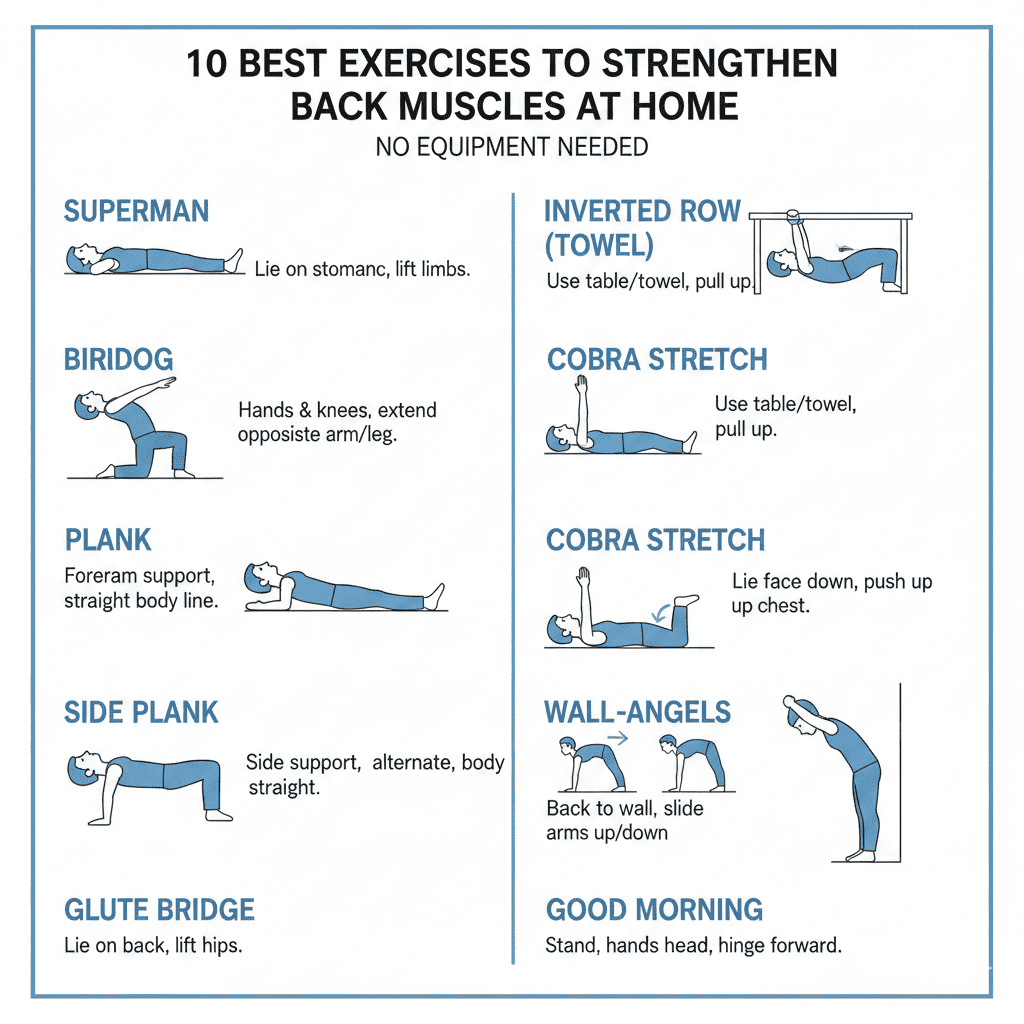
A strong, resilient back is the foundation of overall physical health and functional fitness. Whether you’re sitting at a desk for hours, lifting groceries, or playing with your kids, your back muscles work tirelessly to support every movement. The good news? You don’t need expensive gym memberships or fancy equipment to strengthen back muscles at home. With just your body weight and a small amount of space, you can build a powerful, pain-free back that serves you well for years to come.
Back pain affects millions of people worldwide, often stemming from weak muscles, poor posture, and sedentary lifestyles. By incorporating targeted exercises into your routine, you can address these issues head-on, improving not just your back strength but your overall quality of life. This comprehensive guide will walk you through ten highly effective exercises designed specifically to strengthen back muscles at home, complete with proper form instructions, modifications, and tips to maximize your results.
Why Building Back Strength Matters
Before diving into the exercises, it’s essential to understand why back strength is so critical. Your back consists of multiple muscle groups, including the latissimus dorsi, trapezius, rhomboids, erector spinae, and deeper stabilizing muscles. Together, these muscles perform several vital functions.
Strong back muscles support proper spinal alignment, reducing the risk of chronic pain and injury. They improve your posture, which not only makes you look more confident but also prevents the forward-head, rounded-shoulder position that plagues desk workers. Additionally, a strong back enhances athletic performance across virtually every sport and physical activity, from running to swimming to weightlifting.
Beyond the physical benefits, building back strength contributes to long-term health. As we age, maintaining muscle mass becomes increasingly important for mobility, independence, and preventing falls. The exercises outlined in this guide specifically target the posterior chain—the muscles along the back of your body—which are often neglected in favor of more visible muscles like the chest and abs.
1. Superman Exercise
The Superman exercise is a foundational movement to strengthen back muscles at home that targets the erector spinae, glutes, and lower back muscles. This bodyweight exercise requires no equipment and can be performed anywhere, making it perfect for beginners and advanced practitioners alike.
How to Perform the Superman Exercise
Lie face down on a yoga mat or comfortable surface with your arms extended straight overhead and legs stretched out behind you. Your forehead should rest lightly on the ground. Engage your core and simultaneously lift your arms, chest, and legs off the ground, creating a gentle arch in your back. Hold this position for two to five seconds, squeezing your glutes and back muscles at the top of the movement. Lower back down with control and repeat for 10 to 15 repetitions.
Key Points for Proper Form
Keep your neck in a neutral position by looking down at the floor rather than craning your head upward. Focus on using your back muscles to lift rather than straining your neck. Breathe steadily throughout the movement, exhaling as you lift and inhaling as you lower. If you experience lower back discomfort, reduce the range of motion or try the modifications below.
Modifications and Progressions
Beginners can start with alternating Superman lifts, raising the right arm and left leg together, then switching sides. This reduces the intensity while still providing excellent back activation. For a greater challenge, add a pause at the top of the movement or perform Superman pulses, doing small up-and-down movements while maintaining the lifted position. You can also try holding light water bottles in your hands to increase resistance.
2. Bridge Exercise
The bridge exercise is exceptional for targeting the lower back, glutes, and hamstrings. While often categorized as a glute exercise, the bridge plays a significant role in strengthening the posterior chain and improving spinal stability, making it essential when you want to strengthen back muscles at home.
Executing the Perfect Bridge
Lie on your back with knees bent and feet flat on the floor, positioned hip-width apart. Your feet should be close enough to your glutes that you can almost touch your heels with your fingertips. Place your arms at your sides, palms down. Press through your heels and lift your hips toward the ceiling, creating a straight line from your shoulders to your knees. Squeeze your glutes hard at the top and hold for one to two seconds before lowering back down. Complete 15 to 20 repetitions.
Maximizing Back Engagement
To emphasize back muscle activation during bridges, focus on posterior pelvic tilt at the top position. Think about pressing your lower back toward the floor as you lift your hips, which engages the erector spinae muscles more effectively. Avoid overarching your back, which can place unnecessary stress on the lumbar spine.
Advanced Bridge Variations
Single-leg bridges provide a unilateral challenge that addresses muscle imbalances. Extend one leg straight while performing the bridge with the other leg, then switch sides. Elevated bridges, where you place your feet on a step or sturdy box, increase the range of motion and difficulty. For sustained muscle tension, try holding the bridge position for 30 to 60 seconds rather than performing repetitions.
3. Reverse Snow Angels
Reverse snow angels are an underutilized but highly effective exercise to strengthen back muscles at home, particularly the middle and upper back. This movement targets the rhomboids, middle trapezius, and rear deltoids, helping to combat rounded shoulders and poor posture.
Proper Technique for Reverse Snow Angels
Lie face down with your forehead resting on the ground and arms extended overhead, thumbs pointing upward. Lift your arms slightly off the ground and slowly sweep them out to the sides and down toward your hips, maintaining the lift throughout the entire movement. Your arms should trace a semicircular path, similar to making snow angels but in reverse. Once your arms reach your hips, reverse the motion back to the starting position. Perform 10 to 12 slow, controlled repetitions.
Common Mistakes to Avoid
Many people let their arms drop to the floor during the movement, which eliminates muscle tension and reduces effectiveness. Keep your arms hovering above the ground throughout the entire range of motion. Additionally, avoid lifting your chest too high off the ground, which can cause excessive lower back extension. The movement should come primarily from your shoulder blades and upper back.
Enhancing the Exercise
Focus on squeezing your shoulder blades together as your arms move toward your hips. This retraction movement is crucial for strengthening the muscles responsible for good posture. You can also pause at various points during the sweep to increase time under tension. For an added challenge, hold small objects like water bottles or books in your hands to increase resistance.
4. Bird Dog Exercise
The bird dog is a fundamental core stability exercise that also works wonders to strengthen back muscles at home. It targets the erector spinae, glutes, and deep core muscles while improving balance and coordination.
Step-by-Step Bird Dog Instructions
Start on your hands and knees in a tabletop position, with hands directly under shoulders and knees under hips. Engage your core by drawing your navel toward your spine. Simultaneously extend your right arm forward and left leg backward until both are parallel to the floor. Your body should form a straight line from fingertips to toes. Hold this position for three to five seconds, then return to the starting position and repeat on the opposite side. Complete 10 repetitions per side.
Maintaining Stability and Control
The key to effective bird dogs is minimizing movement in your torso and hips. Your hips should remain square to the ground, not rotating or tilting to one side. Imagine balancing a cup of water on your lower back—it shouldn’t spill during the movement. This stability requirement forces your back muscles and core to work in harmony, building functional strength that translates to real-world movements.
Bird Dog Variations
For beginners, practice extending just the arm or just the leg until you build sufficient stability. Dead bugs, performed on your back, offer a similar movement pattern with less balance challenge. Advanced practitioners can add small circles with the extended arm and leg or incorporate a resistance band around the feet for added difficulty. Another option is to perform bird dogs from a hands-and-feet position rather than hands-and-knees, significantly increasing the stability challenge.
5. Wall Angels
Wall angels are a fantastic exercise for upper back strength and shoulder mobility. This movement helps to strengthen back muscles at home while addressing postural issues caused by excessive sitting and computer work.
Performing Wall Angels Correctly
Stand with your back against a wall, feet about six inches away from the base. Flatten your lower back against the wall by tilting your pelvis slightly. Raise your arms to form a “W” shape, with elbows bent at 90 degrees and upper arms parallel to the ground. Press your elbows, wrists, and back of your hands against the wall. Slowly slide your arms upward, straightening them into a “Y” position while maintaining contact with the wall. Then reverse the movement back to the starting position. Perform 10 to 15 slow, controlled repetitions.
Overcoming Flexibility Limitations
Many people struggle to keep their arms, back, and head flat against the wall simultaneously, particularly if they have tight chest muscles or rounded shoulders. If you experience this limitation, start with a smaller range of motion. Even moving your arms a few inches while maintaining wall contact provides significant benefit. As your flexibility improves, you’ll be able to achieve a fuller range of motion.
Benefits for Posture and Shoulder Health
Wall angels strengthen the muscles responsible for scapular retraction and depression, which are essential for healthy shoulder function. Regular practice helps reverse the forward shoulder position common in desk workers and smartphone users. The exercise also improves thoracic spine extension, counteracting the flexed position that many people spend hours in daily.
6. Prone Y-T-W Raises
Prone Y-T-W raises target the entire upper back musculature with special emphasis on the trapezius, rhomboids, and posterior deltoids. This exercise sequence provides comprehensive upper back development and is particularly effective when you want to strengthen back muscles at home without equipment.
Executing the Y-T-W Sequence
Lie face down on the floor with your forehead resting on a small towel for comfort. For Y raises, extend your arms overhead at approximately 30 degrees from your body, forming a Y shape. Lift your arms off the ground, squeezing your shoulder blades together, and hold for two seconds before lowering. Perform 10 repetitions. Next, position your arms straight out to the sides perpendicular to your body, forming a T shape. Lift, squeeze, and lower for 10 repetitions. Finally, bend your elbows to 90 degrees with upper arms perpendicular to your body, forming a W shape. Lift, squeezing your shoulder blades together intensely, and lower for 10 repetitions.
Muscle Activation and Benefits
Each position in this sequence targets slightly different muscle fibers and movement patterns. Y raises emphasize the lower trapezius, which is often weak and underdeveloped. T raises work the middle trapezius and rear deltoids. W raises intensely activate the rhomboids and middle trapezius with the added benefit of external shoulder rotation, which promotes shoulder health.
Programming Y-T-W Raises
This exercise works excellently as a warm-up before upper body training or as a standalone back strengthening routine. The high repetition format makes it ideal for building muscular endurance and improving posture. As you advance, you can hold light objects in your hands or add resistance bands to increase difficulty.
7. Plank to Downward Dog
This dynamic movement combines core stability with active back engagement, making it a compound exercise that efficiently works multiple muscle groups. The transition from plank to downward dog provides an excellent way to strengthen back muscles at home while also improving flexibility.
Detailed Movement Instructions
Begin in a high plank position with hands directly under shoulders, body forming a straight line from head to heels. Engage your core and maintain a neutral spine. Press firmly through your hands and lift your hips toward the ceiling, shifting backward into a downward dog position. Your body should form an inverted V shape, with your heels pressing toward the ground and arms and legs straight. Hold the downward dog position for two to three seconds, feeling the stretch in your hamstrings and lats. Then, shift forward smoothly back into the plank position. Repeat this flowing movement for 10 to 12 repetitions.
Back Muscle Engagement
During the transition to downward dog, your latissimus dorsi muscles engage to stabilize your shoulders, while your erector spinae and trapezius muscles work to maintain spinal alignment. The plank portion strengthens the entire posterior chain isometrically, while the dynamic movement builds strength through a functional range of motion.
Modifications and Progressions
Beginners can perform this movement from the knees rather than the toes, which reduces the load on the upper body and core. For increased difficulty, add a push-up during the plank phase before transitioning to downward dog, or hold each position for longer periods. You can also incorporate a single-leg variation, lifting one leg while in downward dog to increase glute and lower back activation.
8. Scapular Push-Ups
Scapular push-ups isolate the serratus anterior and other muscles that control shoulder blade movement. While often overlooked, these muscles play a crucial role in back strength and shoulder health. This exercise is particularly valuable when aiming to strengthen back muscles at home with a focus on upper back stability.
How to Do Scapular Push-Ups
Start in a high plank position with your body forming a straight line and arms fully extended. Without bending your elbows, allow your shoulder blades to pinch together, causing your chest to lower slightly toward the floor. Your arms remain straight throughout this movement. Then, push through your hands and protract your shoulder blades, spreading them apart and rounding your upper back slightly. Your chest should rise slightly higher than the starting position. This represents one repetition. Perform 15 to 20 repetitions, focusing on the quality of movement rather than speed.
Understanding the Movement Pattern
The range of motion in scapular push-ups is small, typically just an inch or two. The movement comes entirely from your shoulder blades gliding along your rib cage, not from bending or straightening your elbows. This isolation makes it an excellent corrective exercise for people who have weak or dysfunctional scapular movement patterns.
Benefits for Overall Back Health
Strong scapular stabilizers improve your ability to perform virtually all upper body exercises safely and effectively. They’re essential for preventing shoulder injuries, reducing neck tension, and maintaining good posture. Scapular push-ups also serve as an excellent diagnostic tool. If you struggle to move your shoulder blades independently while keeping your arms straight, it indicates weakness that needs addressing.
9. Cobra Pose
The cobra pose, borrowed from yoga, provides both strengthening and flexibility benefits for the back. It’s particularly effective for the erector spinae muscles along the spine and helps to strengthen back muscles at home while improving spinal extension mobility.
Proper Cobra Pose Technique
Lie face down with your legs extended behind you and the tops of your feet resting on the floor. Place your hands under your shoulders, elbows bent and close to your body. Press through your hands and slowly lift your chest off the ground, straightening your arms partially or fully depending on your flexibility. Keep your hips and legs on the ground throughout the movement. Your shoulders should be drawn back and down, away from your ears. Hold this position for 20 to 30 seconds while breathing deeply, then lower back down with control. Repeat three to five times.
Distinguishing Cobra from Upward Dog
While cobra pose and upward-facing dog appear similar, cobra is a gentler backbend where the hips remain grounded and the arms may not fully straighten. This makes cobra more accessible for beginners and people with lower back sensitivity. The focus is on using your back muscles to lift your chest rather than pushing aggressively with your arms.
Therapeutic Benefits
Cobra pose helps counteract the effects of prolonged sitting by encouraging extension of the thoracic and lumbar spine. It strengthens the back extensors while gently stretching the abdominal muscles and hip flexors. Regular practice can alleviate lower back stiffness and improve overall spinal health. However, people with severe lower back issues should consult a healthcare professional before performing deep backbends.
10. Prone Back Extensions
Prone back extensions provide targeted strengthening for the lower back muscles, making them essential when you want to strengthen back muscles at home with a focus on the lumbar region. This exercise directly addresses lower back weakness, which is a common contributor to back pain.
Executing Prone Back Extensions
Lie face down with your hands placed behind your head or crossed over your chest. Keep your legs extended straight behind you with toes pointed. Engage your glutes and lower back muscles to lift your chest off the ground, creating extension in your spine. Lift only to a comfortable height, typically just a few inches, and avoid hyperextension. Hold the top position for two to three seconds, squeezing your back muscles intensely. Lower back down with control and repeat for 12 to 15 repetitions.
Safety Considerations
Lower back exercises require special attention to form and intensity. Never force your back into excessive extension, and stop immediately if you experience sharp pain. The movement should come from your back muscles contracting, not from momentum or jerking. Keep your movements slow and controlled, focusing on muscle engagement rather than height achieved.
Increasing Difficulty Progressively
As you build strength, you can increase difficulty by changing your hand position. Hands behind your head is more challenging than hands crossed over your chest. For an even greater challenge, extend your arms straight overhead during the exercise. You can also add pauses at the top of the movement or perform the exercise more slowly to increase time under tension.
Creating an Effective Back Strengthening Routine
Now that you know ten excellent exercises to strengthen back muscles at home, the next step is organizing them into an effective routine. A well-structured program considers exercise selection, frequency, progression, and recovery.
Sample Weekly Schedule
For beginners, performing back exercises two to three times per week provides adequate stimulus while allowing proper recovery. A simple routine might include three to four exercises from this list, performing two to three sets of each exercise. For example, Monday could focus on Superman, bridges, and bird dogs, while Thursday incorporates wall angels, Y-T-W raises, and cobra pose.
Intermediate exercisers can increase frequency to three to four sessions weekly, incorporating more exercises per session and adding more challenging variations. Advanced individuals might perform back work four to five times weekly, utilizing different exercises on different days to target various muscle groups and movement patterns.
Progressive Overload Strategies
Since these exercises use body weight rather than external resistance, progressive overload requires creative approaches. Increase the number of repetitions gradually, aiming to add one to two reps each week. Add more sets to increase training volume. Slow down your repetitions, particularly the lowering phase, to increase time under tension. Incorporate longer holds at peak contraction positions. Progress to more challenging variations as exercises become easier.
Balancing Back Work with Other Training
While this guide focuses on back strengthening, a balanced fitness program includes exercises for all major muscle groups. Pair your back training with chest and core work to maintain muscular balance and prevent postural imbalances. Consider incorporating pushing exercises like push-ups alongside your pulling-focused back work.
Common Mistakes and How to Avoid Them
Even simple body weight exercises can be performed incorrectly, reducing their effectiveness or increasing injury risk. Understanding common mistakes helps you strengthen back muscles at home safely and efficiently.
Rushing Through Repetitions
Many people perform exercises too quickly, using momentum rather than muscle contraction to move through the range of motion. This reduces time under tension and limits strength gains. Focus on controlled movements, taking two to three seconds for both the lifting and lowering phases of each exercise.
Neglecting the Mind-Muscle Connection
Simply going through the motions without consciously engaging the target muscles produces inferior results. During each exercise, concentrate on feeling your back muscles contract and work. This mental focus enhances muscle activation and improves neural adaptations.
Ignoring Pain Signals
Distinguish between the discomfort of muscle fatigue and the sharp pain of potential injury. Muscle burn during exercise is normal, but sharp, shooting, or localized pain in joints or specific areas is a warning sign. If you experience problematic pain, stop the exercise and consult a healthcare professional if it persists.
Inconsistent Training
Sporadic exercise sessions won’t produce meaningful results. Consistency is essential for building strength and addressing postural issues. Commit to a regular schedule and treat your back training sessions as non-negotiable appointments with yourself.
Complementary Practices for Back Health
While the exercises in this guide form the foundation for a strong back, several complementary practices enhance your results and overall back health when you work to strengthen back muscles at home.
Stretching and Flexibility Work
Tight muscles can limit range of motion and contribute to imbalances. Incorporate gentle stretching for your hip flexors, chest muscles, and hamstrings. Child’s pose, cat-cow stretches, and doorway chest stretches complement your strengthening work beautifully.
Proper Posture Awareness
Strengthening exercises provide the physical capacity for good posture, but you must also develop postural awareness. Throughout the day, check in with your body position. Are your shoulders rounded forward? Is your head jutting ahead of your spine? Make micro-adjustments to maintain better alignment during daily activities.
Ergonomic Improvements
Assess your home and work environment for ergonomic issues. Adjust your computer monitor to eye level, use a supportive chair with proper lumbar support, and take regular breaks from static positions. These environmental modifications support the strengthening work you’re doing through exercise.
Adequate Recovery and Nutrition
Muscles grow stronger during recovery periods, not during workouts. Ensure you’re getting adequate sleep and consuming sufficient protein to support muscle repair and growth. Stay hydrated and consider anti-inflammatory foods like fatty fish, nuts, and colorful vegetables.
Tracking Progress and Staying Motivated
Measuring your progress provides motivation and helps you determine if your program is effective. Several methods can track your journey as you strengthen back muscles at home.
Subjective Measures
Keep a training journal noting how exercises feel. Are movements becoming easier? Can you maintain better form? Do you experience less back discomfort during daily activities? These qualitative observations provide valuable feedback.
Objective Measurements
Track the number of repetitions you can perform with good form for each exercise. Record how long you can hold isometric positions like planks or bridge holds. Take photos from the side and back to document posture improvements over time.
Functional Improvements
Notice changes in your daily life. Can you maintain better posture during long periods of sitting? Do you experience less back fatigue at the end of the day? Can you perform physical tasks like gardening or carrying groceries more easily? These real-world improvements are the ultimate measure of success.
Setting Realistic Goals
Establish both short-term and long-term goals. A short-term goal might be performing 15 perfect Superman repetitions or holding a plank for 60 seconds. Long-term goals could include completing a full back workout without rest or resolving chronic back discomfort. Celebrate these milestones to maintain motivation.
Conclusion
Building a strong, healthy back doesn’t require expensive equipment or gym memberships. The ten exercises presented in this guide offer a comprehensive approach to strengthen back muscles at home using only your body weight. From the Superman exercise targeting your lower back to wall angels improving upper back posture, these movements address all aspects of back strength and function.
Remember that consistency trumps intensity. Start with exercises appropriate for your current fitness level, focus on proper form, and gradually progress as you build strength. Pay attention to your body’s signals, balance your training with adequate recovery, and complement your exercise routine with good posture habits and ergonomic practices.
Your back supports you in countless ways every single day. By dedicating time to strengthen it properly, you’re investing in long-term health, improved quality of life, and freedom from the back pain that plagues so many people. Whether you’re just beginning your fitness journey or you’re an experienced exerciser looking to address a weak link in your training, these exercises provide the tools you need to build a powerful, resilient back.
Also read this:
7 Best Evening Workouts for Weight Loss — Burn Fat Before Bed the Healthy Way
How to Increase Flexibility With Simple Stretches — 10-Minute Routine for Beginners
Best Workouts to Improve Balance and Stability — Simple Exercises You Can Do at Home