
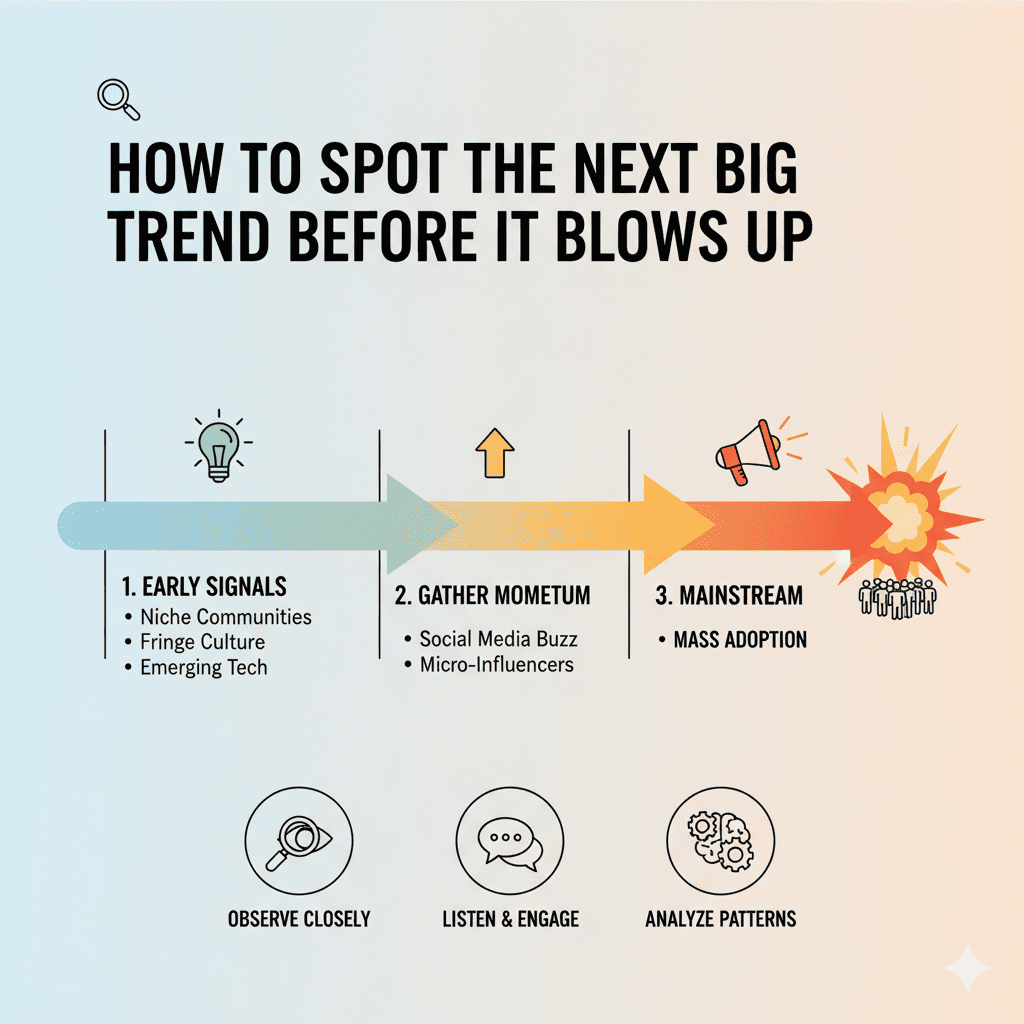
In today’s fast-paced digital world, the ability to spot the next big trend early can be the difference between leading your industry and playing catch-up. Whether you’re an entrepreneur, marketer, investor, or content creator, identifying emerging trends before they explode into mainstream consciousness gives you a competitive edge that’s worth its weight in gold.
But how do you spot the next big trend when there’s so much noise in the marketplace? How do you distinguish between a fleeting fad and a genuine movement that will reshape industries? This comprehensive guide will walk you through proven strategies, practical tools, and insider insights that will help you become a trend-spotting expert.
Why Learning to Spot the Next Big Trend Matters
Before we dive into the strategies, let’s understand why this skill is crucial. Companies like Netflix spotted the streaming trend before Blockbuster, Tesla identified the electric vehicle revolution early, and Instagram recognized the power of mobile-first photo sharing before anyone else. These weren’t lucky guesses—they were the result of careful observation, data analysis, and strategic thinking.
When you learn to spot the next big trend, you can:
- Position your business ahead of competitors by entering markets before they become saturated
- Maximize investment returns by backing emerging opportunities with high growth potential
- Create relevant content that resonates with audiences seeking cutting-edge information
- Build authority in your industry as a forward-thinking leader
- Avoid costly mistakes by steering clear of declining markets or dying trends
Now, let’s explore the systematic approach to spotting trends before they blow up.
1. Master the Art of Digital Listening
The internet is the world’s largest focus group, and it’s constantly broadcasting signals about emerging trends. Your first step to spot the next big trend is to become an active digital listener.
Monitor Social Media Platforms Strategically
Social media platforms are breeding grounds for new trends. However, not all platforms signal trends at the same stage:
TikTok and Instagram Reels are where Gen Z and younger Millennials test new ideas. Trends often start here as micro-movements before spreading to other platforms. Look for:
- Videos with rapidly increasing engagement
- New hashtags gaining traction (10K-100K posts range)
- Sounds or formats being repeatedly remixed
- Comment sections filled with “where can I get this?” or “I need to try this”
Twitter/X reveals real-time conversations and can signal emerging trends in technology, politics, and culture. Monitor:
- Trending topics in your industry
- Conversations among thought leaders and early adopters
- New terminology or jargon appearing frequently
- Debates that attract increasing participation
Reddit communities often discuss niche interests months or years before they go mainstream. Deep-dive into:
- Subreddits related to your industry
- Posts with unusual engagement in smaller communities
- Cross-posted content appearing in multiple subreddits
- Questions that appear repeatedly, indicating growing interest
LinkedIn shows professional and B2B trends emerging:
- Skills being added to profiles in large numbers
- Job postings for new roles or skill sets
- Articles and posts getting disproportionate engagement
- Companies announcing pivots or new initiatives
Use Social Listening Tools
Manual monitoring only goes so far. To truly spot the next big trend, leverage technology:
- Google Trends shows search interest over time and can reveal emerging queries before they peak
- BuzzSumo identifies content that’s gaining traction across platforms
- Exploding Topics specifically focuses on identifying trends in their early stages
- SparkToro reveals audience interests and behaviors
- Hootsuite or Sprout Social for comprehensive social media monitoring
Set up alerts for keywords related to your industry, and check them weekly. Look for steady upward trajectories rather than sudden spikes (which often indicate temporary viral moments rather than lasting trends).
2. Follow the Money and Investment Patterns
Financial flows are powerful indicators of where smart money sees future opportunities. When you learn to spot the next big trend, following venture capital and investment patterns is essential.
Track Venture Capital Investments
Venture capitalists spend millions researching market opportunities. Their investment decisions can signal emerging trends:
- Crunchbase and PitchBook provide data on funding rounds, showing which sectors are attracting capital
- AngelList reveals early-stage investments in startups
- CB Insights offers trend reports and analysis of VC activity
Look for:
- Multiple companies in the same space raising funds simultaneously
- Increasing round sizes in particular sectors
- Notable investors (like Sequoia, Andreessen Horowitz, or Y Combinator) backing similar concepts
- Geographic clustering of investments (often indicates ecosystem development)
Monitor Acquisition Activity
When major companies acquire startups, they’re betting on the future:
- Tech giants like Google, Microsoft, Amazon, and Meta often acquire companies 2-3 years before their technology becomes mainstream
- Industry-specific acquisitions signal where established players see threats or opportunities
- Acquisition multiples (price relative to revenue) indicate confidence in future growth
Watch Public Market Trends
While less predictive than VC activity, public markets still offer insights:
- IPO filings reveal what investors believe is ready for mainstream adoption
- Stock performance of companies in emerging sectors shows market confidence
- Analyst reports from firms like Gartner, Forrester, and McKinsey identify enterprise trends
3. Identify Pattern Recognition Across Multiple Sectors
The ability to spot the next big trend improves dramatically when you can see patterns that others miss. Major trends rarely emerge in isolation—they often manifest across multiple industries simultaneously.
Look for Cross-Industry Signals
When you notice similar concepts appearing in different sectors, you’re likely seeing an early trend:
Example: The “subscription model” appeared first in software (SaaS), then spread to:
- Media (Netflix, Spotify)
- Food (meal kits, HelloFresh)
- Fashion (Stitch Fix, Rent the Runway)
- Transportation (car subscriptions)
- Beauty (Ipsy, Birchbox)
This pattern recognition helped savvy entrepreneurs spot the next big trend and adapt the subscription model to their industries early.
Study Adjacent Industries
Innovation in one field often predicts changes in related fields:
- Healthcare innovations often follow consumer technology trends
- B2B adoption typically lags B2C by 2-5 years
- Enterprise software trends often mirror consumer app trends
- Regulatory changes in one market can predict similar changes globally
Recognize Convergence Points
Powerful trends emerge when multiple technologies or behaviors converge:
- Smartphones + GPS + Payment Systems = Ride-sharing revolution
- AI + Cloud Computing + Big Data = Personalization at scale
- Social Media + E-commerce + Live Video = Live shopping/social commerce
- Remote Work + Cloud Collaboration + Global Talent = Distributed workforce trend
4. Study Early Adopters and Niche Communities
To spot the next big trend, you need to know where to look for early signals. Trends don’t start in the mainstream—they begin in specific communities and subcultures.
Identify Your Industry’s Early Adopters
Early adopters share common characteristics:
- They’re willing to pay premium prices for new solutions
- They actively seek out innovation and novelty
- They influence others through their networks
- They’re vocal about their experiences online
Find them by:
- Joining specialized forums and online communities
- Attending industry conferences and meetups
- Following “power users” on social media
- Participating in beta testing communities
- Reading reviews on Product Hunt, Hacker News, or niche subreddits
Monitor Subcultures and Niche Groups
Mainstream trends often originate in subcultures:
- Fashion trends frequently start in streetwear, skating, or hip-hop communities
- Technology trends emerge from developer communities, hackathons, or gaming
- Wellness trends often begin with biohacking or athletic performance communities
- Food trends typically start in specific neighborhoods or immigrant communities
Don’t just observe these communities—engage with them. Ask questions, understand motivations, and identify what problems they’re solving.
Watch Geographic Trend Origins
Certain locations consistently lead trend adoption:
- Silicon Valley/San Francisco: Technology and startup culture
- New York: Media, fashion, and finance
- Los Angeles: Entertainment and lifestyle trends
- Austin/Miami: Emerging tech hubs with unique cultural blends
- Asian markets (Tokyo, Seoul, Singapore): Often 1-2 years ahead in consumer technology and retail innovation
- Scandinavian countries: Sustainability and design trends
5. Analyze Consumer Behavior Shifts
The most sustainable trends emerge from fundamental changes in how people live, work, and interact. When you spot the next big trend, you’re really identifying shifts in human behavior.
Track Demographic Changes
Population shifts create inevitable trend waves:
- Generational transitions: As Gen Z enters peak earning years, their preferences reshape markets
- Urbanization patterns: Movement to/from cities changes consumption patterns
- Remote work adoption: Impacts real estate, retail, and lifestyle choices
- Aging populations: Creates opportunities in healthcare, leisure, and accessibility
Monitor Lifestyle and Value Shifts
Changes in what people value drive purchasing decisions:
- Sustainability concerns are transforming packaging, manufacturing, and business models
- Health consciousness is reshaping food, beverage, and wellness industries
- Privacy awareness is changing technology adoption patterns
- Work-life balance priorities are creating new markets for convenience and time-saving solutions
- Authenticity demands are favoring transparent, purpose-driven brands
Study Pain Points and Frustrations
The best trends solve real problems. Look for:
- Frequent complaints on social media about existing solutions
- DIY workarounds people create for inadequate products
- High-friction processes people tolerate (opportunities for disruption)
- Emerging needs from lifestyle changes (like remote work creating home office needs)
6. Leverage Data and Analytics
To systematically spot the next big trend, combine qualitative observation with quantitative data analysis.
Use Keyword and Search Trend Analysis
Search behavior reveals what people want before markets fully respond:
- Google Trends: Compare search terms over time; look for consistent growth rather than spikes
- Keyword research tools (Ahrefs, SEMrush, Moz): Identify growing search volumes in niche topics
- Amazon search suggestions: Shows what products people are actively seeking
- YouTube search trends: Video content often leads written content for emerging topics
Look for:
- Search terms with 20%+ monthly growth over 6+ months
- Questions increasing in frequency
- Long-tail keywords that indicate specific, emerging needs
- Seasonal patterns that are changing or disrupting
Analyze Sales and E-commerce Data
If you have access to marketplace or sales data, mine it for signals:
- Amazon Best Sellers: Watch for new categories or products climbing rankings
- Etsy trends: Often signals artisan or maker movement trends early
- Shopify/BigCommerce data: Shows what independent retailers are selling
- App store rankings: New apps climbing charts indicate emerging user needs
Monitor Content Consumption Patterns
What people consume reveals what interests them:
- Netflix/streaming releases that spark conversations
- Podcast categories experiencing growth
- YouTube channels gaining subscribers in specific niches
- Newsletter subscriptions in emerging topics
- Book sales in specific categories (especially non-fiction)
7. Build a Trend Scanning System
To consistently spot the next big trend, create a systematic approach rather than relying on chance discovery.
Create Your Trend Dashboard
Develop a centralized system for monitoring:
Weekly monitoring:
- Google Trends for your key terms
- Social media hashtag performance
- News mentions in trade publications
- Venture capital funding announcements
Monthly analysis:
- Search volume changes for tracked keywords
- Engagement metrics on trend-related content
- Competitor activity and new market entrants
- Consumer survey data or reviews
Quarterly deep-dives:
- Industry reports and research studies
- Conference insights and presentation themes
- Patent filings in your industry
- Regulatory changes or proposals
Establish a Diverse Information Diet
Avoid echo chambers by consuming varied sources:
- Trade publications in your industry and adjacent ones
- Academic research that often predicts commercial applications
- International media to see what’s happening in other markets
- Fringe publications that cover emerging movements
- Opposing viewpoints that challenge your assumptions
Network Strategically
Your professional network is a trend-detection system:
- Cultivate relationships with people in different industries and roles
- Join mastermind groups or professional communities
- Attend diverse conferences, not just industry-specific ones
- Engage with thought leaders on social media
- Participate in online communities where innovation happens
8. Distinguish Between Fads and Lasting Trends
Not every emerging pattern deserves your attention. Learning to spot the next big trend means separating signal from noise.
Evaluate Trend Longevity
Lasting trends typically have these characteristics:
They solve real problems: Not just novelty, but genuine utility They have economic sustainability: A viable business model exists They face favorable macro conditions: Demographics, technology, or regulations support them They show steady, not explosive, growth: Viral spikes often fade fast They attract diverse adopters: Beyond a single demographic or psychographic They inspire ecosystem development: Other businesses building around them
Red Flags for Fads
Be cautious when you see:
- Growth driven primarily by celebrity endorsement or media hype
- No clear value proposition beyond “being different”
- High complexity with little user education or support
- Dependent on temporary conditions (like pandemic-specific behaviors)
- No network effects or competitive moats
- Companies pivoting to the trend without logical connection
Apply the “5 Whys” Test
When evaluating a potential trend:
- Why is this emerging now?
- Why do people want/need this?
- Why is the current solution inadequate?
- Why would this continue to grow?
- Why wouldn’t competitors easily replicate this?
If you can’t answer all five convincingly, it may be too early or too risky.
9. Test and Validate Your Trend Hypotheses
Once you think you’ve spotted something significant, validate before making major commitments.
Conduct Small-Scale Experiments
Before full investment, test your hypothesis:
- Create content around the trend and measure engagement
- Survey your audience about interest and pain points
- Develop a minimum viable product or pilot program
- Run limited advertising campaigns to gauge market interest
- Partner with micro-influencers to test messaging
Gather Qualitative Feedback
Numbers don’t tell the whole story:
- Conduct interviews with potential customers or users
- Host focus groups with your target demographic
- Join online discussions to understand motivations and concerns
- Read reviews and comments on related products or services
- Study case studies of early adopters or similar businesses
Monitor Your Validation Metrics
Set clear success criteria:
- Engagement rates that exceed your baseline
- Conversion rates showing willingness to pay
- Organic sharing and word-of-mouth growth
- Repeat interest rather than one-time curiosity
- Competitive response indicating market validation
10. Act Decisively When You’ve Spotted the Trend
Identifying a trend is only valuable if you act on it. The ability to spot the next big trend must be coupled with execution.
Move Quickly but Strategically
Speed matters, but so does quality:
- Don’t wait for perfection: Launch with a minimum viable offering
- Iterate based on feedback: Early adopters will tell you what needs improvement
- Secure resources: Allocate budget, team, and time before the window closes
- Build partnerships: Collaborate with complementary businesses
- Communicate clearly: Articulate why this matters to stakeholders and customers
Position Yourself as an Early Authority
When you spot the next big trend and act on it, establish thought leadership:
- Create educational content that helps others understand the trend
- Share your journey and lessons learned transparently
- Speak at industry events about your insights and experience
- Build community around the trend topic
- Document the evolution to maintain your early-mover status
Plan for Scale
Trends that succeed grow quickly:
- Build scalable systems from the start
- Anticipate bottlenecks in production, service delivery, or support
- Protect your innovations through patents, trademarks, or trade secrets
- Develop talent pipelines for skills that will be in demand
- Create strategic partnerships that can accelerate growth
The Continuous Practice of Trend Spotting
The ability to spot the next big trend isn’t a one-time skill—it’s a continuous practice. Markets evolve, technologies advance, and consumer preferences shift constantly. The most successful trend-spotters make observation and analysis part of their daily routine.
Develop Your Trend-Spotting Routine
Daily (15-30 minutes):
- Scan social media feeds focused on your industry
- Review Google News for your key topics
- Check trending sections on relevant platforms
Weekly (1-2 hours):
- Deep-dive into one emerging topic
- Review your trend dashboard metrics
- Engage in niche communities
- Read long-form analysis and research
Monthly (half-day):
- Analyze patterns across your observations
- Update your trend hypotheses
- Conduct validation experiments
- Network and exchange insights with peers
Quarterly (full day):
- Comprehensive trend report creation
- Strategic planning based on identified trends
- Resource allocation decisions
- Long-term positioning adjustments
Cultivate a Trend-Spotting Mindset
Beyond tactics and tools, develop these mental habits:
Curiosity: Ask “why?” constantly and dig beneath surface-level observations Skepticism: Question assumptions and test conventional wisdom Pattern recognition: Look for connections across seemingly unrelated domains Contrarian thinking: Consider what everyone might be missing or getting wrong Long-term perspective: Balance immediate signals with sustainable shifts Diverse perspectives: Actively seek viewpoints different from your own
Stay Humble and Adaptable
Even the best trend-spotters get it wrong sometimes. The difference between success and failure often lies in:
- Acknowledging mistakes quickly rather than doubling down on wrong predictions
- Learning from misses to refine your approach
- Remaining flexible enough to pivot when new information emerges
- Diversifying bets rather than staking everything on one trend
- Celebrating small wins while building toward bigger opportunities
Conclusion: Your Competitive Edge in an Ever-Changing World
The ability to spot the next big trend before it explodes into mainstream consciousness is one of the most valuable skills in modern business. It’s not about having a crystal ball—it’s about developing systematic observation skills, leveraging data and tools, understanding human behavior, and acting decisively when opportunities emerge.
By implementing the strategies in this guide—from digital listening and financial pattern recognition to building scanning systems and validation processes—you’ll develop an edge that compounds over time. Each trend you identify successfully sharpens your instincts and expands your network, making the next discovery easier.
Remember that trends exist at the intersection of technological possibility, consumer need, and market readiness. When you spot the next big trend, you’re identifying that convergence point before others recognize it. This foresight allows you to position yourself, your business, or your investments to benefit from the wave rather than being disrupted by it.
Start today by implementing just one or two tactics from this guide. Set up a Google Trends alert, join a niche Reddit community, or schedule your first trend analysis session. Small, consistent actions compound into powerful trend-spotting abilities over time.
The next big trend is emerging right now. Will you be ready to spot it?
Also read this:
Making $10K/Month From One Digital Product — The New Normal