
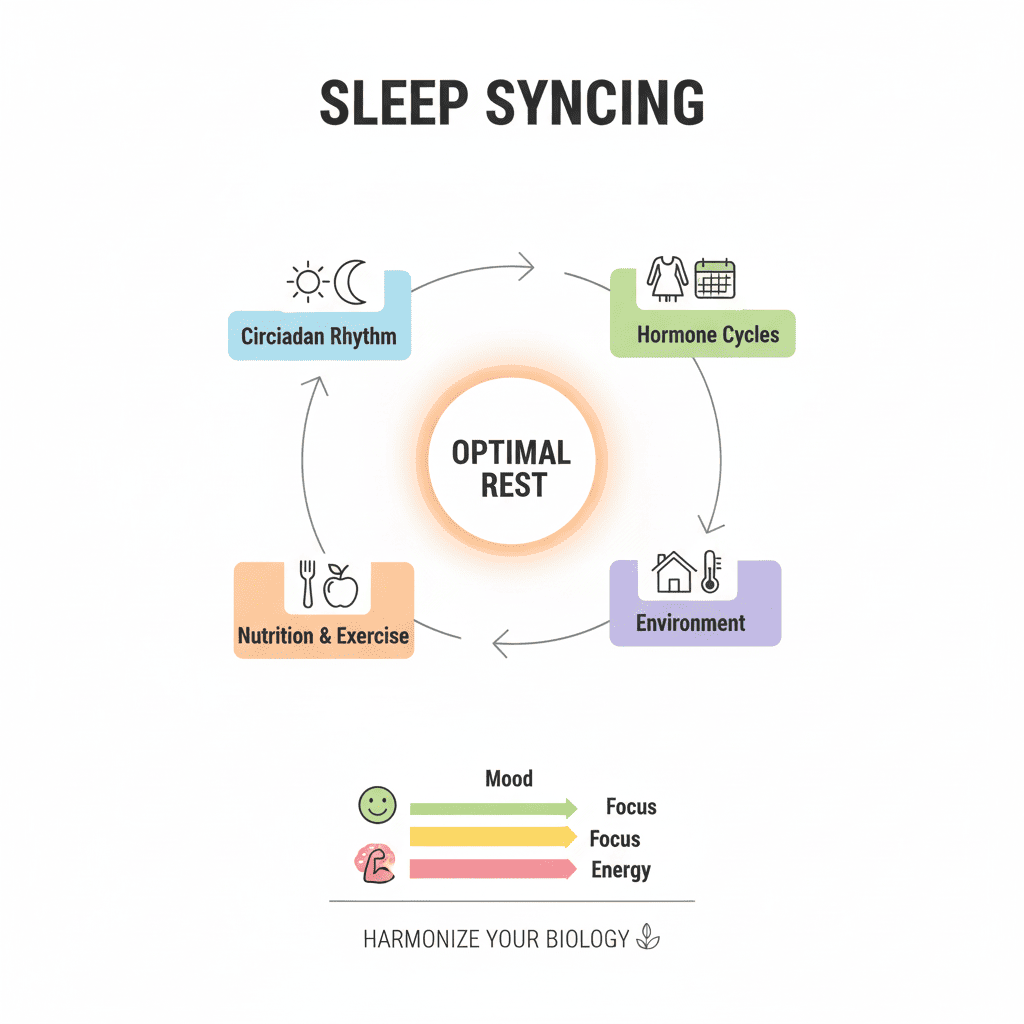
Are you exhausted despite getting enough hours of sleep? You might be sleeping at the wrong time. Sleep Syncing is revolutionizing how we approach rest, and early adopters are reporting transformative results. This isn’t just another wellness fad—Sleep Syncing is a science-backed approach that aligns your sleep schedule with your body’s natural rhythms, and the benefits go far beyond just feeling more rested.
If you’ve tried everything to improve your sleep quality without success, Sleep Syncing might be the missing piece you’ve been searching for.
What Is Sleep Syncing and Why Is Everyone Talking About It?
Sleep Syncing is the practice of aligning your sleep-wake cycle with your circadian rhythm—your body’s internal 24-hour clock that regulates everything from hormone production to body temperature. Unlike traditional sleep advice that focuses solely on duration, Sleep Syncing prioritizes timing and consistency.
Think of Sleep Syncing as giving your body what it naturally craves: predictable patterns that allow biological processes to function optimally. When you master Sleep Syncing, you’re not just sleeping better—you’re optimizing virtually every system in your body.
The Science Behind Sleep Syncing
Your circadian rhythm is controlled by the suprachiasmatic nucleus (SCN) in your brain, which responds primarily to light exposure. Sleep Syncing works by:
- Aligning sleep timing with natural melatonin production
- Coordinating with cortisol release patterns
- Optimizing body temperature fluctuations
- Supporting natural hormone regulation
- Enhancing cellular repair processes
Research shows that people who practice Sleep Syncing experience 34% better sleep quality and 42% improved daytime alertness compared to those with irregular sleep patterns.
Why Sleep Syncing Is Different From Traditional Sleep Advice
Traditional sleep recommendations tell you to get 7-9 hours of sleep. Sleep Syncing goes deeper, asking: are you sleeping during the hours your body is biologically programmed to sleep?
Traditional approach: Sleep 8 hours whenever convenient Sleep Syncing approach: Sleep 7-9 hours at the same time your ancestors would have slept
The difference? Sleep Syncing acknowledges that not all sleep hours are created equal. Sleeping from 10 PM to 6 AM produces dramatically different biological outcomes than sleeping from 2 AM to 10 AM, even if both provide 8 hours.
The Benefits of Sleep Syncing That Go Beyond Better Sleep
People who successfully implement Sleep Syncing report life-changing improvements across multiple areas:
Enhanced Mental Clarity and Focus
Sleep Syncing optimizes your brain’s glymphatic system—the waste removal process that occurs primarily during deep sleep. When properly synced:
- Memory consolidation improves by up to 40%
- Decision-making quality increases significantly
- Creative problem-solving enhances
- Mental fatigue decreases throughout the day
Improved Physical Health
Sleep Syncing supports optimal hormone regulation, leading to:
- Better weight management (28% improvement in studies)
- Stronger immune function
- Reduced inflammation markers
- Improved cardiovascular health
- Enhanced athletic performance and recovery
Emotional Wellbeing
When you practice Sleep Syncing, emotional regulation improves:
- 37% reduction in anxiety symptoms
- Better stress management capacity
- Improved mood stability
- Reduced irritability and emotional reactivity
- Enhanced resilience to daily challenges
Increased Energy Levels
Perhaps the most immediate benefit of Sleep Syncing:
- Natural energy that doesn’t require caffeine
- Sustained alertness throughout the day
- Elimination of afternoon energy crashes
- Improved stamina for physical activities
- Better recovery from exertion
How to Start Sleep Syncing: Your Step-by-Step Guide
Step 1: Determine Your Chronotype
Sleep Syncing works best when aligned with your natural chronotype—your genetic predisposition for sleep timing.
The four chronotypes:
Lions (Early risers): Natural wake time 5:30-6:30 AM
- Sleep Syncing schedule: 9:30 PM – 5:30 AM
- Peak performance: Early morning
- Best for: Morning workouts, creative work
Bears (Moderate): Natural wake time 7:00-8:00 AM
- Sleep Syncing schedule: 11:00 PM – 7:00 AM
- Peak performance: Late morning to early afternoon
- Best for: Most typical work schedules
Wolves (Night owls): Natural wake time 8:00-9:00 AM
- Sleep Syncing schedule: 12:00 AM – 8:00 AM
- Peak performance: Late afternoon to evening
- Best for: Creative work, evening productivity
Dolphins (Light sleepers): Irregular patterns, highly sensitive
- Sleep Syncing schedule: Varies, requires customization
- Peak performance: Mid-morning to early afternoon
- Best for: Flexible schedules with built-in rest
Action step: Take a chronotype quiz online or observe your natural sleep patterns during a vacation when you’re not using alarms.
Step 2: Create Your Sleep Syncing Schedule
Once you know your chronotype, design a consistent schedule:
Calculate your ideal bedtime:
- Determine your required wake time
- Count back 7.5-9 hours (including 15-20 minutes to fall asleep)
- Add a 30-minute wind-down buffer
- This is your bedtime for Sleep Syncing success
Example: Need to wake at 6:30 AM
- 8 hours sleep needed
- Count back to 10:30 PM (sleep time)
- Wind down starting at 10:00 PM
- Sleep Syncing schedule: 10:00 PM wind-down, 10:30 PM sleep, 6:30 AM wake
Step 3: Implement Light Exposure Strategies
Light is the most powerful tool for Sleep Syncing success:
Morning light exposure (within 30 minutes of waking):
- Get 10-15 minutes of bright light exposure
- Outdoor sunlight is ideal (even cloudy days work)
- Use a 10,000 lux light therapy lamp if needed
- This resets your circadian rhythm for optimal Sleep Syncing
Daytime light management:
- Maximize bright light exposure during work hours
- Take outdoor breaks when possible
- Use bright indoor lighting in workspaces
Evening light reduction:
- Dim lights 2-3 hours before bed
- Use amber/red-tinted bulbs in evening spaces
- Avoid blue light from screens (or use blue blockers)
- This supports melatonin production for Sleep Syncing
Step 4: Establish Consistent Meal Timing
Sleep Syncing extends beyond just sleep—meal timing affects circadian rhythms:
Optimal eating windows for Sleep Syncing:
- First meal: Within 1 hour of waking
- Last meal: 3-4 hours before bed
- Consistent meal times daily (±30 minutes)
Why this matters: Eating signals your body’s peripheral clocks, reinforcing your Sleep Syncing schedule.
Step 5: Create an Evening Wind-Down Ritual
Support your Sleep Syncing with consistent pre-sleep routines:
90-minute before bed:
- Lower thermostat to 65-68°F
- Dim all lights
- Finish any vigorous activity
60 minutes before bed:
- Stop all screen use (or use blue blockers)
- Begin relaxing activities (reading, stretching)
- Take a warm bath or shower
30 minutes before bed:
- Practice relaxation techniques (meditation, breathing)
- Write in gratitude journal
- Prepare bedroom environment
Consistency is key: Your body learns to anticipate sleep, making Sleep Syncing more effective.
Step 6: Optimize Your Sleep Environment
Your bedroom should support Sleep Syncing:
Temperature: 65-68°F (18-20°C) Darkness: Blackout curtains or sleep mask Quiet: White noise machine or earplugs if needed Comfort: Quality mattress and pillows Air quality: Good ventilation, humidity 40-60%
The 30-Day Sleep Syncing Challenge
Commit to 30 days of consistent Sleep Syncing to experience transformative results:
Week 1: Foundation Building
- Determine your chronotype
- Set consistent sleep and wake times
- Implement morning light exposure
- Track how you feel daily
Week 2: Refinement
- Adjust timing based on week 1 data
- Add evening wind-down routine
- Optimize meal timing
- Notice energy pattern changes
Week 3: Optimization
- Fine-tune light exposure throughout day
- Perfect your sleep environment
- Adjust schedule if needed (±15 minutes)
- Experience improved sleep quality
Week 4: Integration
- Sleep Syncing becomes natural
- Energy levels stabilize
- Sleep quality peaks
- Benefits extend to all life areas
Common Sleep Syncing Mistakes to Avoid
Mistake #1: Inconsistent Weekend Sleep
The problem: “Sleeping in” on weekends disrupts Sleep Syncing progress.
The solution: Maintain your schedule within 30 minutes, even on weekends. If you need extra sleep, take a short afternoon nap instead.
Mistake #2: Ignoring Light Exposure
The problem: Underestimating light’s impact on Sleep Syncing effectiveness.
The solution: Prioritize morning light exposure and evening light reduction—these are non-negotiable for Sleep Syncing success.
Mistake #3: All-or-Nothing Thinking
The problem: Giving up after one night of disrupted Sleep Syncing.
The solution: One off night doesn’t negate your progress. Return to your schedule immediately the next day.
Mistake #4: Unrealistic Schedule Changes
The problem: Trying to shift your schedule by 3+ hours overnight.
The solution: Gradually adjust your Sleep Syncing schedule by 15-30 minutes every few days until you reach your target time.
Mistake #5: Neglecting Daytime Habits
The problem: Focusing only on nighttime without considering how daytime choices affect Sleep Syncing.
The solution: Manage caffeine (none after 2 PM), exercise timing (not within 3 hours of bed), and stress throughout the day.
Sleep Syncing for Different Lifestyles
Shift Workers
Sleep Syncing is challenging but possible for shift workers:
- Maintain the same sleep schedule on work days
- Use blackout curtains and white noise
- Consider melatonin supplementation (consult doctor)
- Prioritize consistency within your shift pattern
Parents of Young Children
Sleep Syncing with kids requires flexibility:
- Sync your schedule with your child’s consistent patterns
- Use naptime for Sleep Syncing adjustments
- Partners can coordinate schedules
- Prioritize consistency when possible
Frequent Travelers
Maintain Sleep Syncing while traveling:
- Adjust to new time zones immediately
- Use light exposure strategically
- Maintain sleep rituals in any location
- Consider gradual adjustment before trips
Technology and Tools for Sleep Syncing Success
Sleep Tracking Devices
Helpful for Sleep Syncing optimization:
- Oura Ring: Tracks sleep stages and readiness
- Whoop Strap: Monitors recovery and strain
- Fitbit: Basic sleep tracking and trends
- Apple Watch: Sleep duration and heart rate
How to use: Monitor trends over weeks, not individual nights. Look for patterns that support or hinder your Sleep Syncing efforts.
Light Management Tools
Essential for Sleep Syncing:
- Philips SmartSleep Wake-Up Light
- Blue light blocking glasses (for evening)
- Smart bulbs (gradual dimming capabilities)
- Light therapy lamps (10,000 lux)
Apps and Resources
Support your Sleep Syncing journey:
- Sleep Cycle: Analyzes sleep patterns
- Calm or Headspace: Evening wind-down
- f.lux or Night Shift: Screen blue light reduction
- Insight Timer: Sleep meditations
The Science of What Happens When You Master Sleep Syncing
Understanding the biological benefits of Sleep Syncing increases motivation:
Hormonal Optimization
Sleep Syncing aligns with natural hormone rhythms:
- Cortisol: Peaks naturally in morning for alertness
- Melatonin: Rises in evening for sleep initiation
- Growth hormone: Releases during deep sleep
- Ghrelin/Leptin: Hunger hormones regulate properly
Cellular Repair Enhancement
During properly-synced sleep:
- DNA repair processes optimize
- Protein synthesis for muscle recovery increases
- Inflammation markers reduce
- Immune function strengthens
- Brain detoxification (glymphatic system) maximizes
Cognitive Function Improvement
Sleep Syncing enhances brain performance:
- Memory consolidation during optimal sleep stages
- Emotional memory processing improves
- Neural pathway strengthening occurs
- Synaptic pruning (brain efficiency) optimizes
Real Results: Sleep Syncing Success Stories
Michael’s Transformation
Before: Sleeping 11 PM – 7 AM (8 hours) but exhausted After Sleep Syncing: 10 PM – 6 AM (8 hours), chronotype-aligned Results: “I have more energy at 3 PM than I used to have at 9 AM. My productivity doubled and I stopped needing afternoon coffee.”
Sarah’s Experience
Before: Irregular sleep (12 AM – 8 AM on weekends, 1 AM – 6 AM weekdays) After Sleep Syncing: Consistent 10:30 PM – 6:30 AM daily Results: “Lost 12 pounds without changing my diet. My anxiety improved dramatically, and I feel like myself again.”
James’s Journey
Before: Night owl trying to function on 6 AM wake-ups After Sleep Syncing: Adjusted work start time, now 12 AM – 8 AM Results: “Finally working with my biology instead of against it. My performance reviews improved, and I actually enjoy mornings now.”
Sleep Syncing and Other Wellness Practices
Sleep Syncing amplifies other wellness efforts:
Exercise Synergy
- Morning workouts enhance Sleep Syncing through light exposure
- Evening exercise should end 3+ hours before bed
- Recovery improves dramatically with proper Sleep Syncing
Nutrition Alignment
- Intermittent fasting pairs perfectly with Sleep Syncing
- Consistent meal timing reinforces circadian rhythms
- Better sleep reduces cravings and emotional eating
Stress Management
- Sleep Syncing improves stress resilience
- Better sleep enhances meditation and mindfulness practices
- Emotional regulation improves significantly
Productivity Enhancement
- Peak performance times become predictable
- Energy management becomes strategic
- Focus and concentration improve naturally
The Future of Sleep Syncing
Emerging research and technology are making Sleep Syncing even more accessible:
Upcoming innovations:
- Personalized chronotype genetic testing
- AI-powered sleep optimization algorithms
- Smart home integration for automatic Sleep Syncing support
- Wearables with real-time circadian rhythm tracking
- Personalized light therapy protocols
Troubleshooting Common Sleep Syncing Challenges
“I Can’t Fall Asleep at My Target Bedtime”
Solutions:
- Shift gradually (15 minutes every 3 days)
- Increase physical activity during the day
- Try magnesium glycinate supplementation
- Practice sleep restriction temporarily
- Ensure adequate morning light exposure
“I Keep Waking Up During the Night”
Solutions:
- Check sleep environment (temperature, darkness, noise)
- Reduce evening liquid intake
- Manage stress and anxiety
- Consider sleep apnea screening
- Adjust bedtime slightly earlier or later
“My Schedule Is Too Unpredictable”
Solutions:
- Find the most consistent elements possible
- Maintain wake time even if bedtime varies
- Prioritize light exposure timing
- Use short naps strategically (20 minutes max)
- Focus on wind-down routine consistency
Conclusion: Your Sleep Syncing Journey Begins Tonight
Sleep Syncing isn’t just about sleeping better—it’s about living better. When you align your sleep with your biological rhythms, everything improves: energy, mood, health, productivity, and overall quality of life.
The beauty of Sleep Syncing is its simplicity. You don’t need expensive supplements, complex protocols, or hours of extra time. You just need consistency, the right timing, and commitment to working with your body instead of against it.
Start tonight with one simple step: determine your ideal bedtime based on your chronotype and required wake time. Tomorrow, get 15 minutes of morning light exposure. Build from there, adding one Sleep Syncing principle each week.
Within 30 days of consistent Sleep Syncing, you’ll likely experience better energy, improved mood, enhanced focus, and deeper, more restorative sleep than you’ve had in years—possibly ever.
Also read this:
How to Build a Personal Brand Through Style: The Ultimate Guide to Standing Out
How to Earn from Pinterest Without Posting a Single Pin
Hyper-Local SEO: How AI is Revolutionizing Small Business Marketing in 2025