
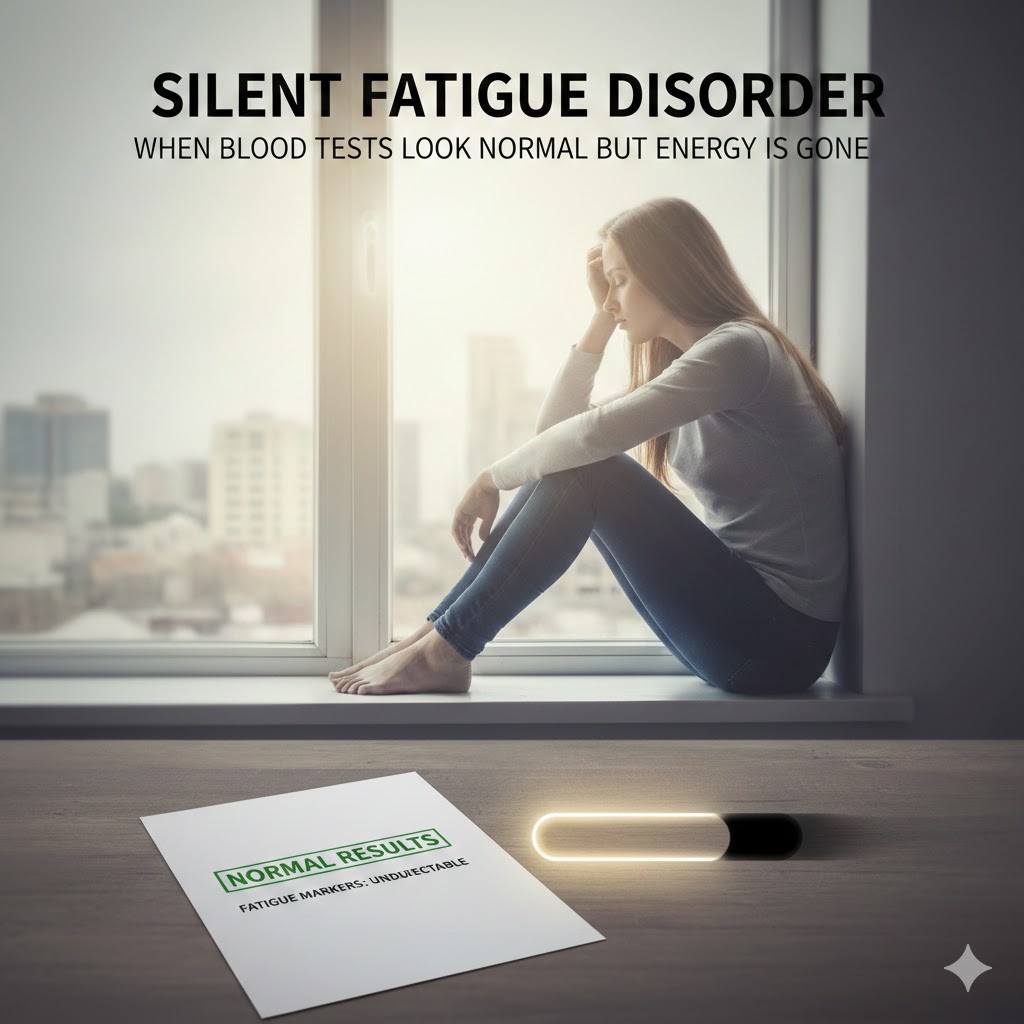
Silent Fatigue Disorder You’ve done the responsible thing. You went to the doctor. You got blood work done. And the results came back normal.
Yet the exhaustion hasn’t lifted.
You wake up tired. You push through the day. You cancel plans. You blame stress. Over time, you start questioning yourself. This frustrating gap between “normal results” and persistent exhaustion is increasingly described as Silent Fatigue Disorder.
It’s not an official diagnosis. It’s a pattern—one that millions of people quietly experience but struggle to explain. And because it doesn’t show up clearly on standard tests, it often goes unseen, unheard, and untreated.
This article explores what silent fatigue disorder really means, why blood tests can look fine while energy disappears, and what people are learning about this hidden exhaustion state.
1. What Is Silent Fatigue Disorder?
Silent fatigue disorder isn’t a single disease.
1.1 What the Term Describes
- Persistent low energy
- Normal standard lab results
- No clear medical explanation
- Daily functioning feels harder than it should
1.2 Why the Word “Silent” Fits
- No obvious warning signs
- No dramatic test abnormalities
- Symptoms are internal and invisible
People experiencing Silent Fatigue Disorder often hear, “Everything looks fine,” while feeling anything but fine.
2. Why Blood Tests Can Look Normal While Energy Is Gone
Standard tests don’t measure everything.
2.1 What Routine Blood Panels Focus On
- Basic deficiencies
- Major organ markers
- Broad reference ranges
These tests are excellent for detecting disease—but not subtle dysfunction.
2.2 The Reference Range Problem
- “Normal” includes a wide range of values
- Optimal energy levels vary by individual
- Borderline issues can still feel debilitating
This is one reason silent fatigue disorder slips through the cracks.
3. Fatigue Isn’t Always About Deficiency
Energy is a systems issue, not a single switch.

3.1 Energy Depends On Multiple Systems
- Nervous system regulation
- Stress hormones
- Sleep quality
- Cellular energy production
- Circulation and oxygen delivery
If even one system is slightly off, fatigue can appear—without showing up on labs.
4. Stress Can Drain Energy Without Leaving Lab Traces
Stress doesn’t always show on paper.
4.1 Chronic Stress Effects
- Keeps the body in alert mode
- Disrupts sleep depth
- Increases mental exhaustion
- Alters energy rhythms
4.2 Why Tests Miss This
- Stress hormones fluctuate throughout the day
- Single blood draws don’t show patterns
- The body adapts—until it can’t
Many cases of Silent Fatigue Disorder are rooted in long-term stress rather than illness.
5. Sleep Looks Fine—But Isn’t Restorative
You can sleep 8 hours and still feel exhausted.
5.1 Quantity vs Quality
- Light sleep dominates
- Poor deep sleep recovery
- Frequent micro-awakenings
5.2 Why Blood Tests Stay Normal
- Sleep quality isn’t measured in labs
- Fatigue comes from recovery failure, not deficiency
This creates the illusion of “doing everything right” while energy continues to drop.
6. Nervous System Fatigue: The Missing Piece
Not all fatigue is physical.
6.1 Signs of Nervous System Overload
- Feeling tired but wired
- Difficulty relaxing
- Low motivation without sadness
- Sensitivity to noise or stimulation
6.2 Why This Matters
- The nervous system controls energy output
- Constant stimulation drains reserves
- Recovery requires regulation, not rest alone
This layer is often central to Silent Fatigue Disorder experiences.
7. Micro-Level Issues Labs Don’t Capture Well
Subtle issues add up.
7.1 Examples of Overlooked Factors
- Mild inflammation
- Circulation efficiency
- Mitochondrial (cellular) energy efficiency
- Nutrient absorption, not just intake
7.2 Why They’re Hard to Detect
- Tests are expensive or specialized
- Symptoms appear before markers
- The body compensates until fatigue becomes chronic
8. Why People Feel Dismissed—and Stop Asking for Help
This is one of the hardest parts.

8.1 The Emotional Impact
- Self-doubt
- Guilt for feeling “lazy”
- Fear of being dramatic
8.2 The Result
- People stop advocating for themselves
- Fatigue becomes normalized
- Quality of life quietly declines
Recognizing silent fatigue disorder is often the first step toward validation.
9. What People Do When Tests Are Normal but Fatigue Isn’t
Many turn to lifestyle investigation.
9.1 Common Exploration Areas
- Stress regulation
- Sleep optimization
- Gentle movement vs overtraining
- Nervous system calming practices
- Nutrition timing and recovery
9.2 Why This Approach Helps
- Focuses on systems, not labels
- Encourages experimentation
- Restores a sense of control
This doesn’t replace medical care—it complements it.
10. Why Silent Fatigue Disorder Is Being Talked About More
Awareness is finally catching up.
10.1 Cultural Shifts
- Burnout recognition
- Nervous system education
- Holistic energy models
10.2 Why the Term Resonates
- Describes lived experience accurately
- Explains the “nothing’s wrong” paradox
- Gives language to invisible exhaustion
Silent Fatigue Disorder isn’t about inventing illness—it’s about naming a real pattern.
FAQs: Silent Fatigue Disorder
Is silent fatigue disorder a medical diagnosis?
No. It’s a descriptive term, not a formal diagnosis.
Can you be exhausted even if blood tests are normal?
Yes. Many energy-related issues don’t show on routine labs.
Is this the same as chronic fatigue syndrome?
No. They are different concepts, though some symptoms may overlap.
Should fatigue always be investigated medically?
Yes. Persistent fatigue should be discussed with a healthcare professional.
Why does this fatigue feel so real if tests are normal?
Because energy is regulated by multiple systems, not all of which are measured in standard testing.
Final Thoughts
Feeling exhausted while being told you’re “fine” can be deeply confusing. Silent Fatigue Disorder gives language to that experience—not to replace medical care, but to acknowledge that energy loss can exist even when tests don’t raise alarms.
Fatigue doesn’t mean weakness.
It doesn’t mean imagination.
And it doesn’t mean nothing is happening.
Sometimes, it simply means the body is asking for attention in ways our current systems don’t always measure yet.
More Related Topics:
Breathwork Therapy for Anxiety: Why It Works Faster Than Mindfulness