
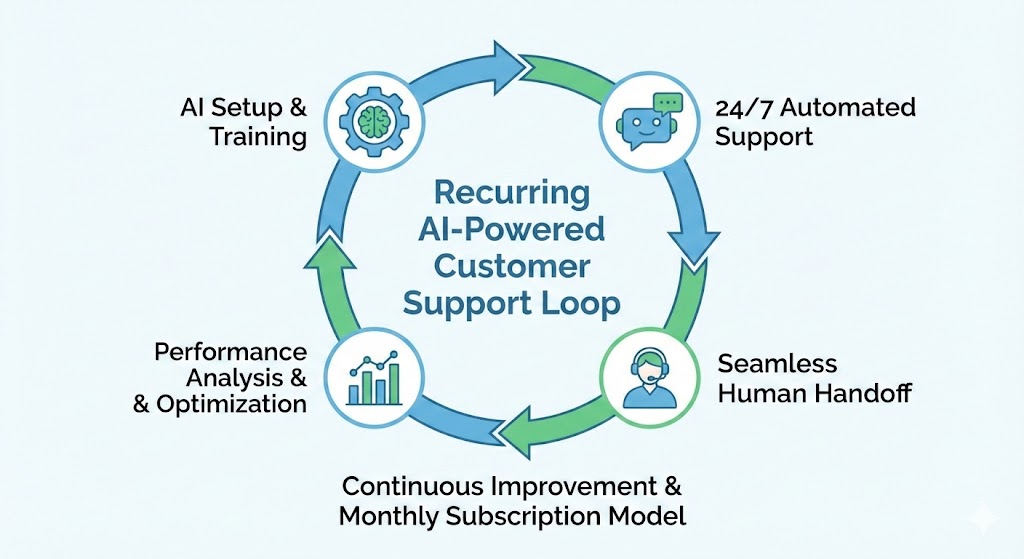
The customer support industry is experiencing a massive transformation. Businesses across every sector are desperately seeking ways to reduce support costs while improving response times and customer satisfaction. This creates an extraordinary opportunity for entrepreneurs and agencies to build profitable recurring revenue businesses by running AI-powered customer support services for clients.
The beauty of running AI-powered customer support as a recurring service lies in its predictability and scalability. Once implemented, businesses become dependent on these systems for their daily operations, creating exceptional customer retention rates and stable monthly revenue. This comprehensive guide will walk you through everything you need to know about building, launching, and scaling a successful AI-powered customer support service business.
Why Running AI-Powered Customer Support is the Perfect Recurring Service Model
Traditional customer support is expensive, inconsistent, and difficult to scale. Companies spend an average of $1.3 trillion annually on customer service costs, with the average support interaction costing between $5 and $15. When you factor in training, turnover, and benefits, the true cost becomes even higher.
Running AI-powered customer support solves these problems comprehensively. Artificial intelligence handles routine inquiries instantly, works 24/7 without breaks, maintains consistent quality, and scales effortlessly during peak times. For businesses, the value proposition is undeniable. For service providers, this creates a perfect subscription model where clients pay monthly fees that become more valuable as the system learns and improves.
The recurring revenue model works exceptionally well in this space because stopping the service means reverting to expensive human-only support. This dependency creates customer lifetime values that often exceed 36 months, with annual retention rates above 85% for well-implemented systems.
1. Understanding the Market Opportunity for AI Customer Support Services
Before diving into implementation, it’s crucial to understand the massive market opportunity available for running AI-powered customer support as a recurring service.
Market Size and Growth Trajectory
The global customer service AI market is projected to reach $58 billion by 2030, growing at a compound annual growth rate of 23%. This explosive growth is driven by businesses of all sizes recognizing that AI-powered support is no longer optional but essential for competitive survival.
Target Client Profiles
Small to medium-sized businesses represent the sweetest spot for service providers. These companies need enterprise-level support capabilities but cannot afford to build internal AI teams or implement solutions like Salesforce Einstein or IBM Watson. They’re willing to pay $1,000 to $5,000 monthly for managed AI support services.
Competitive Advantages Over Traditional Solutions
While large enterprise platforms exist, they require significant technical expertise to implement and maintain. By offering running AI-powered customer support as a fully managed service, you eliminate implementation complexity, provide ongoing optimization, and deliver faster time-to-value. This full-service approach commands premium pricing while creating strong client relationships.
Industry-Specific Opportunities
Certain industries have particularly high support volumes and costs, making them ideal targets. E-commerce businesses handle thousands of order status inquiries, SaaS companies manage technical support tickets, healthcare providers schedule appointments and answer patient questions, and financial services firms process account inquiries. Each industry presents unique opportunities for specialized AI support solutions.
2. Building Your AI-Powered Customer Support Technology Stack
Successfully running AI-powered customer support requires assembling the right combination of technologies. Your stack should balance capability, cost, and ease of implementation.
Core AI Platform Selection
Choose between building custom solutions using APIs from OpenAI, Anthropic, or Google, or leveraging specialized customer service AI platforms. Custom solutions offer more control and better margins, while platforms provide faster deployment. Many successful service providers use a hybrid approach, starting with platforms for rapid client acquisition, then migrating to custom solutions as they scale.
Natural Language Processing Capabilities
Your AI must understand customer intent regardless of how questions are phrased. Modern large language models excel at this, but proper training on industry-specific terminology and common customer queries dramatically improves accuracy. Invest time in building comprehensive knowledge bases that feed your AI system.
Integration Infrastructure
The AI needs to connect with client systems including help desk software like Zendesk or Freshdesk, CRM platforms such as HubSpot or Salesforce, e-commerce platforms including Shopify and WooCommerce, and communication channels spanning email, chat, SMS, and social media. Robust integration capabilities differentiate professional services from amateur offerings.
Analytics and Reporting Systems
Clients need to see the value they’re receiving. Build dashboards that track response times, resolution rates, customer satisfaction scores, cost savings compared to human agents, and common issue categories. Quantifiable metrics justify continued monthly payments and enable upselling opportunities.
3. Designing Your Service Offering and Pricing Model
How you package and price your AI-powered customer support service directly impacts profitability and customer acquisition success.
Service Tier Structures
Create multiple tiers serving different business sizes and needs. A starter tier might handle 500 conversations monthly across two channels for $997 per month. A growth tier could support 2,000 conversations across five channels with advanced features for $2,497 monthly. An enterprise tier offering unlimited conversations, custom integrations, and dedicated support might command $4,997 or more.
Pricing Variables to Consider
Several factors influence appropriate pricing. Conversation volume represents your primary cost driver, as AI API calls scale with usage. The number of integrated channels increases setup complexity and maintenance requirements. Industry specialization justifies premium pricing when you develop deep expertise. Response time guarantees and service level agreements create higher value that supports increased fees.
Value-Based Pricing Strategies
Rather than cost-plus pricing, focus on the value delivered. If your AI handles 2,000 support tickets monthly that would otherwise require two full-time agents at $4,000 each, charging $3,000 monthly provides tremendous value while generating excellent margins. Calculate client ROI and price to capture a reasonable portion of that value.
Contract Terms and Commitment Structures
Monthly subscriptions provide flexibility but higher churn risk. Quarterly contracts balance commitment with accessibility. Annual agreements with monthly billing create the best combination of cash flow predictability and client retention. Consider offering discounts for annual prepayment to improve cash position.
4. Implementing AI Customer Support for Client Success
Successful implementations determine whether clients see value and continue paying. Running AI-powered customer support requires careful planning and execution.
Discovery and Requirements Gathering
Before implementation begins, conduct thorough discovery. Identify current support volume and costs, document common customer inquiries and issues, review existing support workflows and handoffs, analyze customer satisfaction metrics and pain points, and understand integration requirements with existing systems. This information guides implementation and sets success benchmarks.
Knowledge Base Development
Your AI is only as good as the information it accesses. Create comprehensive knowledge bases covering product information and specifications, common troubleshooting steps and solutions, company policies on returns, refunds, and warranties, pricing and billing information, and escalation procedures for complex issues. Structure this information for easy AI retrieval and update it regularly as products and policies evolve.
Conversation Flow Design
Map out how conversations should progress from greeting through resolution. Define when the AI should attempt to solve issues independently versus routing to humans. Establish the tone and personality that matches the client’s brand. Create fallback responses for questions the AI cannot answer. These flows ensure consistent, high-quality customer experiences.
Testing and Quality Assurance
Before going live, rigorously test with real historical support tickets. Verify that the AI correctly identifies customer intent, provides accurate information, and escalates appropriately. Have the client’s support team review AI responses for brand consistency and accuracy. This testing phase prevents embarrassing mistakes that could damage client relationships.
5. Managing and Optimizing Ongoing AI Support Operations
Running AI-powered customer support isn’t a set-it-and-forget-it business. Ongoing management and optimization create the value that justifies monthly fees.
Performance Monitoring and Metrics
Track key performance indicators daily or weekly. Monitor conversation resolution rates showing what percentage of inquiries the AI resolves without human intervention. Measure average response times and first contact resolution rates. Track customer satisfaction scores for AI-handled conversations. Watch escalation rates to identify topics requiring knowledge base improvements. These metrics guide optimization efforts and demonstrate value to clients.
Continuous Training and Improvement
AI systems improve through feedback loops. Review conversations the AI struggled with and update knowledge bases accordingly. Analyze customer feedback to identify gaps in understanding or information. Refine conversation flows based on actual usage patterns. Update responses to reflect product changes, new policies, or seasonal variations. This continuous improvement justifies ongoing fees while increasing system value over time.
Human Agent Collaboration
The best implementations combine AI efficiency with human expertise. Design clear escalation paths for complex issues, sensitive situations, or frustrated customers. Train client support teams to review AI interactions and provide feedback. Create workflows where agents can quickly take over conversations when needed. This hybrid approach delivers better outcomes than purely automated systems.
Proactive Issue Prevention
Use AI analytics to identify recurring problems and suggest process improvements. If the AI handles hundreds of questions about a confusing checkout process, recommend UX changes that prevent those questions. This proactive consulting demonstrates that you’re invested in overall business success, not just running AI-powered customer support.
6. Scaling Your AI Customer Support Service Business
Once you’ve proven your model with initial clients, strategic scaling maximizes revenue and profitability.
Operational Scalability Strategies
Build systems that allow you to serve more clients without proportionally increasing costs. Create standardized onboarding processes and documentation. Develop platform integrations once that work across multiple clients. Build template knowledge bases for common industries. Hire specialists to handle specific aspects like integration development or knowledge base creation. This operational leverage improves margins as you grow.
Team Building and Roles
As you scale, define clear roles including AI engineers who optimize models and improve performance, integration specialists who connect AI systems with client software, knowledge base managers who maintain and update information repositories, customer success managers who ensure client satisfaction and retention, and sales professionals who acquire new clients. Hiring strategically at each growth stage maintains service quality.
Technology Infrastructure for Scale
Your technology must scale efficiently. Use cloud infrastructure that grows with demand. Implement monitoring systems that alert you to performance issues before clients notice. Build client portals where customers can view analytics, submit feedback, and manage their accounts. Create internal tools that automate repetitive tasks like monthly reporting or knowledge base updates.
Client Acquisition and Marketing
Develop marketing systems that generate consistent leads. Content marketing demonstrating expertise attracts inbound interest. Case studies showing quantifiable results provide powerful social proof. Strategic partnerships with complementary service providers create referral channels. Speaking at industry events establishes authority. Running AI-powered customer support is still relatively novel, making thought leadership particularly effective.
7. Handling Common Challenges and Objections
Every service business faces challenges. Anticipating and addressing them prevents them from becoming serious problems.
Managing Client Expectations
Set realistic expectations from the start. AI won’t perfectly handle every interaction immediately. Emphasize that systems improve over time. Clearly communicate what the AI can and cannot do. Define success metrics collaboratively. Under-promise and over-deliver to create positive surprises rather than disappointments.
Dealing with AI Limitations
Current AI technology has boundaries. It struggles with highly technical troubleshooting requiring diagnostic skills. It cannot make judgment calls about exceptional circumstances. It may misunderstand heavily accented speech or unclear writing. Address these limitations by building robust escalation procedures and being transparent about when human agents should handle interactions.
Security and Privacy Concerns
Clients worry about data security and customer privacy when implementing AI. Address these concerns proactively by implementing strong data encryption and access controls, complying with relevant regulations like GDPR or CCPA, signing confidentiality agreements and SLAs, conducting regular security audits, and maintaining cyber liability insurance. These measures build trust and differentiate professional services.
ROI Justification and Value Demonstration
Some clients struggle to see AI’s value, especially early in implementation when systems are still learning. Combat this by tracking and reporting metrics constantly, comparing AI performance against pre-implementation benchmarks, calculating cost savings from reduced agent workload, highlighting improved response times and customer satisfaction, and sharing specific examples of complex issues the AI resolved. Regular value communication prevents churn.
8. Advanced Features That Command Premium Pricing
Basic AI chatbots are becoming commoditized. Advanced features differentiate your service and justify higher fees when running AI-powered customer support.
Sentiment Analysis and Emotional Intelligence
AI that detects customer frustration, urgency, or satisfaction enables appropriate responses and escalations. Angry customers get routed to experienced agents immediately. Happy customers receive upsell opportunities. This emotional intelligence creates better outcomes and higher customer satisfaction.
Predictive Support and Proactive Outreach
Rather than waiting for customers to contact support, predictive AI identifies likely issues before they occur. Detect when a customer’s behavior suggests confusion and proactively offer help. Identify accounts at risk of cancellation and trigger retention campaigns. Send proactive updates about orders or services before customers ask. This shifts support from reactive to proactive.
Multilingual Support Capabilities
Expanding to serve international customers traditionally requires hiring multilingual agents. AI handles dozens of languages instantly, dramatically expanding market reach. This capability particularly appeals to growing businesses entering new markets.
Voice AI Integration
While chat dominates current implementations, voice AI for phone support represents a massive opportunity. Natural-sounding voice AI that handles phone inquiries opens entirely new use cases. The technology has matured significantly, making voice integration feasible for service providers.
9. Legal and Compliance Considerations
Running AI-powered customer support involves legal responsibilities that must be addressed properly.
Contractual Protections
Your service agreements should clearly define scope of service, performance guarantees, and limitations. Include liability limitations protecting you from damages caused by AI mistakes. Define intellectual property ownership of AI models and training data. Establish termination terms and data handling upon contract end. Having lawyers review your agreements prevents costly disputes.
Data Privacy Regulations
Compliance with data privacy laws is non-negotiable. Understand requirements for handling customer data under GDPR, CCPA, and other regulations. Implement proper data collection consent mechanisms. Enable data deletion upon request. Maintain transparent privacy policies. Violations can result in massive fines and reputational damage.
Industry-Specific Compliance
Certain industries have additional requirements. Healthcare AI must comply with HIPAA regulations. Financial services need to follow regulations around advice and disclosures. Regulated industries often require human review of AI interactions. Research specific requirements for target industries and build compliance into your service offering.
Disclosure and Transparency
Best practices suggest disclosing when customers are interacting with AI rather than humans. This transparency builds trust and manages expectations. However, requirements vary by jurisdiction. Research applicable rules and implement disclosure policies that protect both you and your clients.
10. Building Long-Term Client Relationships and Reducing Churn
Recurring revenue businesses live or die based on customer retention. Excellence in running AI-powered customer support requires focus on long-term client success.
Quarterly Business Reviews
Schedule regular reviews where you present performance data, discuss upcoming improvements, gather feedback on service quality, identify new opportunities for AI support expansion, and review competitive developments in their industry. These structured touchpoints demonstrate ongoing value and strengthen relationships.
Continuous Innovation and Feature Releases
Regularly enhance your service with new capabilities. Launch sentiment analysis, add new channel integrations, improve response accuracy, expand language support, or introduce predictive features. Communicating improvements shows clients they’re benefiting from ongoing development rather than stagnant service.
Client Education and Training
Help clients maximize value from their AI investment. Provide training on interpreting analytics dashboards, best practices for human-AI handoffs, strategies for continuously improving knowledge bases, and methods for gathering customer feedback. Educated clients see more value and stay longer.
Building Switching Costs
The more integrated and customized your solution becomes, the harder switching becomes. Deep integration with client systems, extensive customized knowledge bases, historical conversation data and analytics, and trained staff familiar with your system all create friction that prevents clients from considering alternatives. Design your service to naturally increase switching costs over time.
Creating Exceptional Client Outcomes
The ultimate goal when running AI-powered customer support is creating outcomes so valuable that clients wouldn’t dream of canceling. This requires obsessive focus on client success metrics rather than just technical performance.
Focus on Business Impact
While AI metrics like accuracy rates matter internally, clients care about business outcomes. Demonstrate how your service reduces overall support costs, improves customer satisfaction scores, enables faster scaling during growth periods, and frees human agents for complex high-value interactions. Frame every report and conversation around business impact.
Customize for Industry Specificity
Generic solutions deliver generic results. Develop deep expertise in target industries. Build specialized knowledge bases and conversation flows. Understand industry-specific challenges and terminology. This specialization commands premium pricing while delivering better outcomes.
Responsive Communication and Support
Despite running an AI business, your human responsiveness matters enormously. Respond quickly to client questions and concerns. Be proactive about reporting issues before clients discover them. Take accountability when things go wrong and fix problems rapidly. Excellent human service differentiates you in a technology-focused industry.
The Future of AI-Powered Customer Support Services
The opportunity for running AI-powered customer support as a recurring service will only grow stronger. AI technology continues improving, making implementations more capable and valuable. More businesses recognize the necessity of AI support, expanding your addressable market. Competition from DIY solutions and platforms will increase, but managed services that deliver superior outcomes will continue thriving.
Success in this space requires combining technical capability with business acumen. Understand both AI technology and customer support operations. Focus relentlessly on delivering measurable value. Build systems that scale efficiently. Maintain high service standards even as you grow. Stay current with AI developments while maintaining profitable operations.
Conclusion
Running AI-powered customer support as a recurring service represents one of the most compelling business opportunities available today. The market is massive and growing rapidly. The value proposition is clear and quantifiable. The recurring revenue model creates predictable, scalable income. Customer retention rates are high when implementations succeed.
Success requires more than just deploying AI technology. You must understand client businesses deeply, implement thoughtfully, optimize continuously, and demonstrate value consistently. The companies that excel at this combination of technical excellence and client service will build substantial recurring revenue businesses that grow for years to come.
The question isn’t whether AI-powered customer support services represent a viable business opportunity. The market has definitively answered that question. The real question is whether you’re ready to build the systems, develop the expertise, and make the commitments necessary to capture this opportunity. For those who do, running AI-powered customer support offers a path to building a valuable, sustainable business in one of technology’s fastest-growing sectors.
Also read this:
AI Automation Niches That Businesses Pay For Every Month (Recurring Revenue)
AI Converts Legacy Code Into Modern Frameworks for Faster, Scalable Apps
AI Tools That Automatically Optimize Code Performance Without Manual Tuning