
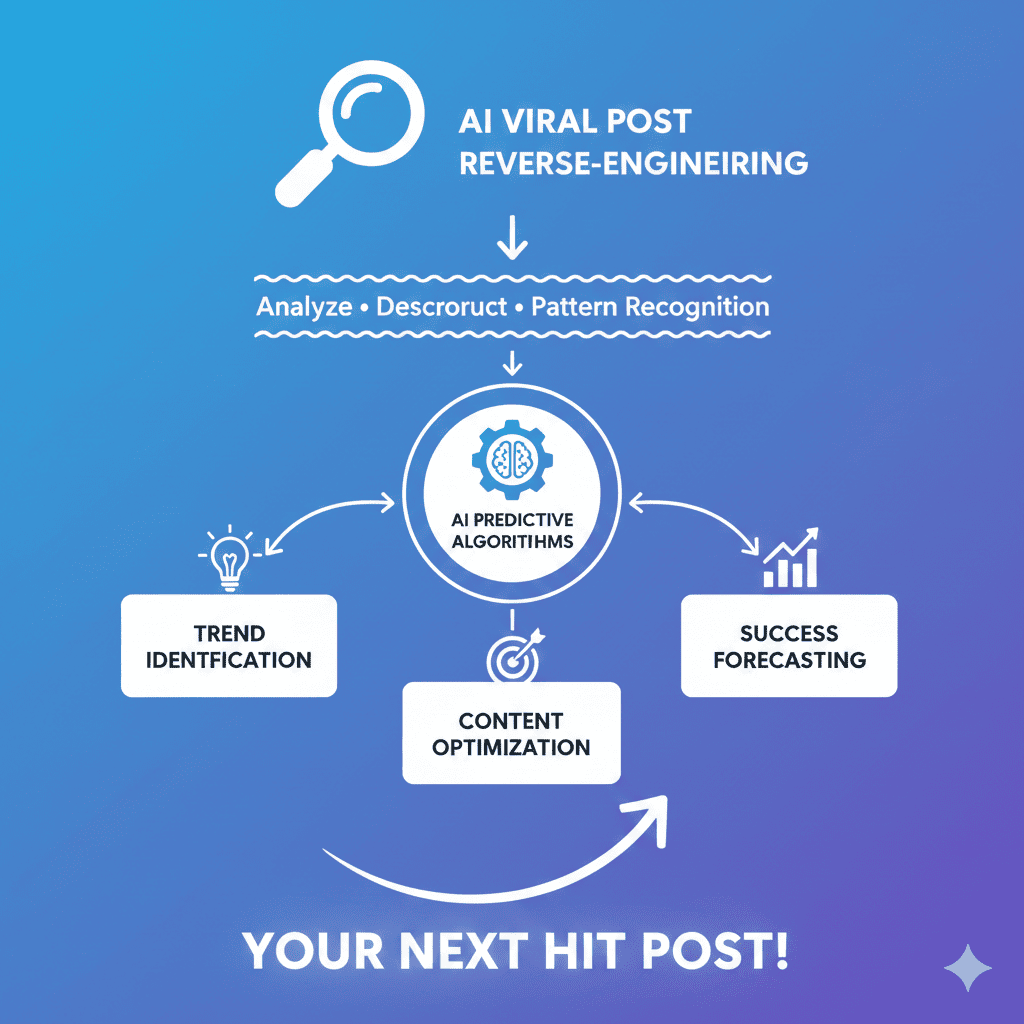
AI tools can now Reverse-Engineer Viral Posts Every content creator has experienced the mystery of virality. You spend hours crafting what you believe is brilliant content, only to watch it disappear into the void with barely a handful of views. Then, almost as an afterthought, you post something that feels unremarkable—and it explodes. Millions of views, thousands of shares, engagement that exceeds anything you’ve produced before. The question that haunts every creator is simple: why did that specific piece of content succeed while others failed?
For years, this question seemed unanswerable. Virality appeared to be part alchemy, part luck, and entirely unpredictable. But artificial intelligence is systematically dismantling this mystery. AI tools can now Reverse-Engineer Viral Posts with unprecedented precision, analyzing millions of successful content pieces to identify the patterns, structures, and elements that drive massive engagement. More remarkably, these same tools can predict which of your content ideas has the highest probability of going viral before you invest time creating it.
This transformation represents a fundamental shift from intuition-based content creation to data-driven strategy. The creators and brands winning in today’s attention economy aren’t just more creative or luckier—they’re leveraging AI to understand what works and why, then systematically applying those insights to produce content with significantly higher success rates. The playing field hasn’t been leveled, but the rules have become visible to anyone willing to use the right tools.
1. Understanding the Anatomy of Viral Content
Before AI can reverse-engineer viral posts, it must understand what makes content spread. This understanding has evolved far beyond simple rules like “be entertaining” or “trigger emotions.”
The Psychological Triggers
AI analysis reveals that viral content consistently activates specific psychological responses. High-arousal emotions—whether positive like awe and excitement or negative like anger and anxiety—drive sharing far more effectively than low-arousal emotions like contentment or sadness. Content that makes people feel something intensely gets shared because sharing becomes a form of emotional release or social signaling.
The AI identifies which emotional triggers appear in viral content, how intensely those emotions are evoked, and at what points in the content they’re activated. A viral video might build curiosity in the first three seconds, deliver surprise at the seven-second mark, then conclude with satisfaction. These emotional arcs aren’t random—they follow patterns AI can map and replicate.
The Structural Elements
Beyond emotion, viral content follows structural patterns. Successful posts have optimal length ranges that vary by platform and format. They employ specific hooks in the opening seconds or sentences. They use particular pacing rhythms that maintain attention. They incorporate visual or linguistic patterns that make content more memorable and shareable.
Tools that Reverse-Engineer Viral Posts can identify these structural elements with precision—not just that a hook matters, but exactly what types of hooks work for specific audiences and contexts. The AI recognizes that a successful hook for financial advice content differs fundamentally from a hook for entertainment content, and it can specify those differences.
The Timing and Context Factors
Virality doesn’t exist in a vacuum. The same content posted at different times or in different contexts produces vastly different results. AI analysis reveals how time of day, day of week, current events, trending topics, and seasonal factors influence content performance. It identifies narrow windows when specific content types have dramatically higher viral potential.
The AI also recognizes how platform algorithms favor certain content types at particular moments. When a platform changes its algorithm to prioritize a specific format or topic, AI tools detect this shift quickly and help creators adapt before the opportunity closes.
The Network Effects
Content doesn’t go viral alone—it requires network amplification. AI analysis maps how successful content moves through networks, identifying the critical early engagement that triggers algorithmic promotion, the influencer shares that provide credibility and reach, and the community dynamics that sustain momentum.
By understanding these network patterns, AI can predict which content has the structural characteristics to trigger cascading shares versus content that might perform well but plateau quickly.
2. How AI Analyzes Millions of Posts to Find Patterns
The power of AI to Reverse-Engineer Viral Posts comes from its ability to analyze content at a scale impossible for human researchers.
Multi-Modal Content Analysis
Advanced AI doesn’t just read text or watch videos—it analyzes all content dimensions simultaneously. For video content, this means examining visual composition, audio patterns, pacing, text overlays, and how these elements interact. For written content, it means analyzing word choice, sentence structure, readability, formatting, and embedded media.
The AI identifies patterns like: viral cooking videos consistently show the finished dish in the first three seconds, use overhead camera angles, and include satisfying transformation moments. Or that viral Twitter threads begin with a provocative statement, use specific paragraph lengths, and incorporate numbered lists at predictable intervals.
Engagement Pattern Recognition
Beyond the content itself, AI analyzes engagement patterns—how quickly posts gain traction, what types of comments they generate, how sharing patterns evolve, and when momentum peaks and declines. These engagement signatures reveal which content has staying power versus fleeting attention.
The AI can distinguish between content that spikes quickly then dies, content that builds gradually to massive reach, and content that generates sustained engagement over days or weeks. Each pattern suggests different content strategies and success definitions.
Audience Segmentation and Preferences
AI tools segment audiences by engagement behavior, identifying distinct groups with different content preferences. One segment might respond to educational content with specific production values, while another engages primarily with entertainment content featuring particular humor styles.
AI tools can now Reverse-Engineer Viral Posts This segmentation allows the AI to predict not just whether content might go viral generally, but whether it will resonate with specific audience segments you care about reaching. You might optimize for maximum reach or for reaching a specific high-value demographic—the AI can guide both strategies.
Competitive Benchmarking
By analyzing your competitors’ most successful content alongside broader viral trends, AI identifies what works specifically in your niche versus what works generally. This competitive intelligence reveals which tactics are becoming saturated, which remain underutilized, and where opportunity gaps exist.
The analysis might reveal that while a specific content format is working exceptionally well for major competitors, it’s not yet widely adopted by smaller creators—suggesting a window to gain early-adopter advantages before the approach becomes commoditized.
3. Essential AI Tools for Viral Content Analysis
Different AI tools excel at different aspects of viral content analysis, and understanding which tools serve which purposes helps you build an effective analysis system.
Social Media Analytics Platforms
Advanced social listening and analytics platforms use AI to track trending content across platforms. Tools like Brandwatch, Sprout Social, and Hootsuite Insights identify what’s gaining traction, analyze why specific posts succeed, and surface patterns in viral content relevant to your niche.
These platforms excel at real-time monitoring—showing you what’s working right now across your industry, competitors, or chosen topics. The AI flags emerging trends before they peak, giving you time to create related content while the topic is hot but not yet saturated.
Video Intelligence Tools
For video-focused creators, specialized tools like Vidooly, Tubular Labs, and various YouTube analytics AI can analyze successful videos frame-by-frame. These systems identify which thumbnails drive clicks, which opening sequences retain viewers, where audience attention drops, and what content structures maximize watch time and sharing.
The tools can analyze thousands of successful videos in your niche to identify patterns in length, pacing, visual style, topic coverage, and optimization techniques. This analysis transforms successful video creation from guesswork to systematic application of proven patterns.
Text and Copy Analysis AI
For written content, AI writing assistants and analysis tools examine successful posts across platforms to understand language patterns. These tools identify which headline structures drive clicks, which opening paragraphs retain readers, what readability levels work best, and which calls-to-action generate responses.
Tools like Copy.ai, Jasper, and specialized headline analyzers use machine learning trained on millions of successful posts to predict how your content will perform before you publish. The AI doesn’t just tell you what’s wrong—it suggests specific improvements based on what’s worked for similar content.
Cross-Platform Trend Aggregators
Some tools specialize in identifying trends that span multiple platforms simultaneously. When a topic, format, or meme gains traction across Twitter, TikTok, Instagram, and YouTube concurrently, it signals genuine cultural momentum rather than platform-specific phenomena.
Tools like Exploding Topics, TrendHunter, and various AI-powered trend dashboards help you spot these cross-platform moments when creating related content has the highest viral potential. The AI’s ability to Reverse-Engineer Viral Posts across platforms reveals universal principles versus platform-specific tactics.
Predictive Content Scoring Systems
The most advanced tools don’t just analyze past viral content—they score your proposed content before you create it. These systems evaluate your topic, proposed angle, target audience, and content format to predict viral probability.
While no tool predicts virality with perfect accuracy, these scoring systems significantly improve your odds by flagging when your content idea aligns with proven success patterns versus when it deviates in ways that typically reduce performance.
4. Practical Applications: From Analysis to Action
Understanding viral patterns only matters if you can apply those insights to create more successful content consistently.
The Viral Blueprint Method
Use AI analysis to create blueprints for different content types. For your niche, what structure do successful posts follow? Analyze 100 viral posts in your category, identify common patterns, and document them as templates. Your blueprint might specify: hooks that work, optimal content length, pacing rhythm, visual style, emotional arc, and calls-to-action.
These blueprints become starting points for new content creation. Rather than beginning from scratch, you start with a structure proven to work, then add your unique perspective, information, or creativity. This approach doesn’t make content formulaic—it ensures you’re building on a solid foundation rather than hoping your experimental structure happens to work.
The Hook Optimization Process
AI analysis consistently shows that the first few seconds or sentences determine success. Use AI tools to test multiple hook variations before committing to content creation. The tools can predict which hooks will capture attention based on successful patterns.
For video content, test different opening shots, first statements, or visual hooks. For written content, test headlines, opening questions, or lead paragraphs. The AI feedback helps you select the hook with highest predicted performance before you invest time in full content development.
The Trend Alignment Strategy
AI tools that Reverse-Engineer Viral Posts reveal how successful creators align their content with trending topics without seeming opportunistic or off-brand. The AI identifies which trends relate to your niche, how to angle them toward your expertise, and when trend momentum makes creation timely.
This isn’t about chasing every viral moment, but about strategically engaging with trends when doing so serves your audience and brand while capitalizing on existing attention and algorithmic momentum.
The Audience Response Prediction
Before publishing, use AI to predict how different audience segments will respond. The tools can forecast which content will resonate with your core audience versus which might attract new viewers, which will generate high engagement versus passive consumption, and which might trigger controversy or negative reactions.
This prediction allows you to make informed decisions about content strategy—sometimes you want broad appeal, sometimes you want to deepen connection with your core audience, and sometimes you’re willing to accept polarization for stronger resonance with your target segment.
5. Platform-Specific Viral Patterns
Each social platform has distinct characteristics that influence what content succeeds, and AI analysis of Reverse-Engineer Viral Posts reveals these platform-specific patterns.
TikTok and Short-Form Video
TikTok’s algorithm favors content that hooks viewers in the first second, maintains engagement throughout, and triggers completion plus replay. AI analysis reveals that viral TikTok content often uses specific audio tracks, follows trending formats, incorporates text overlays strategically, and delivers payoff that makes viewers want to share.
The AI identifies which transitions, effects, pacing rhythms, and content structures work best. It recognizes that TikTok success often comes from executing familiar formats with unique angles rather than creating entirely novel content—the platform rewards recognition combined with novelty.
Instagram and Visual Storytelling
Instagram’s multiple format options—feed posts, Reels, Stories, carousels—each have distinct viral patterns. AI analysis shows successful feed posts use specific visual aesthetics, carousel posts follow particular narrative structures, and Reels that succeed combine Instagram’s visual culture with TikTok-style engagement hooks.
The tools identify which color palettes, composition styles, caption lengths, and hashtag strategies correlate with high performance. They reveal how successful creators balance aesthetic consistency with algorithmic optimization.
Twitter and Conversation Starting
Twitter virality often stems from starting conversations rather than broadcasting information. AI analysis reveals that viral tweets use specific structural patterns—provocative statements followed by explanation, numbered lists that promise valuable information, or questions that invite response.
The tools identify which topics generate discussion in your niche, what opinion angles create engagement without toxicity, and how thread structure influences reading completion and sharing rates. They show how successful creators balance brevity with depth.
LinkedIn and Professional Value
LinkedIn’s professional context creates distinct viral patterns. AI analysis shows successful LinkedIn content often combines personal narrative with professional insight, uses specific formatting structures, and balances vulnerability with authority.
The tools reveal which topics resonate in professional contexts, how successful creators structure long-form posts, and what types of comments and engagement successful posts generate. They identify the difference between content that gets likes versus content that generates meaningful professional discussion.
YouTube and Long-Form Engagement
YouTube success requires different optimization than short-form platforms. AI analysis examines successful videos’ thumbnails, titles, opening sequences, content pacing, retention curves, and how creators maintain engagement across longer durations.
The tools identify which video lengths work for different content types, how successful creators structure videos to maintain retention, and what optimization tactics drive both watch time and algorithmic promotion. They reveal the complex interplay between creator-focused content and algorithm-friendly optimization.
6. Avoiding the Pitfalls of AI-Driven Content Creation
While AI provides powerful insights for Reverse-Engineering Viral Posts, several pitfalls can undermine your success if you’re not careful.
The Authenticity Versus Optimization Trap
AI can tell you exactly what’s most likely to go viral, but following those patterns too rigidly produces content that feels calculated and inauthentic. Audiences increasingly recognize and reject content that prioritizes virality over genuine value or authentic expression.
The solution isn’t ignoring AI insights but using them as guides rather than rigid rules. Let AI inform your structure and optimization while ensuring your unique voice, perspective, and value proposition remain central. The most successful creators use AI to enhance their authentic content rather than replacing it with algorithmic optimization.
The Trend Chasing Exhaustion
AI tools can identify dozens of trending topics daily, creating pressure to constantly produce trend-aligned content. This approach leads to creator burnout, diminished content quality, and brand confusion as you bounce between topics without coherent strategy.
Instead, use AI to identify which trends align with your expertise and audience interests, then engage selectively. Not every trend deserves your attention, and sustainable success comes from consistent value delivery rather than exhaustive trend participation.
The Platform Algorithm Dependence
AI tools can now Reverse-Engineer Viral Posts AI insights often reflect current platform algorithms, which change frequently. Content strategies that work brilliantly today might fail after the next algorithm update. Over-optimizing for current algorithmic preferences creates fragility when those algorithms evolve.
Build sustainable audience relationships alongside algorithmic optimization. Create content that delivers genuine value, establishes direct connections with your audience, and develops distribution channels you control. Use AI to amplify your reach, but don’t make algorithmic favor your only success metric.
The Viral Vanity Metric
Not all virality serves your business or creative goals. Content might explode in reach while attracting audiences uninterested in your core offerings, damaging your brand positioning, or creating unsustainable expectations for future content.
Use AI to predict not just viral potential but audience alignment. Sometimes the content with lower predicted reach but higher predicted engagement from your target audience serves your goals better than broadly viral content that attracts the wrong viewers.
7. Building Your Viral Content System
Rather than using AI tools reactively, build a systematic approach to consistently producing high-performing content.
The Analysis Phase
Establish regular analysis routines where you use AI tools to study successful content in your niche. Weekly or bi-weekly analysis sessions keep you current on what’s working, which patterns are emerging, and where opportunities exist.
During analysis, focus on identifying actionable patterns rather than passively consuming insights. Ask: What specific techniques can I apply? Which patterns align with my brand? What opportunities are competitors missing?
The Ideation Phase
Use AI insights to inform content ideation systematically. Rather than brainstorming randomly, generate ideas at the intersection of trending topics, your expertise, proven content structures, and audience needs. AI tools can suggest content angles, identify gaps in existing coverage, and predict which ideas have highest success potential.
Create an idea bank where you collect and score potential content concepts using AI predictions. This allows you to maintain a pipeline of high-potential content rather than scrambling for ideas under deadline pressure.
The Creation Phase
During content creation, use AI tools to optimize without over-engineering. Test hooks, check readability, verify trend alignment, and predict audience response—but maintain creative flow rather than constantly second-guessing based on AI feedback.
The goal is informed creation, not paralyzed perfectionism. AI should accelerate and improve your creative process, not slow it down with excessive analysis.
The Testing and Learning Phase
After publishing, use AI analytics to understand what worked and what didn’t. Compare AI predictions to actual performance, identify where predictions were accurate versus where they missed, and refine your understanding of what drives success for your specific audience.
This continuous learning loop improves both your use of AI tools and your intuitive understanding of your audience. Over time, you develop pattern recognition that complements AI insights, making you increasingly effective at both creating and predicting successful content.
8. The Future of AI-Powered Viral Content Creation
The capability of AI to Reverse-Engineer Viral Posts continues evolving rapidly, and understanding emerging capabilities helps you prepare for the next generation of content creation tools.
Real-Time Viral Prediction
Current tools analyze past viral content and predict future performance based on historical patterns. Emerging systems will predict viral potential in real-time as content is created, offering immediate feedback and optimization suggestions during the creation process itself.
This real-time prediction allows creators to iterate rapidly, testing multiple approaches and immediately seeing predicted performance before committing to full production. The feedback loop between creation and optimization will become instantaneous.
Automated Content Variation
Advanced AI will generate multiple variations of your content concept, each optimized for different platforms, audiences, or objectives. From a single content idea, the system will produce a TikTok version, Instagram version, YouTube version, Twitter thread, and LinkedIn post—each adapted to platform-specific viral patterns while maintaining core message consistency.
This automated variation dramatically increases content output without proportionally increasing creation time, allowing you to maintain presence across multiple platforms without multiplying your workload.
Personalized Viral Strategies
Rather than generic viral patterns, AI will develop personalized strategies based on your unique brand, audience, strengths, and goals. The system will learn what works specifically for you rather than what works generally, providing increasingly tailored recommendations.
This personalization means different creators in the same niche will receive different AI guidance, each optimized for their particular situation rather than following identical formulas.
Ethical Considerations and Transparency
AI tools can now Reverse-Engineer Viral Posts As AI becomes more powerful at engineering virality, questions about manipulation, authenticity, and transparency will intensify. Future tools will likely include ethical frameworks, transparency features, and guidelines for responsible use of viral content engineering.
The most successful creators will be those who use AI capabilities responsibly—enhancing genuine value rather than manufacturing empty engagement, respecting audience intelligence rather than exploiting psychological vulnerabilities.
Conclusion
The ability of AI to Reverse-Engineer Viral Posts represents one of the most significant shifts in content creation since social media itself emerged. What once seemed like mysterious alchemy—why some content explodes while similar content languishes—is becoming increasingly transparent and predictable. The patterns exist, they can be identified, and they can be systematically applied to improve your content performance dramatically.
This doesn’t mean every post will go viral if you follow AI guidance. Virality remains partly probabilistic, influenced by timing, context, and factors beyond anyone’s control. But the difference between hoping for virality through luck and systematically improving your odds through data-driven insights is substantial. Creators using these tools consistently outperform those relying solely on intuition, not because AI replaces creativity but because it amplifies and focuses creative effort on approaches most likely to succeed.
The democratization of these insights means that creators without massive budgets or industry connections can compete with established players by being smarter about content strategy. The tools that were once available only to major brands with expensive analytics teams are now accessible to individual creators willing to invest time in learning and application.
Success in this environment requires balancing AI insights with authentic creativity, using data to inform rather than dictate content decisions, and maintaining focus on genuine audience value rather than empty engagement metrics. The creators who thrive will be those who master this balance—leveraging AI to Reverse-Engineer Viral Posts while preserving the unique voice, perspective, and value that makes their content worth sharing in the first place.
The future of content creation isn’t human versus AI but human and AI working in concert—combining human creativity, judgment, and authenticity with AI’s pattern recognition, predictive power, and optimization capabilities. Those who embrace this partnership position themselves to create not just more viral content but more meaningful connections with audiences who genuinely value what they produce.
Also read this:
AI Tools That Find Business Opportunities in Any Niche
How AI Turns Five-Minute Ideas Into Full Projects
How AI Creates Cinematic Scenes Without a Film Crew: The Future of Visual Storytelling