
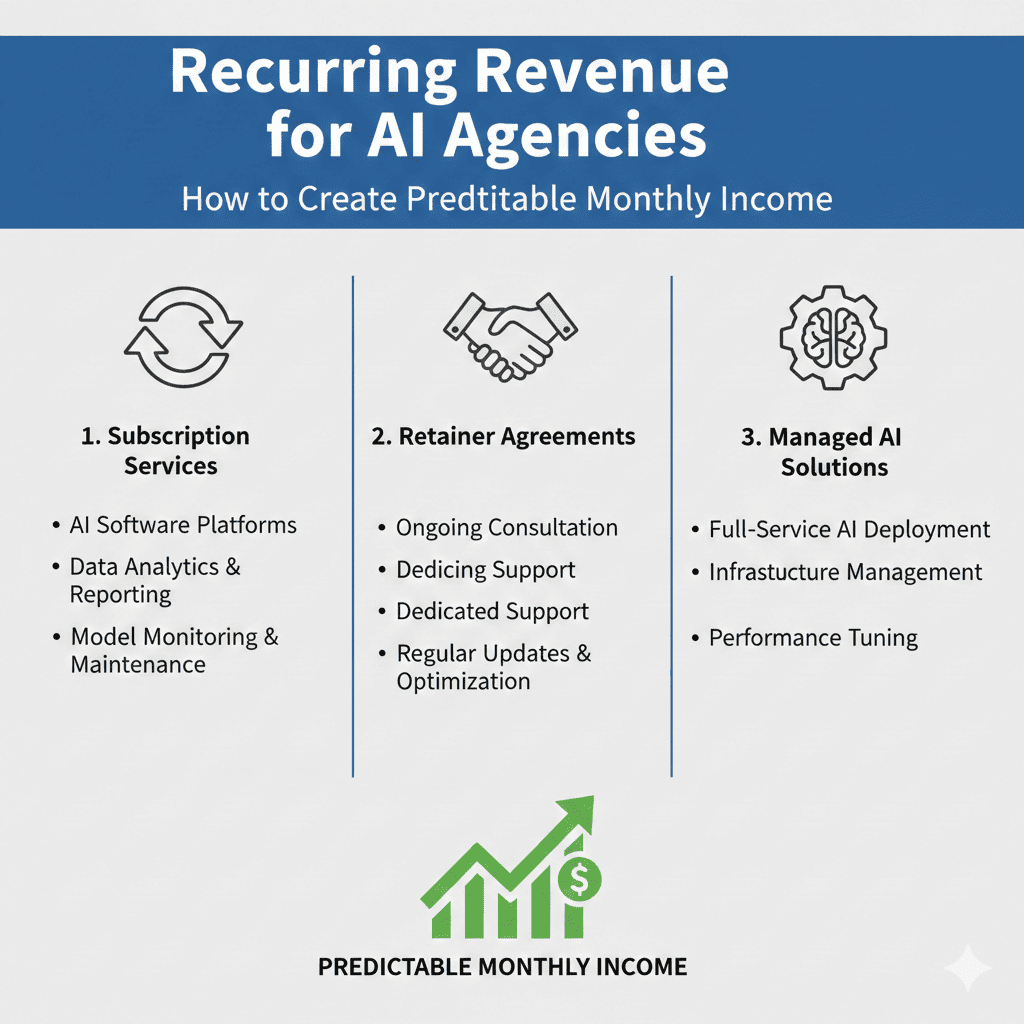
recurring revenue for AI agencies, The feast-or-famine cycle destroys more AI agencies than any technical challenge ever will. One month you’re celebrating a six-figure project win, and the next you’re scrambling to cover payroll. The stress of unpredictable income makes it nearly impossible to plan for growth, hire confidently, or sleep peacefully.
The solution isn’t landing bigger projects or working harder—it’s fundamentally restructuring how your agency generates income. When you establish recurring revenue for AI agencies, you transform your business from a perpetual sales machine into a stable, scalable operation with predictable cash flow.
This comprehensive guide reveals exactly how to build recurring revenue streams that provide consistent monthly income while delivering ongoing value to your clients. You’ll learn proven models, implementation strategies, and pricing approaches that turn one-time projects into long-term client relationships.
1. Understanding the Recurring Revenue Advantage
Before diving into specific models, it’s essential to understand why recurring revenue for AI agencies is not just beneficial—it’s transformational.
The compounding effect of monthly recurring revenue
Unlike project-based work where you reset to zero each month, recurring revenue compounds. Start the year with ten clients paying $5,000 monthly, and you begin January with $50,000 already secured. Add five clients per quarter while maintaining 90% retention, and by December you’re starting the month with $162,500 in guaranteed revenue.
This compounding effect creates exponential business growth. Each new client adds to your baseline rather than simply replacing completed projects. The math becomes incredibly powerful over time.
Predictability enables strategic growth
When you know your monthly baseline revenue, you can make confident decisions about hiring, investing in tools, expanding marketing, and pursuing growth opportunities. You’re no longer making critical business decisions based on whether a proposal closes this week or next month.
Higher business valuation
Businesses with recurring revenue command significantly higher valuations than project-based agencies. Investors and acquirers pay premium multiples for predictable revenue streams. If exit strategy matters to you, recurring revenue directly impacts your agency’s worth.
Deeper client relationships
Ongoing engagements create stronger relationships than one-off projects. You understand client businesses more deeply, deliver better results over time, and become harder to replace. These relationships also generate more referrals and expansion opportunities.
2. AI Monitoring and Optimization Services
The most natural recurring revenue model for AI agencies is ongoing monitoring and optimization of implemented AI systems.
Why AI systems require continuous attention
AI implementations aren’t “set it and forget it” solutions. Models drift over time as data patterns change. Systems require regular retraining with fresh data. Performance degrades without monitoring. New edge cases emerge that need handling. This reality creates perfect conditions for recurring revenue for AI agencies.
Structuring monitoring retainers
Offer tiered monitoring packages based on system complexity and criticality. A basic tier might include weekly performance reviews, monthly optimization updates, and quarterly model retraining. Premium tiers add daily monitoring, immediate issue response, and continuous optimization.
Price these retainers as a percentage of project value (typically 15-25% monthly) or as fixed fees based on system complexity. For a $50,000 AI implementation, a monitoring retainer of $7,500-$12,500 monthly is entirely reasonable given the value protection it provides.
What to include in monitoring services
Comprehensive monitoring packages should cover performance tracking across key metrics, data quality monitoring and anomaly detection, model accuracy verification and drift detection, system uptime and reliability monitoring, regular retraining with updated datasets, optimization based on new usage patterns, monthly reporting with insights and recommendations, and priority support for issues and questions.
Selling ongoing optimization
recurring revenue for AI agencies, Frame monitoring services as insurance for the client’s AI investment. Emphasize that AI systems without ongoing optimization degrade rapidly, competitors continuously improve their implementations, and the business environment constantly evolves requiring adaptation. Position your monitoring service as the difference between a static implementation and a continuously improving competitive advantage.
3. AI-Powered Software as a Service
Building vertical SaaS products represents one of the highest-value approaches to generating recurring revenue for AI agencies.
Identifying SaaS opportunities in your niche
Look for repetitive problems you’ve solved multiple times for different clients. If you’ve built similar AI solutions for five law firms, ten medical practices, or a dozen e-commerce stores, you have a SaaS opportunity.
The ideal SaaS product solves a specific problem for a defined market, requires minimal customization per client, generates measurable ROI that justifies monthly fees, and leverages your existing AI expertise and assets.
Transitioning from custom development to productized software
Start by identifying the 80% of functionality that’s identical across clients in your niche. Build this as a core product that can be deployed quickly. Offer the remaining 20% of customization either as implementation services or premium features.
This hybrid approach lets you generate recurring SaaS revenue while still monetizing your customization expertise. A client might pay $2,000 monthly for the core software plus a $15,000 implementation fee for integration and customization.
Pricing SaaS for AI agencies
AI-powered SaaS products typically command premium pricing compared to traditional software because they deliver automated intelligence rather than just automation. Price based on the value delivered, not development cost.
Consider tiered pricing models based on usage volume (processing 10,000 vs. 100,000 records monthly), feature access (basic AI capabilities vs. advanced analytics), or business size (small business vs. enterprise). Annual contracts with monthly payment options improve cash flow and reduce churn.
Marketing your vertical SaaS
Leverage your existing agency reputation to drive early adoption. Case studies from previous custom work validate your solution. Your thought leadership attracts inbound interest. Consider offering founding customer discounts in exchange for testimonials and referrals.
4. Managed AI Services and Done-For-You Solutions
Managed services represent a powerful middle ground between project work and full SaaS products for generating recurring revenue for AI agencies.
Designing managed service packages
Managed services bundle AI technology with human expertise and ongoing execution. Rather than implementing a system and handing it off, you continue running and optimizing it on behalf of clients.
Examples include managing AI-powered content creation workflows, running AI-driven marketing campaigns, operating AI customer service systems, or executing AI-based data analysis and reporting.
Pricing models for managed services
Use either fixed monthly retainers for defined service levels or performance-based pricing tied to results. A managed AI content service might charge $8,000 monthly for a set volume of content, or $5,000 base plus bonuses for achieving engagement metrics.
Performance-based pricing aligns incentives beautifully but requires more sophisticated tracking and reporting. Fixed retainers provide more predictable revenue but may require volume caps to maintain profitability.
Scaling managed services profitably
The key to profitable managed services is systematization. Document every process, create templates and frameworks, leverage automation wherever possible, and train team members to handle delivery consistently.
Consider a hub-and-spoke model where senior AI specialists oversee multiple accounts while junior team members handle routine tasks. This leverages expertise efficiently while maintaining quality.
Communicating ongoing value
Managed services clients need regular reinforcement of the value you’re delivering. Provide comprehensive monthly reports showing work completed, results achieved, comparisons to baseline metrics, and strategic recommendations for improvement.
Schedule quarterly business reviews to discuss performance, align on goals, and identify expansion opportunities. These touchpoints reduce churn while creating natural upsell moments.
5. AI Training and Advisory Subscriptions
Educational and advisory services create high-margin recurring revenue streams that leverage your expertise without requiring proportional time investment.
Developing subscription-based training programs
Create comprehensive training programs that teach teams how to work effectively with AI systems, leverage AI in their daily workflows, or implement AI strategies in their organizations. Deliver training through monthly webinars, video content libraries, live Q&A sessions, and private community access.
Price these subscriptions based on team size and access level. A small team subscription might be $500 monthly while enterprise access could be $5,000+ monthly.
Structuring advisory retainers
Offer ongoing strategic advisory services where clients get regular access to your expertise for planning AI initiatives, reviewing vendor proposals, troubleshooting implementation challenges, and staying current on AI developments relevant to their industry.
Package advisory retainers with defined hours (10 hours monthly), availability commitments (48-hour response time), and deliverables (monthly strategy memo, quarterly planning session).
Creating AI strategy memberships
Launch membership programs that provide ongoing education, frameworks, and support for companies navigating AI adoption. Members receive monthly training content, template libraries, assessment tools, peer networking opportunities, and expert office hours.
recurring revenue for AI agencies This model works particularly well when combined with your agency’s other services. Members get education and light support through the membership, then hire your agency for implementation when they’re ready.
Building scalable knowledge products
The beauty of training and advisory subscriptions is scalability. Create once, deliver many times. Record webinars, build template libraries, develop assessment frameworks, and document methodologies that serve multiple clients simultaneously.
6. White Label AI Solutions for Partners
Creating white label products that other agencies and consultants can resell generates recurring revenue for AI agencies while multiplying your market reach.
Identifying white label opportunities
Look for complementary service providers who serve your target market but lack AI capabilities. Marketing agencies, business consultants, IT service providers, and industry-specific software vendors are all potential partners.
Your white label solution lets them offer AI capabilities to their clients without building internal expertise. They maintain the client relationship while you provide the technology and support.
Structuring white label partnerships
Typical arrangements include monthly licensing fees, revenue sharing on client subscriptions, or hybrid models combining both. A partner might pay $2,000 monthly for access to your platform plus 40% of client revenue they generate.
Provide partners with sales materials, training on your solutions, technical support, and white label versions of your tools. The goal is making it effortlessly easy for partners to sell and deliver your solutions under their brand.
Supporting partner success
White label success requires treating partners as true clients. Provide comprehensive onboarding, regular training updates, responsive technical support, and dedicated partner success management.
Create partner tiers with increasing benefits to incentivize growth. Bronze partners might get basic support while Platinum partners receive priority assistance, higher revenue shares, and co-marketing opportunities.
Scaling through channels
A successful white label program can dramatically scale your revenue. Ten partners each managing twenty client subscriptions creates 200 recurring revenue streams without your agency handling direct client relationships.
This channel leverage lets smaller agencies achieve enterprise-scale revenue while maintaining focus on product excellence rather than client management.
7. Data Services and AI Infrastructure
Providing ongoing data management and AI infrastructure services creates sticky technical relationships that generate consistent recurring revenue for AI agencies.
Offering data pipeline management
Many organizations need ongoing help collecting, cleaning, processing, and managing data that feeds their AI systems. Offer managed data services that ensure high-quality data flows continuously.
This might include web scraping and data collection, data cleaning and normalization, database management and optimization, API integrations and data synchronization, or data quality monitoring and validation.
Providing AI infrastructure services
Managing the technical infrastructure that runs AI systems creates valuable recurring relationships. Services could include model hosting and deployment, API management and scaling, performance optimization, security and compliance management, or backup and disaster recovery.
Price infrastructure services based on usage metrics (API calls, processing volume, storage) or as fixed monthly management fees. These technical services are often less price-sensitive than strategic services since they’re critical to operations.
Creating data-as-a-service offerings
If you’ve aggregated valuable datasets in your niche, package them as subscription products. A market intelligence database, competitive tracking data, or industry benchmark dataset can generate substantial recurring revenue.
Data-as-a-service works particularly well when combined with AI-powered analysis. Raw data alone is valuable, but data plus automated insights is transformative.
Building switching costs
Infrastructure and data services create significant switching costs. Migrating away from your systems requires substantial effort and risk. This technical stickiness translates into high retention rates and predictable long-term revenue.
8. AI Audit and Compliance Services
The growing focus on AI governance, ethics, and compliance creates opportunities for recurring recurring revenue for AI agencies through ongoing audit and compliance services.
Developing AI governance frameworks
Organizations implementing AI need frameworks for responsible deployment. Offer subscription services that provide governance documentation, policy templates, compliance checklists, risk assessment frameworks, and regular updates as regulations evolve.
This is particularly valuable in regulated industries like healthcare, finance, and legal services where AI compliance is critical.
Offering ongoing compliance monitoring
Provide services that continuously monitor AI systems for bias, fairness issues, regulatory compliance, security vulnerabilities, and performance degradation. Generate regular compliance reports and provide remediation recommendations.
Monthly compliance retainers range from $3,000 for basic monitoring to $20,000+ for comprehensive enterprise programs.
Conducting regular AI audits
Offer quarterly or annual comprehensive AI audits that assess model performance, data quality and bias, security and privacy practices, documentation adequacy, and compliance with evolving regulations.
Package audits as annual subscriptions that include multiple audit cycles plus ongoing support. This creates predictable annual revenue while delivering genuine value.
Positioning compliance as ongoing necessity
AI regulations are evolving rapidly. What’s compliant today might be problematic tomorrow. Position your compliance services as essential ongoing protection rather than one-time assessment.
Emphasize that the cost of non-compliance—legal risk, reputational damage, system failures—far exceeds the investment in ongoing monitoring.
9. Hybrid Models: Combining Project and Recurring Revenue
The most successful agencies don’t choose between project work and recurring revenue—they strategically combine both to maximize recurring revenue for AI agencies while maintaining flexibility.
The land-and-expand approach
Start client relationships with project work that solves immediate needs, then transition to recurring services for ongoing optimization and expansion. A $75,000 implementation project leads to $8,000 monthly monitoring and optimization services.
This approach is easier to sell since clients understand one-time projects. The recurring component is positioned as natural extension rather than initial commitment.
Building recurring components into projects
Structure initial proposals to include ongoing phases from the start. A chatbot implementation might include development (months 1-2), optimization period (months 3-6), and ongoing management (month 7+).
This creates expectation of continuity from the beginning rather than trying to sell continuation later.
Creating success-based transitions
Once initial project results are proven, transition successful implementations to performance-based recurring arrangements. A lead generation AI that proved effective in pilot mode becomes a managed service with ongoing optimization and scaling.
Success creates momentum for continuation that doesn’t exist before results materialize.
Packaging project credits with retainers
Offer retainer packages that include monthly services plus quarterly project credits. A client paying $10,000 monthly might get ongoing optimization plus $30,000 in annual project work for new initiatives.
This hybrid model provides recurring baseline while creating opportunities for additional project revenue.
10. Implementing Your Recurring Revenue Strategy
Understanding models is meaningless without systematic implementation. Here’s how to actually transition your agency to generate predictable recurring revenue for AI agencies.
Assessing your current client base
Review existing clients and completed projects to identify recurring revenue opportunities. Which implementations need ongoing monitoring? Which clients have additional needs you could serve with subscriptions? Which successful projects could become productized offerings?
Create a spreadsheet listing every current and past client, services delivered, potential recurring opportunities, and estimated monthly revenue potential.
Choosing your initial focus
Don’t try implementing every model simultaneously. Choose 1-2 recurring revenue streams to launch first based on your existing expertise, client demand, implementation complexity, and revenue potential.
Your first recurring offering should leverage existing capabilities rather than requiring significant new development.
Developing packaging and pricing
Create clear service packages with defined deliverables, service levels, and pricing. Avoid custom pricing initially—standardized packages are easier to sell and deliver.
Test pricing with a small group before broad launch. You can always adjust based on market response, but starting too low is difficult to correct later.
Creating transition offers for existing clients
Develop special transition offers for current clients to move them to recurring arrangements. This might include discounted first-month pricing, waived setup fees, or bonus services for annual commitments.
Existing clients are your easiest recurring revenue conversions since they already trust your capabilities.
Training your team on recurring sales
Selling recurring services requires different skills than project sales. Train your team to focus on long-term value, emphasize ongoing relationships over transaction, handle objections about ongoing costs, and demonstrate ROI across extended timeframes.
Role-play common scenarios and develop sales materials specifically for recurring offerings.
Building delivery systems for scale
Document processes for delivering recurring services consistently and efficiently. Create client onboarding workflows, regular reporting templates, service delivery checklists, and quality control procedures.
Systematization is essential for profitably scaling recurring revenue.
Measuring and optimizing key metrics
Track monthly recurring revenue (MRR), customer acquisition cost (CAC), customer lifetime value (LTV), churn rate, and expansion revenue. These metrics tell you whether your recurring model is sustainable and profitable.
Set targets for each metric and review progress monthly. Optimize relentlessly—small improvements in retention or expansion revenue compound dramatically over time.
Making the Transition: Your Action Plan
Transitioning from project-based to recurring revenue doesn’t happen overnight, but you can start immediately with these steps.
This week, audit your existing client relationships for recurring opportunities. Choose one recurring revenue model to implement first. Draft initial service packages and pricing for your chosen model. Identify three existing clients to approach with transition offers.
Next month, create sales materials and case studies for recurring services. Train your team on consultative recurring sales approaches. Launch your first recurring offering to existing clients. Document delivery processes for consistent service execution.
Within 90 days, achieve your first $10,000-25,000 in monthly recurring revenue. Refine your offering based on client feedback and delivery experience. Begin developing your second recurring revenue stream. Build systematic processes that support scaling.
The goal isn’t replacing project revenue immediately—it’s building recurring revenue baseline that grows monthly while project work continues. As recurring revenue increases, you gain freedom to be more selective about project work, focus on higher-value initiatives, and build a more sustainable agency.
The Long-Term Vision
Imagine starting each month with 70-80% of your revenue goal already secured through recurring contracts. Imagine making hiring decisions based on growth trajectory rather than current project pipeline. Imagine building an agency that runs smoothly whether you’re actively selling or taking time off.
This is the reality that recurring revenue for AI agencies creates. It’s not theoretical—agencies of all sizes are building these models successfully right now.
The opportunity in AI services is unprecedented, but capturing it requires moving beyond the project-based mindset. Recurring revenue transforms your agency from a perpetual hustle into a valuable, scalable asset that generates predictable income month after month.
Your expertise is valuable enough that clients should pay for ongoing access to it. Your AI implementations deliver enough continuous value to justify monthly fees. Your industry knowledge warrants subscription-based advisory relationships.
The question isn’t whether you can build recurring revenue for AI agencies—it’s whether you’ll commit to the strategic shift required to make it happen. Start with one model. Prove it works. Scale it systematically. Add additional streams over time.
Six months from now, you could be starting each month with tens of thousands in guaranteed revenue, or you could still be chasing the next project. The choice, and the implementation, is entirely up to you.
Also read this:
How to Build Authority as a Niche AI Agency (Step-by-Step Strategy)
Selling AI Services as an Agency: The Complete Client-Acquisition Playbook
How to Build an AI Freelance Portfolio Without Any Past Projects (Beginner Guide)