
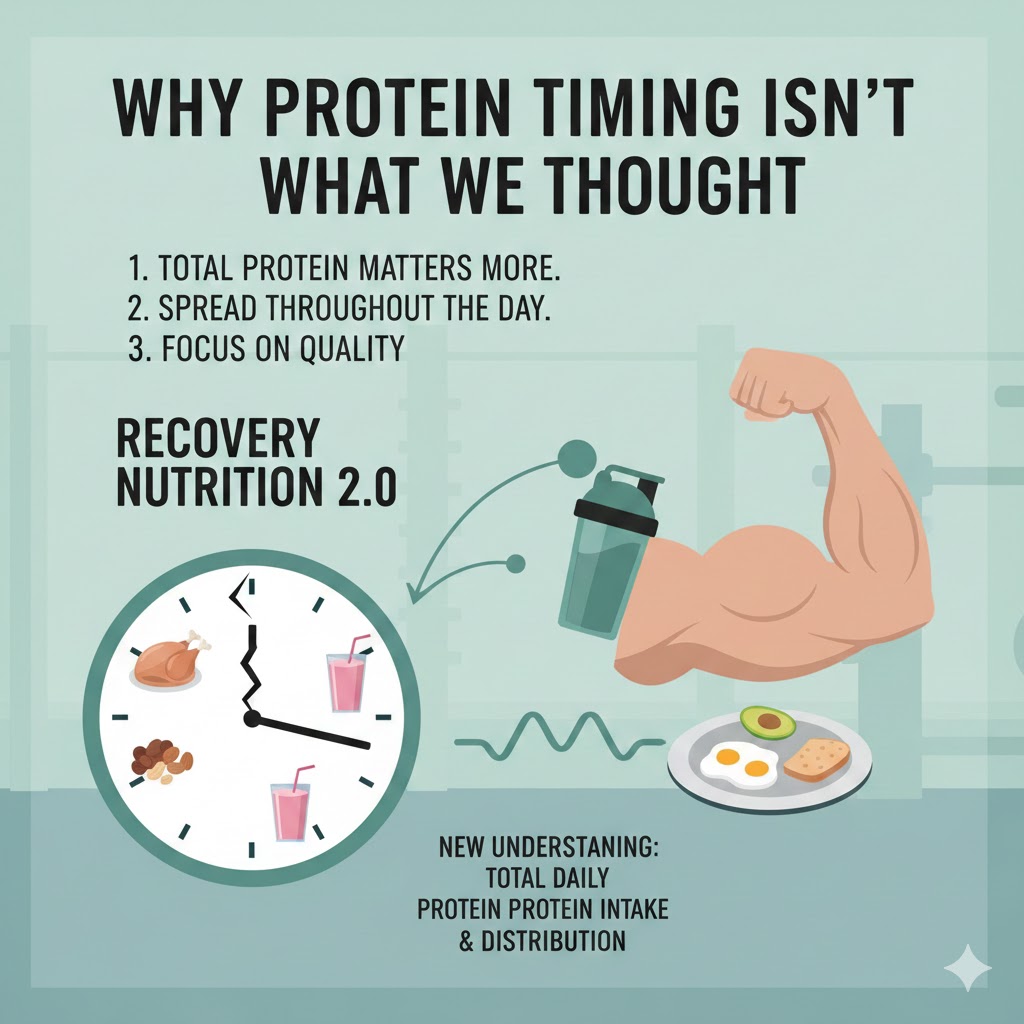
For years, athletes were told one thing over and over again: drink your protein shake within 30 minutes after training or you’ll miss the gains. This so-called “anabolic window” became fitness gospel. Gyms sold shakes at the front desk, alarms were set, and workouts ended in a rush to refuel.
But science has quietly rewritten that story.
Welcome to Recovery Nutrition 2.0—a smarter, more flexible understanding of how recovery actually works. Protein still matters. Timing still matters. But not in the narrow, stressful way we once believed.
This new approach shifts the focus from panic-driven timing to total intake, digestion speed, training context, and recovery quality. Let’s break down what changed and what it means for your training.
1. The Old Protein Timing Rule—and Why It Stuck
The original idea behind strict protein timing was simple: muscles are more sensitive to nutrients immediately after exercise. Consume protein quickly, spike muscle protein synthesis, recover faster.
This concept worked well in controlled lab settings, which is why it spread so fast.
But real-life training is messier than labs:
- People eat mixed meals
- Digestion takes hours, not minutes
- Training frequency matters more than one shake
Recovery Nutrition 2.0 doesn’t deny post-workout nutrition—it corrects the exaggeration.
2. What New Research Actually Shows
Modern studies reveal something critical:
Muscle protein synthesis remains elevated for 24–48 hours after training.
That means:
- Your muscles don’t “shut off” recovery after 30 minutes
- Protein eaten later still contributes to repair
- The body responds to overall availability, not a stopwatch
In short, the anabolic window is much wider than we thought.
This is the scientific backbone of Recovery Nutrition 2.0.
3. Total Daily Protein Matters More Than Exact Timing
One of the strongest findings in recent nutrition research is this:
Total daily protein intake has a bigger impact on recovery than precise timing.
Athletes who:
- Hit their daily protein targets
- Spread intake across meals
- Consistently fuel training
Recover just as well—or better—than those obsessing over post-workout shakes.
Protein timing is now considered secondary, not primary.
4. Protein Distribution Beats Protein Urgency
Instead of rushing protein immediately post-workout, Recovery Nutrition 2.0 focuses on distribution.
The ideal pattern looks like:
- Protein every 3–5 hours
- Moderate doses per meal
- Consistent intake across the day
This keeps muscle protein synthesis elevated repeatedly, rather than spiking once and crashing.
It’s not about one perfect moment—it’s about sustained support.
5. The Role of Pre-Workout Protein (Often Ignored)
Here’s a surprising insight:
Protein eaten before training can still be digesting after training.
If you ate a balanced meal 1–3 hours pre-workout:
- Amino acids are still circulating
- Muscles are already supplied
- The “urgent” post-workout need decreases
This is a core reason why strict timing rules collapsed under scrutiny—and why Recovery Nutrition 2.0 emphasizes context over dogma.
6. Carbs, Calories, and Recovery Matter Too
Protein doesn’t work in isolation.
Recovery depends on:
- Sufficient calories
- Adequate carbohydrates
- Hormonal balance
Low energy availability can blunt muscle repair—even with perfect protein timing.
Recovery Nutrition 2.0 treats recovery as a system, not a single nutrient hack.
7. When Protein Timing Still Matters
While the old rules were overhyped, timing isn’t useless.
Protein timing still matters when:
- Training fasted
- Doing multiple sessions per day
- Training with long gaps between meals
- Recovery time is limited
In these cases, post-workout protein becomes more relevant—but still not urgent to the minute.
8. Strength vs Endurance: Different Needs, Same Principle
Strength athletes benefit from:
- Higher total protein
- Even distribution
- Adequate carbs for training quality
Endurance athletes benefit from:
- Protein + carbs for muscle repair
- Energy balance to avoid breakdown
- Consistency across training days
Both groups thrive under Recovery Nutrition 2.0 because it adapts to real training demands.
9. What a Recovery Nutrition 2.0 Day Looks Like
Instead of obsessing over timing, an athlete might:
- Eat protein with every main meal
- Include carbs around training
- Use protein shakes for convenience, not urgency
- Focus on sleep and hydration
Recovery becomes sustainable, not stressful.
10. Why This Shift Is Better for Long-Term Performance
The biggest win of Recovery Nutrition 2.0 isn’t muscle—it’s adherence.
Athletes experience:
- Less anxiety around food
- Better relationship with training
- More consistent fueling
- Improved long-term recovery
Science didn’t take protein away. It simply freed athletes from unnecessary pressure.
Frequently Asked Questions (FAQ)
Is the post-workout anabolic window a myth?
Not a myth, but greatly overstated. The window is much wider than once believed.
Do I still need protein after workouts?
Yes—but it doesn’t need to be immediate. What matters more is total intake across the day.
How much protein should I eat per meal?
Most people benefit from moderate, evenly spaced doses rather than one large serving.
Is protein timing more important for beginners?
Beginners benefit more from consistency than precision. Timing is less critical early on.
Does Recovery Nutrition 2.0 mean shakes are useless?
No. Shakes are convenient tools, not mandatory recovery requirements.
What’s the biggest recovery mistake athletes make?
Under-eating overall while obsessing over protein timing.
Final Thought
Recovery Nutrition 2.0 doesn’t reject protein—it reframes it. Recovery isn’t a 30-minute race against the clock. It’s a 24-hour process shaped by consistency, context, and balance.
When you stop chasing perfect timing and start fueling intelligently, recovery becomes easier, stronger, and far more sustainable.
More Related Topics:
Keto for Endurance Is Dead—Here’s the New Fat-Adaptation Protocol
Diastasis Recti Exercises That Actually Work—Approved by Pelvic Floor PTs
I Tried the 30-Plant Challenge for 30 Days—Here’s What Happened to My Gut