
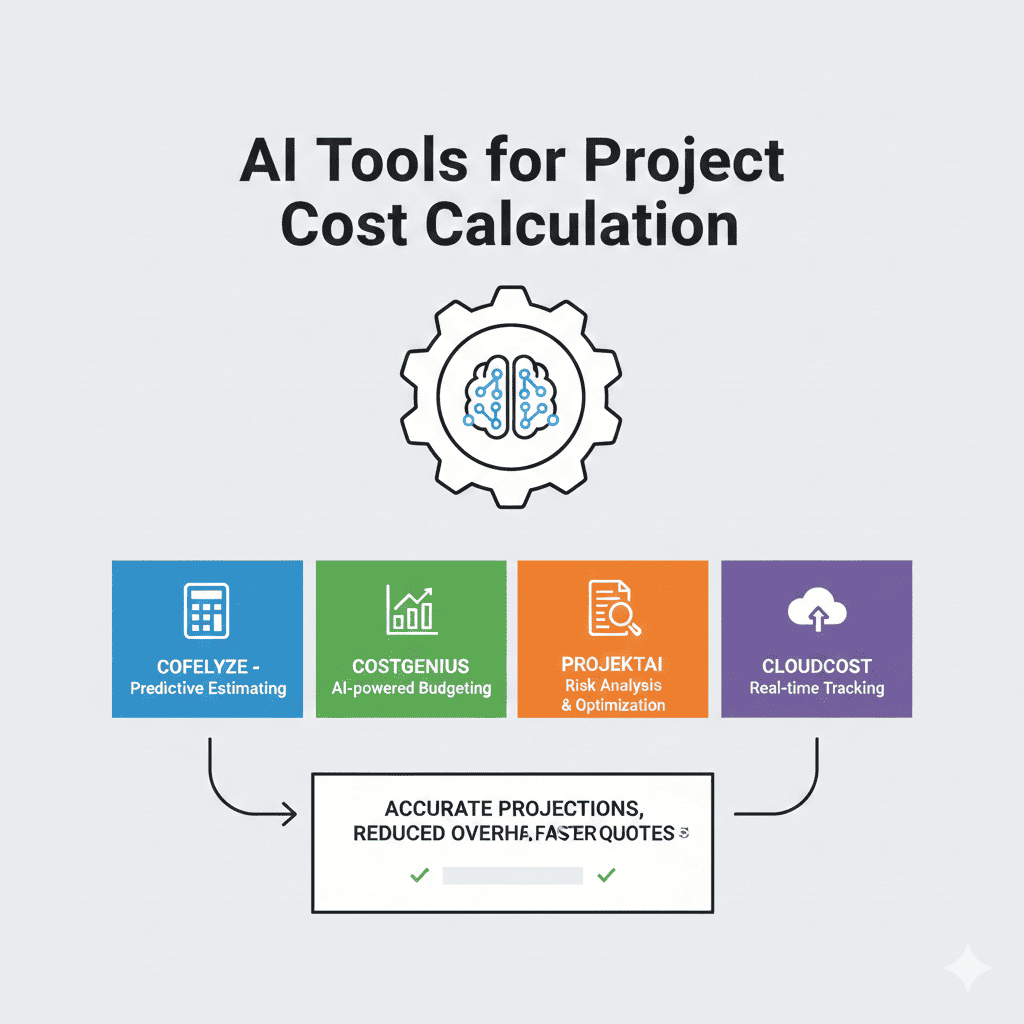
The accuracy of project cost estimation can make or break business success. Whether you’re managing construction projects, software development initiatives, or complex manufacturing operations, precise cost calculations determine profitability, competitiveness, and client satisfaction. Traditional estimation methods—relying on spreadsheets, historical data, and manual calculations—leave substantial room for human error and overlook critical cost drivers that only emerge during project execution.
Artificial intelligence is revolutionizing how professionals approach Project Cost Calculation, transforming it from an educated guessing game into a data-driven science. AI-powered tools analyze vast datasets, identify patterns invisible to human estimators, and generate accurate forecasts that account for variables traditional methods miss entirely.
In this comprehensive guide, we’ll explore the most powerful AI tools transforming Project Cost Calculation and how you can leverage them to deliver more accurate estimates, win more profitable projects, and eliminate costly surprises.
Why AI-Powered Project Cost Calculation Matters
Before diving into specific tools, understanding why AI has become essential for modern Project Cost Calculation provides critical context. Traditional estimation relies heavily on estimator experience, historical project data, and manual calculations—methods that work reasonably well for routine projects but struggle with complex, unique initiatives.
AI addresses fundamental limitations of manual estimation: processing capacity to analyze thousands of comparable projects simultaneously, pattern recognition that identifies cost drivers humans overlook, continuous learning from actual project outcomes, real-time adjustment for market fluctuations in materials and labor, and elimination of cognitive biases that plague human estimators.
The business impact is substantial. Organizations implementing AI-powered Project Cost Calculation report significant improvements including 20-30% reduction in estimation time, 15-25% improvement in cost accuracy, decreased bid preparation costs, higher win rates on competitive proposals, and dramatically reduced cost overruns during project execution.
1. Construction Estimating and Takeoff Tools
Construction projects involve complex cost calculations with thousands of variables, making them ideal candidates for AI enhancement.
Togal.AI
Togal.AI represents a breakthrough in construction cost estimation, using computer vision and machine learning to automatically detect and quantify building elements from blueprints and drawings. The platform eliminates hours of manual takeoff work by instantly recognizing walls, doors, windows, mechanical systems, and other components.
For Project Cost Calculation in construction, Togal.AI’s speed advantage is transformative. What traditionally requires 8-10 hours of manual measurement can be completed in 30-45 minutes with comparable or superior accuracy. The AI learns your specific cost database structure, automatically applying appropriate unit costs to identified elements.
The platform’s comparison capabilities prove invaluable during design changes. When architects revise drawings, Togal.AI instantly identifies modifications and recalculates affected quantities, enabling real-time cost impact analysis that keeps estimates current throughout design development.
ProEst
ProEst delivers cloud-based construction estimating enhanced by AI-powered cost prediction and risk analysis. The platform maintains extensive cost databases that machine learning algorithms continuously update based on market trends, regional variations, and actual project outcomes.
The AI analyzes your project parameters—location, size, complexity, schedule—and identifies comparable historical projects to inform cost predictions. For Project Cost Calculation, this intelligent comparison provides reality-tested unit costs rather than generic database values that may not reflect actual market conditions.
ProEst’s risk analysis features use machine learning to identify cost categories most likely to experience overruns based on project characteristics and historical patterns. This predictive insight enables more strategic contingency allocation rather than applying flat percentage buffers across all cost categories.
STACK
STACK combines takeoff and estimating in a unified platform with AI-enhanced productivity features. The software’s machine learning algorithms automatically recognize similar assemblies across different projects, suggesting appropriate cost data from your historical database.
The platform’s automated counting and measurement tools use computer vision to detect repetitive elements in drawings, dramatically accelerating quantity takeoff. For Project Cost Calculation requiring rapid turnaround, STACK’s automation enables estimators to prepare more bids without sacrificing accuracy or working excessive hours.
STACK’s collaboration features ensure all stakeholders work from current estimates, with automatic notification when cost assumptions change. This real-time synchronization prevents the costly errors that occur when team members base decisions on outdated cost information.
2. Enterprise Resource Planning Integration
Comprehensive project cost management requires integration with enterprise systems that track actual costs and resource utilization.
Oracle Primavera Cloud
Primavera Cloud brings AI-powered analytics to enterprise project portfolio management, with sophisticated cost forecasting that learns from historical project performance. The platform’s machine learning algorithms analyze schedule performance, resource utilization patterns, and cost trends to predict final project costs with increasing accuracy.
For Project Cost Calculation at the portfolio level, Primavera’s AI helps executives understand aggregate cost exposure across multiple simultaneous projects. The system identifies correlations between projects competing for shared resources, revealing cost risks that single-project analysis misses entirely.
The platform’s what-if scenario capabilities enable rapid evaluation of how schedule changes, resource reallocation, or scope modifications affect project costs. This analytical flexibility supports better decision-making during both estimation and execution phases.
SAP S/4HANA Project System
SAP’s project management capabilities leverage machine learning for cost prediction, budget optimization, and variance analysis. The platform analyzes vast quantities of transactional data from completed projects to identify cost drivers and generate more accurate estimates for new initiatives.
The AI-powered cost forecasting continuously updates throughout project execution, incorporating actual costs and current performance trends to refine completion cost predictions. For Project Cost Calculation, this living estimate provides earlier warning of potential overruns when corrective action is still feasible.
SAP’s integration with procurement, inventory, and financial systems ensures cost calculations reflect actual organizational costs rather than theoretical database values. This holistic data foundation dramatically improves estimation accuracy.
Microsoft Project with Power BI
Microsoft Project integrated with Power BI delivers AI-enhanced project analytics accessible to organizations already invested in the Microsoft ecosystem. Power BI’s machine learning capabilities analyze project data to identify cost trends, predict resource needs, and forecast completion costs.
The platform’s natural language query capabilities allow stakeholders to ask questions like “What’s our projected cost overrun on the Johnson project?” and receive instant data-driven answers. This accessibility democratizes Project Cost Calculation insights across organizations rather than restricting them to specialized estimators.
Power BI’s automated insights continuously monitor project metrics, alerting managers to emerging cost issues without requiring manual analysis. This proactive monitoring enables faster response to developing problems.
3. Software Development Cost Estimation
Software projects notoriously suffer from cost estimation challenges due to complexity, changing requirements, and technical uncertainty. AI tools bring much-needed rigor to software cost calculation.
SLIM-Estimate
SLIM-Estimate uses proven software cost models enhanced by machine learning that adapts to your organization’s specific development productivity and cost patterns. The platform analyzes project parameters—size, complexity, team capability—and generates statistically-grounded cost estimates.
For Project Cost Calculation in software development, SLIM’s probabilistic approach provides confidence intervals rather than single-point estimates. Understanding that a project will cost between $850K and $1.2M with 80% confidence enables better financial planning than a false-precision estimate of $1.0M.
The platform’s risk analysis identifies cost drivers with highest uncertainty, focusing management attention on factors that will most impact final costs. This intelligent prioritization improves both estimation accuracy and project control.
Plandek
Plandek applies machine learning to software engineering metrics, analyzing team velocity, code quality, and delivery patterns to generate accurate cost forecasts. The platform ingests data from development tools—Jira, GitHub, GitLab—creating comprehensive visibility into software delivery efficiency.
The AI identifies how specific factors—team composition, technical debt levels, requirements volatility—affect delivery costs in your environment. For Project Cost Calculation, this organization-specific intelligence produces estimates grounded in actual performance data rather than generic industry benchmarks.
Plandek’s predictive analytics forecast project completion dates and costs based on current velocity trends, providing early warning when projects trajectory toward overruns. This foresight enables proactive intervention before small delays compound into major problems.
DevAnalytics
DevAnalytics uses AI to analyze software development patterns and predict project costs based on code complexity, team capabilities, and historical performance. The platform examines codebases to assess technical complexity, a critical cost driver that traditional estimation methods struggle to quantify.
The machine learning models identify correlations between code characteristics and development effort, generating effort estimates that account for technical factors invisible in functional requirements. For Project Cost Calculation, this technical depth produces substantially more accurate software project estimates.
The platform’s continuous learning from actual project outcomes progressively improves estimation accuracy, with the AI adapting to your team’s evolving capabilities and technology stack changes.
4. Manufacturing and Product Development
Product development and manufacturing projects involve materials, tooling, labor, and overhead costs that AI tools can model with impressive accuracy.
aPriori
aPriori delivers AI-powered cost estimation for manufactured products, analyzing CAD designs to predict manufacturing costs across different production methods and volumes. The platform’s should-cost modeling reveals what products should cost to manufacture, enabling informed negotiations with suppliers and identification of cost reduction opportunities.
For Project Cost Calculation in product development, aPriori’s early-stage cost visibility enables design teams to make cost-conscious decisions before committing to expensive tooling and production setup. The AI evaluates alternative manufacturing approaches—machining versus casting, additive versus subtractive methods—with detailed cost comparisons.
The platform’s extensive manufacturing process knowledge database, enhanced by machine learning, ensures cost calculations reflect realistic production requirements rather than theoretical engineering estimates. This real-world grounding dramatically improves accuracy.
FACTON EPC
FACTON specializes in product cost management for complex manufactured goods, using AI to model cost implications of design choices and production strategies. The platform’s simulation capabilities evaluate how volume changes, material substitutions, or process modifications affect total product cost.
The AI analyzes make-versus-buy decisions by comparing in-house production costs against supplier quotations, accounting for quality considerations, lead times, and strategic factors beyond simple cost comparison. For Project Cost Calculation in manufacturing, this holistic analysis supports better sourcing decisions.
FACTON’s target costing capabilities work backward from desired product costs to identify necessary cost reductions across components and processes. The AI suggests specific modifications to achieve cost targets while maintaining quality and functionality requirements.
Costimator
Costimator provides manufacturing cost estimating enhanced by AI that learns from your actual production costs and continuously improves accuracy. The platform supports diverse manufacturing processes including machining, fabrication, molding, and assembly.
The software’s machine learning algorithms identify correlations between design features and manufacturing costs, automatically flagging cost drivers in new designs. For Project Cost Calculation, these intelligent insights help engineers understand cost implications of design decisions in real-time during development.
Costimator’s quotation capabilities generate professional proposals with detailed cost breakdowns that demonstrate value to customers while ensuring profitability for manufacturers.
5. AI-Powered Spreadsheet Enhancement
Many organizations perform cost calculations in spreadsheets. AI tools that enhance spreadsheet capabilities deliver value without requiring wholesale system replacement.
SheetAI
SheetAI brings artificial intelligence directly into Google Sheets, enabling advanced analysis and prediction within familiar spreadsheet environments. The tool’s machine learning functions analyze historical cost data to generate forecasts, identify trends, and flag anomalies.
For Project Cost Calculation in spreadsheets, SheetAI’s natural language capabilities allow users to describe desired analyses—”predict Q4 labor costs based on current trends”—and receive instant results without complex formula construction.
The platform’s automated insights continuously monitor cost data, alerting users to significant changes or unusual patterns that warrant investigation. This intelligent monitoring catches errors and emerging issues that manual spreadsheet review frequently misses.
Coefficient
Coefficient enhances spreadsheets by connecting them to live data sources and adding AI-powered analysis capabilities. The platform automatically refreshes cost data from ERP systems, ensuring estimates reflect current material prices, labor rates, and overhead allocations.
The AI analysis features identify cost variances, predict future costs based on historical trends, and generate visualizations that communicate cost information effectively to stakeholders. For Project Cost Calculation, this combination of live data and intelligent analysis dramatically improves spreadsheet-based estimation accuracy.
Coefficient’s collaboration features ensure all stakeholders work from synchronized data, eliminating version control issues that plague traditional spreadsheet workflows.
Rows
Rows reimagines spreadsheets with built-in AI capabilities including natural language data analysis, automated reporting, and intelligent forecasting. The platform’s sharing and collaboration features make it ideal for teams performing cost calculations collaboratively.
The AI assistant helps users construct complex formulas, analyze data patterns, and generate cost projections without requiring advanced spreadsheet expertise. For Project Cost Calculation, this accessibility enables broader team participation in estimation processes rather than concentrating expertise in specialized estimators.
6. Predictive Analytics Platforms
Dedicated analytics platforms apply sophisticated AI algorithms to project data, generating insights that inform more accurate cost calculations.
Forecast
Forecast delivers AI-powered project management with intelligent resource allocation and cost prediction. The platform’s machine learning analyzes team capacity, task complexity, and historical productivity to generate realistic project timelines and associated costs.
For Project Cost Calculation, Forecast’s AI considers factors traditional methods overlook—team member-specific productivity rates, task switching penalties, collaboration overhead—producing estimates that reflect actual work patterns rather than theoretical capacity.
The platform’s automated time tracking and actuals comparison enable the AI to continuously learn from project outcomes, progressively improving estimation accuracy across your organization.
Celonis
Celonis applies process mining and AI to analyze how work actually flows through organizations, revealing inefficiencies that increase project costs. The platform analyzes system logs, transaction data, and workflow patterns to create objective views of actual processes versus intended processes.
For Project Cost Calculation, Celonis identifies hidden costs that traditional methods miss—rework loops, approval bottlenecks, resource idle time—enabling more complete cost accounting. The AI quantifies cost impact of process inefficiencies, supporting business cases for improvement initiatives.
The platform’s simulation capabilities evaluate how process changes affect costs, enabling data-driven optimization rather than intuition-based process redesign.
Planview Portfolios
Planview combines portfolio management with AI-powered cost optimization and resource capacity planning. The platform’s machine learning algorithms analyze portfolio-level resource demand against organizational capacity, identifying conflicts that will drive costs above estimates.
The AI-powered scenario planning evaluates alternative portfolio compositions and resource allocations, helping executives optimize investment strategies across competing projects. For Project Cost Calculation at the enterprise level, this holistic optimization prevents siloed project estimates that ignore resource constraints and dependencies.
7. Risk Analysis and Contingency Planning
Accurate cost estimates require appropriate contingency allocations. AI tools bring scientific rigor to risk assessment and contingency determination.
Risk Mentor
Risk Mentor uses Monte Carlo simulation and machine learning to quantify project cost risks and determine appropriate contingency reserves. The platform analyzes project schedules, cost estimates, and identified risks to generate probabilistic cost forecasts.
For Project Cost Calculation, Risk Mentor’s probabilistic approach provides realistic cost ranges and confidence levels rather than misleading single-point estimates. Understanding that your project will cost between $2.3M and $3.1M with 70% confidence enables better financial planning and stakeholder communication.
The AI identifies which risks contribute most to cost uncertainty, focusing mitigation efforts on factors that will most improve cost predictability. This intelligent prioritization ensures risk management resources target highest-impact areas.
Safran Risk
Safran Risk integrates with project schedules and cost estimates to perform sophisticated risk analysis using AI-enhanced modeling. The platform’s machine learning identifies correlations between risks that compound their cost impact when they occur simultaneously.
The software’s optimization algorithms determine cost-effective risk mitigation strategies by evaluating mitigation costs against expected risk reduction. For Project Cost Calculation, this intelligent analysis ensures contingency budgets are allocated strategically rather than as arbitrary percentages.
Safran’s risk register functionality tracks identified risks throughout project lifecycle, with AI monitoring for emerging risks based on project performance trends and external factors.
@RISK
@RISK brings advanced risk analysis directly into Excel, enabling probabilistic cost modeling within familiar spreadsheet environments. The software’s Monte Carlo simulation runs thousands of scenarios to generate realistic cost distributions accounting for identified uncertainties.
The platform’s machine learning capabilities analyze simulation results to identify cost drivers with greatest influence on total project costs. For Project Cost Calculation, this sensitivity analysis reveals which estimates warrant additional validation effort versus those where precision matters less.
@RISK’s optimization features determine resource allocations and strategic decisions that minimize expected costs while managing downside risk exposure appropriately.
8. Natural Language Processing for Estimation
NLP enables AI systems to extract cost-relevant information from unstructured documents like specifications, proposals, and contracts.
Kira Systems
Kira Systems applies machine learning to contract analysis, automatically extracting cost-relevant terms, pricing provisions, payment schedules, and risk allocation clauses. The platform identifies inconsistencies between documents and flags unusual terms that may affect project costs.
For Project Cost Calculation, Kira ensures estimators account for all contractual cost implications rather than missing provisions buried in lengthy documents. The AI extracts key information—liquidated damages, warranty obligations, performance bonuses—that directly impact project cost profiles.
The platform’s continuous learning improves extraction accuracy over time as it processes more contracts from your specific industry and client base.
Seal Software (DocuSign)
Seal Software, now integrated with DocuSign, analyzes contracts and procurement documents using AI to extract financial terms, obligations, and commitments. The platform creates searchable repositories of contractual cost information that inform future estimates.
The AI identifies cost patterns across contract portfolios—standard pricing structures, typical payment terms, common risk allocations—providing intelligence that improves negotiation strategies and cost forecasting. For Project Cost Calculation, this institutional knowledge prevents repeatedly learning the same lessons across disconnected projects.
Eigen Technologies
Eigen Technologies delivers AI-powered document analysis that extracts cost data from proposals, specifications, and project documentation. The platform’s machine learning models identify relevant cost information even when expressed in varying formats and terminology.
For Project Cost Calculation, Eigen ensures completeness by automatically flagging specification requirements or scope elements that estimators haven’t yet quantified. This intelligent validation reduces the embarrassing and costly errors that occur when estimators overlook scope elements.
9. Cloud-Based Collaboration Platforms
Modern projects involve distributed teams requiring collaborative cost calculation capabilities that AI-enhanced platforms provide.
Monday.com
Monday.com combines project management with AI-powered automation and prediction capabilities. The platform’s machine learning analyzes project patterns to predict completion times and costs, providing early warnings when projects deviate from plans.
For Project Cost Calculation across distributed teams, Monday.com’s real-time collaboration ensures all stakeholders contribute to estimates without version control chaos. The AI identifies when cost assumptions conflict between team members, prompting resolution before estimates are finalized.
The platform’s automation capabilities reduce manual data entry and calculation errors, with AI-powered templates that adapt based on project characteristics and historical data.
Smartsheet
Smartsheet enhances spreadsheet-style project management with AI features including resource allocation optimization and cost forecasting. The platform’s machine learning identifies resource over-allocation that will drive costs above estimates through overtime or contractor usage.
The AI-powered reporting automatically generates cost dashboards and variance analyses, ensuring stakeholders maintain visibility into cost performance without manual report preparation. For Project Cost Calculation, this automated visibility improves accountability and enables faster response to emerging cost issues.
Smartsheet’s integration capabilities connect cost data across enterprise systems, ensuring estimates reflect current resource rates, material prices, and overhead allocations.
Wrike
Wrike delivers work management enhanced by AI-powered workload balancing and predictive analytics. The platform’s machine learning analyzes team productivity patterns to generate realistic effort estimates that account for individual capabilities and workload context.
For Project Cost Calculation, Wrike’s intelligent resource management ensures cost estimates reflect realistic productivity rather than theoretical capacity. The AI considers factors like context switching penalties, learning curves, and collaboration overhead that significantly impact actual costs.
The platform’s risk prediction identifies projects likely to experience cost overruns based on current performance indicators and historical patterns, enabling proactive intervention.
10. Industry-Specific Specialized Solutions
Certain industries have unique cost calculation requirements best served by specialized AI tools developed specifically for those sectors.
Procore (Construction)
Procore provides comprehensive construction project management with AI-enhanced cost forecasting and budget tracking. The platform’s machine learning analyzes change order patterns, material price trends, and labor productivity to predict final project costs accurately.
For Project Cost Calculation in construction, Procore’s integration with accounting systems ensures estimates reflect actual costs rather than outdated database values. The AI identifies cost trends early, enabling proactive management before minor variances become major overruns.
The platform’s bidding capabilities streamline subcontractor selection with AI-powered bid analysis that identifies anomalies and suggests questions to ask during bid review.
Deltek Costpoint (Government Contracting)
Deltek Costpoint serves government contractors with sophisticated cost accounting and project management capabilities enhanced by AI analytics. The platform’s compliance-focused features ensure cost calculations meet government auditing requirements while providing intelligent insights for better estimation.
The AI analyzes earned value metrics, indirect rate trends, and historical project performance to generate accurate cost-to-complete forecasts. For Project Cost Calculation on government contracts, this predictive capability enables contractors to identify problems early when corrective action is still possible.
Aconex (Infrastructure)
Aconex, now part of Oracle, delivers document and cost management for major infrastructure projects with AI-powered change management and cost tracking. The platform’s machine learning identifies change order patterns that indicate scope creep or systematic estimation errors.
For Project Cost Calculation on complex infrastructure programs, Aconex’s AI provides portfolio-level visibility that reveals dependencies and resource conflicts affecting costs across multiple interconnected projects.
Implementing AI-Powered Project Cost Calculation
Successfully adopting AI tools for cost estimation requires thoughtful strategy beyond simply purchasing software.
Begin by assessing current estimation accuracy and identifying primary sources of cost variance. Select AI tools that specifically address your organization’s biggest estimation challenges rather than adopting technology for its own sake.
Start with pilot implementations on non-critical projects where you can evaluate tool effectiveness and develop best practices before expanding to mission-critical estimates. This measured approach builds confidence and expertise without risking major proposals.
Invest substantially in training, ensuring team members understand both tool capabilities and underlying concepts. AI assists human judgment rather than replacing it—users must know when to trust algorithmic recommendations and when experience should override suggestions.
Establish feedback loops that capture actual project costs and feed them back into AI systems for continuous learning. The greatest value from AI comes through progressive improvement as systems learn from your organization’s specific cost patterns.
Maintain human oversight even as automation increases, particularly during initial implementation. Review AI-generated estimates for reasonableness, investigate anomalies, and validate assumptions before finalizing cost calculations.
The Future of Project Cost Calculation
Project Cost Calculation continues evolving as AI capabilities advance. Emerging technologies like quantum computing for complex optimization problems, blockchain for transparent cost tracking, and augmented reality for immersive cost visualization will create new possibilities.
The organizations that thrive will be those treating AI as a collaborative partner that amplifies human expertise rather than viewing it as either threat or magic solution. The goal isn’t eliminating human judgment but enhancing it with data-driven insights and computational capabilities that surpass manual methods.
Conclusion
The AI revolution in Project Cost Calculation represents a fundamental shift from estimation as art toward estimation as science. The tools explored in this guide enable organizations to calculate project costs with unprecedented accuracy, accounting for complexities and variables that manual methods simply cannot handle.
Success in modern project management requires embracing AI-powered Project Cost Calculation. Organizations implementing these tools today report substantial competitive advantages: winning more bids through accurate yet competitive pricing, eliminating surprise cost overruns that destroy profitability, and building reputations for reliability that generate repeat business.
Also read this:
Top AI Tools for Architecture Blueprint Analysis: Revolutionizing Design in 2025
Top AI Tools for Affiliate Marketing Automation: Transform Your Business in 2025
Top AI Tools for Automated Webinar Hosting: Scale Your Presentations Without the Scheduling Hassle