
I dropped out of college in 2019 with $40,000 in debt and zero job prospects. My parents were devastated. My friends thought I’d lost my mind. But I had a hunch that the traditional degree path wasn’t the only way to build a successful career anymore.
Fast forward to today, and I’m earning six figures working from my laptop. No degree. No corporate ladder. Just profitable online skills I taught myself using free and low-cost resources.
The best part? I’m not special. Thousands of people are doing exactly the same thing, and in 2025, the opportunities have never been better. Let me show you which skills are actually making people money right now.
Why Traditional Degrees Are Losing Their Power
Before we dive into the profitable online skills you need to learn, let’s talk about why this matters more than ever.
The world has fundamentally changed. Companies that once required bachelor’s degrees for entry-level positions are now hiring based on skills and portfolios. Google, Apple, IBM, and dozens of other major companies have eliminated degree requirements for many roles.
The numbers tell the story:
- The average student loan debt is now over $37,000
- A four-year degree costs between $80,000 and $200,000+
- Meanwhile, you can learn most profitable online skills for under $1,000 (often free)
- The average time to profitability? 3-6 months versus 4+ years
I’m not saying degrees are worthless. If you want to be a doctor or lawyer, obviously get that degree. But for most careers in the digital economy? Skills trump credentials every single time.
The 15 Most Profitable Online Skills for 2025
Let me break down the skills that are genuinely making people money right now. I’ve ranked these based on earning potential, demand, and barrier to entry.
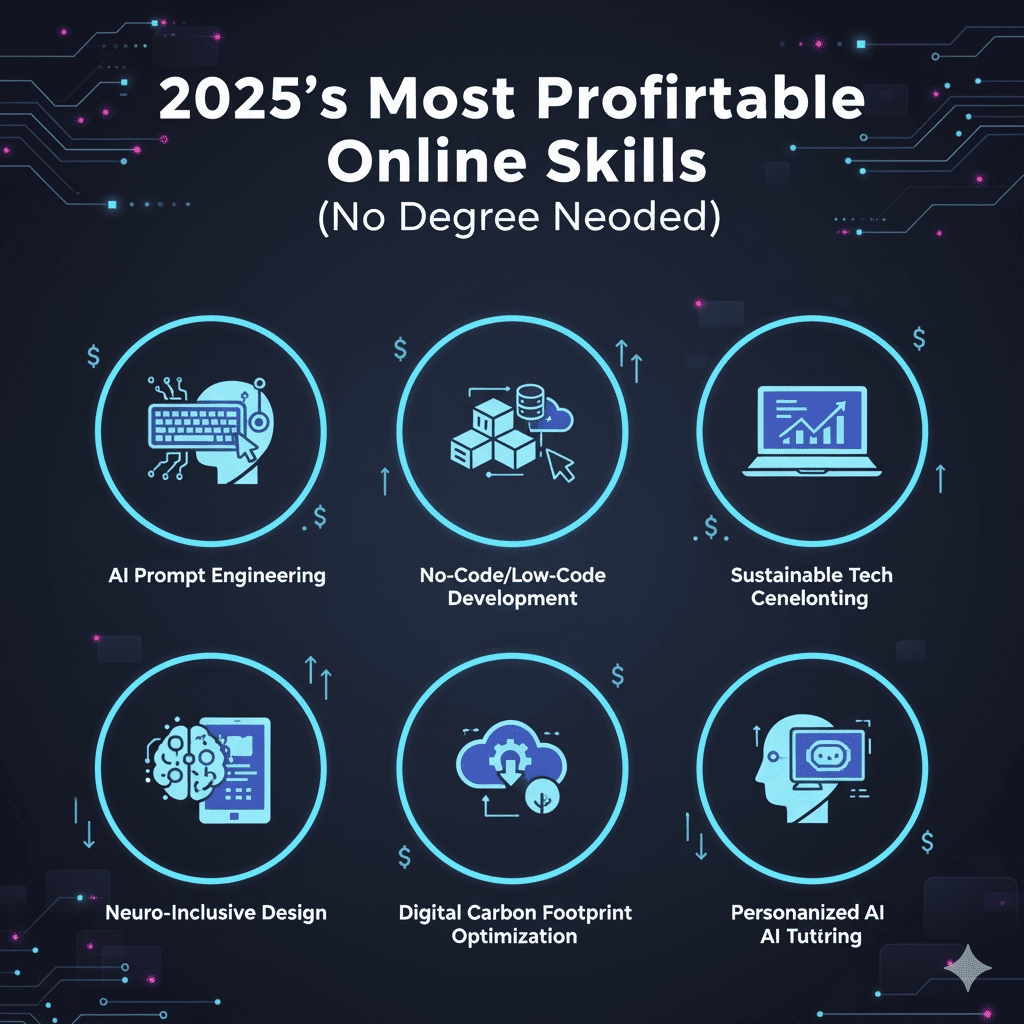
1. AI Prompt Engineering and Automation
This is the hottest skill on the market right now, and it’s barely two years old as a profession. AI prompt engineers know how to communicate effectively with AI tools to get incredible results.
Why it’s profitable: Companies are desperate to implement AI but don’t know how. Someone who can bridge that gap is worth their weight in gold.
Earning potential: $50-$150 per hour freelance, $80,000-$150,000 full-time
What you’ll do:
- Design prompts that get optimal AI responses
- Build automated workflows using tools like ChatGPT, Claude, and Midjourney
- Create AI-powered solutions for business problems
- Train teams on effective AI usage
How to learn it:
- Experiment with ChatGPT, Claude, and other AI tools daily
- Take courses on platforms like Maven or Coursera
- Join AI communities on Discord and Reddit
- Build a portfolio of AI-powered projects
Real success story: Marcus taught himself prompt engineering in three months. He now charges $125/hour helping e-commerce companies automate their customer service using AI chatbots.
2. Content Creation and Copywriting
Content is still king, and businesses need it constantly. But we’re not talking about boring blog posts anymore. Profitable online skills in content creation mean understanding psychology, storytelling, and conversion.
Why it’s profitable: Every business needs content. Email campaigns, social media, websites, video scripts, sales pages. The demand is endless.
Earning potential: $50-$200 per hour, $60,000-$120,000 full-time
What you’ll do:
- Write email sequences that convert
- Create social media content strategies
- Develop sales copy for landing pages
- Script video content for YouTube and TikTok
How to learn it:
- Study proven copywriting frameworks (AIDA, PAS, etc.)
- Read books like “Cashvertising” and “Made to Stick”
- Practice writing daily on your own platforms
- Take free courses from copywriting legends like Joanna Wiebe
Pro tip: Specialize in one type of copywriting (email, sales pages, social media) to stand out and charge premium rates.
3. Video Editing and Post-Production
Video content has exploded, and it’s not slowing down. YouTube, TikTok, Instagram Reels, LinkedIn videos—everyone needs editors who can make their content shine.
Why it’s profitable: Most creators can film content but hate editing. They’ll happily outsource it to skilled editors.
Earning potential: $40-$100 per hour, $50,000-$90,000 full-time
What you’ll do:
- Edit YouTube videos, podcasts, and social media content
- Add graphics, transitions, and effects
- Color grade and audio mix
- Create engaging thumbnails and visual assets
How to learn it:
- Start with free tools like DaVinci Resolve or CapCut
- Watch YouTube tutorials from editors like Ali Abdaal’s team
- Practice by editing your own content or offering free work initially
- Build a portfolio on platforms like YouTube or Vimeo
Hot niche: Short-form video editing (Reels, TikToks, Shorts) is incredibly in-demand right now. You can charge $50-$100 per video once you’re experienced.
4. Social Media Management and Growth
Brands know they need social media presence but don’t have time to manage it. Enter: social media managers who understand the algorithms and know how to grow engaged audiences.
Why it’s profitable: It’s an ongoing service (monthly retainer), not one-time projects. Predictable income is beautiful.
Earning potential: $1,500-$5,000 per client monthly, $55,000-$90,000 full-time
What you’ll do:
- Develop content strategies for Instagram, TikTok, LinkedIn, Twitter
- Create and schedule posts
- Engage with communities and grow followings
- Analyze metrics and optimize performance
How to learn it:
- Grow your own social media accounts first (proof of concept)
- Take courses from successful social media managers
- Stay updated on platform algorithm changes
- Learn tools like Later, Buffer, or Metricool
Insider tip: Focus on one or two platforms maximum. Being an Instagram/TikTok specialist is more valuable than being mediocre at five platforms.
5. Web Development (Frontend)
Websites aren’t optional anymore—they’re essential. And businesses need developers who can build beautiful, functional sites without breaking the bank.
Why it’s profitable: Frontend development is more accessible than ever with tools like Webflow, but businesses still need experts.
Earning potential: $60-$150 per hour, $70,000-$130,000 full-time
What you’ll do:
- Build responsive websites using HTML, CSS, and JavaScript
- Create e-commerce stores on Shopify or WooCommerce
- Design user interfaces with Figma or Adobe XD
- Implement CMS solutions like WordPress
How to learn it:
- FreeCodeCamp (completely free, comprehensive)
- The Odin Project (free, project-based)
- Scrimba or Codecademy (interactive learning)
- Build real projects, not just tutorials
Reality check: You don’t need to know everything. Master the basics really well, then specialize in one area (e.g., Shopify stores or WordPress sites).
6. SEO and Digital Marketing
Search engine optimization is one of the most valuable profitable online skills because it directly impacts a company’s revenue. Rank higher = more traffic = more sales.
Why it’s profitable: ROI is measurable, so businesses clearly see your value. Plus, it’s complex enough that most people won’t learn it themselves.
Earning potential: $50-$150 per hour, $65,000-$120,000 full-time
What you’ll do:
- Conduct keyword research and strategy
- Optimize website content for search engines
- Build backlink strategies
- Analyze SEO metrics and improve rankings
How to learn it:
- Google’s free SEO courses
- Moz’s Beginner’s Guide to SEO
- Neil Patel and Brian Dean’s YouTube channels
- Practice on your own website or blog
Smart move: Combine SEO with content writing. This combo skill makes you incredibly valuable and you can charge premium rates.
7. Graphic Design (Digital Focus)
Visual content dominates online spaces. Businesses need designers for social media graphics, websites, ads, presentations, and more.
Why it’s profitable: Design is everywhere, and good design directly impacts conversion rates and brand perception.
Earning potential: $45-$120 per hour, $50,000-$85,000 full-time
What you’ll do:
- Create social media graphics and templates
- Design logos and brand identities
- Develop marketing materials and ad creatives
- Build presentation decks and infographics
How to learn it:
- Start with Canva to understand design principles
- Learn Adobe Creative Suite (especially Illustrator and Photoshop)
- Study design theory through YouTube and Skillshare
- Copy designs you love to build your skills
Trending niche: Motion graphics and animated social media content. If you can make designs move, you’re in high demand.
8. Email Marketing Specialist
Email isn’t dead—it’s thriving. For every $1 spent on email marketing, the average return is $42. Companies know this, and they need experts who can build and manage profitable email campaigns.
Why it’s profitable: Email directly drives sales, making your value crystal clear. Plus, it’s a skill many businesses neglect.
Earning potential: $50-$100 per hour, $55,000-$95,000 full-time
What you’ll do:
- Build email lists and lead magnets
- Write conversion-focused email sequences
- Design email templates and campaigns
- A/B test and optimize for better results
How to learn it:
- Master platforms like Mailchimp, ConvertKit, or ActiveCampaign
- Study successful email campaigns in your inbox
- Learn copywriting fundamentals
- Build your own email list as practice
Pro strategy: Specialize in e-commerce email marketing. Abandoned cart sequences, post-purchase campaigns, and re-engagement emails can make stores thousands extra monthly.
9. Data Analysis and Visualization
Every company has data. Most have no idea what to do with it. Data analysts turn numbers into insights that drive business decisions.
Why it’s profitable: Data-driven decisions are the gold standard, and companies will pay well for people who can interpret their metrics.
Earning potential: $55-$130 per hour, $70,000-$115,000 full-time
What you’ll do:
- Analyze business metrics and customer data
- Create dashboards and reports
- Identify trends and actionable insights
- Present findings to stakeholders
How to learn it:
- Google Data Analytics Certificate (affordable, job-ready)
- Learn Excel/Google Sheets advanced features
- Master tools like Tableau, Power BI, or Looker
- Practice with public datasets from Kaggle
Hot tip: You don’t need advanced statistics. Most businesses need someone who can organize their data and create clear, actionable reports.
10. UX/UI Design
User experience design is about making digital products intuitive and enjoyable. As more businesses go digital, UX designers are in massive demand.
Why it’s profitable: Good UX directly increases revenue by reducing friction in customer journeys. Companies see immediate ROI.
Earning potential: $60-$140 per hour, $75,000-$130,000 full-time
What you’ll do:
- Research user behavior and needs
- Design user flows and wireframes
- Create high-fidelity mockups
- Conduct usability testing
How to learn it:
- Google UX Design Certificate on Coursera
- Practice with Figma (free and industry-standard)
- Study existing apps and websites critically
- Redesign poor interfaces as portfolio pieces
Beginner-friendly path: Start with UI design (the visual part) before diving into the research-heavy UX side.
11. Virtual Assistance with Specialized Skills
General virtual assistants are a dime a dozen. But VAs with specialized profitable online skills (tech, marketing, project management) can charge premium rates.
Why it’s profitable: Entrepreneurs and executives need reliable help with specific tasks and will pay well for expertise.
Earning potential: $25-$75 per hour, $45,000-$70,000 full-time
What you’ll do:
- Manage calendars, emails, and scheduling
- Handle customer service and communications
- Manage projects and team coordination
- Perform specialized tasks (bookkeeping, social media, tech support)
How to learn it:
- Master tools like Asana, Notion, Slack, and Zoom
- Learn specific software your target clients use
- Develop strong communication and organization skills
- Take courses on VA platforms like Belay or Time Etc.
Stand out strategy: Niche down to one industry (real estate VAs, podcast VAs, e-commerce VAs) and become indispensable.
12. Online Course Creation and Educational Content
If you have expertise in anything—literally anything—you can package it into an online course and sell it repeatedly.
Why it’s profitable: Create once, sell forever. It’s one of the few truly scalable online skills.
Earning potential: Highly variable, $30,000-$500,000+ annually depending on topic and marketing
What you’ll do:
- Identify knowledge gaps in your area of expertise
- Structure information into digestible lessons
- Record video or written content
- Market and sell your courses
How to learn it:
- Take successful courses to understand structure
- Learn basic video recording and editing
- Study platforms like Teachable, Kajabi, or Gumroad
- Follow course creators like Pat Flynn or Amy Porterfield
Reality check: The skill isn’t just teaching—it’s also marketing. The best course creators spend 50% of their time on promotion.
13. E-commerce and Dropshipping Management
Online shopping continues to grow, and store owners need help managing their businesses. If you understand e-commerce platforms and logistics, you’re valuable.
Why it’s profitable: E-commerce is complex with many moving parts. Business owners will gladly pay someone to handle it.
Earning potential: $40-$100 per hour, $50,000-$90,000 full-time
What you’ll do:
- Manage Shopify, Amazon, or Etsy stores
- Handle product listings and inventory
- Optimize product pages for conversion
- Manage customer service and fulfillment
How to learn it:
- Start your own small e-commerce store to learn the ropes
- Master platforms like Shopify through their free resources
- Learn product research and supplier management
- Understand Facebook Ads and Google Shopping
Smart approach: Offer to manage one aspect really well (like product photography or customer service) before expanding to full management.
14. Podcast Production and Management
Podcasting has exploded, and hosts need help with everything from editing to show notes to guest outreach.
Why it’s profitable: Podcasters are often busy entrepreneurs or creators willing to invest in quality production.
Earning potential: $500-$2,000 per podcast monthly (depending on services)
What you’ll do:
- Edit audio and clean up recordings
- Write show notes and timestamps
- Schedule and coordinate guests
- Distribute episodes across platforms
- Create audiograms and promotional content
How to learn it:
- Learn audio editing with Audacity (free) or Adobe Audition
- Start your own podcast to understand the process
- Study successful podcasts’ workflows
- Learn transcription tools like Descript
Quick win: Start with just audio editing services, then expand your offerings as you learn what podcasters need most.
15. No-Code Development
You can now build sophisticated apps, websites, and automations without writing code. This is one of the fastest-growing profitable online skills in 2025.
Why it’s profitable: Companies need custom solutions but can’t afford traditional development costs. No-code is the perfect middle ground.
Earning potential: $50-$120 per hour, $60,000-$100,000 full-time
What you’ll do:
- Build websites with Webflow or Wix
- Create apps with Bubble or Adalo
- Automate workflows with Zapier or Make
- Design databases with Airtable or Notion
How to learn it:
- Explore platforms through their free tiers
- Follow no-code creators on YouTube
- Join communities like Makerpad or No Code Founders
- Build projects for yourself first
Future-proof: As no-code tools get more powerful, this skill becomes more valuable, not less. You’re essentially translating business needs into solutions.
How to Choose the Right Skill for You
With so many profitable online skills to choose from, how do you decide? Here’s my framework:
Step 1: Assess Your Natural Interests
Don’t chase money alone. You’ll burn out. Ask yourself:
- What do I enjoy doing even when I’m not paid?
- What tasks make time fly by for me?
- What do friends and family say I’m naturally good at?
Your answers reveal where you have natural aptitude. Build skills around those interests.
Step 2: Consider Your Current Situation
If you need money FAST (1-3 months): Choose skills with immediate freelance opportunities like virtual assistance, social media management, or video editing.
If you can invest time (6-12 months): Go for higher-paying skills like web development, UX design, or data analysis.
If you want flexibility: Content creation, course creation, or email marketing offer the most location and schedule independence.
Step 3: Research Market Demand
Look at freelance platforms like Upwork or Fiverr. What services have the most job postings? What are people actually paying for?
Check job boards too. See what remote positions are available and what skills they require.
Step 4: Test Before You Fully Commit
Don’t spend thousands on courses before validating your interest. Try these instead:
- Watch free YouTube tutorials and complete a small project
- Offer your emerging skill to a friend or local business for free
- Freelance for very low rates initially (just to test if you enjoy the work)
- Join online communities in that field and see if the culture fits you
If you still enjoy it after 20-30 hours of practice, that’s a good sign.
The Learning Strategy That Actually Works
Here’s the truth: most people fail at learning profitable online skills not because they chose the wrong skill, but because they learned it the wrong way.
The 4-Phase Learning System
Phase 1: Consume (Week 1-2) Watch tutorials, read articles, take a foundational course. Get the big picture understanding.
Phase 2: Replicate (Week 3-4) Follow along with tutorials exactly. Copy what experts do. Build muscle memory.
Phase 3: Modify (Week 5-6) Take examples and change elements. Remix tutorials. Add your own twist.
Phase 4: Create (Week 7+) Build something original from scratch. This is where real learning happens.
Most people get stuck in Phase 1, endlessly consuming courses without doing anything. Or they jump straight to Phase 4 and get overwhelmed.
Follow the phases. Trust the process.
Free and Low-Cost Learning Resources
You don’t need expensive bootcamps. Here are the resources I actually used:
For multiple skills:
- YouTube (seriously, it’s incredible)
- freeCodeCamp
- Coursera (audit courses for free)
- Skillshare (first month free)
For design:
- Canva Design School (free)
- Refactoring UI (paid but worth it)
For coding:
- The Odin Project (free)
- Scrimba (interactive)
- JavaScript.info (free, comprehensive)
For marketing:
- HubSpot Academy (free certifications)
- Google Digital Garage (free)
- Neil Patel’s blog and videos
For writing:
- Copyhackers blog
- SwipeFile (examples of great copy)
- Ann Handley’s newsletters
How Long Until You Can Earn Money?
Let me give you realistic timelines based on what I’ve seen:
3-4 weeks: Virtual assistance, basic social media management, simple video editing
2-3 months: Content writing, graphic design, podcast editing, no-code development
4-6 months: Web development, SEO, email marketing, more advanced video editing
6-12 months: Data analysis, UX/UI design, specialized development, course creation
These assume you’re dedicating 10-20 hours per week to learning and practicing. Full-time learning accelerates everything.
Getting Your First Paying Clients
You’ve learned the skill. Now you need to get paid. Here’s how:
Strategy 1: Start With Your Network
Tell everyone you know what you’re learning. Post about it on social media. You’d be surprised how many people in your extended network need exactly what you’re offering.
Message template: “Hey! I’m becoming a [skill]. I’m looking to build my portfolio with a few projects. Do you know anyone who needs [specific service]? I’m offering a discount for my first few clients while I build experience.”
Strategy 2: Freelance Platforms (Used Strategically)
Yes, Upwork and Fiverr are competitive. But they work if you approach them right:
- Write personalized proposals (not templates)
- Charge less initially to get reviews
- Over-deliver massively on first projects
- Once you have 5-10 great reviews, raise your rates
Strategy 3: Create Content to Attract Clients
This is the long game, but it’s powerful. Share your learning journey:
- Write about what you’re learning on LinkedIn or Medium
- Create portfolio pieces and share the process
- Offer free value related to your skill
- Position yourself as an expert-in-training
People hire people they know, like, and trust. Content builds all three.
Strategy 4: The “Foot in the Door” Approach
Offer something small and affordable to prove your value:
- “I’ll write one email for $50 to show you what I can do”
- “Let me edit one video as a test”
- “I’ll do an SEO audit for half my normal rate”
Once you deliver exceptional results, upselling to ongoing work is easy.
Pricing Your Services (Don’t Undersell Yourself)
One of the biggest mistakes new freelancers make is charging too little. Here’s my pricing philosophy:
Beginner Phase (First 5 clients)
Charge 50-70% of market rate. Get experience and testimonials.
Intermediate Phase (Clients 6-20)
Charge market rate. You’re competent now.
Advanced Phase (20+ clients)
Charge above market rate. You have proof of results.
How to find market rate:
- Search your skill on Upwork and see the price range
- Check freelance rate calculators
- Join professional Facebook groups and ask
- Look at what others with your experience charge
The Value-Based Pricing Mindset
Stop thinking in hours. Start thinking in value.
If your SEO work generates $10,000 extra monthly revenue for a client, charging $2,000 is a steal for them. But if you charged by the hour at $50/hour, you’d only make $500 for the same work.
As you get better, always communicate the value you create, not just the time you spend.
Avoiding Common Mistakes
I’ve made every mistake in the book. Let me save you the trouble:
Mistake #1: Learning Too Many Skills at Once
The fix: Master one skill first. Get to the point where you’re earning with it. Then add complementary skills.
Mistake #2: Tutorial Hell (Never Actually Building)
The fix: 80/20 rule. Spend 20% of your time learning, 80% building and practicing.
Mistake #3: Waiting Until You’re “Ready”
The fix: You’ll never feel ready. Start offering your services when you’re 60% confident. You’ll figure out the rest on the job.
Mistake #4: Not Building in Public
The fix: Share your journey, your projects, your learnings. It attracts opportunities you can’t imagine.
Mistake #5: Underestimating the Importance of Sales
The fix: Being skilled doesn’t guarantee clients. Learn basic sales and marketing. It’s just as important as your technical skill.
The Realistic Path: My 12-Month Plan
Here’s what a realistic path to replacing a full-time income with profitable online skills looks like:
Months 1-2: Learn and Build Portfolio
- Choose your skill
- Complete 1-2 foundational courses
- Build 3-5 portfolio projects
- Set up your online presence
Months 3-4: Get First Clients
- Pitch 50+ potential clients
- Land 3-5 projects at reduced rates
- Over-deliver and collect testimonials
- Refine your process
Months 5-6: Establish Consistency
- Aim for $1,000-$2,000/month
- Raise rates slightly
- Start building systems
- Improve efficiency
Months 7-9: Scale and Specialize
- Focus on your most profitable niche
- Aim for $3,000-$5,000/month
- Build more passive marketing
- Consider raising rates again
Months 10-12: Replace Full-Time Income
- Target $5,000-$8,000/month
- Establish recurring clients
- Maybe hire help for basic tasks
- Plan your next phase of growth
This isn’t get-rich-quick. But it’s realistic and achievable if you stay consistent.
Success Stories That’ll Inspire You
Let me share some real people who’ve built careers with profitable online skills:
Jessica, 29 – Email Marketing Specialist Learned email marketing while working retail. Started freelancing on nights and weekends. Quit her job after 7 months when she hit $4,000/month. Now manages email for 6 e-commerce brands at $2,000-$3,000 per client monthly.
Marcus, 24 – Video Editor Taught himself editing during COVID lockdown. Built a portfolio editing his own content. Found a YouTuber client on Reddit who became a recurring client. That led to referrals. Now edits for 3 YouTubers full-time earning $7,000/month.
Priya, 31 – UX Designer Switched from nursing to design. Took Google’s UX certificate. Built a portfolio of app redesigns. Got her first contract through LinkedIn. Two years later, she’s a senior UX designer at a startup making six figures.
David, 26 – SEO Consultant Started a blog to learn SEO. Ranked for competitive keywords. Business owners noticed and started asking for help. Now runs an SEO agency with 4 employees.
Notice the pattern? They all started with zero experience. They learned one skill deeply. They put themselves out there before feeling ready. And they stayed consistent.
Your Next Steps Start Today
You’ve read this far, which means you’re serious about changing your career trajectory. Don’t let this be another article you read and forget.
Here’s what you should do in the next 24 hours:
- Choose one skill from this list based on your interests
- Find one free course or resource to start learning
- Complete the first lesson tonight
- Tell someone about your new goal (accountability matters)
- Schedule 30 minutes daily for learning this skill
That’s it. Don’t overthink it. Don’t research for another week. Just start.
The difference between people who build successful careers with profitable online skills and those who don’t isn’t talent or connections or luck. It’s simply starting and not giving up.
The Real Secret Nobody Talks About
Here’s what I wish someone had told me when I started:
Learning profitable online skills isn’t just about making money. It’s about taking control of your career, your time, and your life.
It’s about not needing permission from gatekeepers with outdated requirements.
It’s about building something that can’t be taken away by layoffs or economic downturns.
It’s about proving to yourself that you’re capable of more than you think.
The money is great. The freedom is better. But the confidence and self-respect you gain from teaching yourself valuable skills and building a career on your own terms? That’s priceless.
You don’t need a degree. You don’t need permission. You just need to start.
Also read this:
Why Reels Without Hashtags Are Performing Better: The Truth Instagram Won’t Tell You
Automation Businesses: Your Complete Guide to Earning While You Sleep
Zero-Face Business: How Anonymous Brands Are Making Millions Without Showing Their Face