
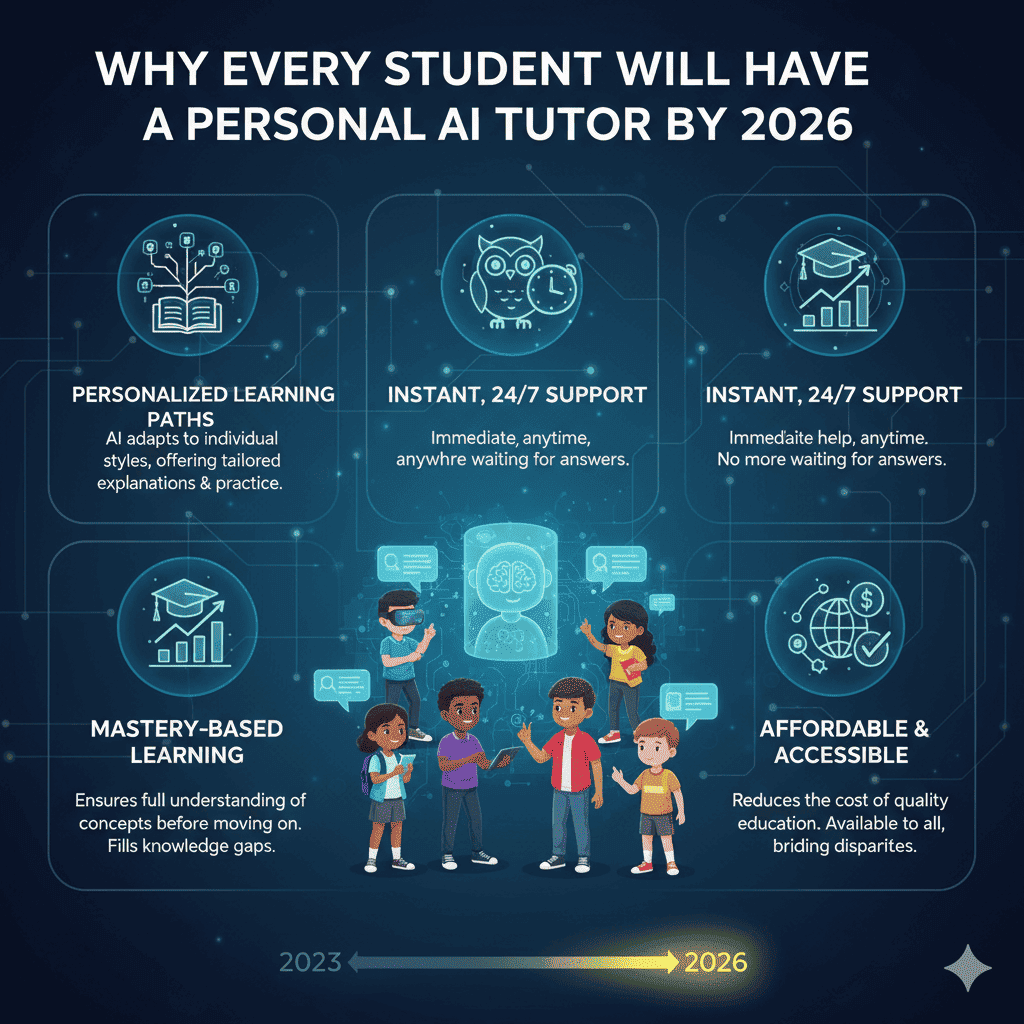
The classroom of 2026 will look nothing like what we know today. Within the next two years, virtually every student—from kindergarteners to college graduates—will have access to their own personal AI tutor, fundamentally transforming how we learn, teach, and think about education itself.
This isn’t science fiction or empty hype. The convergence of advanced artificial intelligence, widespread internet access, and affordable computing power has created the perfect storm for an educational revolution that’s already underway. Let’s explore why the personal AI tutor is about to become as common as smartphones, and what this means for students, parents, and educators worldwide.
The Current State: AI Tutoring Has Already Arrived
Before we discuss the future, let’s acknowledge the present. Personal AI tutors aren’t coming—they’re already here. Millions of students are currently using AI-powered educational tools like Khan Academy’s Khanmigo, ChatGPT for homework help, and specialized tutoring apps that adapt to individual learning styles.
What’s changing isn’t the existence of these tools, but their sophistication, accessibility, and integration into mainstream education. The personal AI tutor of 2026 will be lightyears ahead of today’s prototypes, offering seamless, intuitive, and remarkably effective learning experiences that rival—and often surpass—traditional one-on-one human tutoring.
Why 2026? The Perfect Convergence of Five Factors
1. Exponential AI Advancement
Artificial intelligence is improving at a breathtaking pace. The AI models powering personal AI tutors in 2024 can explain concepts, answer questions, and provide feedback with impressive accuracy. By 2026, these systems will understand context better, recognize individual learning patterns, and adapt their teaching methods in real-time with unprecedented precision.
The gap between today’s AI and tomorrow’s is not incremental—it’s exponential. Each generation of AI models demonstrates capabilities that seemed impossible just months earlier. This trajectory means that by 2026, personal AI tutors will possess the teaching sophistication that currently requires years of human educational training.
2. Plummeting Costs and Universal Access
The cost of AI computation has fallen dramatically and continues to decline. What once required expensive supercomputers now runs on smartphones. This democratization means that a world-class personal AI tutor will cost less than a single session with a human tutor—potentially free for many students through school programs or subsidized services.
Internet connectivity is also reaching previously underserved areas. By 2026, an estimated 5.4 billion people will have internet access, ensuring that students in rural India, remote Africa, and isolated Latin American villages can access the same quality personal AI tutor as students in Silicon Valley or Singapore.
3. Growing Educational Crisis and Achievement Gaps
Traditional education systems are struggling. Teacher shortages, overcrowded classrooms, and widening achievement gaps have created urgent demand for scalable solutions. The personal AI tutor addresses these challenges by providing unlimited, patient, personalized instruction to every student, regardless of their school’s resources or their family’s income.
Post-pandemic learning loss has further accelerated this need. Millions of students fell behind during school closures, and traditional catch-up methods have proven insufficient. Personal AI tutors offer a practical solution to help these students recover lost ground at their own pace.
4. Institutional Adoption and Integration
Major educational institutions, governments, and technology companies are investing billions in AI education technology. By 2026, these initiatives will mature from pilot programs to standard educational infrastructure. Schools will integrate personal AI tutors into their curricula, not as optional supplements but as core components of the learning experience.
Several countries, including Estonia, Singapore, and the UAE, are already implementing national AI education strategies. These early adopters will pave the way for global standards, interoperability, and best practices that make personal AI tutor adoption smooth and effective worldwide.
5. Proven Effectiveness and Student Demand
Research consistently shows that one-on-one tutoring is the most effective educational intervention, typically improving student performance by two standard deviations—moving an average student to the 98th percentile. The personal AI tutor replicates many benefits of human tutoring while eliminating practical barriers like cost, scheduling, and availability.
Perhaps most importantly, students themselves are embracing AI learning tools. Gen Z and Gen Alpha are digital natives who find AI interaction natural and intuitive. They’re already seeking out AI assistance for homework and learning, creating bottom-up demand that will drive personal AI tutor adoption regardless of institutional resistance.
What Your Personal AI Tutor Will Actually Do
Understanding the “why” is important, but let’s get concrete about the “what.” What will your personal AI tutor actually look like and do in 2026?
Truly Personalized Learning Paths
Unlike traditional classrooms where one teacher must serve 30 students simultaneously, your personal AI tutor will know exactly where you are in your learning journey. It will identify your knowledge gaps, recognize your learning style, and adjust its teaching approach accordingly.
If you’re a visual learner struggling with algebra, your personal AI tutor might use graphical representations and interactive animations. If you’re an auditory learner mastering Spanish, it might emphasize conversational practice and pronunciation feedback. The same curriculum becomes infinitely flexible, molded perfectly to each student’s needs.
24/7 Availability and Infinite Patience
Your personal AI tutor never sleeps, never gets frustrated, and never makes you feel stupid for asking the same question for the fifth time. This creates a psychologically safe learning environment where students can struggle, fail, and try again without embarrassment or judgment.
Late-night study session before an exam? Your personal AI tutor is ready. Confused about a concept at 3 AM? Ask away. This round-the-clock availability removes temporal barriers to learning that have constrained education for centuries.
Immediate, Detailed Feedback
Traditional homework assignments might be returned days or weeks later with minimal feedback—a checkmark or an “X” that doesn’t explain what went wrong. Your personal AI tutor provides instant, comprehensive feedback on every problem, every essay, every question.
This immediacy is pedagogically powerful. Students learn best when feedback comes quickly, while the material is still fresh. The personal AI tutor can explain not just that an answer is wrong, but why it’s wrong, what misconception led to the error, and how to think about the problem correctly.
Socratic Questioning and Critical Thinking
Advanced personal AI tutors won’t just provide answers—they’ll ask probing questions that guide students to discover solutions themselves. This Socratic method develops critical thinking skills and deeper understanding rather than rote memorization.
Imagine asking your personal AI tutor for help with a history essay. Instead of writing it for you, it might ask: “What were the economic factors driving this conflict? How might different groups have perceived the same events differently? What sources would help you support this argument?” This approach builds analytical skills that transfer across subjects.
Multimodal Learning Experiences
The 2026 personal AI tutor won’t be limited to text. It will seamlessly integrate voice conversations, visual demonstrations, interactive simulations, and even augmented reality experiences. Learning about ancient Rome? Your personal AI tutor might overlay a 3D model of the Colosseum in your room, walking you through its architecture while explaining Roman engineering.
This multimodal capability addresses different learning preferences while making education more engaging and memorable. Complex concepts that once required imaginative leaps become tangible and intuitive.
Emotional Intelligence and Motivation
Perhaps surprisingly, the personal AI tutor of 2026 will recognize when you’re frustrated, bored, or losing confidence. It will adjust its approach, offer encouragement, suggest breaks, or switch to more engaging material. While not replacing human emotional connection, these capabilities help maintain motivation through difficult learning challenges.
The AI will celebrate your victories, acknowledge your efforts, and help you develop growth mindset—the belief that intelligence and abilities can be developed through dedication and hard work.
The Impact on Traditional Education: Complement, Not Replace
A common fear is that personal AI tutors will replace human teachers. This fundamentally misunderstands how AI will integrate into education. The future isn’t “AI instead of teachers”—it’s “AI empowering both teachers and students.”
Liberating Teachers from Administrative Burden
Teachers currently spend enormous time on tasks that AI handles better: grading, lesson planning, tracking individual student progress, creating personalized assignments. The personal AI tutor automates these functions, freeing teachers to do what only humans can: inspire, mentor, facilitate collaboration, and provide emotional support.
Imagine a classroom where the personal AI tutor handles personalized practice and assessment while the human teacher focuses on group discussions, creative projects, and helping students navigate social-emotional challenges. This partnership produces better outcomes than either could achieve alone.
Enabling True Differentiation
The traditional classroom’s biggest limitation is the impossible task of simultaneously teaching students at vastly different levels. Some students are bored because they grasp concepts immediately; others are lost because they need more foundational work; most are somewhere in between.
With each student having a personal AI tutor, this problem dissolves. Every student works at their optimal challenge level, receiving exactly the support they need. The teacher orchestrates this differentiated environment, checking in where needed and facilitating collaborative learning experiences that AI cannot provide.
New Educational Models Emerge
The personal AI tutor enables entirely new approaches to education. Flipped classrooms become more effective when students have AI support for asynchronous learning. Mastery-based progression becomes practical when AI tracks each student’s genuine understanding rather than time spent. Project-based learning becomes more ambitious when students have expert assistance for every component of complex projects.
We’ll likely see hybrid models where students spend part of their time in AI-guided independent learning, part in human-facilitated collaborative work, and part in traditional instruction—with the balance optimized for each subject and student.
Breaking Down Barriers: Accessibility and Equity
One of the most powerful aspects of the personal AI tutor revolution is its potential to democratize access to quality education.
Economic Accessibility
Private tutoring has always been a luxury that reinforces inequality—wealthy families can afford expert help while others cannot. The personal AI tutor collapses this advantage. When world-class tutoring costs pennies or nothing, every student gets support that was previously accessible only to the elite.
This isn’t theoretical. Studies of AI tutoring systems show similar learning gains across socioeconomic groups, suggesting that the personal AI tutor can actually reduce achievement gaps rather than widen them.
Geographic Accessibility
Rural students no longer depend on the quality of their local school system or proximity to universities. A student in a village with no qualified math teacher can access a personal AI tutor with expertise equivalent to the world’s best mathematicians. Geographic location becomes irrelevant to educational opportunity.
Disability Accommodation
Personal AI tutors can seamlessly adapt to different abilities. Text-to-speech for visually impaired students, speech-to-text for hearing-impaired students, alternative input methods for students with motor challenges, pacing adjustments for students with processing differences—all automatically and invisibly integrated.
These accommodations don’t stigmatize or require special requests. Every student’s personal AI tutor simply adapts to their needs, making high-quality accessible education the default rather than an accommodation.
Language Inclusivity
The personal AI tutor speaks every language fluently and can seamlessly translate between them. A Spanish-speaking student learning English can ask questions in Spanish and receive explanations that bridge both languages. An immigrant family doesn’t need to choose between learning in their native language or the dominant language—they can do both simultaneously.
This multilingual capability preserves cultural identity while removing language as a barrier to educational opportunity.
Real-World Implementation: How the Transition Happens
The shift to universal personal AI tutor adoption won’t happen overnight or uniformly. Here’s the likely progression between now and 2026:
Phase 1: Early Adopters (2024-2025)
Forward-thinking schools, wealthy districts, and tech-savvy families begin integrating personal AI tutors into regular learning. These early implementations reveal best practices, identify challenges, and generate proof of effectiveness that drives broader adoption.
Tech companies compete to offer the most effective platforms, driving rapid improvement and innovation. Educational research establishes evidence-based guidelines for optimal AI-human teaching partnerships.
Phase 2: Mainstream Integration (2025-2026)
Major school districts, educational publishers, and online learning platforms incorporate personal AI tutors as standard features. Teacher training programs add AI collaboration skills to their curricula. Parents increasingly expect AI tutoring as part of their children’s education.
Costs continue falling while capabilities improve. Free or low-cost options become widely available, ensuring that financial barriers don’t prevent adoption. Mobile apps make personal AI tutors accessible anywhere, anytime.
Phase 3: Universal Expectation (2026 onwards)
By 2026, not having a personal AI tutor seems as strange as not having textbooks. Students take for granted that they have unlimited access to personalized assistance. Educational systems are redesigned around the assumption of AI tutoring availability.
The question shifts from “Should we use AI tutors?” to “How do we optimize the AI-human partnership for each student and subject?”
Addressing Concerns: The Responsible Path Forward
The personal AI tutor revolution raises legitimate concerns that deserve serious consideration:
Over-Reliance and Reduced Effort
Will students become dependent on AI assistance and stop thinking for themselves? This concern parallels historical anxieties about calculators, spell-checkers, and search engines. The solution isn’t to avoid powerful tools but to teach responsible use.
Well-designed personal AI tutors promote genuine learning by requiring students to engage actively rather than passively receiving answers. They use scaffolding that gradually reduces support as mastery develops, building independence rather than dependence.
Data Privacy and Security
Personal AI tutors require data about student learning to be effective. This raises valid privacy concerns about who controls this data and how it’s used. Robust privacy frameworks, clear consent mechanisms, and strict data protection regulations will be essential.
The education technology industry is already moving toward privacy-first designs, local data processing where possible, and transparent data policies. By 2026, privacy protection will likely be a key competitive differentiator among personal AI tutor platforms.
Equity in Quality
Not all personal AI tutors will be equally effective. Without careful oversight, market forces could create a two-tier system where wealthy students access superior AI while others get inferior versions. Addressing this requires:
- Open standards ensuring baseline quality
- Public investment in high-quality free options
- Rigorous evaluation and certification of educational AI
- Ongoing monitoring of outcomes across demographic groups
Teacher Displacement Fears
While this article argues that personal AI tutors complement rather than replace teachers, the economic reality is that some educational roles may change or disappear. Society has a responsibility to support educators through this transition with retraining, new role development, and financial security.
The most likely outcome is that we’ll need fewer teachers for basic instruction but more for advanced mentorship, socio-emotional support, and learning environment design—a shift that elevates the teaching profession rather than diminishing it.
What Parents Should Do Right Now
If you’re a parent reading this, the personal AI tutor revolution presents both opportunity and responsibility. Here’s how to prepare:
Start Exploring Options
Experiment with current AI tutoring tools with your children. See what works, what doesn’t, and how your kids respond. Build familiarity with these technologies now so you’re not starting from zero when they become ubiquitous.
Teach Critical Use
Help your children understand that personal AI tutors are tools for learning, not shortcuts to avoid learning. Discuss when AI help is appropriate and when they need to struggle independently. Model asking good questions rather than seeking easy answers.
Stay Engaged
AI tutoring doesn’t mean parents can disengage from their children’s education. Stay involved, ask about what they’re learning, review their progress, and maintain the human connection that no AI can replace.
Advocate for Equity
Push your school district and local representatives to ensure all students have access to quality personal AI tutors, not just those in well-funded schools. Educational equity in the AI age requires intentional effort and investment.
What Students Should Expect
If you’re a student, the personal AI tutor will likely be your constant learning companion throughout your education. Here’s how to make the most of it:
Ask Fearlessly
Your personal AI tutor never judges, never gets impatient, and never makes you feel stupid. Use this to ask the “dumb questions” you’re afraid to raise in class. Often these are the most important questions because they address fundamental misunderstandings.
Demand Explanations
Don’t just accept answers—ask your personal AI tutor to explain the reasoning. “Why?” is the most powerful question in learning. Use your AI tutor to develop deep understanding rather than surface-level familiarity.
Explore Your Curiosity
Traditional education follows rigid curricula. Your personal AI tutor lets you pursue tangents and explore topics that fascinate you. Love dinosaurs but stuck studying the Revolutionary War? Your AI tutor can connect them, showing how we know about ancient climates through geological techniques developed during early American mineral surveys. Learning becomes an adventure rather than a checklist.
Develop Metacognition
Use your personal AI tutor to reflect on how you learn. Ask it to help you identify patterns in your thinking, recognize when you’re confused versus when you understand, and develop strategies for tackling difficult material. Learning how to learn is the most valuable skill the personal AI tutor can help you develop.
The Broader Implications: Education Transformed
The universal adoption of personal AI tutors by 2026 represents more than a new educational tool—it’s a fundamental reimagining of what education can be.
Lifelong Learning Becomes Practical
Education doesn’t end at graduation. In an economy where skills rapidly become obsolete, continuous learning is essential. The personal AI tutor makes this practical and affordable, enabling career changers, retirees learning new subjects, and professionals updating their skills to access expert instruction whenever needed.
Credentialing and Assessment Evolve
When everyone has a personal AI tutor, traditional testing becomes less meaningful. What matters isn’t memorized facts but the ability to think critically, solve novel problems, and create original work. Assessment will shift toward demonstrating genuine capability rather than reproducing learned information.
Global Knowledge Distribution Accelerates
Ideas, techniques, and discoveries that once took decades to spread globally can now be integrated into personal AI tutors within weeks. A breakthrough teaching method developed in Finland can benefit students in Brazil almost immediately. Educational innovation accelerates dramatically.
Human Potential Unlocks
Perhaps most exciting: We don’t really know what humans can achieve with truly personalized, always-available, expert instruction from early childhood through adulthood. The personal AI tutor represents an unprecedented experiment in human development. How much faster can we learn? How much deeper can we understand? How many people have untapped potential that poor educational circumstances have hidden?
We’re about to find out.
The Inevitable Conclusion: Embrace the Future
The personal AI tutor revolution isn’t a possibility—it’s an inevitability. The technology exists, the demand is clear, the benefits are compelling, and the momentum is undeniable. By 2026, virtually every student will have access to personalized AI tutoring that would have seemed like science fiction just years earlier.
This transformation will be disruptive, challenging, and occasionally uncomfortable. It will require us to rethink educational institutions, teaching practices, and the very nature of learning. Not everyone will embrace it immediately, and legitimate concerns will need careful addressing.
But the alternative—clinging to an educational system designed for the industrial age in an AI-powered world—is far worse. The students who grow up with personal AI tutors will have capabilities that previous generations could barely imagine. They’ll learn faster, understand deeper, and achieve more than was previously possible.
The question isn’t whether your student will have a personal AI tutor by 2026. The question is whether we’ll prepare them to use it wisely, whether we’ll ensure equitable access for all students, and whether we’ll build the supporting systems that help humans and AI collaborate effectively.
The personal AI tutor is coming. The only question is whether we’ll be ready.
Also read this:
AI-Powered Resume Hacks to Get Hired Faster in 2025