
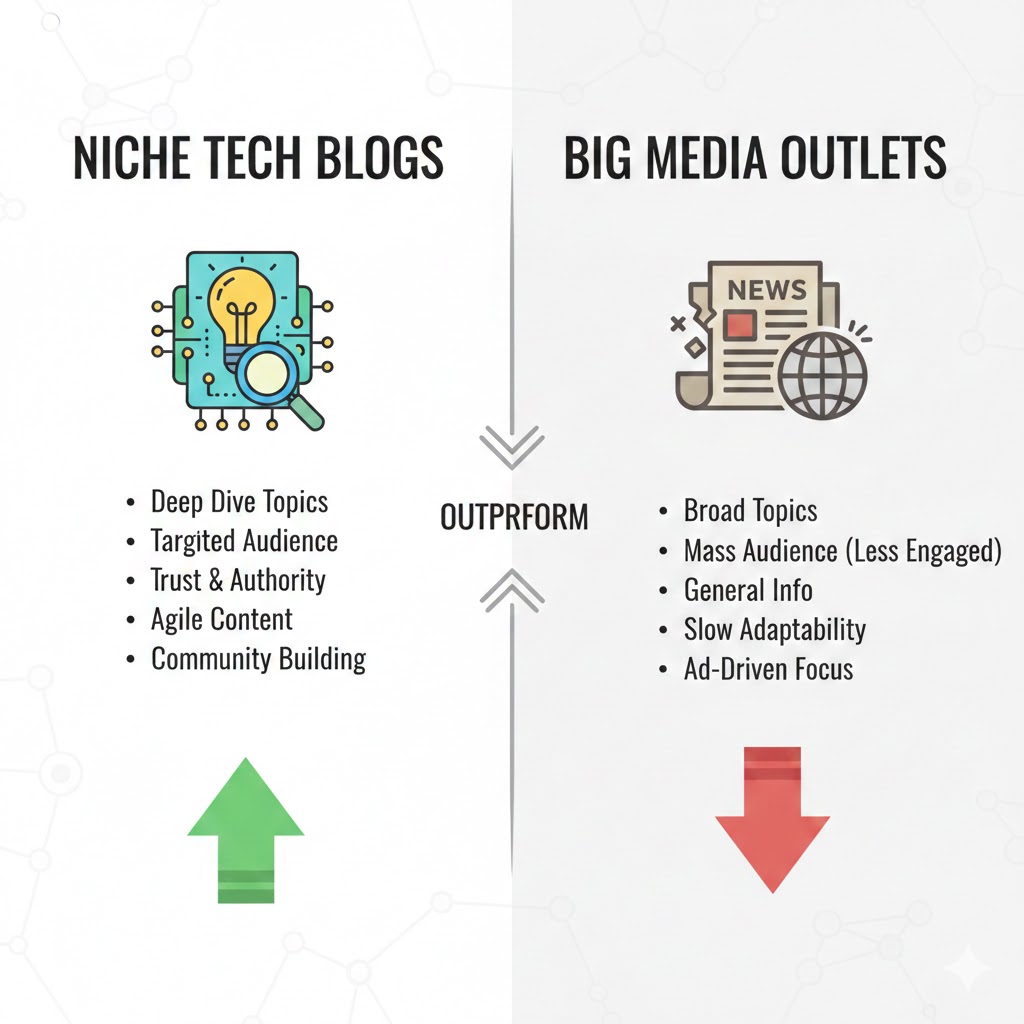
The technology media landscape has undergone a seismic transformation over the past decade. While major publications like TechCrunch, The Verge, and Wired continue commanding significant readership, a surprising trend has emerged: specialized niche technology blogs are increasingly outperforming these established media giants in engagement, influence, and even profitability within their focused domains.
This phenomenon challenges conventional wisdom about media economics and audience reach. The traditional assumption held that larger organizations with more resources, bigger teams, and established brand recognition would naturally dominate digital media. However, Niche Tech Blogs Outperform Big Media in numerous measurable ways, from reader loyalty to conversion rates to advertiser returns on investment.
The advantages that niche tech blogs possess aren’t accidental—they stem from fundamental structural differences in how these publications operate, who they serve, and what they prioritize. While big media organizations optimize for maximum scale and broad appeal, niche blogs focus intensely on depth, expertise, and community connection within specific technology sectors.
Understanding why and how niche tech blogs achieve superior performance provides valuable lessons for content creators, marketers, and anyone seeking to build influential media properties in specialized spaces. The dynamics at play reveal broader truths about audience preferences, the value of expertise, and the changing economics of digital publishing.
1. The Power of Specialized Expertise
The most fundamental advantage that niche tech blogs hold over general technology publications stems from genuine, deep expertise in their chosen domains. This specialization creates qualitative differences that audiences immediately recognize and value.
Deep Technical Knowledge vs. Surface Coverage
Big media technology publications employ generalist journalists who cover broad beats—consumer electronics, enterprise software, startups, policy, and more. While these journalists are skilled at their craft, they cannot possibly maintain expert-level knowledge across all the technologies they cover. Their stories necessarily remain somewhat surface-level, explaining concepts for broad audiences rather than diving into technical nuances.
Niche tech blogs, by contrast, are often written by practitioners, engineers, or specialists who work directly with the technologies they cover. A blog focused on Kubernetes infrastructure isn’t written by general technology journalists—it’s created by DevOps engineers who implement these systems daily. This lived experience produces insights that generalist coverage simply cannot match.
The depth of technical analysis in specialized publications attracts audiences seeking more than basic explanations. Experienced professionals, advanced hobbyists, and decision-makers researching purchases want detailed technical specifications, performance benchmarks, implementation guidance, and nuanced comparisons that only expert sources provide. Niche blogs serve these needs far better than publications optimizing for general readership.
Accurate Context and Industry Understanding
Understanding the broader context around technological developments requires immersion in specific industry ecosystems. Niche bloggers attend specialized conferences, participate in relevant online communities, maintain relationships with key industry figures, and follow developments that general publications miss entirely.
This contextual knowledge manifests in coverage that accurately interprets announcements, anticipates implications, and identifies genuinely significant developments versus marketing hype. When a niche database blog analyzes a new PostgreSQL feature, the writer understands how it fits into existing workflows, which use cases benefit most, and what edge cases might cause problems—context that general technology coverage lacks.
Big media organizations attempting to cover everything inevitably miss subtleties and occasionally publish inaccurate analyses because their journalists lack deep domain immersion. Niche publications, by maintaining relentless focus on specific areas, develop accuracy and insight advantages that build credibility and reader trust over time.
Cutting Through Marketing Narratives
Technology companies invest heavily in public relations designed to shape media narratives around their products and strategies. General technology publications, dependent on maintaining access and relationships with major companies, sometimes publish stories that uncritically echo vendor marketing messages.
Niche Tech Blogs Outperform Big Media partly because independent specialists can afford to be more critical and skeptical. A niche security blog analyzing a new authentication protocol isn’t worried about losing access to Microsoft or Google press events—they’re focused on providing honest technical assessment for their expert audience. This editorial independence produces more valuable, trustworthy analysis.
The technical expertise of niche bloggers also makes them harder to mislead with sophisticated marketing narratives. They can evaluate technical claims against their own experience, run their own tests, and identify when vendor assertions don’t match reality. This bullshit detection capability serves audiences seeking truth rather than spin.
2. Highly Engaged and Targeted Audiences
The audience dynamics of niche tech blogs differ fundamentally from those of major media properties, creating superior engagement metrics and more valuable reader relationships.
Quality Over Quantity in Readership
Big media technology publications measure success primarily through scale metrics—total monthly visitors, page views, unique readers. These massive numbers attract broad-based advertising and create impressive media kits, but they obscure important questions about engagement depth and audience composition.
Niche tech blogs typically attract far smaller absolute audience numbers but achieve dramatically higher engagement rates. Readers of specialized publications spend more time with content, read more thoroughly, return more frequently, and participate more actively in communities. A niche blog with ten thousand monthly readers might generate more meaningful impact than a general publication with millions of casual visitors.
The self-selection inherent in niche audiences creates valuable concentration of relevant readers. Everyone reading a specialized machine learning blog is genuinely interested in machine learning, whereas general tech publication audiences include many visitors who clicked through from social media without strong topic interest. This audience quality difference translates into superior outcomes for both content creators and advertisers.
Higher Conversion Rates and Purchase Intent
Readers arrive at niche tech blogs with specific intent—researching purchasing decisions, seeking solutions to problems, or deepening expertise in areas relevant to their work. This intentionality creates purchase-ready audiences that convert at multiples of general publication rates.
Affiliate revenue data demonstrates this conversion advantage clearly. A niche blog reviewing specialized developer tools might convert five to ten percent of readers into purchasers, while general publication product coverage typically converts below one percent. The concentrated relevance of niche content to reader needs directly drives these superior conversion economics.
B2B technology vendors particularly value niche publication audiences because readers often hold purchasing authority or technical influence within their organizations. A detailed review of enterprise database software on a specialized database blog reaches decision-makers and architects who actually select these products, creating advertising value that justifies premium rates despite smaller absolute reach.
Community Formation and Participation
Niche publications naturally foster community formation because readers share specific interests and expertise levels. Comment sections, forums, Discord channels, and social media groups around specialized blogs become valuable communities where professionals network, share knowledge, and solve problems collaboratively.
These communities create tremendous value beyond the blog content itself, transforming publications into platforms that readers depend on for both information and connection. The community effect generates loyalty that general publications struggle to match because their diverse audiences lack the common ground necessary for meaningful community formation.
Active communities also contribute content through comments, forum posts, and shared experiences that enhance publication value. Reader contributions effectively become unpaid content that serves other community members, creating network effects where publication value increases as the audience grows.
3. SEO and Discovery Advantages
Search engine optimization dynamics heavily favor specialized publications over general ones for queries within their domains of focus, creating sustainable traffic advantages.
Topical Authority and Google Ranking Signals
Google’s search algorithms increasingly prioritize topical authority—the perception that a website is a comprehensive, expert resource on specific subjects. Niche tech blogs build this authority naturally through concentrated coverage of their chosen domains, publishing dozens or hundreds of articles on related topics that demonstrate expertise depth.
General technology publications dilute their topical authority by covering everything. While they may have greater overall domain authority from their size and backlink profiles, they cannot compete with specialized publications for expert-level topical authority in specific niches. When someone searches for advanced Rust programming patterns, Google recognizes specialized Rust blogs as more authoritative sources than general technology news sites.
The sustained focus of niche publications allows them to comprehensively cover their topics, addressing long-tail search queries that general publications never create content for. This long-tail coverage captures cumulative traffic that exceeds what any single article on a general site could achieve, even if that article ranks well for a popular head term.
Lower Competition for Specialized Keywords
Niche Tech Blogs Outperform Big Media in search rankings for specialized terms because they face less competition. General publications compete with every other major site for broad keywords like “best laptops” or “iPhone review,” making top rankings difficult and expensive to achieve through content investment.
Specialized publications target technical, long-tail keywords that major sites ignore as insufficiently popular to warrant coverage. Keywords like “PostgreSQL connection pooling best practices” or “implementing OAuth 2.0 PKCE flow” might only generate hundreds of monthly searches, but niche blogs can dominate these terms and aggregate meaningful traffic across thousands of such specialized queries.
The cumulative effect of ranking for hundreds or thousands of long-tail keywords creates traffic that rivals or exceeds what general publications achieve from ranking for a few competitive head terms. This long-tail strategy proves more sustainable because rankings face less competition and remain stable over time.
Content Longevity and Evergreen Value
Technical content ages more slowly than news, creating long-term traffic value from past publications. A comprehensive guide to Docker container optimization written three years ago continues attracting search traffic and providing value, whereas news articles become irrelevant within days or weeks.
Niche tech blogs benefit enormously from this evergreen content dynamic. Their article archives become valuable libraries that compound in value over time as search engines index more content and internal links strengthen topical relationships. General publications focus more on news that quickly loses relevance, limiting long-term traffic value from older articles.
The permanent value of quality technical content justifies greater investment in comprehensive, well-researched pieces. Niche bloggers know that effort invested in detailed guides pays dividends for years through ongoing search traffic, whereas news publications optimize for immediate traffic knowing stories will quickly become obsolete.
4. Agility and Operational Efficiency
The structural characteristics of niche blogs enable operational advantages that translate into better content, faster publication, and higher profitability despite smaller scale.
Minimal Bureaucracy and Faster Publishing
Big media organizations operate with editorial hierarchies, approval processes, fact-checking departments, legal reviews, and coordination overhead that slows content publication. Stories can take days or weeks to move from pitch to publication as they navigate organizational processes.
Niche blogs typically operate with minimal bureaucracy—often just the blogger or small teams making rapid decisions without lengthy approval chains. This agility allows them to publish timely content covering breaking developments, respond quickly to reader questions, and capitalize on trending topics before interest fades.
The speed advantage proves particularly valuable in fast-moving technology sectors where first comprehensive coverage of new developments attracts disproportionate attention and traffic. Being first with quality analysis creates lasting advantages through backlinks, social sharing, and search ranking that persist long after others publish similar content.
Lower Overhead and Higher Profitability
General technology publications maintain expensive operations including large editorial staffs, business development teams, video production facilities, and executive overhead. These costs require substantial revenue to achieve profitability, pushing publications toward mass-market content that attracts maximum advertising.
Niche blogs operate much more efficiently, often with solo creators or small teams working remotely without expensive infrastructure. Revenue requirements for sustainability remain modest, allowing bloggers to maintain editorial independence and focus on serving their specific audiences rather than maximizing scale for advertisers.
The profitability difference can be stark. A niche blog generating two hundred thousand dollars in annual revenue with ninety percent margins returns more profit than a major publication generating five million dollars with typical media economics. This financial sustainability allows quality niche publications to persist and thrive while even large media organizations face financial pressures.
Flexible Monetization Strategies
Big media publications depend heavily on display advertising and sponsored content to monetize their large audiences. These models have suffered from declining rates, ad blocking, and privacy regulations that limit targeting effectiveness, creating revenue challenges across traditional media.
Niche Tech Blogs Outperform Big Media financially by employing diverse monetization that better suits their engaged audiences. Affiliate marketing converts at higher rates with qualified audiences, direct sponsorships from relevant vendors command premium rates, digital products and courses serve community needs, and consulting services leverage expertise into high-value engagements.
This monetization flexibility allows niche publications to adapt as industry economics change. When one revenue stream weakens, others compensate, whereas traditional media organizations locked into advertising-dependent models lack similar adaptability.
5. Authenticity and Editorial Independence
The credibility advantages that independent niche publications maintain over corporate media entities drive superior influence despite smaller scale.
No Corporate Agenda or Conflicts of Interest
Major technology publications increasingly face conflicts of interest as they’re owned by larger media conglomerates or funded by venture capital investors with stakes in technology companies. These ownership structures can create subtle or explicit pressures around coverage that audiences increasingly recognize and distrust.
Independent niche bloggers typically lack these conflicts, allowing them to maintain editorial independence and cover topics without corporate pressures. This freedom to criticize vendors, challenge industry narratives, and prioritize reader interests over business relationships produces more trustworthy content that audiences value.
The perception of independence matters even when big media organizations maintain journalistic integrity. Readers skeptical of corporate media naturally trust independent voices more, giving niche publications credibility advantages simply by operating outside traditional media structures.
Personal Voice and Authentic Communication
Big media writing follows house styles that prioritize consistency and professionalism over individual voice. While this approach ensures quality baselines, it creates somewhat generic content that lacks the personality and authenticity that audiences increasingly value.
Niche bloggers write in their own voices, sharing personal experiences, opinions, and perspectives that readers find more engaging and relatable than corporate media prose. This authenticity creates stronger connections with audiences who feel they know the blogger personally rather than consuming faceless institutional content.
The personal nature of niche blogs also allows for vulnerability and transparency that corporate media avoids. Bloggers can admit mistakes, share learning processes, and discuss failures in ways that humanize their expertise and make content more valuable to readers navigating similar challenges.
Responsive to Community Feedback
Small independent operations can pivot quickly based on community feedback, adjusting coverage priorities, content formats, and publication schedules to better serve audience needs. This responsiveness creates alignment between what publications produce and what audiences want.
Large media organizations move more slowly in response to audience feedback due to organizational inertia, established processes, and competing priorities. Strategy decisions often reflect internal politics and management preferences rather than direct audience needs, creating disconnect between what publications produce and what readers want most.
The ability to evolve based on community input allows niche publications to continuously improve their product-market fit, strengthening their positions over time while larger competitors struggle to match their agility and audience alignment.
6. Network Effects and Industry Integration
Successful niche publications become embedded in their industry ecosystems in ways that amplify their influence beyond what readership numbers alone would suggest.
Becoming Essential Industry Infrastructure
Within specialized technology domains, leading niche publications often become essential infrastructure that industry participants depend on daily. Developers building in particular frameworks bookmark specific blogs as authoritative references, creating habitual traffic that general publications rarely achieve.
This essentiality creates defensible positions that newcomers struggle to challenge. Once a publication establishes itself as the definitive resource in a niche, displacing it requires not just better content but overcoming entrenched habits and community loyalty built over years.
The infrastructure role also creates self-reinforcing advantages. Companies announce products knowing they must reach specific niche publications to adequately inform their target markets, giving those publications privileged access and information that further strengthens their positions.
Influencing Product Development and Strategy
Niche Tech Blogs Outperform Big Media in actual industry influence because specialized publications reach the practitioners, developers, and decision-makers who shape technology directions. A critical analysis on a respected database blog might influence thousands of database professionals and even prompt vendors to reconsider product strategies.
Companies building products actively monitor relevant niche publications for feedback, feature requests, and community sentiment. Blog posts identifying problems or proposing improvements often directly influence product roadmaps in ways that general media coverage never does because the audience overlap with actual product builders is so high.
The influence that niche publications wield within their domains attracts vendors seeking to shape community perceptions, creating opportunities for premium partnerships and advisory relationships that generate revenue while maintaining editorial independence.
Creating and Defining Standards
Within emerging technology areas, niche publications often play roles in establishing terminology, best practices, and informal standards that shape how entire communities approach their domains. Tutorial series establishing patterns for solving common problems can define how thousands of developers structure their implementations.
This standard-setting influence stems from expertise credibility and community trust that allows certain publications to set agendas within their niches. When respected voices declare that particular approaches are best practices, communities often adopt those perspectives widely, giving those publications outsized influence.
General publications lack the domain authority to establish standards because their broad coverage prevents them from building the concentrated expertise credibility necessary for communities to accept their pronouncements as authoritative within specific technical domains.
7. Sustainable Business Models for the Long Term
The economic structures underlying successful niche tech blogs prove more sustainable than those supporting traditional media, suggesting continued outperformance into the future.
Direct Audience Relationships
Niche publications typically own their audience relationships directly through email lists, RSS feeds, and owned platforms rather than depending on social media intermediaries or search traffic. This direct connection reduces platform risk and allows publications to communicate with audiences regardless of algorithm changes.
The value of owned audiences has become increasingly clear as social media platforms reduce organic reach and search algorithms become less predictable. Publications that cultivated email subscribers and community platforms maintain stable audience connections while those dependent on external platforms face volatile traffic patterns.
Building direct relationships also enables more sophisticated audience understanding through surveys, feedback, and community interaction. This qualitative insight about audience needs, preferences, and pain points allows niche publications to serve their communities more effectively than publications relying primarily on analytics.
Multiple Revenue Streams Reduce Risk
Successful niche blogs diversify revenue across advertising, affiliates, sponsorships, products, consulting, and community memberships. This diversification protects against disruption in any single monetization channel and creates financial sustainability even during industry downturns.
Traditional media publications remain heavily dependent on advertising revenue, creating vulnerability as advertising markets weaken and privacy regulations limit targeting effectiveness. The inability to diversify stems partly from their scale—large operations require massive revenue that only advertising can potentially provide.
The flexibility to experiment with monetization approaches allows niche publications to discover what works for their specific audiences and adjust as conditions change. This adaptive capacity contrasts with traditional media’s structural lock-in to advertising-dependent models.
Scalability Through Focused Expansion
Rather than trying to compete broadly, successful niche publications can expand by launching additional focused properties in adjacent niches. A popular DevOps blog might expand into separate publications covering Kubernetes specifically, cloud security, or infrastructure automation, each targeting distinct but related audiences.
This focused expansion strategy allows growth while maintaining the specialization advantages that made the original publication successful. Each new property can achieve niche dominance in its domain rather than diluting coverage across too many topics.
The multi-property approach also diversifies business risk across different niches and revenue sources while potentially sharing infrastructure, technology, and operational knowledge. This portfolio strategy provides growth pathways without sacrificing the core advantages of specialization.
Conclusion
The evidence that Niche Tech Blogs Outperform Big Media within their specialized domains reflects fundamental shifts in how audiences discover, consume, and value content. The advantages of expertise depth, community focus, operational agility, and editorial independence prove more valuable than the scale and resources that traditional media organizations command.
This dynamic doesn’t mean major technology publications will disappear or become irrelevant—they continue serving important roles in providing broad technology coverage, breaking major news stories, and reaching mainstream audiences. However, their dominance in shaping opinion and influencing decisions within specific technology communities has clearly diminished as specialized publications have risen.
For content creators and entrepreneurs, the lessons are clear. Focusing deeply on specific niches allows building authoritative positions that prove defensible against larger competitors. The combination of genuine expertise, engaged communities, and flexible business models creates sustainable operations that can thrive without requiring massive scale.
Technology professionals and enthusiasts benefit from this media ecosystem evolution through access to higher-quality, more detailed coverage from sources with authentic expertise and minimal conflicts of interest. The proliferation of excellent niche publications means that whatever specialized technology interest someone pursues, dedicated expert resources likely exist serving that specific community.
The future will likely see continued fragmentation as successful niche publications inspire new entrants in increasingly specific sub-niches, while major media organizations adapt by launching focused vertical publications attempting to capture niche advantages within larger organizational structures. The fundamental dynamics favoring specialized expertise and community focus should persist regardless of specific platform or format evolution.
Understanding why Niche Tech Blogs Outperform Big Media provides valuable insights extending beyond technology publishing. In knowledge-intensive fields where expertise and depth matter, specialized focused operations consistently outperform larger generalist competitors on metrics that truly matter—influence, trust, engagement, and often profitability. These patterns suggest broad lessons about the value of specialization in an era of information abundance.
Also read this:
The Smart Way to Monetize Tech Content in 2026