
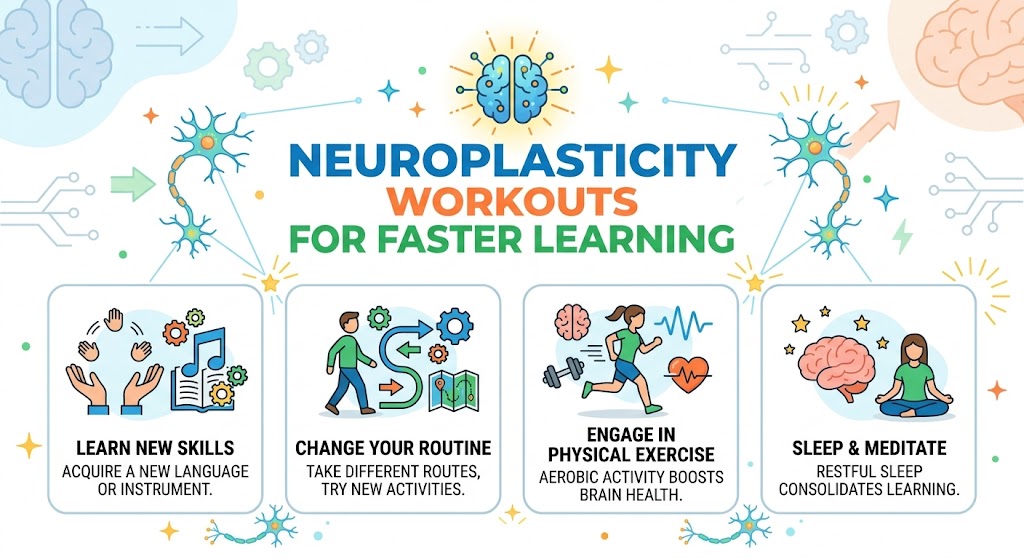

Learning is no longer limited to traditional study techniques. Modern neuroscience shows that the brain is capable of continuously adapting and reorganizing itself. This ability is known as neuroplasticity. By using Neuroplasticity Workouts, individuals can train their brain to process information faster, improve memory, and enhance cognitive performance.
Neuroplasticity Workouts for Faster Learning are structured mental exercises designed to strengthen neural connections. These exercises help your brain adapt to new information quickly and retain knowledge more efficiently.
Students, professionals, and entrepreneurs are increasingly adopting Neuroplasticity Workouts to boost productivity, sharpen focus, and accelerate learning in today’s fast-paced world.
In this comprehensive guide, we will explore powerful Neuroplasticity Workouts for Faster Learning, the science behind them, and how you can apply them daily to unlock your brain’s full potential.
1. What Are Neuroplasticity Workouts?
Neuroplasticity Workouts are mental exercises that stimulate the brain to create new neural pathways. These exercises challenge the brain, forcing it to adapt and improve cognitive abilities.
Unlike passive learning methods, Neuroplasticity Workouts actively engage multiple areas of the brain, strengthening connections between neurons.
Key Characteristics of Neuroplasticity Workouts
Sub points:
- They challenge existing thinking patterns
- They stimulate multiple brain regions
- They encourage problem solving
- They strengthen neural connections
- They improve long-term memory
When performed consistently, Neuroplasticity Workouts help the brain become more flexible, efficient, and capable of learning complex information faster.
2. The Science Behind Neuroplasticity Workouts for Faster Learning
The human brain contains billions of neurons connected through synapses. When we learn something new, these connections become stronger.
Neuroplasticity Workouts for Faster Learning work by repeatedly stimulating these neural pathways, allowing the brain to process information more efficiently.
How Neuroplasticity Improves Learning
Sub points:
- strengthens memory networks
- increases cognitive flexibility
- improves attention span
- enhances problem-solving ability
Research in neuroscience has shown that regular Neuroplasticity Workouts can significantly improve cognitive performance and learning speed.
3. Why Neuroplasticity Workouts Are Important for Faster Learning
Many people struggle with slow learning because their brains rely on outdated cognitive patterns.
Neuroplasticity Workouts help break these patterns and create stronger learning pathways.
Benefits of Neuroplasticity Workouts
Sub points:
- faster information processing
- improved memory retention
- better concentration
- stronger analytical thinking
- enhanced creativity
Students, professionals, and knowledge workers can dramatically improve their performance by practicing Neuroplasticity Workouts for Faster Learning regularly.
4. Powerful Neuroplasticity Workouts to Improve Brain Performance
Below are some effective Neuroplasticity Workouts that help accelerate learning and cognitive development.
1. Learning a New Skill
Learning something unfamiliar forces the brain to build new neural pathways.
Sub points:
- learn a new language
- practice musical instruments
- explore new technical skills
These activities act as powerful Neuroplasticity Workouts because they require the brain to process new patterns and information.
2. Memory Training Exercises
Memory training strengthens the hippocampus, the brain region responsible for learning and recall.
Sub points:
- memory palace technique
- spaced repetition learning
- visualization exercises
Practicing these Neuroplasticity Workouts for Faster Learning helps improve memory capacity significantly.
3. Problem-Solving Challenges
Complex problems stimulate multiple cognitive regions of the brain.
Sub points:
- puzzles and brain teasers
- logic games
- mathematical challenges
These types of Neuroplasticity Workouts encourage deeper thinking and strengthen neural connections.
4. Mindfulness and Meditation
Mindfulness training improves brain connectivity and emotional regulation.
Sub points:
- focused breathing exercises
- body scan meditation
- awareness training
Research suggests that meditation acts as a powerful Neuroplasticity Workout by improving concentration and mental clarity.
5. Physical Exercise
Physical activity increases blood flow to the brain and stimulates neural growth.
Sub points:
- aerobic workouts
- yoga and stretching
- coordination exercises
Regular movement supports Neuroplasticity Workouts for Faster Learning by improving brain health and cognitive performance.
5. Daily Neuroplasticity Workout Routine for Faster Learning
Creating a structured routine helps maximize the benefits of Neuroplasticity Workouts.
Morning Brain Activation
Sub points:
- 10 minutes meditation
- quick memory exercises
- reading new information
Midday Cognitive Challenge
Sub points:
- solve puzzles or logic games
- learn new vocabulary
- practice analytical thinking
Evening Brain Reflection
Sub points:
- review what you learned
- visualize information
- write summary notes
Following a daily routine of Neuroplasticity Workouts for Faster Learning helps reinforce neural pathways and improve long-term memory.
6. Lifestyle Habits That Boost Neuroplasticity
In addition to mental exercises, certain lifestyle habits support Neuroplasticity Workouts.
1. Quality Sleep
Sleep strengthens neural connections formed during learning.
Sub points:
- improves memory consolidation
- enhances cognitive performance
- supports brain recovery
2. Brain-Friendly Nutrition
Certain nutrients promote neural growth and brain health.
Sub points:
- omega-3 fatty acids
- antioxidants
- healthy fats
3. Continuous Learning
Constant learning stimulates brain adaptation.
Sub points:
- reading books
- exploring new ideas
- taking online courses
Combining these habits with Neuroplasticity Workouts for Faster Learning creates an ideal environment for cognitive development.
7. Common Mistakes When Practicing Neuroplasticity Workouts
Some people fail to see results because they approach brain training incorrectly.
1. Lack of Consistency
Neuroplasticity requires repeated stimulation.
Sub points:
- irregular practice
- inconsistent routines
- lack of discipline
2. Passive Learning
Simply consuming information does not stimulate strong neural connections.
Sub points:
- passive reading
- watching without engagement
- memorizing without understanding
Active Neuroplasticity Workouts are necessary for meaningful brain development.
3. Overloading the Brain
Trying to learn too much at once can reduce learning efficiency.
Sub points:
- cognitive fatigue
- information overload
- reduced retention
Balanced Neuroplasticity Workouts for Faster Learning provide the best results.
8. Technology and Neuroplasticity Workouts
Modern technology provides many tools that enhance Neuroplasticity Workouts.
Examples of Digital Brain Training
Sub points:
- cognitive training apps
- memory improvement platforms
- interactive learning systems
These tools make Neuroplasticity Workouts for Faster Learning more accessible and engaging.
9. Who Can Benefit from Neuroplasticity Workouts?
Anyone looking to improve their cognitive abilities can benefit from Neuroplasticity Workouts.
1. Students
Sub points:
- faster learning
- improved exam performance
- stronger memory
2. Professionals
Sub points:
- improved problem solving
- better decision making
- increased productivity
3. Entrepreneurs
Sub points:
- strategic thinking
- innovation
- adaptability
Regular Neuroplasticity Workouts for Faster Learning can significantly enhance mental performance in all areas of life.
10. Future of Neuroplasticity and Brain Training
Scientific research continues to uncover new ways to enhance brain performance.
Future developments may include:
- AI-powered cognitive training
- personalized brain workout programs
- advanced neurofeedback technologies
As neuroscience advances, Neuroplasticity Workouts will become even more effective in helping people learn faster and think more clearly.
Conclusion
The human brain has an incredible ability to adapt and grow. By practicing Neuroplasticity Workouts, anyone can strengthen neural connections, improve memory, and accelerate learning.
Neuroplasticity Workouts for Faster Learning provide a structured way to train the brain just like physical workouts train the body.
Whether you are a student preparing for exams, a professional developing new skills, or an entrepreneur seeking mental clarity, consistent Neuroplasticity Workouts can dramatically improve cognitive performance.
The key is consistency. When practiced daily, Neuroplasticity Workouts for Faster Learning help unlock the full potential of the human brain.
Frequently Asked Questions (FAQ)
1. What are Neuroplasticity Workouts?
Neuroplasticity Workouts are mental exercises designed to strengthen neural connections and improve brain performance.
2. Can Neuroplasticity Workouts improve memory?
Yes. Regular Neuroplasticity Workouts for Faster Learning strengthen memory networks and improve information retention.
3. How long does it take to see results?
Most people begin noticing cognitive improvements within a few weeks of consistent Neuroplasticity Workouts.
4. Are Neuroplasticity Workouts scientifically proven?
Yes. Neuroscience research confirms that repeated mental stimulation strengthens neural pathways and enhances brain plasticity.
5. Can adults benefit from Neuroplasticity Workouts?
Absolutely. The brain retains its ability to adapt throughout life, making Neuroplasticity Workouts for Faster Learning beneficial at any age.
More Related Topics:
Indoor Air Quality and Respiratory Health: Why Clean Indoor Air Matters for Your Health
Mushroom Complex Supplements Ranked: The Best Functional Mushroom Blends in 2026