
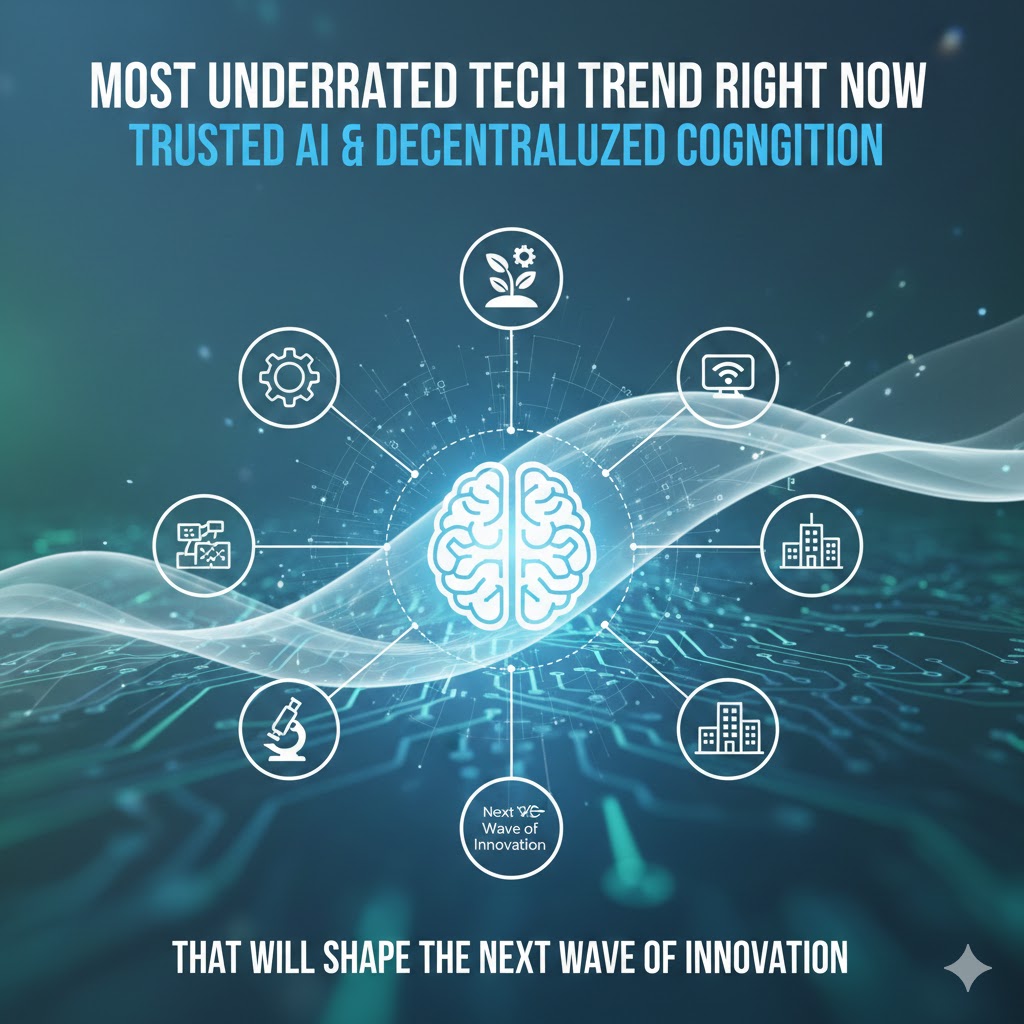
While headlines obsess over artificial intelligence breakthroughs and the latest smartphone releases, a quieter revolution is unfolding beneath the surface of mainstream tech discourse. This transformation will fundamentally reshape how we build, deploy, and interact with technology over the next decade, yet it receives a fraction of the attention devoted to more glamorous innovations.
The most underrated tech trend dominating forward-thinking engineering teams and research labs isn’t a single technology but rather a convergence: the systematic integration of ambient computing, edge intelligence, and spatial awareness into everyday objects and environments. This trend, often dismissed as incremental improvement or relegated to niche applications, represents nothing less than the next paradigm shift in human-computer interaction.
Unlike previous technology waves that required us to adapt our behaviors to machines, this emerging trend makes technology adapt to us. It eliminates interfaces, anticipates needs, and operates invisibly within the physical spaces we already inhabit. The implications stretch far beyond convenience, touching everything from healthcare delivery to urban planning, from manufacturing efficiency to environmental sustainability.
1. Understanding the Ambient Intelligence Revolution
The term “ambient intelligence” has circulated in academic circles for two decades, yet only now are the enabling technologies mature enough for widespread implementation. This convergence represents the most underrated tech trend because its power lies not in any single breakthrough but in the synergistic combination of multiple technologies reaching critical maturity simultaneously.
The Core Components
Ambient intelligence systems combine several technological elements into seamless experiences. Ultra-low-power sensors have become so inexpensive and energy-efficient that embedding them in virtually any object or surface has become economically viable. A sensor that once cost twenty dollars and required frequent battery replacement now costs thirty cents and can operate for years on energy harvested from its environment.
Edge computing processors have achieved remarkable efficiency improvements, enabling sophisticated data processing to occur locally rather than in distant data centers. This shift reduces latency, enhances privacy, and enables real-time responsiveness that cloud-dependent systems cannot match.
Machine learning models have been compressed and optimized to run on resource-constrained devices. What once required server farms can now execute on processors consuming less power than a LED lightbulb, enabling intelligent decision-making to occur at the point of data collection.
Wireless communication protocols have evolved to support massive device deployments with minimal infrastructure. Technologies like LoRaWAN, narrowband IoT, and advanced Bluetooth mesh networks allow thousands of devices to communicate reliably over extended ranges while consuming minimal power.
Why This Remains Underrated
Despite these technological achievements, ambient intelligence remains underappreciated for several reasons. First, its success manifests as invisible convenience rather than flashy demonstrations. When your home heating system learns your preferences and adjusts automatically, you simply stop thinking about temperature control. The technology succeeds by disappearing.
Second, the benefits accumulate gradually rather than arriving as revolutionary moments. Each individual improvement seems incremental, obscuring the cumulative transformation. A smart building that reduces energy consumption by fifteen percent while improving occupant comfort doesn’t generate headlines, yet multiply that across millions of buildings and the impact rivals any consumer technology launch.
Third, ambient intelligence challenges the interface-centric paradigm that has dominated computing for decades. We’re culturally conditioned to evaluate technology through screens and buttons, making it difficult to appreciate systems that deliberately eliminate these familiar touchpoints.
2. Real-World Applications Transforming Industries
The abstract promise of ambient intelligence becomes concrete when examining its applications across diverse sectors. These implementations showcase why discerning technologists consider this the most underrated tech trend shaping the next decade.
Healthcare Transformation
Healthcare delivery is experiencing fundamental transformation through ambient monitoring systems that track patient wellness without invasive devices or conscious patient effort. Hospital rooms embedded with distributed sensor networks monitor vital signs, movement patterns, sleep quality, and environmental factors continuously and unobtrusively.
These systems detect subtle changes that might indicate developing complications hours or days before traditional monitoring would reveal problems. A patient’s gait changes slightly, their breathing pattern shifts marginally, their sleep becomes more fragmented. Individually, these signals might mean nothing. Collectively, analyzed through machine learning models running at the edge, they trigger early interventions that prevent serious complications.
The impact extends beyond acute care. Elderly individuals living independently benefit from ambient systems that monitor activity patterns, detect falls, assess cognitive function through conversation analysis, and alert caregivers to concerning changes while preserving dignity and independence. These systems don’t require wearing devices or remembering to charge equipment, eliminating the primary barriers to adoption among older adults.
Manufacturing and Industrial Operations
Factory floors are being reimagined around ambient intelligence infrastructure that monitors equipment health, tracks inventory movement, optimizes logistics, and ensures worker safety without interrupting operations. Every machine, tool, and material becomes a data source feeding real-time optimization systems.
Predictive maintenance reaches new sophistication levels. Distributed acoustic sensors detect the subtle vibration changes indicating bearing wear weeks before failure. Thermal imaging systems identify electrical connection degradation before problems occur. Chemical sensors monitor lubricant conditions and trigger proactive replacement.
The economic impact is substantial. Unplanned downtime represents the largest operational expense for many manufacturers. Ambient intelligence systems that prevent failures rather than responding to them deliver ROI measured in millions of dollars for medium-sized operations, with proportionally larger benefits at enterprise scale.
Smart City Infrastructure
Urban environments are integrating ambient intelligence to optimize traffic flow, reduce energy consumption, improve public safety, and enhance quality of life for residents. These implementations demonstrate the scalability of ambient systems across complex, heterogeneous environments.
Intelligent street lighting systems adjust brightness based on pedestrian and vehicle presence, reducing energy consumption by forty to sixty percent while maintaining safety. The same sensor infrastructure feeds traffic optimization systems that reduce congestion, monitors air quality and triggers alerts during pollution events, detects infrastructure problems like water main leaks, and provides data for urban planning decisions.
Copenhagen has deployed over 380 sensor installations throughout the city, creating a real-time understanding of urban dynamics that informs everything from emergency response routing to long-term infrastructure investment. The system has reduced emergency response times by eighteen percent while cutting municipal energy consumption by twenty-two percent.
Retail and Commercial Spaces
Retail environments are evolving beyond simple point-of-sale transactions toward ambient experiences that understand customer needs and preferences without explicit input. These systems track inventory in real-time, analyze traffic patterns to optimize store layouts, detect shoplifting through behavioral analysis, and personalize experiences based on observed preferences.
Amazon’s Just Walk Out technology, deployed in Amazon Fresh stores and licensed to other retailers, exemplifies ambient commerce. Customers select items and leave without stopping at checkout. Distributed cameras and weight sensors track products and automatically charge customers’ accounts. The technology eliminates the most frustrating aspect of physical retail while providing retailers with unprecedented data about customer behavior.
3. The Technical Architecture Enabling Ambient Intelligence
Understanding why ambient intelligence represents the most underrated tech trend requires examining the technical infrastructure making these applications possible. The architecture combines edge computing, distributed intelligence, and sophisticated networking in novel configurations.
Edge Computing Infrastructure
Traditional cloud computing architectures prove inadequate for ambient intelligence applications requiring real-time responses, privacy preservation, and resilience to connectivity interruptions. Edge computing addresses these limitations by distributing processing capability throughout the system rather than centralizing it in remote data centers.
Modern edge computing spans multiple tiers. Ultra-edge devices perform immediate sensor fusion and preliminary analysis at the point of data collection. These might be microcontroller-class processors consuming milliwatts while running lightweight machine learning models that filter data and detect events requiring attention.
Gateway devices aggregate data from multiple ultra-edge nodes, perform more sophisticated analysis, and manage communication with cloud infrastructure. These edge gateways run containerized applications enabling flexible deployment of business logic close to data sources.
Cloud infrastructure handles computationally intensive tasks like training machine learning models, performing complex analytics, and managing system-wide coordination. However, unlike traditional architectures, the cloud serves as orchestrator and trainer rather than primary processor.
Distributed Machine Learning
Ambient intelligence systems deploy machine learning models across the edge-to-cloud continuum, with different models optimized for different locations and purposes. This distributed approach enables sophisticated intelligence while respecting constraints around latency, privacy, and connectivity.
Federated learning techniques allow models to improve through experience without raw data leaving edge devices. Individual devices train local models on their own data, then share only model updates with central coordinators. These updates are aggregated to improve global models that are redistributed to edge devices, creating a virtuous cycle of improvement while preserving privacy.
Transfer learning enables rapid adaptation to new environments and use cases. A model trained on manufacturing data from one facility can be fine-tuned for another facility with minimal additional training data, dramatically reducing deployment time and cost.
Communication Protocols and Standards
Effective ambient intelligence requires robust communication between thousands or millions of distributed devices. Traditional networking approaches designed for intermittent connections between relatively few devices prove inadequate at this scale.
Low-power wide-area networks enable devices to communicate over kilometers while operating for years on small batteries. These networks support massive device densities, with single base stations managing tens of thousands of sensors across square kilometers.
Mesh networking protocols create resilient communication fabrics where devices relay messages for each other, eliminating single points of failure and extending coverage without infrastructure investment. If any individual device fails or loses connectivity, the network automatically routes around the problem.
Time-sensitive networking standards ensure deterministic communication latency for applications requiring real-time guarantees. Industrial control systems, autonomous vehicles, and healthcare monitoring applications cannot tolerate unpredictable delays, making these standards essential for safety-critical ambient intelligence applications.
4. Privacy and Security Considerations
The proliferation of sensing and computing capability throughout our environments raises legitimate concerns about privacy and security. Addressing these concerns is essential for ambient intelligence to fulfill its potential as the most underrated tech trend transforming technology infrastructure.
Privacy-Preserving Design Principles
Leading ambient intelligence implementations incorporate privacy protection from the ground up rather than treating it as an afterthought. Edge processing enables privacy-preserving architectures where sensitive data never leaves the collection point.
Consider a smart building monitoring occupancy and activity patterns. Rather than streaming video footage to central servers, edge processors analyze video locally and extract only abstract metadata like occupancy counts and movement vectors. The raw video is immediately discarded, ensuring personal privacy while providing the information needed for building optimization.
Differential privacy techniques add mathematical guarantees that individual privacy is preserved even when sharing aggregate statistics. These approaches ensure that even sophisticated attackers cannot reconstruct individual behaviors from published data, enabling beneficial data sharing while protecting personal information.
Homomorphic encryption allows computation on encrypted data without decrypting it, enabling cloud processing while maintaining end-to-end encryption. Though still computationally expensive for many applications, rapid advances are bringing this technology into practical deployment for privacy-critical applications.
Security Architecture
Ambient intelligence systems present expanded attack surfaces that require comprehensive security approaches. With potentially millions of distributed devices, securing each individual component becomes impractical. Instead, system-level security assumes individual devices may be compromised and implements defenses that contain and limit damage.
Zero-trust architectures verify every communication and transaction regardless of source. Devices must continually prove their identity and authorization rather than being trusted based on network location. This approach prevents compromised devices from moving laterally through systems.
Hardware-based security anchors provide trusted execution environments that protect critical operations even if device software is compromised. Secure enclaves process sensitive data and cryptographic operations in isolated environments that cannot be accessed by potentially malicious software.
Continuous monitoring and behavioral analysis detect anomalous device behavior that might indicate compromise. Machine learning systems establish baseline behavior patterns for each device and flag deviations for investigation, enabling rapid response to security incidents.
5. Economic Impact and Market Opportunities
The business case for ambient intelligence is compelling across industries, explaining why informed investors and strategists recognize it as the most underrated tech trend creating market opportunities measured in trillions of dollars.
Cost Reduction and Efficiency Gains
Ambient intelligence systems deliver measurable ROI through operational improvements that compound over time. Energy optimization alone justifies implementation in many contexts. Commercial buildings implementing comprehensive ambient control systems reduce energy consumption by twenty to forty percent, translating to savings of $50,000 to $500,000 annually for typical office buildings.
Predictive maintenance prevents costly unplanned downtime. Manufacturing facilities implementing ambient monitoring reduce maintenance costs by fifteen to thirty percent while improving equipment uptime by five to ten percentage points. For capital-intensive industries, these improvements generate millions in annual value.
Labor productivity increases as workers spend less time on routine monitoring and more time on high-value activities. Healthcare workers freed from manual vital sign checks can focus on patient care. Factory workers augmented by ambient safety systems can operate more confidently. The cumulative productivity impact across the economy reaches tens of billions annually.
New Business Models and Revenue Streams
Beyond cost reduction, ambient intelligence enables entirely new business models. Equipment manufacturers are transitioning from selling products to offering outcomes-as-a-service, enabled by ambient monitoring that tracks performance and enables proactive maintenance.
Elevator companies now offer guaranteed uptime rather than selling maintenance contracts. HVAC manufacturers provide comfortable indoor environments rather than selling equipment. Industrial equipment vendors guarantee production capacity rather than selling machines. These outcome-based models transfer risk from customers to vendors while creating ongoing revenue streams tied to delivered value.
Data monetization creates additional revenue opportunities, though privacy concerns require careful navigation. Aggregate, anonymized insights from ambient systems have substantial value for urban planning, retail site selection, insurance underwriting, and numerous other applications. Companies that develop trustworthy approaches to data sharing can capture value while respecting individual privacy.
Market Size and Growth Projections
Market analysts project the ambient intelligence market will exceed $180 billion by 2030, growing at a twenty-three percent compound annual rate. This growth is distributed across hardware components, software platforms, integration services, and managed service offerings.
The semiconductor industry is experiencing renewed growth driven by demand for specialized edge processing chips optimized for machine learning inference, low-power operation, and integrated security features. Companies like NVIDIA, Qualcomm, and Intel are investing billions in edge computing silicon.
Software platforms orchestrating distributed ambient intelligence systems represent high-margin opportunities. Companies providing the middleware connecting edge devices, gateway systems, and cloud infrastructure are attracting substantial venture investment and acquisition interest.
6. Technical Challenges and Innovation Frontiers
Despite rapid progress, significant technical challenges remain before ambient intelligence achieves its full potential. Solving these challenges represents opportunities for researchers, entrepreneurs, and established companies to shape the most underrated tech trend defining the next technology era.
Power and Energy Management
While low-power electronics have advanced dramatically, powering millions of distributed sensors remains challenging. Battery replacement is impractical at scale, driving innovation in energy harvesting and ultra-low-power electronics.
Photovoltaic energy harvesting works well for outdoor applications but proves less reliable indoors. Kinetic energy harvesting captures power from vibration and movement but provides intermittent, unpredictable power. Thermal energy harvesting exploits temperature differentials but requires careful system design.
Backscatter communication represents a promising approach where devices communicate by reflecting ambient radio signals rather than generating their own, reducing power consumption by orders of magnitude. Battery-free sensors powered by and communicating through backscatter could operate indefinitely without maintenance.
Event-driven architectures where devices sleep deeply between events and wake only when interesting phenomena occur can extend battery life from days to years. Advanced power management integrated circuits and sophisticated wake-up radio receivers enable this approach.
Interoperability and Standards
The ambient intelligence ecosystem involves components from dozens or hundreds of vendors. Ensuring these components work together reliably requires comprehensive standards covering communication protocols, data formats, security mechanisms, and interoperability testing.
Standards bodies are actively developing frameworks, but progress is slow relative to market evolution. Proprietary ecosystems risk creating vendor lock-in and limiting ambient intelligence benefits. Open standards enable the combinatorial innovation that unlocks ambient intelligence’s full potential.
Industry consortia like the Connectivity Standards Alliance are working toward unified approaches, but fragmentation remains problematic. Devices supporting multiple protocols can bridge ecosystems but increase cost and complexity.
AI Model Efficiency and Adaptability
Running sophisticated machine learning models on resource-constrained edge devices requires continued innovation in model compression, quantization, and architectural efficiency. Models must be both accurate and computationally efficient, often presenting trade-offs requiring careful optimization.
Neural architecture search techniques automatically discover efficient model architectures optimized for specific hardware platforms and application requirements. These approaches can produce models achieving ninety percent of the accuracy of much larger models while operating at ten times the speed on edge hardware.
Continual learning enables deployed models to adapt to changing environments and new patterns without requiring cloud connectivity or manual intervention. This capability is essential for ambient systems operating in dynamic, unpredictable real-world environments.
Robustness and Reliability
Ambient intelligence systems must operate reliably in uncontrolled environments subject to temperature variations, electromagnetic interference, physical damage, and numerous other challenges. Achieving the reliability required for safety-critical applications demands robust hardware design and fault-tolerant software architectures.
Redundancy and diversity principles from safety-critical systems apply to ambient intelligence. Using multiple independent sensors and processing paths allows systems to tolerate individual component failures without system-level failures.
Graceful degradation ensures systems remain useful even when components fail or conditions exceed design parameters. Rather than failing catastrophically, systems should provide reduced functionality until normal operation can resume.
7. Societal Implications and Ethical Considerations
As the most underrated tech trend shaping technology’s future, ambient intelligence will have profound societal impacts extending beyond economic and technical dimensions. Thoughtful consideration of ethical implications is essential for responsible development and deployment.
Digital Divide and Access Equity
Ambient intelligence risks exacerbating existing inequalities if benefits accrue primarily to wealthy individuals, corporations, and communities while others are left behind. Smart city implementations in affluent neighborhoods while underserved areas lack basic infrastructure could deepen urban disparities.
Addressing this challenge requires intentional policies ensuring equitable access. Public sector investments in ambient infrastructure for underserved communities can prevent disparities. Open standards and open-source implementations reduce barriers to entry, enabling broader participation.
Universal design principles ensure ambient systems work for all users regardless of age, ability, or technical sophistication. Systems that require smartphone ownership or technical knowledge to operate exclude significant populations.
Surveillance and Control Concerns
The pervasive sensing capability enabling ambient intelligence also enables unprecedented surveillance if misused. Authoritarian governments could exploit ambient infrastructure to monitor and control populations. Even in democratic societies, mission creep could transform beneficial systems into surveillance apparatus.
Technical safeguards like privacy-preserving design and encryption are necessary but insufficient. Regulatory frameworks establishing clear boundaries around data collection, retention, and usage are essential. Meaningful transparency and accountability mechanisms must ensure systems operate within defined constraints.
Democratic governance of ambient infrastructure is crucial. Communities should have voice in how systems are designed, what data is collected, and how it is used. Public ownership or strong public oversight of critical ambient infrastructure may be necessary to prevent abuse.
Environmental Sustainability
Manufacturing and operating billions of ambient devices consumes resources and generates electronic waste. Ensuring ambient intelligence provides net environmental benefits requires lifecycle thinking about material sourcing, manufacturing processes, energy consumption, and end-of-life disposal.
The efficiency gains ambient systems enable often outweigh their direct environmental footprint. Smart buildings reducing energy consumption by thirty percent more than offset the environmental cost of sensor networks. The challenge is ensuring lifecycle impacts are rigorously assessed rather than assumed.
Designing for longevity, repairability, and recyclability reduces environmental impact. Devices that operate for decades rather than years, can be repaired rather than replaced, and have recyclable components create more sustainable ambient infrastructure.
8. The Path Forward: Preparing for the Ambient Future
Recognizing ambient intelligence as the most underrated tech trend shaping technology’s future is just the beginning. Individuals, organizations, and societies must prepare for the transformations ahead.
For Technologists and Developers
Professionals building tomorrow’s technology should develop skills spanning the full edge-to-cloud continuum. Understanding embedded systems, edge computing, machine learning deployment, and distributed systems architecture positions developers to create ambient intelligence applications.
Specialization opportunities abound in areas like ultra-low-power system design, on-device machine learning, sensor fusion algorithms, edge security, and distributed system orchestration. These skills will be increasingly valuable as ambient intelligence deployment accelerates.
Cross-disciplinary knowledge combining technical skills with domain expertise in healthcare, manufacturing, urban planning, or other application areas enables creation of truly valuable solutions rather than technology seeking applications.
For Organizations and Enterprises
Organizations should assess opportunities for ambient intelligence within their operations and offerings. Start with focused pilots addressing specific pain points rather than attempting comprehensive transformations immediately. Learn from early implementations before scaling investments.
Build or acquire expertise in relevant technologies. Partner with technology vendors, hire specialists, or develop internal capabilities through training and experimentation. Organizations lacking ambient intelligence capabilities will find themselves at increasing competitive disadvantage.
Consider business model implications. Ambient intelligence enables outcome-based offerings that can create stronger customer relationships and more predictable revenue streams than traditional product sales. Explore how monitoring and intelligence capabilities might transform customer value propositions.
For Policymakers and Regulators
Governments must balance enabling beneficial innovation while protecting citizens from potential harms. Regulatory frameworks should address privacy protection, security requirements, interoperability standards, and liability allocation for ambient systems.
Public investment in ambient infrastructure for smart cities, transportation systems, and public spaces can ensure equitable access while stimulating economic development. Such investments create platforms enabling private sector innovation while serving public purposes.
International cooperation on standards and norms prevents fragmentation that would limit ambient intelligence benefits while ensuring regulatory approaches remain harmonized across jurisdictions.
For Society
Public dialogue about ambient intelligence is essential for shaping its development trajectory. Citizens should engage with questions about what kinds of ambient systems we want, what trade-offs between convenience and privacy are acceptable, and how to ensure benefits are broadly shared.
Digital literacy education should evolve to help people understand ambient systems, make informed choices about participation, and exercise meaningful control over personal data. Understanding how ambient systems work and what rights individuals have is essential for democratic governance.
Conclusion: Embracing the Ambient Revolution
The convergence of sensing, edge intelligence, and distributed computing represents far more than incremental improvement to existing technologies. It constitutes a fundamental reimagining of how humans and computers interact, moving from explicit interfaces toward implicit, contextual intelligence woven into our environment.
This transformation remains the most underrated tech trend because its success manifests as convenience and efficiency rather than spectacular demonstrations. Yet its impact will ultimately exceed many technologies receiving far greater attention and investment today.
The opportunities span every industry and application domain. Healthcare will become more proactive and preventive. Manufacturing will achieve unprecedented efficiency and reliability. Cities will operate more sustainably and livably. Buildings will consume far less energy while providing superior comfort. The cumulative impact rivals any technology revolution in history.
Realizing this potential requires continued innovation addressing technical challenges around power, interoperability, and robustness. It demands thoughtful approaches to privacy, security, and equity ensuring benefits are broadly shared while protecting fundamental rights. It needs engaged communities shaping ambient intelligence development to reflect societal values and priorities.
The ambient intelligence revolution is not coming. It is here, unfolding in research labs, pilot deployments, and early commercial implementations. The question is not whether ambient intelligence will reshape technology but whether we will recognize it as the transformative force it represents and engage thoughtfully with its development.
For technologists, entrepreneurs, investors, and policymakers willing to look beyond the obvious to identify truly transformative trends, ambient intelligence represents the opportunity of the decade. The most underrated tech trend today will be recognized as obvious in hindsight, but by then, the positioning and competitive advantages will already be established.
The future will not be about better screens, faster processors, or more sophisticated chatbots, though those will continue improving. The future will be about technology that understands context, anticipates needs, and operates invisibly in service of human flourishing. That future is taking shape right now, for those with eyes to see it.
Also read this:
AI-Focused Content Attracts High-Value Sponsors and Premium Brand Deals in 2026
The Best Tech Content Model for Long-Term Revenue: Building Sustainable Tech Publishing Businesses
Tech Bloggers Are Monetizing Without Massive Traffic: Smart Strategies for Sustainable Income