
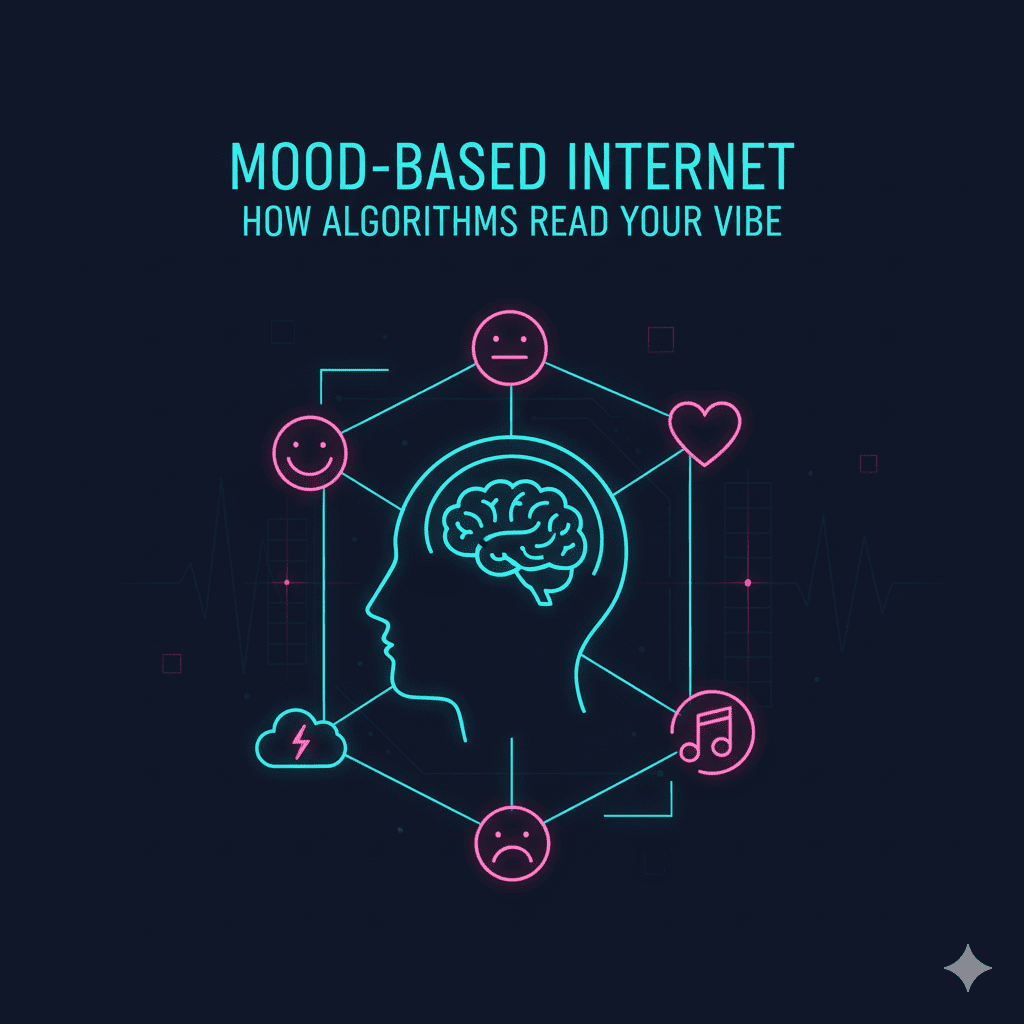
Mood-Based Internet 🎭
Ever catch yourself thinking, “Instagram is literally reading my mind right now”?
You’re not paranoid. You’re just experiencing the mood-based internet in full effect.
Picture this: It’s 2 AM, you’re scrolling through TikTok after a rough day, and suddenly your feed is filled with comfort food videos, relatable memes about burnout, and that oddly specific content that feels like a warm hug. Meanwhile, your morning Instagram is all sunrise motivation and productivity hacks.
Coincidence? Not even close.
Welcome to the era where algorithms don’t just track what you click—they track how you feel. And honestly? It’s equal parts fascinating and terrifying.
🔮 What Exactly Is the Mood-Based Internet?
The mood-based internet is like having a digital therapist who never sleeps, never forgets, and definitely doesn’t respect boundaries.
It’s the sophisticated evolution of personalization where platforms have stopped asking “What does this user like?” and started asking “What is this user feeling right now?”
Your phone has basically become an emotion-reading crystal ball. Except instead of predicting your future, it’s predicting your next emotional state—and serving content to either soothe it, amplify it, or exploit it.
Here’s the wild part: The mood-based internet doesn’t just respond to your emotions. It actively shapes them. And it’s getting better at this every single day.
🕵️ How Do Algorithms Actually Detect Your Mood?
1. Your Scrolling Speed Reveals Everything
Fast, frantic scrolling = anxiety or boredom
Slow, deliberate pauses = deep focus or contemplation
Repeatedly revisiting content = emotional resonance or obsession
The mood-based internet tracks these micro-behaviors like a hawk. Every millisecond you spend hovering over a post becomes data about your psychological state.
2. The Time-Stamped Emotional Map
Algorithms know that “3 AM You” is completely different from “10 AM You”:
- Late night browsing = vulnerability, loneliness, or insomnia anxiety
- Morning scrolls = optimistic, seeking motivation
- Lunch hour = distracted, looking for quick entertainment
- Evening wind-down = seeking relaxation or connection
The mood-based internet literally maps your emotional patterns to your daily schedule. Creepy? Yes. Effective? Absolutely.
3. Content Consumption = Emotional Fingerprint
What you watch tells a story:
📺 Binge-watching comfort shows? → Stressed and seeking familiarity
📚 Deep-diving educational content? → Growth mindset activated
😂 Comedy clips on repeat? → Trying to lift your spirits
💔 Sad song playlists? → Processing heartbreak or loss
🔥 Controversial debate videos? → Agitated, seeking validation
Each choice is a breadcrumb leading algorithms deeper into your psyche.
4. Your Music Is a Mood Diary
Spotify and Apple Music are basically emotional surveillance devices that you pay for:
- Listening to breakup anthems at midnight? Flag: user is heartbroken
- Replaying angry rap songs? Flag: user is frustrated
- Sudden classical music phase? Flag: user seeking calm or focus
The mood-based internet uses your playlist as a real-time mood tracker, then creates feedback loops that keep you emotionally engaged.
5. How You Type Speaks Volumes
Even your typing patterns expose your emotional state:
- Lots of typos = stressed, rushing, or emotionally dysregulated
- ALL CAPS = excited or angry
- Short, one-word responses = annoyed or withdrawn
- Long, rambling searches = confused, anxious, seeking answers
- Excessive punctuation!!! = heightened emotional state
The mood-based internet runs your text through sentiment analysis faster than you can hit send.
6. The Purchase Pattern Psychology
Your shopping cart is an emotional confession booth:
- Midnight online shopping = stress relief behavior
- Impulse luxury purchases = feeling successful or compensating
- Comfort food delivery orders = seeking emotional regulation
- Self-help book binges = motivated but maybe struggling
🎪 The Two Faces of the Mood-Based Internet
✨ The Magic: When It Feels Like Digital Telepathy
Let’s be real—sometimes the mood-based internet feels like having a best friend who just gets you:
💚 Emotional support at your fingertips: Feeling anxious? Here’s a community of people sharing the same struggle, breathing techniques, and calming content.
🎯 Hyper-relevant experiences: No more wading through irrelevant content. The algorithm serves exactly what resonates with your current state.
⚡ Reduced decision fatigue: When you’re emotionally drained, having an algorithm predict what you need feels like relief.
🎨 Creative discovery: Algorithms introduce you to artists, creators, and communities aligned with your emotional wavelength that you’d never find otherwise.
📈 Productivity optimization: Morning motivation, afternoon focus music, evening wind-down content—all automatically curated.
⚠️ The Manipulation: When Algorithms Become Puppet Masters
But here’s where the mood-based internet gets dark:
🌀 Emotional echo chambers: Feeling sad? Here’s 3 more hours of melancholic content to keep you scrolling (and advertising revenue flowing). The algorithm isn’t helping you feel better—it’s monetizing your sadness.
😤 Rage amplification: Notice how anger-inducing content keeps appearing when you’re already frustrated? That’s intentional. Outrage drives engagement. The mood-based internet literally profits from your anger.
💸 Predatory targeting: Algorithms detect vulnerability and strike:
- Depressed? Here’s overpriced therapy apps and sketchy wellness products
- Insecure? Here’s beauty products and plastic surgery ads
- Financially stressed? Here’s crypto schemes and get-rich-quick courses
🎭 Artificial emotional cycles: Platforms discovered that keeping you slightly anxious, envious, or FOMO-driven keeps you engaged longer. The mood-based internet doesn’t just read your mood—it engineers it.
🧠 Psychological addiction loops: Every emotional trigger, every dopamine hit, every perfectly-timed notification—it’s all designed to make you dependent on these platforms for emotional regulation.
📉 Mental health impact: Studies show the mood-based internet correlates with increased anxiety, depression, and emotional instability—especially in younger users who don’t recognize the manipulation.
🎬 Real-World Examples You’ve Definitely Experienced
TikTok: The Mood-Reading Machine
TikTok’s algorithm is insanely good at the mood-based internet game. Within 20 minutes, it knows:
- Your sense of humor
- Your insecurities
- Your aspirations
- Your relationship status
- Your emotional triggers
And it uses all of this to create the most addictive feed in existence.
Instagram’s Midnight Shift
After 10 PM, Instagram’s algorithm pivots hard. Your feed suddenly becomes more:
- Personal and intimate
- Emotionally vulnerable
- Nostalgia-driven
- Connection-focused
Why? Because the mood-based internet knows you’re more emotionally available (and manipulable) late at night.
YouTube’s Rabbit Hole Engineering
Watch one video about productivity, and suddenly you’re 47 videos deep into “How to completely transform your life.”
One breakup video? Welcome to Heartbreak Central for the next week.
The mood-based internet doesn’t just recommend—it creates emotional journeys designed to keep you watching.
Spotify’s Creepy Accuracy
“Daylist” creates playlists based on what you typically listen to at specific days and times. It’s predicting—and potentially creating—your mood before you even feel it.
Amazon’s Emotional Targeting
Ever notice how product recommendations change based on your browsing patterns?
- Stressed scrolling = comfort purchases (cozy blankets, snacks)
- Focused browsing = productivity tools
- Late-night browsing = impulse luxury items
The mood-based internet optimizes not just for clicks, but for emotional purchasing triggers.
🛡️ How to Take Back Control (Without Going Off-Grid)
🎯 Become Algorithm-Aware
The first step is simply noticing. When your feed perfectly matches your mood, pause and ask:
- “Is this genuinely what I want to feel?”
- “Is this helping me or keeping me stuck?”
- “Am I being emotionally manipulated right now?”
💥 Intentionally Disrupt the Pattern
Break the mood-based internet feedback loop:
- Feeling down? Force yourself to watch uplifting content
- Angry? Switch to educational or calming content
- Anxious? Engage with grounding, present-moment content
Train your algorithm that you’re not a predictable emotional puppet.
⚔️ Use Platform Features Against the Algorithm
- “Not Interested” on content that feeds negative emotions
- “Hide” ads that exploit your vulnerabilities
- “Take a Break” features when you notice emotional manipulation
- Clear watch/search history periodically to reset the algorithm
⏰ Time-Based Boundaries
The mood-based internet is most powerful when you’re:
- Tired (late night)
- Stressed (after work)
- Lonely (weekends alone)
- Bored (waiting periods)
Set boundaries for these high-vulnerability times.
🧘 Emotional Check-Ins Before Scrolling
Before opening social media, ask yourself:
- “How do I currently feel?”
- “How do I want to feel?”
- “Will this platform help or hurt that goal?”
This simple awareness breaks autopilot behavior.
🔄 Algorithm Cleanse Rituals
Periodically “reset” your algorithm:
- Watch random, neutral content
- Follow new, diverse accounts
- Search unrelated topics
- Use platforms without logging in
📱 App Timers & Grayscale Mode
Practical tools that reduce the mood-based internet’s power:
- Screen time limits
- Grayscale display (reduces dopamine hits)
- Notification pruning
- App-specific time restrictions
🔮 The Future: Where Is the Mood-Based Internet Heading?
Buckle up, because it’s about to get way more intense:
⌚ Biometric Integration
Your smartwatch already tracks:
- Heart rate variability (stress indicator)
- Sleep patterns (fatigue and mood)
- Activity levels (energy states)
- Breathing patterns (anxiety markers)
Soon, this data will feed directly into the mood-based internet, creating real-time emotional profiles that adjust your feed based on your physical state, not just digital behavior.
📸 Facial Recognition Mood Detection
Webcams and phone cameras will analyze:
- Micro-expressions
- Eye movement patterns
- Facial muscle tension
- Pupil dilation
Imagine Instagram adjusting your feed based on the expression it sees through your front camera. The mood-based internet won’t just infer your mood—it’ll see it.
🎤 Voice and Audio Analysis
Smart speakers and phones will detect:
- Vocal stress patterns
- Speech speed changes
- Tone and pitch variations
- Linguistic markers of mental states
Alexa won’t just answer questions—she’ll detect you’re having a bad day and adjust accordingly.
🧠 Predictive Mood Modeling
AI will predict your emotional states before you feel them:
- “Based on your patterns, you’ll likely feel anxious tomorrow afternoon”
- Pre-emptive content curation for predicted moods
- Intervention strategies for predicted negative states
The mood-based internet will move from reactive to predictive.
🌐 Cross-Platform Emotional Profiles
Your mood data will be shared across platforms:
- TikTok detects you’re sad
- Spotify adjusts your music
- Instagram changes your feed
- Amazon shows comfort products
- Netflix recommends your genre
One unified mood-based internet experience across your entire digital life.
🎮 Immersive Mood Manipulation
VR and AR will create emotional experiences so immersive that the line between “feeling something” and “being made to feel something” disappears entirely.
💭 The Existential Question
Here’s what keeps me up at night about the mood-based internet:
If an algorithm can predict your emotional state before you’re aware of it… and then shape the content you see to influence that state… are you really feeling your emotions, or are you being fed emotions?
Think about it:
- When you feel motivated after watching success content—is that genuine inspiration, or algorithmic conditioning?
- When you feel connected through online communities—is that real connection, or manufactured emotional engagement?
- When you feel the need to buy something after seeing targeted ads—is that authentic desire, or implanted want?
The mood-based internet blurs the line between:
- Authentic emotions and algorithmic suggestions
- Genuine needs and manufactured desires
- Real connection and simulated intimacy
🎯 The Bottom Line: You’re Already In The Matrix
Let’s get real: You can’t escape the mood-based internet.
It’s not a feature you can turn off. It’s the fundamental architecture of modern digital life. Every major platform uses it. Every tech company invests billions in perfecting it.
But here’s the empowering truth: Awareness is resistance.
The moment you recognize that your feed is an emotional puppet show, you gain power. You can:
- Notice the strings
- Question the narrative
- Choose different responses
- Reclaim emotional autonomy
The mood-based internet is neither good nor evil—it’s a mirror that reflects whoever wields it. In the hands of corporations maximizing engagement, it’s manipulative. In the hands of aware individuals, it’s a tool.
Your emotions are valuable. Every scroll, every pause, every click teaches the algorithm something intimate about your psychology. Tech companies know this. They’re building trillion-dollar empires on your feelings.
The question isn’t whether you’re participating in the mood-based internet—you already are. You have been for years.
The real question is: Now that you know how deep the rabbit hole goes, what are you going to do about it?
🚀 Your Next Move
Here’s your action plan:
Today: Just notice. Pay attention to how your feed matches your mood.
This Week: Experiment. Intentionally disrupt your algorithm once a day.
This Month: Audit. Which platforms make you feel better? Which make you feel worse?
Long-term: Build digital habits that serve you, not engagement metrics.
The mood-based internet isn’t going anywhere. It’s only getting smarter, more pervasive, more sophisticated.
But so can you.
Stay aware. Stay intentional. Stay in control of your own emotional experience.
Because in the age of the mood-based internet, self-awareness isn’t just wisdom—it’s survival.
Also read this:
AI Clones for Content: The Future of 24/7 Posting is Here (And It’s Wild)
AI Portfolios: The New Resume of Digital Creators (Your Old PDF Just Became Obsolete)
Ad-Free Brands: The Rise of Community-Driven Marketing Revolution