
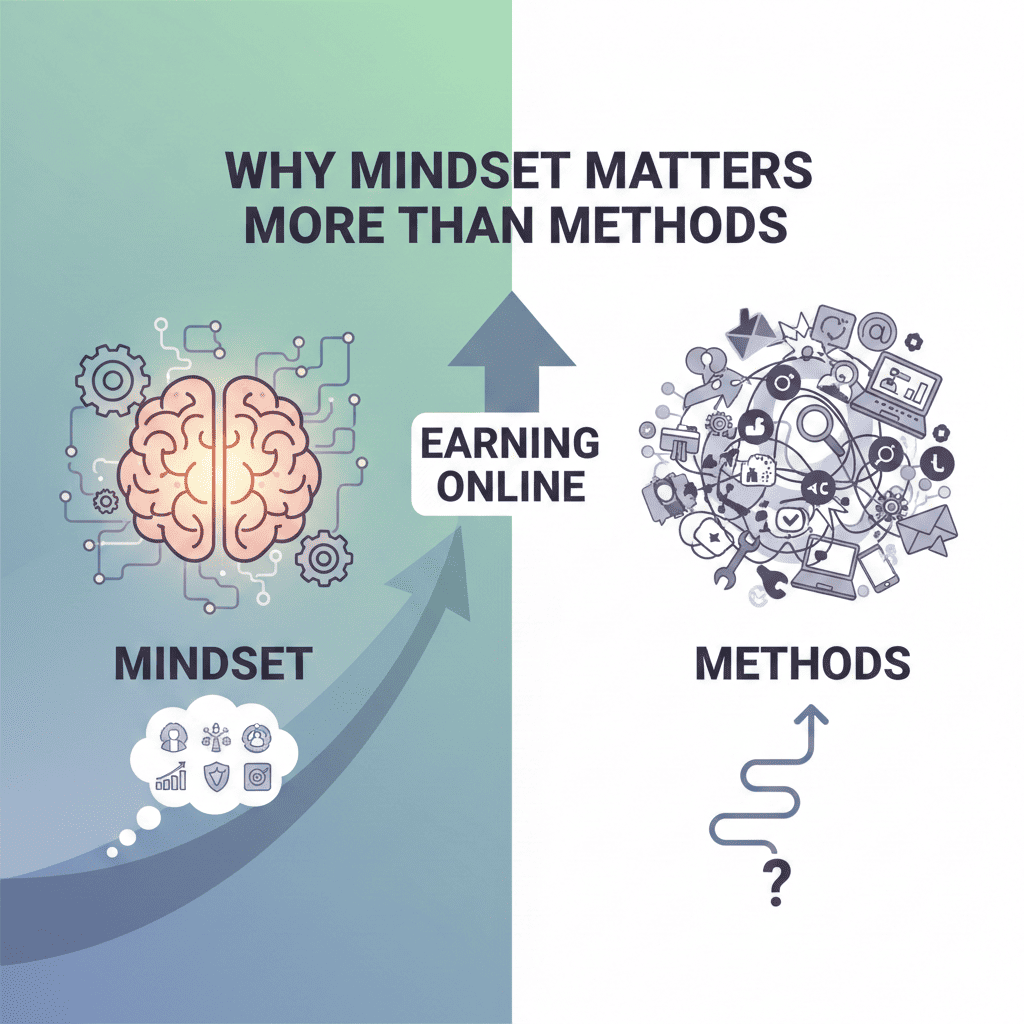
The internet is saturated with methods for earning online. Courses promising to teach you affiliate marketing secrets. YouTube videos revealing dropshipping strategies. Podcasts discussing the latest cryptocurrency opportunities. Blogs detailing exactly how someone built a six-figure freelance business. There’s no shortage of proven methods, step-by-step blueprints, and actionable strategies available—many of them completely free.
Yet despite this abundance of knowledge, most people who attempt to earn online never generate meaningful income. They consume endless content about methods, purchase courses, follow exact blueprints, and implement proven strategies—only to quit within months, frustrated and convinced online income isn’t for them. Meanwhile, a smaller group succeeds with those same methods, sometimes even inferior ones, building sustainable online income that transforms their financial reality.
What separates these two groups isn’t access to better methods, superior technical skills, or privileged resources. The differentiating factor is mindset. Mindset matters more than methods because methods are abundant and accessible, while the psychological framework to implement them persistently and adapt them intelligently is rare. This isn’t motivational platitude—it’s observable reality backed by research in psychology, neuroscience, and extensive documentation of online business success and failure patterns.
This article explores why your mental approach to earning online determines outcomes more than tactical knowledge, how specific mindset shifts create breakthrough results, and practical ways to develop the psychological foundation that makes online income inevitable rather than accidental.
1. The Method Abundance Paradox
Why More Information Doesn’t Equal More Success
We live in an unprecedented era of information accessibility. Every successful online earner’s strategy is documented somewhere, often in exhaustive detail and available free. Yet success rates haven’t increased proportionally with information availability—in many ways, they’ve decreased as information overload creates paralysis and confusion.
This paradox reveals a fundamental truth: information isn’t the bottleneck. The limiting factor is psychological—the ability to choose one method, commit to it, execute consistently, and persist through inevitable challenges. Mindset matters more than methods because superior mindset enables execution of mediocre methods, while poor mindset sabotages even the best methods.
Consider two people following identical courses on building an Amazon FBA business. One implements everything mechanically, quits at the first obstacle, and concludes the method doesn’t work. The other approaches it as learning opportunity, adapts to challenges, treats failures as data, and ultimately succeeds. Same method, different mindsets, opposite outcomes.
The Myth of the Perfect Method
Many aspiring online earners spend months or years searching for the perfect method—the one strategy that guarantees success without risk, effort, or failure. This search is procrastination disguised as preparation. No such method exists.
Every legitimate earning method involves uncertainty, learning curves, and failure probability. Affiliate marketing requires content creation and audience building. Freelancing involves rejection and client management. E-commerce demands inventory risk and marketing skill. Digital products need audience development and sales capability. Each method has trade-offs and challenges.
When mindset matters more than methods, you recognize that success comes from mastering one imperfect method rather than endlessly searching for perfect methods that don’t exist. The “best” method is simply the one you’ll actually implement consistently.
Why Successful People Use Different Methods
If methods were primarily responsible for success, we’d see convergence—everyone successful using the same approaches. Instead, we observe massive diversity. Some earn through freelancing, others through e-commerce, content creation, consulting, software, courses, or countless other models.
This diversity proves that multiple methods work, and method choice matters less than mindset brought to that method. Success stories feature people who committed to their chosen path, adapted it to their circumstances, persisted through challenges, and continuously improved. The common factor isn’t the method—it’s the mindset.
2. The Psychology of Persistent Action
Understanding Delayed Gratification in Online Business
Online income rarely provides immediate results. You might create content for months before generating revenue, build an audience for a year before monetizing effectively, or develop skills through unpaid work before commanding high rates. This delayed gratification challenges our psychological wiring for immediate rewards.
Mindset matters more than methods because the ability to persist through this delay period determines whether you ever reach the reward phase. Two people using identical methods will have different outcomes based purely on who maintains consistent action during the unrewarded period.
This requires developing what psychologists call “frustration tolerance”—the capacity to continue goal-directed behavior despite lack of immediate reinforcement. People with low frustration tolerance abandon promising methods prematurely, interpreting the normal delay period as failure. Those with high frustration tolerance persist, ultimately reaching the inflection point where efforts compound into results.
Overcoming the Consistency Challenge
The most common failure pattern in online earning isn’t dramatic collapse—it’s gradual fade. People start enthusiastically, maintain effort for weeks or months, then slowly reduce activity until they’ve effectively quit without consciously deciding to quit.
This fade happens because maintaining consistency requires more than initial motivation—it requires identity-level commitment and systems that don’t depend on willpower. When your identity includes “I’m someone who creates content weekly,” consistency feels natural. When it’s just something you’re trying, consistency requires constant willpower that inevitably depletes.
The mindset shift from “trying something” to “being someone who does this” transforms consistency from effortful to automatic. This identity-level commitment enables the persistent action that separates successful online earners from perpetual experimenters.
Managing the Motivation-Discipline Relationship
Motivation fluctuates naturally. Some days you feel energized and excited about your online business; other days it feels like pointless drudgery. Relying on motivation for action means your progress follows this emotional rollercoaster—productive when motivated, stagnant when not.
When mindset matters more than methods, you develop discipline that operates independently of motivation. You create content, reach out to potential clients, or work on your online business because that’s what you do on Tuesdays, regardless of how you feel. The work happens whether you feel like it or not.
This isn’t about grinding through misery indefinitely—it’s about recognizing that feelings are unreliable guides for important activities. Disciplined action, paradoxically, often creates motivation rather than requiring it. Starting a task when unmotivated frequently leads to engagement and energy. Waiting for motivation before starting leads to inaction and demotivation.
3. The Growth Mindset Advantage
Fixed Versus Growth Mindset in Online Business
Carol Dweck’s research on fixed versus growth mindsets provides crucial insight into online earning success. People with fixed mindsets believe abilities are static—you either have talent for something or you don’t. Those with growth mindsets view abilities as developable through effort and learning.
In online business contexts, fixed mindset sounds like: “I’m not tech-savvy enough,” “I’m not a good writer,” “I’m not creative,” or “Some people are natural entrepreneurs; I’m not.” These beliefs create self-fulfilling prophecies where you avoid challenges that would develop those very capabilities.
Growth mindset reframes these as: “I’m developing tech skills,” “I’m improving my writing,” “I’m learning to think creatively,” or “I’m building entrepreneurial capabilities.” This framing acknowledges current limitations while maintaining belief in improvement potential. Mindset matters more than methods because growth mindset enables skill acquisition that makes methods work, while fixed mindset prevents the learning necessary for any method to succeed.
Embracing Failure as Feedback
Perhaps the most crucial mindset distinction is how you interpret failure. In fixed mindset, failure confirms inadequacy—you tried and failed because you lack inherent ability. In growth mindset, failure provides information—you tried something that didn’t work, learned from it, and can now try something informed by that learning.
Every successful online earner has extensive failure experience. Failed products, rejected pitches, ignored content, unsuccessful launches—these aren’t deviations from the path to success; they’re the path itself. The difference is viewing failure as terminal judgment versus temporary setback.
This reframe isn’t just psychological comfort—it changes behavior. When failure is informative rather than definitive, you take more intelligent risks, experiment more freely, and extract learning from setbacks. These behaviors dramatically increase success probability over time.
The Compound Effect of Incremental Improvement
Growth mindset enables focus on incremental improvement rather than dramatic breakthroughs. Instead of seeking the one course or strategy that changes everything, you commit to getting slightly better at your craft every week—improving your writing, refining your marketing, deepening your expertise, or enhancing your processes.
These small improvements seem insignificant daily but compound dramatically over time. After a year of 1% weekly improvement, you’re not 52% better—you’re exponentially better. Your skills, knowledge, and capabilities have compounded into genuine expertise that commands attention and income.
When mindset matters more than methods, you recognize that this compounding process matters more than your starting point or chosen method. Mediocre methods executed with commitment to continuous improvement outperform superior methods executed with static skill levels.
4. Resilience in the Face of Inevitable Obstacles
Normalizing the Difficulty Curve
One critical mindset error is expecting online earning to be easy because you’ve seen others make it look easy. Successful creators, entrepreneurs, and freelancers make their work look effortless because you see polished results, not the struggle, revision, and learning behind them.
The reality is that building online income is challenging. You’ll face technical problems, market rejection, creative blocks, algorithm changes, difficult clients, and countless obstacles you can’t anticipate. This isn’t a flaw in your method or indication you’re on the wrong path—it’s the normal experience of building anything worthwhile.
Mindset matters more than methods because resilient mindset interprets obstacles as expected and manageable rather than catastrophic and personal. When you expect smooth sailing, every storm seems like a disaster. When you expect storms, you prepare mentally and practically, making them navigable challenges rather than insurmountable barriers.
Developing Antifragility
Nassim Taleb’s concept of antifragility—systems that gain from disorder rather than merely resisting it—applies powerfully to online earning mindset. Resilient people endure setbacks without breaking. Antifragile people grow stronger from setbacks.
Antifragile mindset views obstacles as strength training rather than damage. A rejected proposal improves your pitching. An unsuccessful product launch teaches you about market validation. A critical comment reveals a blindspot. Each challenge, properly interpreted, makes you more capable and successful.
This mindset transformation requires conscious reframing. When obstacles occur, ask: “What capability am I building by overcoming this?” The answer transforms the experience from pure negative to productive challenge. Over time, this reframing becomes automatic, and you develop genuine antifragility where challenges become opportunities.
The Attribution Pattern That Predicts Success
How you explain success and failure to yourself matters immensely. Research on “attribution style” shows that people who attribute success to their efforts and abilities while viewing failures as temporary, specific, and external tend toward optimism and persistence. Those who attribute success to luck or external factors while viewing failures as permanent, pervasive, and personal tend toward pessimism and quitting.
When mindset matters more than methods, you consciously develop productive attribution patterns. Success becomes evidence of developing capability: “This worked because I’ve improved my skills and made good decisions.” Failure becomes specific and correctible: “This particular approach didn’t work in this situation; I can adjust.”
This isn’t delusional positive thinking—it’s strategic interpretation that supports continued action. The “truth” of why things succeed or fail is often ambiguous. Choosing interpretations that support persistence and learning over those that encourage quitting creates dramatically different long-term outcomes.
5. The Abundance Versus Scarcity Paradigm
How Scarcity Thinking Sabotages Online Success
Scarcity mindset views opportunities, customers, and success as limited resources. In this frame, other people’s success threatens yours, sharing knowledge depletes your advantage, and the market is a zero-sum competition where your gain requires others’ loss.
This mindset creates counterproductive behaviors: hoarding knowledge instead of sharing, viewing successful peers as threats instead of inspirations, making desperate decisions from fear of missing opportunities, and competing on price instead of value. These behaviors actively undermine success in online markets that reward generosity, collaboration, and value creation.
Mindset matters more than methods because scarcity mindset makes even excellent methods ineffective. Your content becomes guarded instead of generous. Your networking becomes transactional instead of relational. Your marketing becomes aggressive instead of attractive. Customers sense this energy and respond accordingly—by going elsewhere.
Embracing Abundance in Digital Markets
Abundance mindset recognizes that digital markets have unprecedented scale and opportunity. The internet contains billions of people with diverse needs. Your success doesn’t require monopolizing attention or outcompeting everyone—it requires serving a specific audience exceptionally well.
This mindset enables generosity that paradoxically increases success. You share knowledge freely because teaching establishes expertise and attracts clients. You celebrate others’ success because their achievements prove market viability and inspire your efforts. You focus on creating unique value rather than imitating competitors because you recognize that authenticity attracts better opportunities than imitation.
When you operate from abundance, you make better strategic decisions, create more valuable content, build stronger relationships, and position yourself as a trusted resource rather than desperate seller. These factors matter more than tactical execution for long-term success.
Collaboration Over Competition
The most successful online earners often succeed through collaboration—joint ventures, partnerships, affiliate relationships, guest appearances, and community participation—rather than pure competition. These opportunities only arise for people whose mindset values collaboration.
When mindset matters more than methods, you actively seek collaboration opportunities, support others’ success, make introductions, and participate generously in communities. These behaviors create networks, reputation, and opportunities that no amount of tactical skill can replace.
The methods for collaboration aren’t complex—reach out to peers, offer value before asking for anything, support others’ work publicly, and remain open to partnership opportunities. The challenge is mindset: viewing others as potential partners rather than threats, investing in relationships without immediate return expectations, and genuinely celebrating others’ wins.
6. Self-Awareness and Personal Alignment
Understanding Your Unique Strengths
Generic methods often fail not because they don’t work but because they don’t fit the person implementing them. A method requiring extensive video creation won’t work well for someone deeply uncomfortable on camera. A strategy based on aggressive networking will frustrate introverts.
Mindset matters more than methods because self-awareness enables you to choose and adapt methods that align with your strengths, interests, and personality. This alignment dramatically increases execution quality and sustainability. You’re not fighting your nature—you’re leveraging it.
This requires honest self-assessment: What energizes versus drains you? Where do your natural strengths lie? What work feels meaningful rather than merely profitable? These aren’t soft considerations—they’re practical success factors. People sustain effort far longer in aligned activities than misaligned ones, and sustained effort determines outcomes.
Playing Infinite Games Instead of Finite Ones
James Carse distinguishes between finite games (played to win and end) and infinite games (played to continue playing and improve). Most people approach online earning as a finite game: find a method, implement it perfectly, achieve success, win. When this doesn’t happen as expected, they quit.
Successful online earners play infinite games. They’re not trying to achieve a final state of “having made it”—they’re committed to continuous participation, learning, and improvement in their chosen field. This mindset removes the pressure of any single outcome determining success or failure.
When you play the infinite game, short-term failures don’t end the game—they’re just rounds you didn’t win. You remain in play, learning and adapting. This perspective enables the long-term persistence necessary for compound success. When mindset matters more than methods, infinite game mentality matters more than specific tactical approaches.
Authentic Expression Versus Manufactured Persona
Many people believe online success requires creating a persona—projecting confidence they don’t feel, claiming expertise they don’t possess, or presenting a lifestyle they don’t live. This manufactured approach is exhausting, unsustainable, and increasingly ineffective as audiences develop sophisticated detection for inauthenticity.
The mindset shift to authentic expression—showing up as yourself, sharing genuine experiences, acknowledging limitations while demonstrating strengths—creates sustainable success. Authenticity attracts the right audience, reduces psychological burden, and enables long-term consistency because you’re not maintaining a facade.
This doesn’t mean oversharing or lacking professionalism—it means grounding your online presence in genuine expertise, experiences, and personality rather than manufactured image. People connect with humans, not highlight reels, and that connection creates the trust necessary for online business success.
7. The Relationship Between Mindset and Learning
Adopting the Student Mentality
Experts in any field maintain student mentality—remaining curious, acknowledging knowledge gaps, and actively seeking to learn. This contrasts with the expert trap of believing you already know enough and defending your existing knowledge against new information.
When mindset matters more than methods, student mentality ensures you continuously improve your implementation of any method. You study successful examples, seek feedback, experiment with variations, and remain open to discovering you were wrong about something.
This learning orientation creates compound improvement. Someone with student mentality implementing a B-level method will eventually outperform someone with expert pretension implementing an A-level method, because the student continually improves while the expert stagnates.
Strategic Experimentation
Many people view business decisions as right or wrong, success or failure. This binary thinking creates paralysis and emotional volatility. Reframing decisions as experiments—hypotheses to test with data collected—transforms the psychological experience.
Experiments can’t fail; they produce results and learning. This framing enables more action, faster iteration, and better decision-making. You test an approach, collect data about what happened, draw conclusions, and design the next experiment informed by previous results.
Mindset matters more than methods because experimental mindset accelerates learning from any method. You’re not rigidly following a blueprint—you’re intelligently adapting based on results. This adaptation often matters more than the starting method’s quality.
Intellectual Humility in Strategy
Intellectual humility—recognizing the limits of your knowledge and remaining open to being wrong—seems to contradict entrepreneurial confidence, but it’s actually essential for success. The market regularly disproves assumptions, expectations, and strategies. People who can’t acknowledge being wrong and adjust accordingly fail regardless of their initial method quality.
This humility enables pivot capacity—the ability to abandon approaches that aren’t working and try different ones without ego damage. Many failed online businesses fail not from bad initial methods but from founder inability to acknowledge those methods aren’t working and try alternatives.
8. Time Perspective and Patience
Long-Term Thinking in a Short-Term World
Social media culture creates expectation of rapid results—viral success, overnight fame, explosive growth. This short-term thinking sabotages online earning because meaningful income building requires extended time horizons. Building authority takes years. Growing audiences takes consistency measured in months and years. Developing expertise takes practice measured in projects and clients.
When mindset matters more than methods, you adopt time perspectives appropriate to your goals. Building sustainable online income requires 1-3 year thinking, not 30-day thinking. This doesn’t mean ignoring short-term actions—it means evaluating those actions based on contribution to long-term outcomes rather than immediate results.
Long-term thinking also reduces emotional reactivity to short-term fluctuations. A bad month doesn’t feel catastrophic when you’re thinking in years. Slow initial growth doesn’t trigger quitting when you expect the first year to be foundation-building rather than income-generating.
The Patience-Urgency Balance
While patience is essential, it must balance with urgency. Patience without urgency becomes complacency and inaction. Urgency without patience becomes frantic, unfocused effort that burns out quickly.
The productive balance is urgent execution of patient strategy. You act with urgency on daily and weekly actions while maintaining patience about long-term outcomes. You create content urgently each week while patiently building audience over months. You reach out to potential clients urgently while patiently building reputation over time.
This balance maintains motivation and momentum while avoiding the disappointment of unrealistic timelines. When mindset matters more than methods, you develop this nuanced time perspective that enables both persistent action and emotional stability through the building period.
Measuring Progress Appropriately
Short-term thinkers measure progress by income and other lagging indicators. When income doesn’t materialize quickly, they conclude their efforts aren’t working and either quit or frantically change approaches.
Long-term thinkers measure leading indicators—skills developed, content created, relationships built, audience growth, market learning, and systems improved. These measures show progress even before revenue appears, maintaining motivation and confirming your efforts are working even when income lags.
9. Self-Leadership and Accountability
Internal Versus External Locus of Control
Locus of control refers to whether you believe outcomes result primarily from your actions (internal locus) or external circumstances (external locus). This might be the single most predictive mindset variable for online earning success.
Mindset matters more than methods because internal locus of control makes you the architect of your success rather than victim of circumstances. When something doesn’t work, internal locus asks “What can I do differently?” rather than “Why is this happening to me?” This empowered questioning leads to different actions and outcomes.
External locus creates helplessness—algorithm changes, market conditions, competition, and countless other factors outside your control become explanations for failure. Internal locus focuses on the variables you can control: your effort, skill development, strategy, relationships, and value creation.
Self-Accountability Systems
Without external accountability—bosses, deadlines, performance reviews—many people struggle with self-accountability. Building online income requires creating accountability systems that maintain performance without external enforcement.
Effective self-accountability involves specific commitments, tracking mechanisms, and consequences. You commit to specific actions on specific schedules, track completion, and create meaningful consequences for non-completion. These might be social accountability partners, financial commitments, or personal integrity standards.
When you develop robust self-accountability, method choice becomes secondary. You’ll execute whatever method you choose consistently enough for it to work. Without self-accountability, even the best methods fail from inconsistent implementation.
The Identity-Behavior Connection
Your actions ultimately reflect your identity—who you believe yourself to be. Trying to maintain behaviors inconsistent with identity requires constant willpower and eventually fails. Aligning identity and desired behaviors makes those behaviors automatic.
When mindset matters more than methods, you focus on identity transformation: from “I’m trying freelancing” to “I’m a freelancer,” from “I’m attempting content creation” to “I’m a creator.” This identity shift changes everything—your daily decisions, commitment level, and persistence through challenges.
Conclusion: The Foundation That Supports All Methods
The online earning landscape constantly evolves. Methods that worked brilliantly last year become less effective. New platforms emerge while established ones decline. Algorithms change. Market preferences shift. Competition intensifies. In this dynamic environment, method-focused approaches constantly play catch-up, chasing the next working strategy.
Mindset matters more than methods because while methods change, the psychological foundation for success remains constant. Growth mindset, resilience, persistence, patience, self-awareness, abundance thinking, and self-accountability work across all methods, platforms, and markets. These mental frameworks adapt to changing conditions while method-focused knowledge becomes obsolete.
Also read this:
How to Build Your First Online Income Stream Without Stress