
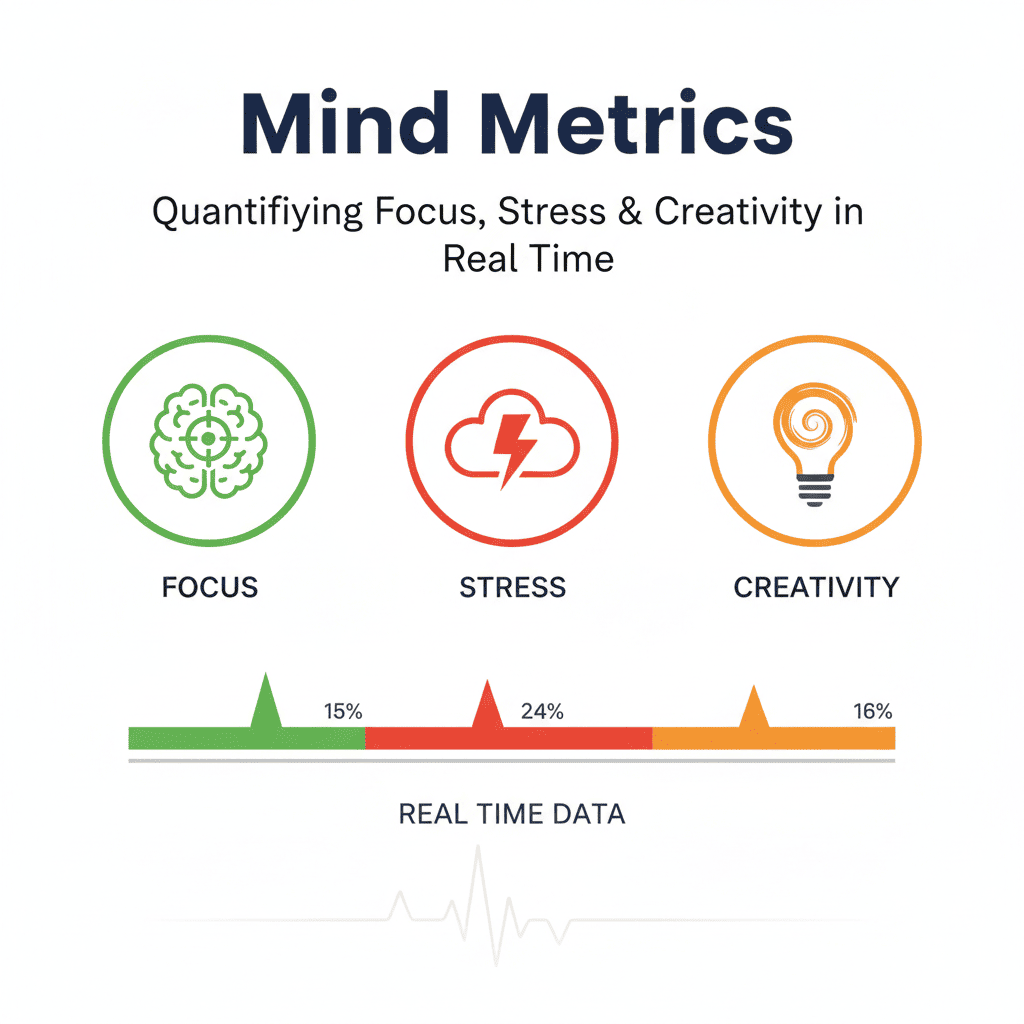
1. Understanding the Science Behind Mental Performance Measurement
In an era where productivity is paramount and mental wellness is finally receiving the attention it deserves, the ability to measure and track cognitive states has become increasingly valuable. Mind Metrics represents the cutting-edge intersection of neuroscience, psychology, and technology—offering unprecedented insights into how our brains function throughout the day.
The concept of Mind Metrics isn’t just another wellness trend; it’s a scientifically-grounded approach to understanding and optimizing mental performance. By quantifying abstract mental states like focus, stress, and creativity, we can make data-driven decisions about our work habits, lifestyle choices, and overall cognitive health.
2. The Evolution of Mental State Measurement
2.1 From Subjective to Objective
Historically, understanding our mental states relied entirely on subjective self-reporting. We’d ask ourselves, “How focused am I?” or “How stressed do I feel?” While self-awareness remains valuable, these assessments are inherently biased and inconsistent.
The advent of Mind Metrics technology has revolutionized this landscape. Using sophisticated sensors, algorithms, and biometric data, we can now objectively measure mental states with remarkable accuracy. This shift from subjective to objective measurement represents one of the most significant advances in cognitive science and personal wellness.
2.2 The Technology Behind Mind Metrics
Modern Mind Metrics systems employ multiple data sources to create comprehensive mental state profiles:
Neurological Signals: EEG (electroencephalography) headbands and sensors detect brainwave patterns associated with different cognitive states. Alpha waves indicate relaxation, beta waves suggest active thinking, and gamma waves correlate with high-level cognitive processing.
Physiological Markers: Heart rate variability (HRV), skin conductance, eye movement, and breathing patterns all provide valuable insights into stress levels and cognitive load.
Behavioral Data: Keystroke dynamics, mouse movements, and interaction patterns with digital devices offer indirect but powerful indicators of focus and mental state.
Environmental Context: Factors like ambient noise, lighting, temperature, and time of day are integrated to provide context for mental state measurements.
3. Quantifying Focus: The Cornerstone of Productivity
3.1 What Is Focus, Really?
Focus, or sustained attention, represents the brain’s ability to maintain cognitive resources on a specific task while filtering out distractions. Mind Metrics approaches to measuring focus consider multiple dimensions:
Depth of Focus: How deeply engaged is your brain with the current task? This correlates with specific brainwave patterns, particularly theta and beta wave combinations.
Stability of Focus: How consistently can you maintain attention without significant fluctuations? This metric reveals your cognitive endurance.
Recovery Speed: When distracted, how quickly can you return to a focused state? This indicates mental flexibility and resilience.
3.2 The Neuroscience of Measured Focus
When measuring focus through Mind Metrics, researchers typically look at the prefrontal cortex activity—the brain’s executive control center. Increased beta wave activity (13-30 Hz) in this region indicates active, focused thinking. Simultaneously, reduced activity in the default mode network (DMN) suggests the brain has successfully suppressed mind-wandering.
Modern EEG devices can detect these patterns in real-time, providing instant feedback about your focus levels. Some advanced systems use machine learning algorithms trained on thousands of hours of cognitive data to distinguish between different types of focus:
- Concentrated focus: Intense, narrow attention on a single task
- Divided attention: Managing multiple streams of information simultaneously
- Sustained vigilance: Maintaining readiness over extended periods
- Selective attention: Filtering relevant information from noise
3.3 Practical Applications of Focus Metrics
Understanding your focus patterns through Mind Metrics enables powerful optimizations:
Peak Performance Timing: Identify when during the day your focus naturally peaks. Schedule your most demanding cognitive work during these windows.
Break Optimization: Recognize when focus begins deteriorating before you consciously feel tired. This allows strategic breaks that prevent burnout rather than responding to exhaustion.
Environment Design: Discover which environmental factors enhance or diminish your focus. Perhaps certain types of music boost your concentration, or specific lighting conditions optimize your attention.
Task Matching: Learn which types of tasks align best with different focus states. Creative brainstorming might work well during moderate focus, while detailed analytical work requires peak concentration.
4. Stress Measurement: Beyond “Feeling Overwhelmed”
4.1 The Multifaceted Nature of Stress
Stress isn’t monolithic. Mind Metrics systems distinguish between different stress types and intensities:
Acute Stress: Short-term, intense stress responses to immediate challenges. This can actually enhance performance when managed properly.
Chronic Stress: Long-term, persistent stress that degrades health and performance. This is what most stress-reduction techniques target.
Eustress: “Good stress” that motivates and energizes without causing harm. Athletes and performers often operate in this zone.
Distress: Harmful stress that overwhelms coping mechanisms and impairs function.
4.2 Physiological Markers of Stress
Mind Metrics platforms measure stress through multiple physiological channels:
Heart Rate Variability (HRV): Perhaps the most reliable stress indicator, HRV measures the variation in time between heartbeats. Higher HRV generally indicates better stress resilience and parasympathetic nervous system activation. Chronic stress consistently reduces HRV.
Cortisol Patterns: While not measured in real-time by consumer devices, understanding your cortisol rhythm provides crucial context for stress levels throughout the day.
Skin Conductance: Also called galvanic skin response (GSR), this measures electrical conductivity of the skin, which increases with stress-induced sweating.
Respiratory Rate: Stress typically increases breathing rate and decreases breathing depth. Mind Metrics systems can detect these patterns through various sensors.
Muscle Tension: EMG (electromyography) sensors can detect muscle tension patterns associated with stress, particularly in the shoulders, neck, and jaw.
4.3 The Cognitive Dimension of Stress
Beyond physiological markers, Mind Metrics also captures cognitive indicators of stress:
Mental Fatigue: Decreased reaction times and increased error rates suggest cognitive resources are depleted by stress.
Cognitive Rigidity: Stress reduces mental flexibility, making it harder to shift between tasks or perspectives. This can be measured through various cognitive tests integrated into Mind Metrics platforms.
Working Memory Capacity: Stress temporarily reduces working memory, the mental workspace we use for reasoning and problem-solving.
4.4 Stress Management Through Data
Armed with objective Mind Metrics about your stress levels, you can implement targeted interventions:
Early Warning Systems: Many people don’t recognize their stress until it becomes overwhelming. Mind Metrics provide early warnings, allowing preventive action rather than reactive crisis management.
Intervention Testing: Systematically test different stress-reduction techniques (meditation, exercise, breathing exercises) and objectively measure their effectiveness for you personally.
Stress Pattern Recognition: Identify specific triggers, times of day, or situations that consistently elevate your stress. This awareness enables avoidance or better preparation.
Recovery Tracking: Monitor how quickly you recover from stressful events. Improved recovery speed indicates better stress resilience, a key component of mental health.
5. Measuring Creativity: Quantifying the Unquantifiable
5.1 The Challenge of Measuring Creativity
Creativity seems inherently subjective—how can Mind Metrics possibly quantify something so abstract and personal? While we can’t directly measure “creativity” as a simple number, we can measure brain states and cognitive patterns strongly associated with creative thinking.
5.2 Neurological Signatures of Creativity
Research has identified specific brain activity patterns during creative thought:
Alpha Wave Increases: Particularly in the right hemisphere, increased alpha wave activity (8-12 Hz) correlates with creative insight and ideation. This represents a relaxed but alert mental state.
Reduced Prefrontal Control: During creative thinking, the brain’s executive control centers slightly reduce their regulatory activity, allowing more spontaneous connections between disparate ideas.
Default Mode Network Activation: Contrary to focused work, creativity often involves activation of the DMN—the network active during daydreaming and mind-wandering.
Increased Connectivity: Creative states show increased communication between normally distinct brain regions, enabling novel combinations of concepts.
5.3 Types of Creativity Measured by Mind Metrics
Mind Metrics systems distinguish between different creative modes:
Divergent Thinking: Generating multiple possible solutions or ideas. This expansive, exploratory mode shows specific brainwave patterns measurable through EEG.
Convergent Thinking: Narrowing possibilities to find the single best solution. This requires different neural patterns than divergent thinking.
Insight Moments: Those “aha!” moments of sudden understanding show distinct gamma wave bursts that Mind Metrics can detect.
Imaginative Flow: Extended periods of creative engagement, often described as being “in the zone,” demonstrate particular combinations of alpha and theta waves.
5.4 Environmental and Contextual Factors
Mind Metrics doesn’t just measure creativity in isolation—it correlates creative states with environmental and behavioral factors:
Time of Day Effects: Most people experience creativity peaks at specific times. Morning people might be more creative early, while night owls peak later.
Activity Preceding Creative Work: Walking, showering, or other semi-automatic activities often boost creativity. Mind Metrics can help identify which activities prime your creative brain.
Stimulation Levels: Some people create best in busy coffee shops, others need silent isolation. Objective measurement reveals your optimal creative environment.
Cognitive State Transitions: The shift from focused work to creative thinking often requires a transition period. Mind Metrics can identify how long this takes and what facilitates it.
5.5 Enhancing Creativity Through Data
Understanding your creativity patterns through Mind Metrics enables strategic optimization:
Creative Scheduling: Reserve time blocks during your natural creativity peaks for ideation, brainstorming, and innovative problem-solving.
Environment Optimization: Design spaces and contexts that consistently trigger creative brain states based on your personal data.
Creative Rituals: Develop evidence-based routines that reliably induce creative states. Your Mind Metrics data shows what actually works versus what you only think works.
Collaboration Timing: Understand when you’re most receptive to others’ ideas versus when you need solitary creative time.
6. The Integration of Multiple Metrics
6.1 The Interplay Between Focus, Stress, and Creativity
The true power of Mind Metrics emerges when tracking multiple mental states simultaneously. These states don’t exist in isolation—they interact in complex ways:
The Focus-Stress Relationship: Moderate stress can enhance focus through increased alertness and motivation. However, excessive stress destroys focus and impairs cognitive function. Mind Metrics helps you find your optimal stress-focus balance.
The Creativity-Focus Paradox: High focus sometimes inhibits creativity by preventing the mental wandering necessary for novel connections. Conversely, zero focus produces random thoughts without productive output. Mind Metrics reveals your personal sweet spot.
Stress and Creativity: While chronic stress impairs creativity, mild acute stress can sometimes spark creative problem-solving by forcing novel approaches to challenges.
6.2 Building Comprehensive Mental State Models
Advanced Mind Metrics systems create personalized models of your cognitive patterns:
State Transition Maps: Understanding how you move between mental states—from stressed to calm, from focused to creative, from energized to fatigued.
Optimal State Combinations: Identifying which mental state combinations produce your best work in different domains.
Vulnerability Windows: Recognizing when you’re most susceptible to distraction, stress, or creative blocks.
Recovery Patterns: Mapping how quickly you bounce back from depleted states and what factors accelerate recovery.
7. Real-Time Applications and Interventions
7.1 Adaptive Work Environments
The future of Mind Metrics includes environments that respond to your mental state in real-time:
Intelligent Lighting: Systems that adjust color temperature and brightness based on whether you need focus enhancement or creative stimulation.
Soundscape Management: Audio environments that adapt to your current state—white noise for focus, natural sounds for stress reduction, or strategic silence for creativity.
Task Routing: Software that presents work matching your current cognitive state. If Mind Metrics detect optimal creativity, your system might surface brainstorming tasks rather than detail-oriented work.
Notification Control: Interruption management based on your focus depth. During peak concentration, all non-critical notifications are blocked automatically.
7.2 Biofeedback and Self-Regulation
Mind Metrics enables powerful biofeedback loops:
Real-Time Awareness: Visual or auditory feedback about your current mental state helps you recognize patterns and develop better self-awareness.
Guided Regulation: When Mind Metrics detect excessive stress or failing focus, the system can prompt specific interventions—breathing exercises, short walks, or posture adjustments.
Training Programs: Systematic programs that use Mind Metrics feedback to teach you to voluntarily enter desired mental states more easily and consistently.
Progress Tracking: Long-term data shows how your cognitive regulation abilities improve with practice, providing motivation and validation.
8. The Technology Landscape
8.1 Current Tools and Platforms
The Mind Metrics ecosystem includes various devices and platforms:
EEG Headbands: Consumer-grade devices like Muse, Emotiv, and NeuroSky provide real-time brainwave data. While less precise than research-grade equipment, they’re sufficient for meaningful Mind Metrics applications.
Wearable Biosensors: Smartwatches, rings, and patches measure HRV, skin conductance, body temperature, and movement—all contributors to mental state assessment.
Software Platforms: Applications that integrate data from multiple sensors, apply machine learning algorithms, and present actionable insights about your mental states.
Camera-Based Systems: Emerging technology uses standard cameras to detect pupil dilation, facial micro-expressions, and other visual indicators of mental state.
8.2 Accuracy and Limitations
Current Mind Metrics technology has important limitations to acknowledge:
Individual Variation: Baseline brainwave patterns and physiological responses vary significantly between individuals. Systems require calibration periods to establish your personal baselines.
Context Dependency: The same physiological signal can indicate different mental states depending on context. Walking up stairs increases heart rate, but so does anxiety—distinguishing requires sophisticated algorithms.
Environmental Interference: Electrical interference, movement artifacts, and sensor positioning issues can affect measurement accuracy, particularly for EEG devices.
State Complexity: Human mental states are incredibly complex and multifaceted. Current Mind Metrics provide useful approximations rather than perfect measurements.
9. Privacy and Ethical Considerations
9.1 The Sensitivity of Cognitive Data
Mind Metrics involve collecting deeply personal data about your mental states and cognitive patterns. This raises important privacy questions:
Data Ownership: Who owns your cognitive data? What rights do you have to control its use and distribution?
Employer Access: Should employers have access to employee Mind Metrics? Could this data be used for unfair performance evaluation or discrimination?
Insurance Implications: Could insurance companies use cognitive performance data to adjust rates or deny coverage?
Security Concerns: Cognitive data could potentially reveal sensitive information about mental health, personality, or even thoughts. Protecting this data is crucial.
9.2 Establishing Ethical Guidelines
The Mind Metrics field needs robust ethical frameworks:
Informed Consent: Users must understand what data is collected, how it’s used, and potential risks before participating in Mind Metrics programs.
Right to Disconnect: People should have the option to take breaks from monitoring without professional or social penalties.
Data Minimization: Systems should collect only the minimum data necessary for their stated purpose, avoiding excessive surveillance.
Transparency: Algorithms that interpret Mind Metrics data should be transparent and explainable, not opaque black boxes.
10. Practical Implementation: Getting Started with Mind Metrics
10.1 Choosing Your First Device
For those interested in exploring Mind Metrics, start with accessible, affordable options:
Entry-Level Wearables: A good smartwatch or fitness band provides basic stress and focus indicators through HRV and activity tracking. This offers a gentle introduction to Mind Metrics concepts.
EEG Headbands: If you’re specifically interested in focus and meditation, consumer EEG devices provide direct brain activity measurement at reasonable cost.
Integrated Platforms: Some smartphone apps use camera and microphone data to estimate mental states without additional hardware, though with reduced accuracy.
10.2 Establishing Baselines
Effective Mind Metrics require understanding your personal baselines:
Initial Monitoring Period: Spend at least two weeks simply observing your metrics without trying to change them. This establishes normal patterns.
Context Recording: Note what you’re doing during different measurements. Correlating activities with mental states reveals valuable patterns.
Environmental Documentation: Record environmental factors—location, noise levels, lighting, time of day—that might influence your metrics.
Subjective Ratings: Combine objective Mind Metrics with subjective self-assessment. This helps calibrate the system to your personal experience.
10.3 Creating Experiments
Once you have baselines, design personal experiments:
Single Variable Testing: Change one factor at a time—sleep schedule, caffeine intake, exercise timing—and observe effects on your Mind Metrics.
Intervention Trials: Test specific techniques (meditation apps, productivity methods, environmental changes) and measure their impact objectively.
Optimal Timing: Experiment with scheduling different task types at various times to discover your peak performance windows.
Recovery Methods: Compare different recovery activities (naps, walks, social breaks) to identify what most effectively restores your mental resources.
11. The Future of Mind Metrics
11.1 Emerging Technologies
Mind Metrics technology continues advancing rapidly:
Non-Invasive Neural Interfaces: Next-generation devices will provide research-grade accuracy in consumer-friendly form factors.
AI-Powered Prediction: Machine learning will move beyond measurement to prediction—forecasting when you’ll become stressed or distracted before it happens.
Integrated Ecosystems: Your workspace, home environment, and even transportation will adapt automatically to optimize your mental states based on continuous Mind Metrics monitoring.
Neurofeedback Games: Entertainment that simultaneously measures and trains optimal mental states, making cognitive enhancement engaging and accessible.
11.2 Societal Implications
Widespread adoption of Mind Metrics could transform multiple domains:
Education: Personalized learning systems that adapt to each student’s cognitive state in real-time, optimizing information delivery and maximizing retention.
Healthcare: Early detection of cognitive decline, mental health issues, or neurological conditions through pattern recognition in Mind Metrics data.
Workplace Design: Offices and workflows optimized for human cognitive patterns rather than forcing humans to adapt to rigid systems.
Well-being Culture: Shift from productivity-at-all-costs to sustainable performance through better understanding of mental resource management.
Conclusion: The Quantified Mind
Mind Metrics represents a fundamental shift in how we understand and manage our cognitive lives. By making the invisible visible—transforming subjective mental states into objective, actionable data—we gain unprecedented control over our focus, stress, and creativity.
This isn’t about becoming robots optimized for productivity. Rather, Mind Metrics provides tools for more humane work and life—respecting our cognitive limitations, leveraging our natural strengths, and achieving sustainable high performance without burnout.
Also read this:
The Future of SEO: How AI Search Engines Are Revolutionizing Google Traffic
How to Create AI Actors for Your Next YouTube Channel: The Complete Guide
Ultra-Niche Channels Dominating YouTube Right Now: The Secret to Viral Success in 2025