
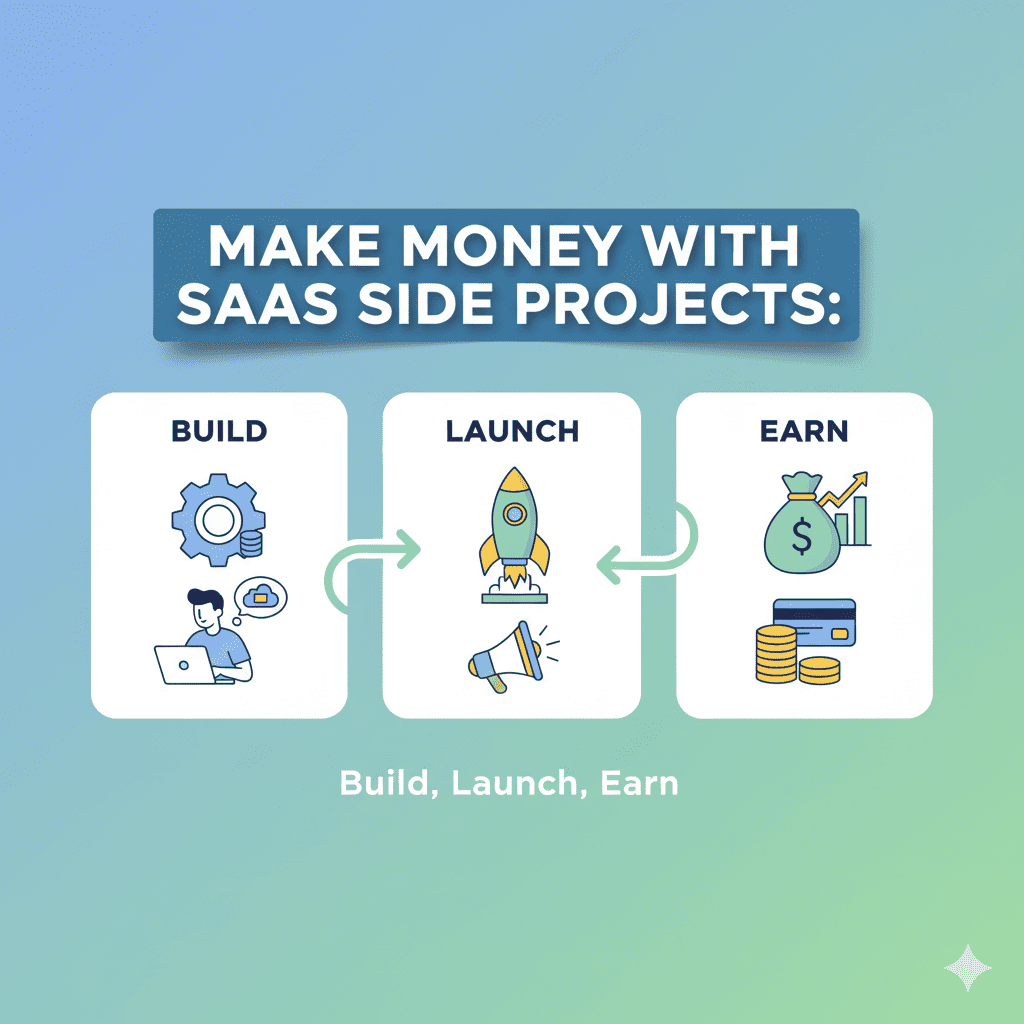
The software-as-a-service (SaaS) revolution has democratized entrepreneurship in ways unimaginable just a decade ago. Today, solo developers and small teams regularly build SaaS side projects that generate thousands of dollars monthly—sometimes even replacing full-time incomes. The barrier to entry has never been lower, the tools never more accessible, and the potential never more lucrative.
This comprehensive guide reveals exactly how to make money with SaaS side projects, from identifying profitable ideas to building minimum viable products, launching to your first customers, and scaling toward sustainable revenue. Whether you’re a developer seeking additional income streams or an entrepreneur with technical skills wanting to build something meaningful, SaaS side projects offer one of the most scalable, rewarding paths available.
The economics of SaaS are compelling: recurring revenue, high profit margins, location independence, and scalability limited only by your marketing efforts and infrastructure capacity. Unlike physical products requiring inventory or services trading time for money, SaaS products can serve one customer or one million with minimal incremental cost.
Understanding the SaaS Side Project Opportunity
Before diving into building, understanding what makes SaaS side projects particularly attractive helps frame your approach and set realistic expectations.
Why SaaS Side Projects Succeed
Recurring revenue transforms business economics entirely. Instead of constantly hunting new customers, SaaS businesses build on previous months’ revenue. Land 100 customers paying $20 monthly and you’ve created $2,000 in monthly recurring revenue. Next month, retain those customers while adding 50 more—now you’re at $3,000 MRR. This compounding effect creates momentum impossible with one-time sales.
High profit margins characterize successful SaaS businesses. After building your product, serving each additional customer costs pennies—server resources, payment processing, support time. Profit margins of 70-90% are common, especially for bootstrapped side projects without investor pressure or large teams.
Location independence lets you work from anywhere with internet. Your customers access your software globally while you build, maintain, and grow from home, coffee shops, or remote locations. This flexibility is particularly valuable for side projects fitting around full-time jobs or personal commitments.
Automation potential means SaaS businesses can largely run themselves once established. Automated onboarding, billing, and customer communication reduce hands-on time requirements. Many successful SaaS side projects require just 5-10 hours weekly once they’re stable.
Scalability without proportional effort differentiates SaaS from services. Doubling customers doesn’t require doubling your time investment. The same product serves 100 or 10,000 users with similar maintenance effort, though infrastructure costs increase.
The Side Project Mindset
Approaching SaaS as a side project requires different thinking than VC-backed startups or full-time ventures. You’re optimizing for sustainable profitability and reasonable time investment, not explosive growth or billion-dollar valuations.
Profitability first means launching quickly, charging from day one, and focusing on customers who’ll pay reasonable prices. You can’t afford years of free usage building for eventual monetization—you need revenue within months.
Lean operations emphasize doing more with less. Use no-code tools, existing services, and time-efficient approaches. Your competitive advantage comes from solving problems elegantly, not from having the most features.
make money with SaaS side projects Sustainable pace acknowledges this is supplemental to your primary life commitments. Set realistic goals—a few focused hours several times weekly, not 80-hour work weeks burning you out.
Customer-funded growth means using revenue to reinvest in the business rather than raising outside capital. This maintains complete control while forcing financial discipline.
1. Finding Profitable SaaS Ideas
The difference between successful and failed SaaS side projects often begins at ideation. Great ideas aren’t necessarily innovative or complex—they solve real problems for people willing to pay for solutions.
Problem-First Discovery
The most reliable path to profitable SaaS ideas starts with problems, not solutions. Observe pain points in your own work, hobbies, and daily life. What frustrates you repeatedly? What tasks feel unnecessarily complicated? What software do you wish existed?
Your professional experience represents your richest idea source. You understand industry problems intimately and know who experiences them. A project manager might build better resource allocation tools. A marketer could create simpler analytics dashboards. A teacher might develop specialized classroom management software.
Online communities overflow with problems seeking solutions. Browse Reddit, forums, Facebook groups, and Twitter in niches you understand. Look for recurring complaints, questions asking for tool recommendations, or discussions about workflow inefficiencies. These conversations reveal unmet needs and validate demand before building.
Competitor reviews expose gaps in existing solutions. Read one-star reviews of popular SaaS products in categories you’re interested in. What do customers complain about? What features do they desperately want? Building a product addressing these specific frustrations gives you immediate differentiation.
Your own workflows contain friction worth eliminating. What manual processes do you execute regularly that could be automated? What data do you copy between applications? What decisions do you make based on information scattered across multiple sources? Your personal pain points likely affect thousands of others.
Validating Demand Before Building
Enthusiasm for solving a problem doesn’t guarantee people will pay for your solution. Validation separates hobby projects from businesses.
Keyword research reveals search volume for solution-related terms. Use tools like Google Keyword Planner, Ahrefs, or Ubersuggest to check monthly searches for terms like “project management tool,” “invoice generator,” or “social media scheduler.” Healthy search volume suggests market demand.
Landing page testing lets you gauge interest before writing code. Create a simple page describing your planned product, its benefits, and pricing. Drive traffic through ads, social media, or communities. Track email signups or pre-order conversions. A 2-5% conversion rate suggests viable demand.
Direct outreach provides qualitative validation. Message 20-50 people in your target market explaining the problem you’re solving and asking if they’d pay for a solution. Their responses reveal whether the problem is painful enough to justify purchasing software.
Competitive analysis examining existing solutions confirms market viability. Competitors prove paying customers exist. Your job becomes differentiation—serving a specific niche better, simplifying complex features, or significantly underpricing enterprise solutions.
Niche Selection Strategy
Broad markets attract intense competition from well-funded companies. SaaS side projects thrive in niches—specific customer segments with particular needs ignored by mainstream solutions.
Vertical SaaS serves specific industries. Instead of “project management for everyone,” build “project management for interior designers” with features tailored to their unique workflows—client mood boards, material sourcing, vendor coordination. This specificity lets you charge premium prices while facing minimal competition.
Feature-focused alternatives take one aspect of comprehensive tools and execute it exceptionally. “Simple invoicing without bloat” targets freelancers frustrated by complex accounting software forcing them through unnecessary features.
Workflow-specific tools address particular use cases. “Landing page builder for podcasters” or “email capture for Shopify stores” serve narrower needs than general-purpose builders.
Idea Evaluation Framework
Not every validated idea deserves building. Evaluate opportunities against criteria predicting side project success.
Can you build an MVP in 4-8 weeks? Ideas requiring months of development before launching don’t suit side projects. Start with core functionality delivering immediate value.
Will customers pay $10-100 monthly? Pricing below $10 makes reaching profitability difficult due to payment processing fees and customer acquisition costs. Above $100 typically requires sales teams and longer sales cycles unsuitable for side projects.
Do you have access to target customers? Marketing is harder than building. Ideas targeting audiences you can reach—through existing networks, communities you’re part of, or channels you understand—dramatically improve success odds.
Is ongoing maintenance manageable? Some products require constant updates, extensive support, or complex infrastructure. Choose ideas where automated systems and stable codebases minimize ongoing time investment.
2. Building Your Minimum Viable Product
Speed to market determines SaaS side projects success more than perfect features. Your MVP should solve the core problem adequately, not comprehensively.
Defining True Minimum Viability
Most founders overbuild MVPs, delaying launches while adding “just one more feature.” Your MVP needs exactly enough functionality for early customers to accomplish their primary goal and nothing more.
Core feature extraction identifies the absolute essential capability. For a social media scheduler, that’s planning and publishing posts. Analytics, team collaboration, content libraries—all nice-to-haves for later versions.
Pain point prioritization focuses on the most acute customer problem. If users primarily struggle with content ideation, emphasize content suggestions over advanced scheduling. Solve the biggest pain first, smaller pains later.
Manual processes can replace features in your MVP. Don’t build automated invoicing if you can manually generate PDFs for early customers. Don’t create complex reports if you can export data for customers to analyze. These workarounds buy time validating demand before building.
No-Code and Low-Code Approaches
Modern tools let non-developers or developers avoiding custom code launch SaaS side projects faster than ever.
Bubble creates full web applications without coding. Build databases, workflows, and interfaces visually. While limited compared to custom development, Bubble handles many SaaS use cases admirably.
Webflow combined with Airtable and Zapier creates surprisingly powerful applications. Webflow provides front-end interfaces, Airtable stores data, Zapier connects services and automates workflows.
Softr or Glide transforms Airtable databases into web or mobile apps with minimal configuration. Ideal for internal tools, directories, or simple data management applications.
WordPress with appropriate plugins still powers many successful micro-SaaS products. WooCommerce handles payments, MemberPress manages subscriptions, and countless plugins extend functionality.
The trade-off is flexibility and scalability. No-code solutions eventually hit limits, but for MVPs and validating ideas, they’re invaluable.
Development Best Practices for Side Projects
If you’re coding your SaaS side project, prioritize shipping over perfection.
Choose familiar technologies rather than learning new frameworks. Experimentation is fun but delays launch. Use languages, frameworks, and tools you already know well.
Leverage existing services for non-core features. Use Stripe for payments, SendGrid for emails, AWS S3 for file storage, and Auth0 for authentication. Building these from scratch wastes precious time.
Start monolithic rather than microservices. Complex architectures create unnecessary complexity for early products. A single application on one server suffices until you’re serving thousands of customers.
Skip premature optimization. Obsessing over performance, perfect database schemas, or scalability concerns before having customers wastes time. Build functionally first, optimize when actual problems emerge.
Version control and testing save future headaches. Use Git from day one and write basic tests for critical functionality. Your future self will thank you.
3. Pricing Strategy for Profitability
Pricing makes or breaks SaaS side projects. Too low and you struggle reaching profitability despite healthy user numbers. Too high and you limit your addressable market unnecessarily.
Finding Your Pricing Sweet Spot
Value-based pricing ties costs to the value delivered rather than your costs or competitor pricing. If your tool saves freelancers 5 hours weekly and their hourly rate is $50, you’re providing $250 weekly in value. Charging $29 monthly is extremely reasonable despite your costs being just $2 monthly per customer.
Psychological pricing thresholds exist at $9, $19, $29, $49, $99, and $199 monthly. Prices ending in 9 feel meaningfully cheaper than round numbers. Test prices within these bands rather than arbitrary amounts.
Competitor reference points anchor customer expectations. If similar tools charge $50-$100 monthly, pricing yours at $29 positions it as the value option. Charging $149 requires clearly superior features or targeting premium segments.
Start higher than comfortable. Most founders underprice initially, then struggle raising prices later. Begin at the higher end of reasonable. It’s easier to discount or offer promotions than to increase base pricing significantly.
Pricing Model Selection
Tiered pricing offers multiple plans at different price points. Basic plans attract price-sensitive customers while Professional and Enterprise tiers capture those needing advanced features or higher limits. This structure maximizes revenue across customer segments.
Common tier structures include Starter at $19 monthly with core features and limited usage, Professional at $49 monthly with full features and higher limits, and Business at $99 monthly with team features and priority support.
Usage-based pricing charges based on consumption—number of projects, contacts, emails sent, or storage used. This feels fair to customers and automatically scales revenue with their growth.
Flat rate pricing simplifies decisions. One price, all features, unlimited usage. This reduces decision paralysis and support questions about plan differences. It works well for simple products targeting solopreneurs.
Annual discounts encourage longer commitments. Offer 2-3 months free when paying annually, representing 15-25% discounts. This improves cash flow and reduces churn as customers are less likely to cancel mid-contract.
Free Trials vs Freemium
Free trials of 14-30 days let prospects experience full value before committing. This works well for products with clear, quickly-realized benefits. Require credit cards during signup to convert more trials to paid subscriptions.
Freemium models offer permanently free limited plans. This builds large user bases but struggles with conversion rates around 1-4%. Freemium suits products benefiting from network effects or where free users indirectly create value.
For SaaS side projects, free trials with credit cards typically outperform freemium. You want paying customers quickly, not thousands of free users creating support load without revenue.
4. Launching and Acquiring Your First Customers
Building a great product means nothing without customers. Your launch strategy determines how quickly your SaaS side project gains traction and starts generating revenue.
Pre-Launch Momentum Building
Email list growth before launching creates a ready audience for your release. Create a landing page explaining your product and collecting emails of interested prospects. Share it in relevant communities, on social media, and with your network.
Aim for 100-500 emails before launch. This isn’t massive, but enough to generate initial paying customers validating your product-market fit.
Beta programs let you refine your product with real users before public launch. Offer free or heavily discounted access in exchange for feedback. Beta users become advocates, providing testimonials and word-of-mouth marketing.
Pre-launch content builds authority and traffic. Write blog posts addressing problems your SaaS solves. Create tutorials, comparison guides, or thought leadership content. Publish on Medium, your blog, or guest post on relevant sites. Include calls-to-action mentioning your upcoming product.
Launch Day Strategies
Product Hunt remains one of the best launch platforms for SaaS side projects. Prepare thoroughly—compelling descriptions, attractive screenshots, demo videos, and founder availability for comments throughout launch day. Top products gain hundreds of visitors and dozens of signups.
Reddit launches in relevant subreddits can drive significant traffic if approached correctly. Don’t spam promotional links. Instead, write helpful posts genuinely contributing value while mentioning your tool as a solution. Some subreddits allow promotional posts on specific days.
Hacker News serves technical products well. Post to “Show HN” with an honest, humble title. Engage thoughtfully with commenters. Being on the front page drives thousands of visitors, though conversion rates vary widely.
Twitter announcements to your network and relevant hashtags spread awareness. Share your launch story—why you built it, problems you’re solving, and what makes your approach different. People connect with founder stories.
Indie Hackers community supports bootstrapped founders launching products. Share your launch there for feedback, encouragement, and potential customers.
Sustainable Customer Acquisition Channels
Beyond launch day, building consistent customer acquisition determines long-term success.
Content marketing drives organic traffic through SEO-optimized blog posts, tutorials, and guides. Write about problems your software solves, alternatives to competitors, how-to guides, and industry insights. This builds authority while attracting prospects searching for solutions.
Content compounds over time. Posts written months ago continue generating traffic and signups indefinitely. For side projects with limited marketing time, content marketing offers excellent ROI.
SEO optimization makes your website discoverable. Research keywords your target customers search, optimize your landing pages, and build backlinks through guest posting or partnerships. Ranking for “best category tool for specific niche” drives qualified leads.
Community participation in forums, Facebook groups, Slack channels, and Discord servers where your target customers gather builds relationships and awareness. Genuinely help people, share expertise, and occasionally mention your product when directly relevant.
Cold outreach works surprisingly well for B2B SaaS. Identify specific companies or individuals who’d benefit from your solution. Send personalized emails explaining how you can solve their specific problems. Keep messages brief and focused on them, not your product features.
Partnerships and integrations with complementary tools expose you to established user bases. Build integrations with popular platforms your customers already use. List your product in partner marketplaces and directories.
5. Monetization and Revenue Optimization
Getting customers is step one. Maximizing revenue per customer and minimizing churn transforms SaaS side projects from break-even hobbies to profitable businesses.
Onboarding for Activation
The period between signup and experiencing core value determines retention. Users who achieve meaningful results in their first session have dramatically higher long-term retention rates.
Guided setup walks new users through essential configurations. Interactive tours, checklists, or setup wizards reduce friction and confusion. Show users exactly what to do first, second, and third.
Example data or templates let users explore functionality without starting from scratch. A project management tool could include a sample project demonstrating features. A social media scheduler might include example post templates.
Early wins should come quickly. If your tool requires significant setup before delivering value, you’ll lose impatient users. Find ways to provide immediate benefit—quick insights, instant results, or satisfying interactions—within minutes.
Email sequences nurture new users with helpful content, tips, and encouragement. Automated emails over the first 7-14 days guide users toward success, addressing common questions and highlighting valuable features.
Expansion Revenue Strategies
Growing revenue from existing customers is more profitable than acquiring new ones.
Upselling encourages customers on lower plans to upgrade. Trigger upgrade prompts when they approach plan limits or try to access premium features. Highlight benefits of higher tiers at strategic moments.
Usage-based expansion automatically increases charges as customers’ usage grows. If you charge per contact or project, customers naturally pay more as they get more value from your product.
Add-on features sold separately from base subscriptions provide additional revenue streams. Priority support, advanced reporting, white-labeling, or API access might be add-ons rather than tier-specific features.
Annual plan conversions move monthly subscribers to annual plans, improving cash flow and reducing churn. Offer compelling discounts and proactively reach out to satisfied long-term monthly customers with upgrade offers.
Reducing Churn and Retaining Customers
Churn kills SaaS businesses. Reducing monthly churn from 8% to 5% dramatically impacts long-term profitability.
Proactive support prevents cancellations. Monitor engagement metrics and reach out to customers showing decreased usage. Offer help, answer questions, and understand their changing needs.
Cancellation interviews reveal why customers leave. Ask directly—what didn’t work, what would have kept them subscribed, what could be improved? This feedback guides product development and retention strategies.
Pause or downgrade options instead of cancellation work well. When customers want to cancel for temporary reasons like budget constraints or seasonal needs, offer to pause their account or downgrade to a cheaper plan. This keeps them in your ecosystem.
Continuous value delivery reminds customers why they subscribed. Regular product updates, new features, and educational content keep your product feeling fresh and valuable.
Win-back campaigns target churned customers with special offers or announcements of new features addressing their past concerns.
6. Marketing Your SaaS Side Project
Consistent marketing separates SaaS side projects that reach profitability from those that stagnate after initial launches. You need systematic approaches to generating awareness and acquiring customers.
Content Marketing Strategy
Content remains the most sustainable, scalable customer acquisition channel for bootstrapped SaaS.
Problem-focused blog posts targeting keywords your prospects search attract qualified traffic. “How to solve specific problem” or “Best tools for use case” rank well and convert readers into trials.
Publishing 2-4 comprehensive, well-researched posts monthly builds momentum. Each article continues driving traffic indefinitely, compounding results over time.
Guest posting on established blogs in your niche exposes you to existing audiences. Pitch valuable content to sites your target customers read. Include bio links back to your product.
Video content on YouTube reaches visual learners and benefits from YouTube’s recommendation algorithm. Tutorial videos, product comparisons, or educational content about your niche all work.
Email newsletters keep prospects engaged during their consideration process. Share tips, industry news, case studies, and subtle product mentions. Many prospects need months of nurturing before subscribing.
Social Media Presence
Twitter serves B2B SaaS particularly well. Share insights, tips, and perspectives related to your niche. Engage authentically with potential customers, peers, and industry leaders. Build relationships, not just audiences.
Tweet about your building journey—challenges, lessons, metrics, and milestones. Founder stories resonate, humanizing your brand and attracting supporters.
LinkedIn targets professionals, making it ideal for business-focused SaaS. Share thought leadership content, comment meaningfully on relevant posts, and participate in industry discussions.
Niche communities like specific subreddits, Facebook groups, or Slack channels connect you directly with target customers. Focus on genuine contribution—promotion flows naturally from helpfulness.
Paid Acquisition Experiments
With limited budgets, paid advertising requires careful testing and quick pivoting.
Google Ads targeting high-intent keywords like “best category software” or “alternative to competitor” converts well for products with clear search demand. Start with small budgets of $10-$20 daily testing specific keyword groups.
Facebook and Instagram ads work for products with broad appeal and visual demonstration potential. Test different ad creative, targeting parameters, and landing pages systematically.
Reddit ads reach specific communities at lower costs than Facebook or Google. Target relevant subreddits where your product provides value.
Track unit economics carefully. Calculate customer acquisition cost and lifetime value. Profitable channels have LTV to CAC ratios of at least 3 to 1, ideally higher for side projects with limited capital.
7. Essential SaaS Metrics and Analytics
Tracking the right metrics helps you understand business health and make informed decisions about where to focus limited time on your SaaS side project.
Core Metrics to Monitor
Monthly Recurring Revenue represents predictable monthly income from subscriptions. This is your primary growth metric. Track total MRR, new MRR from new customers, expansion MRR from upgrades, and churned MRR from cancellations.
Customer Acquisition Cost calculates total spending on marketing and sales divided by new customers acquired. Lower is better, but context matters—higher CAC is acceptable if customer lifetime value justifies it.
Lifetime Value estimates total revenue from an average customer across their entire subscription. Calculate as Average Revenue Per User multiplied by 1 divided by Monthly Churn Rate. Target LTV at least 3 times your CAC.
Churn rate measures the percentage of customers canceling monthly. Calculate as customers lost this month divided by total customers at start of month. Keep monthly churn below 5 percent, under 3 percent is excellent for small SaaS businesses.
Activation rate tracks the percentage of signups who complete key actions indicating they’ve experienced core value. This predicts retention better than signup numbers alone.
Free trial conversion rate shows percentage of trials converting to paid subscriptions. Industry average hovers around 10-15 percent, though variations are huge based on product, pricing, and market.
Tools for Tracking
Stripe dashboard provides revenue metrics, MRR, subscriber counts, and churn data automatically if you’re using Stripe for billing.
Baremetrics or ChartMogul connect to Stripe and other payment processors, calculating SaaS metrics automatically and visualizing trends over time. Worth the investment of $50-$100 monthly once you have meaningful revenue.
Google Analytics tracks website traffic, user behavior, conversion funnels, and traffic sources. Essential for understanding what marketing channels drive results.
Mixpanel or Amplitude for product analytics reveal how users interact with your application, which features drive retention, and where onboarding friction exists.
8. Legal and Financial Foundations
Proper business structure and financial management prevent headaches as your SaaS side project grows into something substantial.
Business Structure Considerations
Sole proprietorship is simplest—no formal registration required in most jurisdictions. However, you’re personally liable for business debts and obligations. Fine for tiny side projects but risky as revenue grows.
LLC or Limited Liability Company provides liability protection while maintaining tax simplicity with profits passing through to your personal return. Formation costs $50-$500 depending on location and whether you use services or DIY approaches.
Corporation becomes relevant for projects attracting outside investment or significant revenue. Adds complexity and costs but provides stronger liability protection and investment infrastructure.
Consult local business advisors or attorneys about requirements in your specific jurisdiction.
Financial Management Basics
Separate accounts keep business and personal finances distinct. Open business checking and savings accounts. This simplifies accounting, tax filing, and expense tracking dramatically.
Accounting software like Wave which is free, FreshBooks, or QuickBooks tracks income, expenses, and profit-loss automatically. Connect to your bank accounts for automatic transaction import.
Tax obligations vary by location but generally include income tax on profits, sales tax or VAT in applicable jurisdictions, and potentially self-employment taxes. Set aside 25-35 percent of revenue for taxes to avoid surprises.
Invoice and receipt retention maintains documentation for tax purposes and potential audits. Cloud storage or accounting software preserves records indefinitely.
Legal Documents and Compliance
Terms of Service protect you legally by defining acceptable use, disclaiming warranties, limiting liability, and establishing dispute resolution processes. Use templates from services like Termly or Iubenda, customizing for your specific product.
Privacy Policy is legally required in most jurisdictions if you collect any user data. Explain what data you collect, how it’s used, who it’s shared with, and how users can request deletion.
GDPR compliance for European customers requires proper consent mechanisms, data deletion capabilities, and transparent data practices. Services like Iubenda provide GDPR-compliant policy generators.
Refund policy clearly stated prevents disputes. Define refund eligibility typically 30 days from purchase, process for requesting refunds, and any exceptions to the standard policy.
9. Scaling Operations Efficiently
As your SaaS side project grows, operational efficiency becomes crucial. You can’t proportionally increase time investment, so systems and automation must scale for you.
Automating Customer Support
Support consumes significant time in growing SaaS businesses. Strategic automation reduces burden without sacrificing customer satisfaction.
Knowledge bases answer common questions without your involvement. Create comprehensive documentation, video tutorials, and FAQs addressing typical customer issues. Invest time upfront building this resource to save countless hours answering repetitive questions.
Chatbots handle initial customer inquiries, providing instant responses to common questions and routing complex issues to you. Tools like Intercom, Drift, or Crisp offer affordable chatbot functionality for growing businesses.
Email templates for frequent support scenarios speed responses. Create templates for account issues, feature requests, billing questions, and bug reports. Personalize before sending, but templates provide structure and save time.
Self-service account management lets customers update billing information, change plans, download invoices, and manage settings without contacting support. Stripe Customer Portal handles much of this automatically.
Technical Scaling
Early SaaS side projects don’t need complex infrastructure, but planning for growth prevents painful migrations later.
Cloud hosting with platforms like Heroku, AWS, Digital Ocean, or Vercel handles scaling automatically within reason. Start with their simplest, cheapest tiers and upgrade as customer numbers increase and demands grow.
Database performance monitoring catches issues before they impact users. Tools like New Relic or built-in monitoring from your hosting provider alert you to slow queries or connection problems.
Background job processing moves time-intensive tasks like report generation, email sending, or data processing out of user-facing requests. This keeps your application responsive even under load.
Caching strategies reduce database queries and speed response times. Implement caching at multiple layers—database query results, rendered pages, and external API responses.
Monitoring and alerts ensure you know about problems before customers complain. Services like Pingdom, UptimeRobot, or Sentry monitor availability and report errors automatically to your email or phone.
Strategic Outsourcing
Solo founders hitting capacity can strategically outsource non-core activities without sacrificing quality or control.
Customer support can be partially outsourced to virtual assistants handling tier-one questions while you tackle complex technical issues. Hire through Upwork or specialized support agencies.
Content creation for marketing benefits from freelance writers. Provide outlines and key points and writers expand them into full articles. Platforms like Contently or hiring directly from job boards like ProBlogger work well.
Design work for marketing materials, feature updates, or website improvements can be contracted to freelancers on Dribbble or 99designs when your design skills are limited or time is better spent elsewhere.
Development help becomes necessary when feature requests exceed your coding capacity. Hire contractors for specific projects rather than full-time employees, maintaining flexibility and controlling costs.
10. From Side Project to Full-Time Business
Growing SaaS side projects into full-time businesses requires strategic planning and realistic financial preparation combined with patience.
Revenue Milestones
$1,000 MRR validates product-market fit. You’ve proven people will pay for your solution. Focus on learning what drives acquisition and retention at this stage.
$5,000 MRR begins feeling like a real business. You’re generating supplemental income comparable to part-time work. Reinvest in content creation, feature development, and potentially paid acquisition experiments.
$10,000 MRR represents the threshold where full-time transition becomes feasible in lower cost-of-living areas. You’re earning $120,000 annually before expenses, taxes, and reinvestment.
$20,000 plus MRR provides comfortable full-time income in most markets with room for reinvestment, taxes, health insurance, and personal salary without financial stress.
Timeline varies dramatically. Some founders reach $10K MRR in 6 months, others take years. Focus on consistent progress rather than comparing yourself to outlier success stories that dominate social media.
Making the Transition Decision
Financial runway should cover 6-12 months expenses before leaving employment. Quitting with three months of savings creates unnecessary stress hampering your ability to build effectively and think strategically.
Revenue stability matters more than peaks. Reaching $10K MRR once doesn’t mean you’ll sustain it. Achieve your target monthly revenue for 3-6 consecutive months, demonstrating trend stability before transitioning.
Opportunity cost of your current job must be considered carefully. If you’re earning $150K with growth potential, leaving for $100K SaaS revenue might not make financial sense unless you have strong conviction in dramatically higher growth potential.
Personal circumstances including dependents, health insurance needs, debt obligations, and personal risk tolerance factor into this deeply personal decision that varies for every founder.
Life After Going Full-Time
Time allocation shifts dramatically. What consumed evenings and weekends now has 40 plus hours weekly. Resist the urge to immediately work 80 hours weekly—maintain sustainability for long-term success.
Strategic focus becomes crucial. You can now pursue growth initiatives impossible as a side project—attending conferences, building strategic partnerships, major feature development, and comprehensive content creation campaigns.
Team building unlocks new capabilities. Hire contractors or eventually employees for areas outside your expertise, multiplying effectiveness and allowing you to focus on highest-value activities.
Multiple products or markets become viable. Your successful SaaS provides stable income while you build related products serving adjacent customer needs or expanding into complementary markets.
Conclusion: Your Path to SaaS Success
The opportunity to make money with SaaS side projects has never been more accessible or promising. Development tools have dramatically lowered technical barriers, marketing channels reach global audiences affordably, and payment infrastructure handles complex billing automatically. Success requires solving real problems, launching quickly, and persistently improving based on customer feedback.
Start small with realistic expectations. Your first SaaS side project likely won’t replace your income immediately, and that’s completely acceptable. You’re learning fundamentals including validation, development, marketing, and customer acquisition that compound across every future project you undertake.
The founders earning thousands monthly from SaaS side projects all started exactly where you are now. They faced doubt, technical challenges, and slow initial growth. What separated success from failure wasn’t genius or luck—it was consistent action, customer-focused development, and refusing to quit when immediate results didn’t materialize.
Choose a problem you understand, build something useful quickly, charge fair prices from day one, and market consistently. Those four principles underpin every successful bootstrap SaaS story. The tactics evolve, tools change, and markets shift, but these fundamentals remain constant across all successful projects.
Also read this:
Best Platforms to Sell Digital Products Online: Building a Profitable Digital Business
AI Cashback & Rewards Apps That Pay Instantly:Earning Money While Shopping